
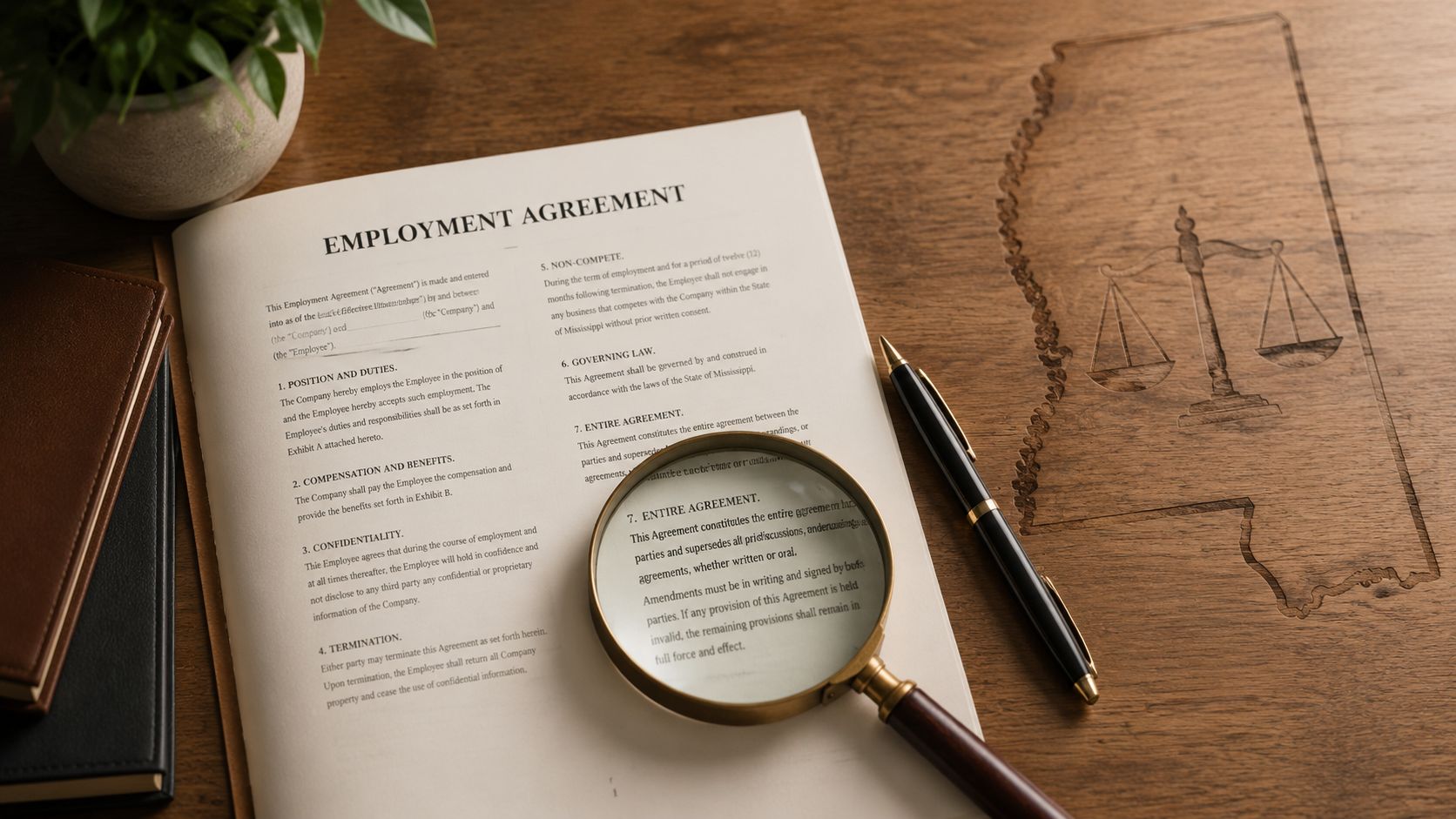
You're handed a stack of onboarding papers at a new Mississippi job. Most of it looks routine. Tax forms, benefit elections, handbook acknowledgments. Then you hit a paragraph called arbitration.
It's dense. It sounds formal. It may say that any dispute connected to your employment must go to binding arbitration. If you're like most employees, you pause there and wonder what that means. Are you giving up your right to go before a jury? Can the company force you into a private process if you later face discrimination, harassment, unpaid wages, or retaliation?
Those are the right questions. An arbitration clause in contract language often appears as just one paragraph, but it can reshape how an employment dispute gets decided. For Mississippi employees, that matters because workplace claims already feel hard enough without finding out later that the rules changed before the dispute even started.
You Just Signed a Contract What Did You Agree To
A common Mississippi scenario goes like this. You accept the job, you're trying to make a good impression, and HR says the paperwork needs to be signed today. Buried in the packet is language saying disputes will be resolved by arbitration. No one explains it. No one asks whether you understand it. You sign because the first day of work doesn't feel like the moment to negotiate legal terms.

That moment is more important than it looks. Arbitration clauses are no longer unusual add-ons. By 2018, 81 of the Fortune 100 companies used arbitration agreements in connection with consumer transactions, and more than 60% of U.S. retail e-commerce sales were covered by broad consumer arbitration agreements, according to this empirical law review study on the prevalence of arbitration agreements. Employment contracts often follow the same broader pattern of normalizing arbitration as a standard term.
Why employees often miss the real issue
Individuals don't get hung up on the word itself. They get hung up later, when there's a problem at work and they learn the clause had consequences.
Here's where readers usually get confused:
- You signed an employment document, not a lawsuit waiver, or so it seemed. In reality, the arbitration clause may control how legal claims get heard.
- The clause may be in a handbook receipt, offer letter, standalone agreement, or stock plan. It doesn't always look dramatic.
- The timing works against you. On a first day or during a policy rollout, people tend to sign first and ask questions later.
A short paragraph in a hiring packet can become one of the most important terms in your employment relationship.
If you're reviewing job documents now, it helps to slow down and compare what you're signing against broader workplace compliance materials. A practical baseline is LeaveWizard's employment law guide, which helps employees understand how employment policies and legal rules often show up in ordinary workplace documents.
What to do before you sign
You don't need to become your own lawyer overnight. But you should read with purpose.
- Look for the trigger words. “Arbitration,” “binding arbitration,” “AAA,” “JAMS,” “waive jury trial,” and “class waiver” all matter.
- Ask for a copy to take home. Even a short pause can help you spot what you missed in the HR office.
- Get the contract reviewed if the job or dispute stakes are high. A focused employment contract review for Mississippi workers can help you understand whether the clause is broad, one-sided, or written in a way that raises enforceability issues.
A lot of employees feel embarrassed for not noticing the clause sooner. Don't. These provisions are designed to look routine.
What Is an Arbitration Clause in an Employment Contract
An arbitration clause is a contract term that says certain disputes must be decided in arbitration instead of in the ordinary court system. In plain English, it's an agreement about where and how a future dispute will be resolved.
The easiest way to think about it is this. If a dispute is a game with rules, an arbitration clause picks a private referee system before the game even starts.

What arbitration actually does
In an employment setting, the clause usually says that if you and the employer later disagree about your rights, a neutral third party called an arbitrator will hear the dispute and issue a decision. That decision is usually binding, which means it's intended to be final.
The practical change for many employees is this:
- No jury decides the case
- The process is private rather than public
- The rules come from the contract and the arbitration forum
- Appeal rights are much narrower than people expect
That's why the phrase arbitration clause in contract language matters so much. It isn't just procedural fine print. It can shape relative power, cost, privacy, and how much information each side can force the other to produce.
What a well-drafted clause usually includes
A technically sound clause usually spells out key details. Model clauses from ICC and JAMS show that drafters often define the dispute scope, the seat of arbitration, the rules that apply, the number of arbitrators, and whether the process is administered or ad hoc. Wording such as “all disputes arising out of or in connection with” the contract is used to sweep in both formation and performance disputes, as reflected in ICC guidance on arbitration clause drafting.
That sounds abstract, but it affects real life. If the clause is vague about who decides what, where the hearing happens, or what rules apply, the parties may fight first about procedure instead of addressing the workplace claim itself.
Practical rule: The more complete the clause, the less room there is to argue later about who decides the dispute and under what rules.
If you want a business-side explanation of the drafting issues companies focus on, managing contract arbitration clauses gives a useful overview of how these provisions are structured and tracked.
What employees usually give up
Employees often ask whether arbitration means they gave up all legal rights. Not exactly. A clause usually doesn't erase the underlying claim. It changes the forum and the process.
That distinction matters. You may still have an employment claim, but you may have to bring it in a private dispute system instead of a public courtroom before a jury.
How Arbitration Works for Mississippi Employees
For Mississippi employees, the power behind many arbitration clauses comes from federal law, not from a special Mississippi rule. Modern enforceability grew out of U.S. Supreme Court doctrine that embraced a broad “national policy favoring arbitration” under the Federal Arbitration Act, extending arbitration into ordinary consumer and employment contracts, as explained in this discussion of how arbitration became widespread in everyday contracts.
That's why many workers are surprised when an employer insists the arbitration agreement must be enforced. The employer usually isn't relying on a casual policy preference. The employer is relying on a legal framework that strongly favors enforcing arbitration agreements.
What the process often looks like on the ground
A Mississippi employee usually first learns how serious the clause is after a dispute begins. Maybe you believe you were denied overtime. Maybe you reported harassment. Maybe you were fired after raising a concern. You pull out the agreement and see that disputes must be arbitrated.
From there, the process often looks something like this:
- The employer points to the clause. The company says the dispute belongs in arbitration.
- The fight shifts to the forum. Before anyone reaches the merits, there may be a battle over whether the clause covers your claim.
- The case moves into a private system. The selected provider's rules, or the wording of the agreement itself, begin to control.
- An arbitrator decides the dispute. There is no jury. Procedure is often narrower than employees expect.
A helpful primer on these pathways appears in this overview of employment dispute resolution options for Mississippi workers.
Why the process feels different
Arbitration doesn't just change the location of the dispute. It changes the texture of the dispute.
Employees often notice these differences first:
- Discovery may be narrower. You may not get the same access to internal records, emails, or witness testimony you expected.
- The hearing is private. That can reduce public pressure on the employer.
- Review is limited. If the arbitrator gets something wrong, the path to undoing that decision is much narrower than many people assume.
For a Mississippi worker, that can create a harsh mismatch. You may already feel outmatched by a company with HR staff, managers, records, and counsel. Then the contract channels the dispute into a system that may provide fewer tools to force information into the open.
What this means in practical terms
The hardest part isn't always understanding what arbitration is. It's accepting what it does to strategic advantage.
A worker may think, “I have a strong claim, so the process should work out.” Sometimes it does. But process affects outcomes because process affects cost, timing, proof, and pressure. If the contract requires arbitration, those issues move to the center very quickly.
Decoding the Language of Your Arbitration Clause
Most arbitration clauses look intimidating because they compress a lot of legal effect into a few familiar words. The wording matters. Sometimes a single verb changes whether arbitration is optional or mandatory.
The word that changes everything
Practical Law's standard drafting guidance advises using “shall” rather than “may” to make arbitration mandatory, because permissive language can leave room for a court action and weaken exclusivity, as discussed in this Practical Law standard arbitration clause material.
That gives you a useful reading rule:
- “Shall be resolved by arbitration” usually signals a mandatory requirement
- “May be resolved by arbitration” can create room to argue arbitration is optional
- “Binding arbitration” usually means the decision is intended to be final
If your agreement says disputes “shall” be arbitrated, don't assume that's casual wording. It was likely chosen for a reason.
Phrases that broaden the clause
Another phrase to watch is language like “all disputes arising out of or in connection with employment” or “related to this agreement.” That kind of wording is often designed to capture as many possible claims as the drafter can include.
Here is what readers often miss:
| Contract phrase | What it usually signals |
|---|---|
| “All disputes” | The drafter wants broad coverage |
| “Arising out of” | Claims directly tied to the contract |
| “In connection with” | Claims that are related, even indirectly |
| “Binding” | The result is meant to be final |
| “Exclusive remedy” | The clause is trying to block other forums |
References to AAA or JAMS
If the clause names a provider such as the American Arbitration Association or JAMS, that's not filler. It tells you which organization's procedures may govern the dispute. Those rules can affect filing, scheduling, arbitrator selection, and motion practice.
If the clause names a forum, read that as part of the agreement, not as an afterthought.
Class waivers and group claims
Many arbitration clauses also include a class waiver, which tries to stop workers from bringing claims together. That matters because employment disputes often become harder to pursue when employees have to proceed one by one.
When you read your clause, don't just ask whether it mentions arbitration. Ask three better questions: Is it mandatory, how broad is it, and does it force you to proceed alone?
Pros and Cons of Arbitration for Employees
Employers often present arbitration as a cleaner, faster, less expensive way to handle workplace disputes. Some employees do value privacy and informality. But the employee experience can look very different once a real claim is on the table.
Arbitration for Employees A Realistic Look
| Claimed Advantage | Employee Reality & Disadvantage |
|---|---|
| Faster resolution | Sometimes the schedule is quicker, but speed can also mean less time to gather proof and prepare a claim |
| Privacy | Privacy can protect personal details, but it can also keep patterns of workplace misconduct out of public view |
| Simpler process | A shorter process may also mean narrower discovery and fewer tools to force the employer to produce evidence |
| Expert decision-maker | An experienced arbitrator may understand procedure, but the employee still loses a jury |
| Lower cost | Cost can become a barrier before the merits are ever heard |
The cost trap many employees don't see
One of the biggest myths is that arbitration is always cheaper for the person bringing the claim. A neutral industry source citing a Public Citizen survey reported that initiating arbitration for an $80,000 contract claim averaged about $9,000, compared with about $250 to file in court, and arbitrator or administrative fees could exceed $10,000, according to this explanation of arbitration clause costs and practical barriers.
For an employee dealing with lost wages, job loss, or retaliation, those upfront costs can function as a real barrier. A clause may look neutral on paper while making it much harder to bring a smaller claim in practice.
The tradeoffs are not equal
Employees also run into non-financial disadvantages that aren't obvious at signing.
- Loss of a jury: Many workers value having a community hear what happened.
- Limited information access: If evidence sits in the employer's files, narrower discovery can hurt.
- Isolation: If a class waiver is attached, workers may not be able to proceed together.
- Finality: A bad decision may be difficult to undo.
Arbitration may streamline disputes for employers, but employees often experience it as a system with fewer pressure points and fewer chances to correct a bad result.
When arbitration might still appeal to an employee
A balanced view matters. Some employees prefer a private setting. Some want a less formal hearing. Some want a dispute resolved without prolonged public exposure.
But those possible advantages only help if the forum is truly fair, the costs are manageable, and the clause doesn't strip away too much bargaining power before the case begins.
Can You Challenge or Negotiate an Arbitration Clause
Many employees assume “mandatory” means untouchable. It doesn't. But challenging an arbitration clause is usually harder than people hope, and the strongest arguments often depend on the exact wording and the exact facts around how the agreement was presented.

An arbitration clause is not automatically valid. Its enforceability can fail if it is poorly drafted, overly broad, internally inconsistent, or names an unavailable provider, creating room for court intervention, as noted in AAA guidance on avoiding a badly drafted arbitration agreement.
Where clauses can break down
Employees often think of enforceability as an all-or-nothing issue. In practice, the clause may fail because of drafting problems that look small until a dispute starts.
Potential trouble spots can include:
- Contradictory terms: One part of the agreement says arbitration is required, another suggests claims may proceed elsewhere.
- Unavailable provider: The clause names a forum that can't administer the dispute as written.
- Unclear scope: The employer says the clause covers your claim, but the wording may not reach that far.
- One-sided procedures: The clause imposes terms that may support an argument that the agreement is unfair.
For Mississippi workers, that usually means the first serious question is not “Do I like arbitration?” It's “Is this particular clause enforceable against this particular claim?”
Can you negotiate before signing
Sometimes. Often, not much.
A high-level executive or specialized professional may have room to revise dispute terms. A rank-and-file employee usually has less bargaining power, especially before the first day of work. Even then, asking isn't pointless. You may be able to request changes to cost allocation, forum choice, or mutuality.
Some employees also seek a legal review before they sign. A Mississippi-focused employment contract attorney review can help identify whether the clause appears mandatory, whether it is mutual, and whether it contains drafting issues worth preserving for later challenge.
What to gather if a dispute already exists
If you already have a workplace problem and the employer is pointing to arbitration, preserve the paperwork now.
- Keep every version of the agreement. Offer letters, handbook acknowledgments, policy rollouts, and email attachments all matter.
- Save proof of how it was presented. Screenshots, onboarding portals, deadlines, and instructions can matter if fairness becomes an issue.
- Collect related policies. Fee provisions, forum rules, and opt-out language, if any, should be reviewed together.
- Write down the timeline. Dates of hiring, policy updates, complaints, discipline, and termination can shape the analysis.
Here's a short overview that helps explain why wording and enforceability disputes matter in real employment cases:
A realistic next step for Mississippi employees
If you're facing discrimination, harassment, unpaid overtime, wrongful termination, or retaliation issues and an arbitration clause is in the background, the contract needs to be read carefully before major decisions get made. One Mississippi option is Nick Norris, P.A., which evaluates employment contracts and arbitration provisions for workers and analyzes whether the clause appears to cover the claim, waive a jury, impose problematic costs, or present enforceability issues under employment law.
The right answer usually isn't panic, and it isn't blind trust in the clause either. It's a close review of the actual document, the actual claim, and the actual way the agreement was rolled out.
If you're a Mississippi employee dealing with an arbitration clause in a job contract or workplace policy, Nick Norris, P.A. can review the language, explain what rights the clause may affect, and assess how it may apply to your employment dispute.
Leave a Reply