

Employment Contract Review: A Mississippi Worker’s Guide
A job offer can feel like relief. You finally have a start date, a title, and numbers on paper. Then the employer sends a longer document, and the tone changes fast. What looked simple in the interview turns into pages of legal terms about termination, confidentiality, arbitration, outside work, and post-employment restrictions.
Most Mississippi workers don't need a lecture at that moment. They need clarity. They need to know what matters, what language is routine, what language is dangerous, and what can still be changed before they sign.
That is where a careful employment contract review matters. In Mississippi, that review isn't just about confirming pay. It's about finding out whether the contract gives you any real protection at all.
Beyond the Offer Letter Why a Thorough Review Matters
A lot of employees treat the contract as paperwork that follows the primary decision. They decide they want the job, skim for salary, then sign. That approach causes problems because the contract often controls the hard parts of the relationship long after the excitement of the offer wears off.

The first contract review I want a worker to do is mental. Stop asking only, “Do I want this job?” Start asking, “What rights am I giving up, and what protection am I getting?” Those are different questions.
A contract sets the rules for the relationship
An employment agreement usually reaches far beyond compensation. It may define your duties, who owns your work product, whether you can work for a competitor later, how bonuses are handled, when you can be terminated, and whether you must arbitrate disputes instead of taking them to court.
A lawyer's review of an employment contract is a strategic risk-assessment. The goal is to identify unfair, unenforceable, or risky clauses and negotiate amendments before you sign. Once executed, you are typically bound by the terms, making the pre-signing review a critical window of opportunity, as explained in this employment contract review overview.
Practical rule: If a clause would matter after a disagreement, a firing, or a resignation, it matters before you sign.
Review is often short, but it still matters
One useful benchmark is timing. A UK employment-law source notes that 3 working days is generally enough time for a contract review to take place and describes the process as review, negotiation, revisions, and signature in that order. That sequence tracks what good practice looks like. You read first, raise concerns second, revise third, and sign last.
That same basic discipline shows up in other contract contexts too. If your job is tied to a broader business transaction or outsourcing arrangement, resources on reviewing PEO contracts during a sale can help you understand how employment terms often connect to operational and financial decisions happening behind the scenes.
Mississippi workers especially need a contract that says what it means. If a term is vague, one-sided, or missing altogether, you may later learn that the state default rules don't fill the gap in your favor.
Your Contract Checklist Key Clauses to Scrutinize
A strong employment contract review starts with a checklist. Not because every clause matters equally, but because important risks hide in ordinary-looking documents. You want a method, not a skim.
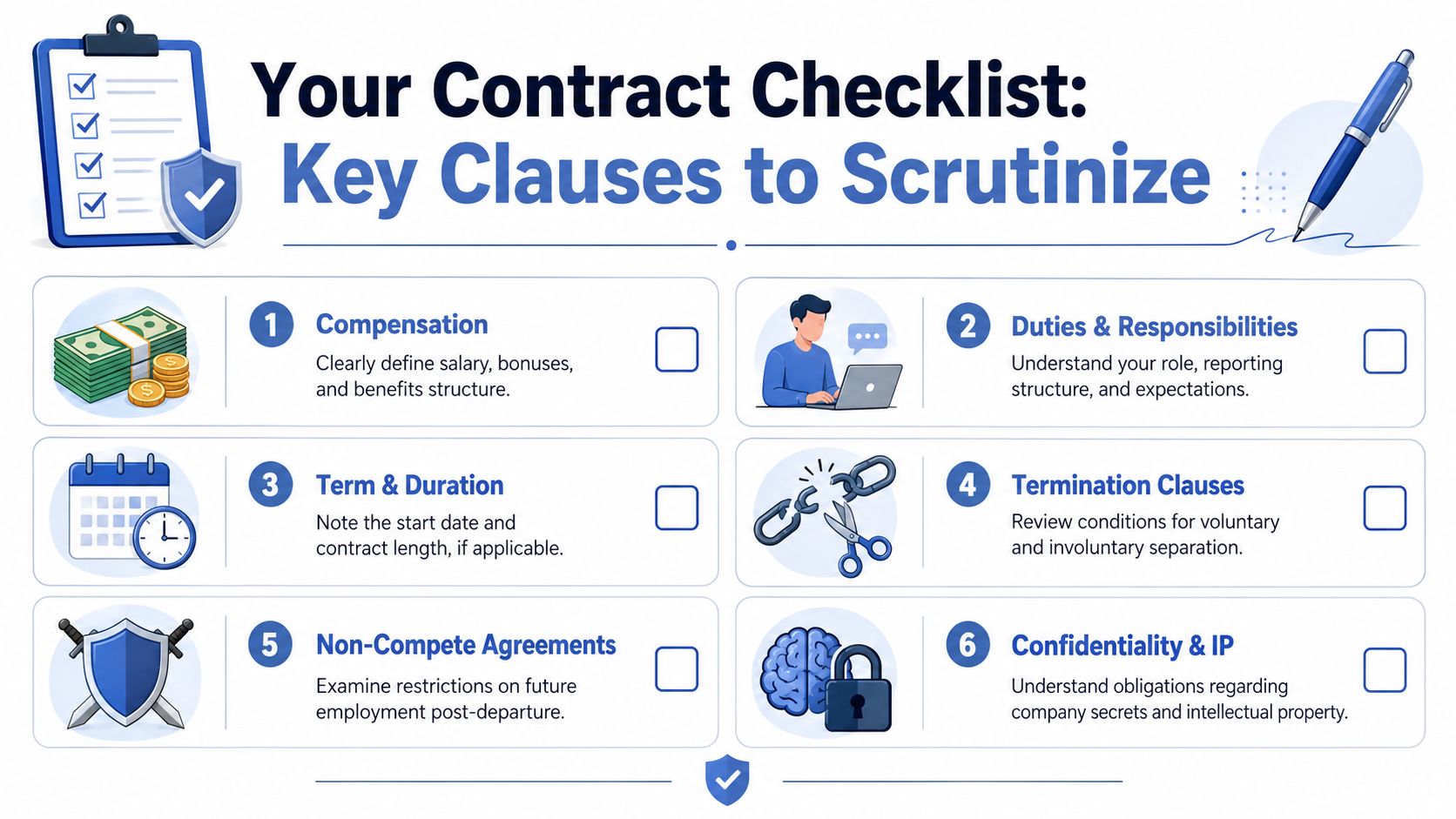
Compensation and the parts around it
Start with the terms people usually read first. Salary, hourly pay, bonuses, commissions, benefits eligibility, expense reimbursement, paid time off, and any sign-on payment should be stated clearly.
A good clause tells you what you earn, when you earn it, and when it gets paid. A bad clause uses fuzzy phrases like “discretionary,” “subject to policy,” or “may be modified” without explaining limits. That doesn't always mean the term is unlawful. It does mean your expectations may not match the document.
Look for these issues:
- Bonus language: Does the contract say when a bonus is earned, or only when it is paid?
- Commission terms: What happens if you bring in business and leave before collection?
- Benefits timing: Are health and retirement benefits immediate, delayed, or controlled by a separate handbook?
- Repayment obligations: Must you repay training costs, advances, or a sign-on bonus if you leave?
If the compensation section depends on separate policies, ask for those policies before signing.
Job duties and title
Titles can flatter people into signing weak contracts. The core issue is authority, reporting structure, and expected work.
Here is the question to ask: does the contract define your role narrowly enough to be fair, but broadly enough to let the employer run the business? If the employer can change your title, duties, territory, compensation structure, or reporting line at any time, your job may not be what you think it is.
A fair clause usually gives a defined role with reasonable flexibility. A problematic one gives unlimited management discretion with no corresponding protection for you.
Vague duties often become a litigation problem later because the employer argues the worker failed expectations that were never clearly stated.
Termination and what happens on the way out
Many employees jump straight to pay and ignore termination language. In Mississippi, that's a mistake.
Read for three separate issues: when the employer can terminate you, whether you get notice, and whether you receive severance or other post-employment compensation. If the contract says the employer may end employment immediately and for any reason, you should understand that for what it is. A highly employer-friendly clause.
Also check practical details:
| Issue | What to look for |
|---|---|
| Resignation notice | How much notice must you give, and what happens if you don't |
| Employer termination rights | Whether discharge requires cause or can occur at any time |
| Final compensation | Whether accrued pay, commissions, or bonuses are addressed |
| Severance | Whether severance is guaranteed, conditional, or absent |
Restrictive covenants
Non-compete and non-solicitation clauses deserve slow reading. These clauses affect your next job, not just your current one.
Watch for restrictions on geography, time, customers, coworkers, and entire industries. In plain English, ask whether the clause only protects legitimate business interests or instead tries to control where you can work after you leave.
Red flags include language that bars you from working for any competitor, in any role, across a broad region, for an extended period. Restrictions can sound tidy on paper and become brutal in practice if your field is specialized or local.
For readers comparing employment terms across jurisdictions, this guide from Go Hires on employment in Canada is useful as a contrast. It shows how much contract review depends on local law, which is exactly why Mississippi workers should resist generic online checklists.
Confidentiality and intellectual property
Most employers need real confidentiality protection. The question is scope.
A fair confidentiality clause protects trade secrets, proprietary business information, customer data, and internal strategy. An overreaching one tries to classify everything you learn, say, create, or know as the employer's confidential property forever.
Pay close attention to intellectual property language if your job involves writing, coding, design, research, process improvement, marketing, training materials, or side projects. Some contracts claim ownership over anything you create during employment, even if done off-hours. Others reach further and try to claim unrelated outside work.
Arbitration and hidden procedural traps
One of the most overlooked parts of an employment contract review is dispute resolution. Many employees don't realize they agreed to arbitration until a dispute arises.
A 2024 EEOC report found that 58% of employment contracts in potential discrimination cases contained mandatory arbitration clauses, often buried in "miscellaneous" sections, which can prevent workers from accessing public courts, according to the EEOC.
That means you should search for more than the word “arbitration.” Review the miscellaneous, dispute resolution, governing law, waiver, and venue sections carefully. If you want a deeper explanation of how these provisions work, this article on arbitration clauses in employment contracts is a useful starting point.
Look for whether the clause:
- Requires individual arbitration: This may bar group claims.
- Limits remedies: Some clauses try to narrow what relief is available.
- Shifts costs: Arbitration filing fees and forum rules matter.
- Shortens deadlines: Contractual time limits can create traps.
A clause can be short and still have major consequences. That is why the boring sections are often the most dangerous.
The Mississippi Factor Why At-Will Employment Changes Everything
In Mississippi, many workers assume that a written contract automatically gives them job security. It often doesn't.
Mississippi follows the at-will employment doctrine in most situations. In practical terms, that means an employer can often end the relationship without cause unless the contract itself creates stronger rights. If your agreement doesn't add protection, state default rules may leave you with very little.
A fair-sounding contract may still leave you exposed
For Mississippi workers, generic employment advice often proves insufficient. A document can look professional, balanced, and detailed, yet still preserve broad employer discretion to terminate at any time.
That is why the phrases that matter most are often simple ones. “For cause only.” “Thirty days' notice.” “Severance upon termination without cause.” “Defined grounds for immediate discharge.” Those are the kinds of terms that can turn a paper offer into an actual promise.
Legal scholarship from 2025 highlights that 41% of employees in at-will states like Mississippi are unaware that their contract review should prioritize negotiating notice periods or severance triggers to create stability, because the default at-will status offers no job security, according to this BLS-linked reference.
The safest Mississippi contract is not the one that sounds respectful. It is the one that clearly limits what the employer can do.
What to negotiate if you want real protection
If an employer won't agree to a true for-cause standard, don't assume the conversation is over. There are middle-ground terms that still help.
Consider asking for:
- Notice before termination: Even a modest notice provision gives you time to plan.
- Severance triggers: If the employer ends the relationship without cause, severance can soften the risk.
- Defined cause language: Misconduct, fraud, and serious policy violations can be listed specifically.
- Cure periods: For performance concerns, you may want a chance to correct the issue before termination.
- Written amendment requirements: That helps prevent confusion about alleged verbal changes.
If you need a clearer explanation of the doctrine itself, this discussion of Mississippi employment at will helps frame why contract wording matters so much here.
What doesn't work in Mississippi
Hope is not a contract term. Neither is a good relationship with the hiring manager.
Workers sometimes rely on statements like “we're looking for someone long-term” or “people here only get fired for serious reasons.” If the written agreement preserves at-will language and broad termination discretion, those conversations may not protect you later.
In Mississippi, review the text you can prove. That is where your strength lies.
Spotting Red Flags and Preparing to Negotiate
Some contracts don't need a rewrite. They need targeted changes. The key is recognizing what deserves pushback and what is just standard drafting style.

Red flags that deserve a second look
A few warning signs come up again and again in employment contract review:
- One-sided change clauses: The employer can change pay, duties, territory, or policies unilaterally, but you remain bound to every restriction.
- Broad non-competes: The restriction seems disconnected from your actual role or market.
- Undefined bonus terms: You are promised upside, but the contract never explains how it is earned.
- Immediate termination language only: The employer keeps broad exit rights while requiring lengthy notice from you.
- Buried procedural waivers: Arbitration, shortened deadlines, or forum rules appear in back-end sections.
- Overbroad confidentiality language: The clause reads less like protection of business information and more like a gag rule.
A contract can contain one of these issues and still be fixable. Several together usually justify a slower review.
Prioritize your asks
Many workers make the same negotiation mistake. They challenge every sentence. That rarely works.
Instead, sort issues into three buckets:
| Priority level | What belongs there |
|---|---|
| Must fix | Terms that affect job security, future employment, pay, or dispute rights |
| Should clarify | Ambiguous duties, bonus formulas, reporting lines, side work permissions |
| Can live with | Stylistic drafting, routine definitions, boilerplate that doesn't change your practical rights |
This approach keeps the conversation credible. It also shows the employer you are focused on business risk, not trying to be difficult.
Negotiation mindset: Ask for precision before you ask for concessions. Employers often agree to clarify language even when they resist larger economic changes.
Use business language, not outrage
The most effective negotiation emails are calm and specific. “I want to make sure I understand how this works in practice” gets better results than “this contract is unfair.”
Try language like this:
- On termination: “Could we add a notice provision if the company ends the agreement without cause?”
- On a non-compete: “Could we narrow this restriction to the customers or territory I would work with?”
- On bonuses: “Could we define when the bonus is earned and whether payout depends on employment status on the payment date?”
- On side projects: “Could we confirm that unrelated work created on my own time remains mine?”
Later in the process, it often helps to hear the issues explained out loud before you respond in writing.
Know the difference between uncomfortable and unacceptable
Not every employer-favorable term is a deal-breaker. Some are standard. The main question is whether the clause creates a risk you can live with.
If a company refuses to define bonus triggers, wants a broad non-compete, insists on immediate at-will termination, and won't explain the arbitration language, that combination tells you something important about the relationship before it begins.
Sample Questions to Ask Your Future Employer
The best contract questions don't sound combative. They sound careful. That matters because you are trying to gather information, preserve the offer, and improve the terms at the same time.
Questions about compensation
You might say, “Could you walk me through when a bonus is considered earned under this agreement?” That question often reveals whether the employer has a clear system or is relying on broad discretion.
If commissions are involved, ask, “How does the agreement handle deals that close or get collected after employment ends?” That is a practical question, not an accusation.
Questions about job scope
A title doesn't tell you much by itself. Ask, “Can we clarify the reporting structure and the main responsibilities expected in the first several months?” If the contract allows reassignment, try, “How broad is the company's intended flexibility to change duties or territory?”
Those questions do two things. They reduce ambiguity now, and they create a written record of what you were told.
Questions about restrictive covenants
For a non-compete, a useful script is: “Could you help me understand the business reason for the scope of this restriction, including the geography and the length of time?” That invites explanation without escalating the tone.
For non-solicitation language, ask, “Does this apply to all company customers and employees, or only those I would work with directly?” A narrow clause is very different from a blanket one.
“I want to be fully aligned with the company's protective goals, but I also want to understand how this would affect my ability to work in my field later.”
Questions about termination and dispute terms
If the agreement preserves broad termination rights, ask, “Is the company open to adding notice or severance if the position ends without cause?” In Mississippi, that question matters more than many workers realize.
For dispute language, keep it simple: “I noticed a dispute resolution provision. Is the company's intent to require arbitration for employment-related claims?” Sometimes the answer confirms what the text already says. Sometimes it exposes language that even the hiring manager hasn't focused on.
A good contract conversation should leave fewer mysteries than you started with. If the employer resists basic clarification, that itself is useful information.
Getting an Expert Opinion When to Call a Mississippi Lawyer
Some agreements are realistic for self-review. Others are not.
If the contract includes equity, deferred compensation, a broad non-compete, repayment obligations, complex commission language, intellectual property issues, executive duties, or a hard-to-read arbitration provision, it makes sense to get legal input before you sign. The same is true if the employer says the document is “standard” but won't explain what key terms mean.
Cost, timing, and what a lawyer actually does
The good news is that contract review is usually a defined service, not an open-ended legal fight. Based on marketplace data, the average employment contract review cost is about $420, with lawyer hourly rates ranging from $150 to $500, according to ContractsCounsel's employment contract review cost guide.
That is very different from how many employment disputes are handled after a problem develops. Workers often hear about contingency arrangements in litigation, and the author's brief notes that a common contingency range is 40-50%. A pre-signing review is usually a separate kind of service. It is typically narrower, faster, and aimed at prevention.
When local judgment matters
Mississippi workers benefit from advice that reflects Mississippi employment law, not a generic national checklist. A local lawyer can help you decide whether a clause is merely unfriendly, likely negotiable, or serious enough to affect whether you should take the job at all.
If you want legal help focused on this specific issue, employment contract attorney services are one option to consider. The work usually involves reading the agreement, identifying risk points, explaining them in plain English, and suggesting edits or negotiation points that fit your goals.
A short review before signing can be the cheapest moment to protect your job, your bargaining power, and your next career move.
If you're a Mississippi worker looking at an offer, severance package, non-compete, or arbitration clause and want a clear read on what it means, contact Nick Norris, P.A.. The office advises Mississippi employees on employment agreements and related workplace rights so you can make an informed decision before you sign.
This article has been reviewed for legal accuracy by Nick Norris. For employment law matters in Mississippi, consult with an attorney licensed to practice in your state.
Leave a Reply