

Your Rights: Find an Employment Class Action Attorney
You're usually here because something stopped feeling random.
Your paycheck has been short in the same way for months. A whole group of salaried employees suddenly started doing long weeks with no overtime. Women in one department keep getting passed over while less qualified men move up. A layoff happened fast, with no real warning, and the same story keeps coming out from coworker after coworker.
When that happens, your problem may not be an individual dispute. It may be a company-wide one. That's when an employment class action attorney matters. Not a general lawyer. Not somebody who “also handles employment cases.” You need somebody who knows how to turn a pattern into a case that can survive federal court scrutiny.
In Mississippi, that distinction matters even more. The state doesn't give workers many of the procedural supports people assume exist. There is no state human rights commission to step in on a discrimination complaint. For many claims, federal law is the primary forum for action. If you wait too long, or start in the wrong place, you can weaken your position before the case even gets moving.
When One Worker's Problem Is Everyone's Problem
A worker in Mississippi notices his check is off again. Not by much at first. Then he talks to the people on his line, or in his unit, or in the office next door. Same issue. Time shaved. Meal breaks handled wrong. “Salaried” employees working overtime with no extra pay. Management keeps giving the same answer, which usually means no real answer at all.
That's the moment a case can shift from frustration to strategy.

An employment class action exists for that exact kind of problem. It's built for workplace misconduct that affects a group of employees in the same essential way. One worker can speak up, but a properly built group case can force an employer to answer for the whole pattern.
What a group case changes
When workers proceed together, the case stops being about one paycheck or one bad manager. It becomes about the employer's policy, practice, payroll method, promotion system, or layoff decision.
That shift matters because employers count on isolation. They know many workers won't bring a solo claim over losses that feel too small to justify a legal fight. A group case changes the economics and the pressure.
Practical rule: If the same unlawful thing happened to many employees for the same underlying reason, don't treat it as a personal grievance. Treat it as a potential pattern.
This isn't rare anymore. Labor and employment class actions now constitute 43.4% of all class action litigation filed in the United States, with nearly 80% of companies reporting they have faced such a claim within the last five years, according to the Carlton Fields 2024 Class Action Survey.
Why the right lawyer matters early
A real employment class action attorney doesn't just ask, “Were you treated unfairly?” The better question is, “What policy tied all these workers together?”
That's where cases are won or lost. If the lawyer can identify a common policy or common decision-making process, the case has shape. If not, you may just have a collection of separate complaints.
In Mississippi, workers often wait too long because they assume somebody else will fix it. Usually, nobody will. If the problem is systemic, you need to act like it is.
Class Actions vs Collective Actions Explained
People use these terms as if they mean the same thing. They don't. If you're dealing with unpaid overtime, off-the-clock work, or misclassification, that difference can decide who ends up in the case and how strong the case becomes.
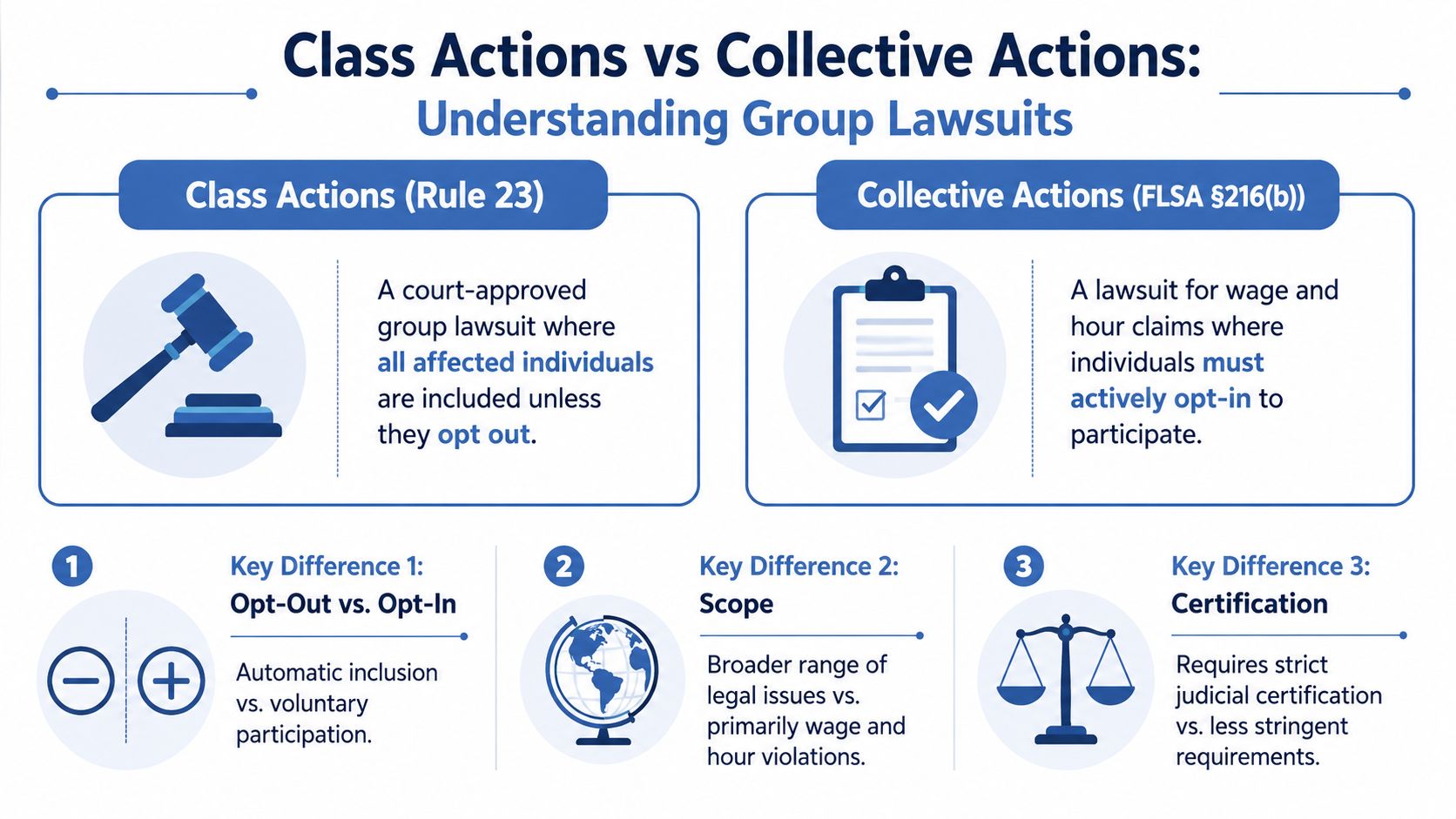
What a class action is
A class action usually refers to a Rule 23 case. In practical terms, one or more workers seek to represent a larger group with the same legal injury. If the court certifies the class, affected workers are generally included unless they opt out.
That structure often comes up in systemic discrimination cases. If a company uses the same promotion process, pay system, or evaluation method across a workforce, a Rule 23 case may be the right vehicle.
What a collective action is
A collective action usually comes up under the Fair Labor Standards Act. That matters in Mississippi wage cases. Unpaid overtime claims often proceed this way.
The major difference is simple. In a collective action, workers must opt in. They aren't automatically part of the case. They have to affirmatively join.
If you need a plain-English explanation of the federal wage law behind many of these cases, review this breakdown of the Fair Labor Standards Act.
The practical difference that actually matters
The simplest way to understand this is:
| Type | Who gets included |
|---|---|
| Class action | Workers are generally included unless they opt out |
| Collective action | Workers must opt in to join |
That isn't just procedural trivia. It affects bargaining power.
In a class action, the group can be broader from the start once certification is granted. In a collective action, participation depends on workers stepping forward. Some do. Some don't. Some are scared. Some moved. Some don't understand the notice they received. Employers know that.
In wage cases, silence usually helps the employer. Action helps the workers.
Why this matters right now in Mississippi
The overtime rules changed in a way Mississippi workers should pay attention to. Recent Department of Labor rule changes in 2024 increased the overtime salary threshold to $58,656, making thousands of formerly “exempt” Mississippi workers eligible for overtime and potential members of new wage-and-hour collective actions if they are not paid correctly, as noted by Jackson Lewis on class actions and complex litigation.
That means a worker who was told, “You're salaried, so you don't get overtime,” may need to revisit that assumption. Salary alone doesn't end the analysis. Job duties matter, and now the threshold matters too.
My advice on this issue
If your workplace problem is unpaid overtime, ask about a collective action immediately. If your workplace problem is a broader discrimination pattern, ask whether the facts support a class action. Don't let a lawyer blur the line. A lawyer who can't explain the difference clearly probably shouldn't be leading a group employment case.
The Four Hurdles to Winning Class Certification
Before a case becomes a real class action, the court has to certify it. This is the pressure point. A lot of workers think filing the case is the hard part. It isn't. Certification is where the legal fight gets serious.

Numerosity
This doesn't mean there's a magic headcount. It means there are enough affected workers that forcing everybody to sue separately makes no practical sense.
A famous example shows why this matters. A major employment class action ended in a $250 million settlement for 7,000 female pharmaceutical sales representatives, as described in Sanford Heisler's discussion of employment class actions. That kind of case shows what numerosity looks like in practice. The point isn't that your case needs thousands of workers. The point is that the group must be large enough that individual lawsuits aren't the sensible way to handle it.
Commonality
Often, cases fall apart here. The court wants to know whether workers share a common issue, not just a common employer.
If one person was denied overtime because of one supervisor's bad call, and another person has a totally different complaint in a different department for a different reason, that's not a strong class theory. But if the company used the same payroll rule, same timekeeping practice, or same biased decision process across the board, that's different.
Approximately 40% of proposed employment classes fail to achieve certification because the plaintiffs cannot sufficiently prove that a common question of law or fact predominates across the entire group, according to Moeller Barbaree's discussion of class actions.
A common employer is not enough. A common policy is what usually gives the case its backbone.
Typicality
The lead worker's claim has to look like the class's claim. If the representative's situation is unusual, the defense will exploit that immediately.
That means the best lead plaintiff is not always the angriest person. It's often the person whose facts are strong, clear, and representative of what happened to everyone else.
Adequacy of representation
The court has to believe the class representative and the lawyer will protect the group's interests fairly. That includes whether the representative has conflicts, whether the lawyer understands class litigation, and whether the case is being handled with the discipline federal court requires.
A lawyer who doesn't regularly litigate employment cases can damage a class case fast. The defense will test every weakness.
Evidence wins this fight
In discrimination class cases, lawyers often need labor economists or statisticians to show a real pattern, not just a suspicion. Courts frequently focus on expert analysis when deciding whether workers have shown the kind of shared proof needed for certification. Defendants often answer with their own experts, which turns certification into a battle over methods, assumptions, and data.
If you're also worried that your employment contract may try to force disputes out of court, read about an arbitration clause in an employment contract. Arbitration language can reshape the whole strategy.
Common Employment Claims Handled as Class Actions
Some workplace problems are built for group litigation. Others aren't. The fastest way to think about this is by category.
Wage and hour claims
These are often the cleanest group cases because employers tend to apply pay practices broadly. One payroll rule can affect dozens or hundreds of workers.
Examples include:
- Unpaid overtime: Salaried workers are treated as exempt when they shouldn't be.
- Off-the-clock work: Employees are required to set up, clean up, travel, or answer messages without pay.
- Automatic meal break deductions: Time gets deducted whether workers received a real break.
- Bad time rounding practices: Small losses repeat over long periods and affect many workers the same way.
If your issue falls in this lane, start with a close look at wage and hour disputes. These cases often move as collective actions under federal law.
Discrimination patterns
A discrimination case becomes a potential class action when the problem is systemic. The issue isn't just that one supervisor acted unfairly. The issue is that a company's process keeps producing the same unlawful result.
Common patterns include:
| Claim type | What it can look like |
|---|---|
| Gender discrimination | Women are consistently paid less or passed over for promotion under the same review system |
| Race discrimination | Hiring, discipline, or promotion decisions follow a recurring pattern across departments |
| Age discrimination | Older workers are screened out during reorganizations or denied advancement using the same criteria |
These cases are harder than workers expect. They often require deeper statistical proof and tighter case framing. But when the facts support them, they can expose problems an employer has hidden behind “manager discretion.”
Leave, layoff, and military service issues
Some federal statutes also create group litigation opportunities when one employer practice affects many workers at once.
- FMLA violations: A company uses the same unlawful leave policy or punishes protected leave in a consistent way.
- WARN Act issues: A mass layoff or plant closing happens without the required notice.
- USERRA problems: Service members face the same reemployment failures after military duty.
If several employees can describe the same unlawful rule in nearly the same words, that's often the beginning of a group case.
What usually does not make a good class case
Not every bad employment experience belongs in a class action. Personal disputes with unique facts often stay individual. A one-off firing decision, one supervisor's isolated behavior, or a claim that depends entirely on a private conversation may still be valid, but it may not be a class case.
That's why a serious employment class action attorney won't just ask what happened to you. The lawyer should ask who else experienced it, how often it happened, whether the employer had a written or unwritten policy, and what records can prove it.
Your Legal Roadmap in Mississippi Federal Court
If you're in Mississippi, keep this straight from the start. These cases are handled through federal law and federal process. Don't waste time assuming a state agency will step in and sort it out for you.
Step one for discrimination claims
Mississippi is one of the few states without a state-level human rights commission. This means Mississippi workers alleging employment discrimination must file their complaints directly with a federal agency like the U.S. Equal Employment Opportunity Commission to pursue their rights under federal law, as reflected by the University of Minnesota Human Rights Library's state agency listing.
That affects how you begin a discrimination claim. If the issue is race, sex, religion, national origin, disability, or another federally protected category, the EEOC process usually comes first.
If you need to contact the federal civil rights office serving Mississippi, the Southern District of Mississippi Civil Rights office lists complaint information and telephone contact details.
What the path usually looks like
For many workers, the sequence is straightforward even if the case itself isn't:
Initial review of facts
A lawyer determines whether your issue is individual, class-wide, or better suited for a collective action.Administrative filing when required
For discrimination claims, the EEOC charge often comes first.Investigation and evidence gathering
Pay records, handbooks, emails, time data, personnel files, and witness accounts become central.Federal court filing when the case is ready
The complaint defines the class or collective theory.Certification fight
The employer tries to keep the case small. Your side tries to prove the workers belong together.Discovery, settlement, or trial
Most of the hard work happens here, not in dramatic courtroom scenes.
Discovery is where the case gets built
Discovery means both sides have to exchange information. In employment group cases, that can include payroll records, job descriptions, internal communications, complaint histories, promotion data, and policy documents.
At this point, patterns either become provable or fall apart.
Good class cases are document cases. Memory helps. Records win.
Remedies workers should ask about
A serious case is about more than “Can I sue?” The better question is, “What can this case fix?”
Possible outcomes can include:
- Back pay: Money that should've been paid already
- Other damages allowed by law: Depending on the claim
- Policy changes: Revised payroll, leave, promotion, or complaint systems
- Prospective relief: Orders affecting future treatment of workers
Two Mississippi-specific warnings
First, don't sit on deadlines. Federal employment claims have filing limits, and missing them can kill a strong case.
Second, don't assume every form of retaliation has a state-law fix. Mississippi doesn't provide broad employee protections in the way many workers expect. That gap is real, and it changes strategy from day one.
How to Choose the Right Attorney for Your Case
Hiring the wrong lawyer can wreck a good employment case. That's not an exaggeration. Group employment litigation is specialized work. If the lawyer doesn't know certification standards, federal procedure, evidence strategy, and how to manage a group of workers, you can lose before the core facts ever get tested.
Don't hire a dabbler
An employment class action attorney should be able to answer direct questions without dancing around them.
Ask these:
- How often do you handle employment cases in federal court?
- Have you dealt with class certification or collective action procedure before?
- How do you identify the class definition or opt-in group early?
- What records do you want from workers right away?
- How do you handle communication with a large group of employees?
- What happens if the employer points to an arbitration agreement?
If the answers sound vague, move on.
Fee structure should be clear on day one
In Mississippi and nationwide, employment lawyers typically handle these cases on a contingency fee basis, with the standard fee ranging from 40% to 50% of the total recovery. That means workers generally pay no legal fees unless the case succeeds.
You should not have to guess how the fee works. The representation agreement should spell it out plainly.
Here's the practical reality:
| Question | What you should expect |
|---|---|
| Upfront legal fee | Usually none in a contingency case |
| Attorney payment | A percentage of recovery if the case succeeds |
| Typical contingency range | 40% to 50% |
What a strong lawyer does differently
A strong lawyer doesn't promise a jackpot. A strong lawyer identifies risk, pressure points, documents, and proof.
Look for somebody who will tell you:
- what facts help,
- what facts hurt,
- whether your issue is better as an individual case,
- whether enough workers are similarly situated,
- and whether federal law gives you a remedy.
You want candor, not cheerleading. The best employment lawyers don't sell fantasy. They build cases.
My blunt advice
Don't choose counsel because the website looks polished. Don't choose counsel because somebody says they handle “all civil matters.” And don't assume a lawyer who has tried personal injury cases knows how to run a federal employment class case.
You need focus. In Mississippi employment law, focus matters more than volume.
Working with Nick Norris P.A. and Mississippi FAQs
When workers call a Mississippi employment lawyer, they're often carrying two burdens at once. They're trying to understand the law, and they're trying to keep their job, support their family, and avoid making things worse. A good first conversation should lower the temperature, not raise it.
That process should start with facts. What happened, when it happened, who else was affected, what documents exist, whether you signed an arbitration agreement, and whether the claim belongs under wage law, discrimination law, leave law, or another federal statute.

A Mississippi-focused practice should also understand something many firms miss. Workers here don't have the backup of a state human rights commission. They often need clear direction on federal procedure from the outset. That means practical advice, honest case evaluation, and steady communication matter just as much as legal knowledge.
Mississippi FAQs
Can I sue for being fired after filing a workers' compensation claim
Mississippi law is especially harsh here. Unlike many other states, Mississippi law does not recognize a specific cause of action for retaliation if an employee is fired for filing a workers' compensation claim, making it a difficult claim to pursue within the state's legal framework.
That means there is not a standalone Mississippi retaliation claim for filing a workers' compensation claim. Workers are often shocked by that. They assume the law protects them automatically. Mississippi does not provide that protection in the way many people think it does.
How do I start a discrimination claim in Mississippi
You usually start with the federal administrative process. Because Mississippi does not have a state human rights commission, workers generally have to proceed through the EEOC route for employment discrimination claims under federal law.
That step isn't optional when the law requires it. If you skip it, you can damage the case.
What if only a few of us have this problem
Then the first question is whether the facts still show a real group claim. A class action requires enough workers and enough common issues to make group treatment sensible. A small number of workers may still have strong claims, but the case might proceed differently.
The answer depends on the actual facts, not on a slogan.
What should I gather before talking to a lawyer
Bring what you have, even if it feels incomplete:
- Pay records: Checks, pay stubs, time records
- Written policies: Handbooks, schedules, leave rules, emails
- Communications: Texts, messages, emails from supervisors or HR
- Names of affected coworkers: Especially if the same thing happened repeatedly
- Timeline notes: Dates matter more than people realize
What should I expect from the first consultation
You should expect direct answers. Maybe not every answer on day one, but a clear explanation of whether the issue looks individual, class-wide, or not legally actionable. You should also expect honesty about weaknesses.
That's the right way to begin. Mississippi workers don't need confusion. They need a plan.
If you're dealing with unpaid overtime, discrimination, harassment, retaliation, FMLA problems, or a workplace policy that harmed a group of employees, talk with Nick Norris, P.A.. The office focuses on Mississippi employment law and helps workers understand what federal remedies are available, what claims aren't available under Mississippi law, and what steps make sense before critical deadlines expire.
This article has been reviewed for legal accuracy by Nick Norris. For employment law matters in Mississippi, consult with an attorney licensed to practice in your state.
Leave a Reply