

Mississippi Statute of Limitations Harassment Laws 2026
You may be reading this after months of putting up with comments, texts, touching, jokes, or intimidation at work and telling yourself you’d deal with it later. Then something changes. You get written up. You get pushed out. Or the conduct finally becomes unbearable, and now the first question is simple and scary: Is it too late?
In Mississippi, that question has a hard legal answer. A harassment claim doesn’t stay open forever just because the conduct was wrong. The law gives you a limited amount of time to act, and once that deadline passes, your ability to pursue a claim can quickly vanish.
Generic national articles often miss the part that matters most for Mississippi workers. This state does not have a human rights commission handling employment discrimination charges, so the filing path and deadline analysis are different here than in states with a state civil rights agency. If you work in Mississippi and you’re dealing with statute of limitations harassment issues, you need Mississippi-specific guidance, not recycled national advice.
Your Legal Clock Is Ticking on Harassment Claims
A lot of workers don’t call a lawyer when the harassment starts. They wait because they need the paycheck. They hope HR will fix it. They worry they’ll be labeled difficult. That’s normal.
Then one day they sit at the kitchen table looking through old emails, screenshots, and write-ups, trying to figure out whether the law still gives them a path. That’s when the statute of limitations harassment problem stops being a legal phrase and becomes a deadline that can shut the door.

Why delay hurts your case
Harassment cases are built on timing as much as evidence. Witnesses leave. Messages get deleted. Memories soften. Internal records become harder to get. And most important, the legal deadline keeps running whether your employer investigates or not.
The biggest mistake I see is waiting for the workplace to “do the right thing” while the filing period keeps shrinking.
That’s why I tell Mississippi workers to stop treating harassment as a workplace drama issue. It’s a legal deadline issue. If the conduct was based on sex, race, religion, national origin, or another protected category under federal law, you may need to file an administrative charge before you can pursue the claim further.
What counts as harassment for deadline purposes
The legal analysis usually turns on facts like these:
- Ongoing conduct: repeated comments, repeated propositions, repeated slurs, repeated unwanted touching, or repeated humiliation.
- A single serious event: one incident can still matter, especially if it’s severe.
- A related job action: discipline, transfer, write-up, suspension, or termination can change how the claim is framed.
The point is simple. If you think something unlawful happened, don’t wait to see whether it gets worse. Start preserving records and get advice early. Waiting is how valid claims expire.
The Critical 180-Day EEOC Deadline for Mississippi Workers
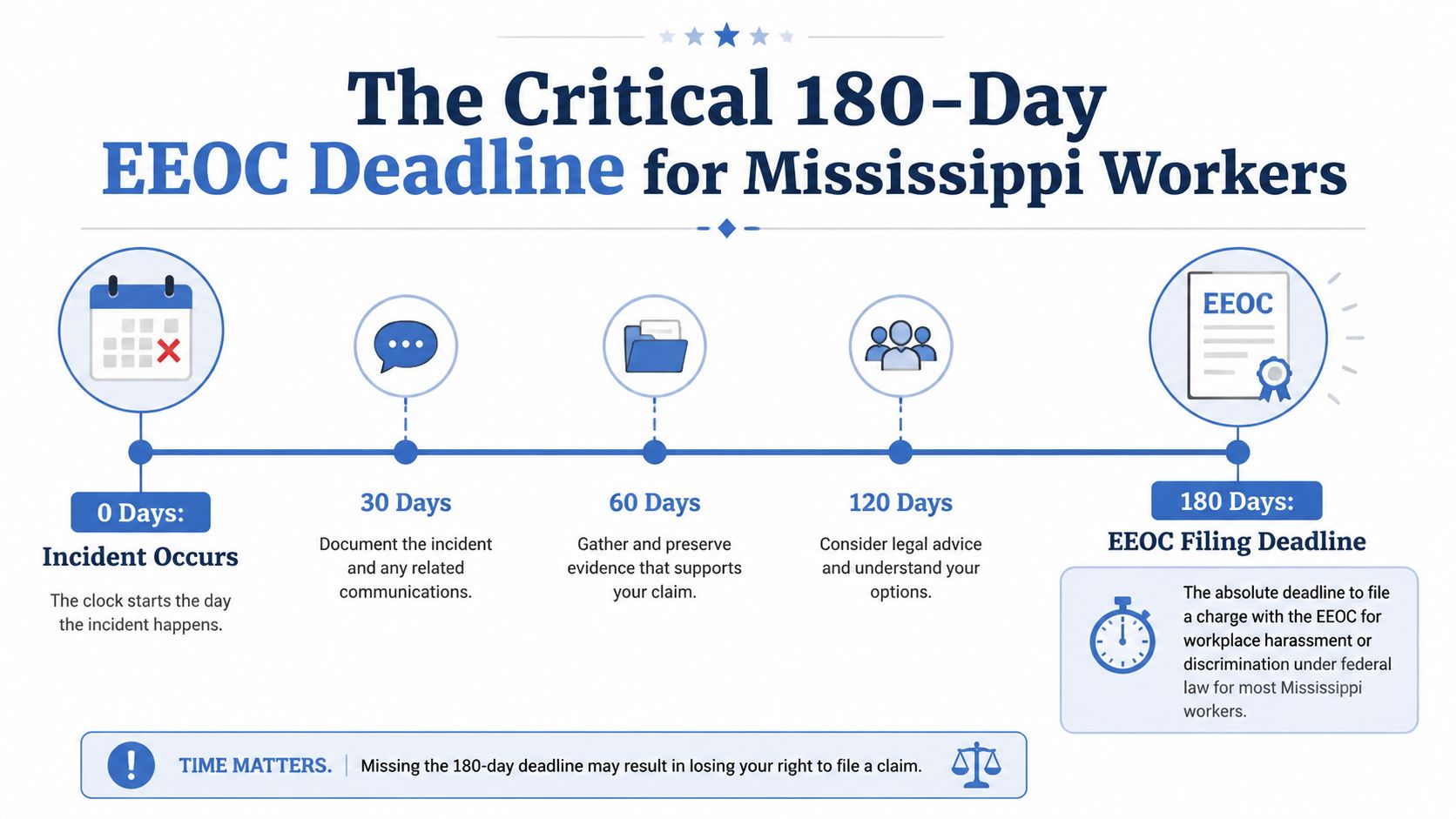
If you work in Mississippi and you’re dealing with workplace harassment, the deadline you need to know first is the EEOC filing deadline. Under federal Title VII, an employee generally must file a charge with the EEOC within 180 days of the last alleged harassing act, and if that filing window is missed, the claim can be time-barred and later legal action can be lost, as explained in this Title VII harassment deadline overview.
Why Mississippi workers usually live under the shorter deadline
Some states have their own fair employment agency, and that can extend the federal filing period to 300 days. Mississippi is different. Mississippi does not have a state-level human rights commission to handle employment discrimination complaints, meaning workers must file directly with federal agencies like the EEOC rather than a state civil rights body, as reflected in the Mississippi complaint pathway information.
For practical purposes, that means Mississippi workers should act as if 180 days is the deadline that controls.
Practical rule: In Mississippi harassment cases, assume the 180-day EEOC clock is running now. Don’t rely on a longer deadline that may not apply.
That shorter window surprises people. They read a national article that talks about 300 days or a much longer state filing period and think they have time. In Mississippi, that assumption can cost you the claim.
What the EEOC filing actually does
Filing with the EEOC is not busywork. It’s the administrative step that preserves many federal workplace harassment claims. If you skip it, or file late, you may lose the ability to move the case forward at all.
Here’s the practical sequence:
- You identify the last act of harassment. That date matters.
- You prepare a charge. It needs to describe the unlawful conduct clearly enough to preserve the claim.
- You file with the EEOC before the deadline expires.
- The agency process begins. If you want a better sense of what comes next, review this breakdown of the EEOC investigation process.
What happens if you miss the deadline
Miss the EEOC deadline and you may lose the right to pursue damages for that harassment claim. There’s no gentle way to say it. Courts and agencies don’t treat these deadlines as suggestions.
A lot of workers think an internal HR complaint stops the clock. It usually doesn’t. The company’s investigation timeline and the EEOC’s filing timeline are not the same thing. Your manager saying, “We’re looking into it,” does not protect your rights.
Use this quick reference:
| Issue | Mississippi reality |
|---|---|
| Main filing path for most harassment claims | EEOC |
| State human rights commission | No |
| Federal filing deadline usually treated as critical | 180 days |
| Risk of waiting for HR | You may run out of time |
If you’re anywhere close to the edge of that deadline, stop debating whether the conduct was “bad enough” and start protecting the claim.
Identifying the Last Act That Starts the Clock
The hardest timing issue in harassment cases is usually not the length of the deadline. It’s figuring out when the clock starts.
For a hostile work environment claim, the law focuses on the last incident in the pattern, not necessarily the first. Under federal EEOC timing rules, the charge must be filed within 180 days or, in some jurisdictions, 300 days of the last incident, and when the claim involves ongoing harassment, the clock starts from the final act in the series, as discussed in this workplace harassment limitations analysis.
Ongoing harassment versus one-time acts
This distinction matters:
- Hostile work environment pattern: repeated comments, repeated touching, repeated sexual remarks, repeated racial remarks, repeated humiliating conduct.
- Discrete act: one firing, one demotion, one suspension, one refusal to promote.
If your supervisor made offensive comments for months and then made another one recently, that latest event may be the date that matters most for the filing clock on a hostile environment theory.
If the claim is based on a one-time employment decision, the clock is usually tied to that specific decision date.
Older events may still matter if they’re part of the same continuing pattern and a more recent act falls within the filing window.
A practical example
Take two workers.
Worker A endured repeated sexual comments over a long period, and the most recent incident happened recently. That worker may still have a timely hostile work environment claim because the last act is recent.
Worker B was demoted on one specific date and no related unlawful conduct happened afterward. For that type of claim, the demotion date usually drives the deadline analysis.
That’s why I tell people not to guess. Build a timeline. Write down each incident. Identify the most recent one. Save the text messages, emails, calendar entries, write-ups, and names of witnesses. The filing deadline in a statute of limitations harassment case often turns on details that seem small until they decide the entire case.
What not to do
Don’t assume the claim died just because the harassment started a long time ago. And don’t assume the claim is alive just because you’ve been suffering for a long time. The right answer comes from the pattern, the dates, and the last act.
Timelines for Different Types of Workplace Claims in Mississippi
One workplace situation can trigger more than one legal claim, and each claim can run on a different clock. That’s where workers get trapped. They think, “I have a harassment problem,” when the actual answer might be that they have a federal discrimination claim, a possible tort issue, and a retaliation question, all moving on different deadlines.

Federal harassment and discrimination claims
For many Mississippi workers, the main path is a federal administrative charge tied to harassment or discrimination. That’s the claim category where timing errors do the most damage because missing the charge deadline can wipe out the federal case before it starts.
Examples include harassment tied to protected characteristics and retaliation tied to reporting discrimination or harassment. Those claims require careful charge drafting, not just speed.
Other workplace-related claims can run separately
Sometimes the same facts also raise non-EEOC issues. A physical incident at work may suggest assault or battery concerns. Extreme conduct may raise other state-law theories. Wage issues, leave problems, or contract disputes may have a different limitations analysis entirely.
That’s why broad internet advice is dangerous. It tends to flatten every workplace dispute into one deadline.
Here’s the smarter way to approach this matter:
| Type of issue | Main timing concern in Mississippi |
|---|---|
| Harassment or discrimination under federal law | EEOC charge deadline |
| Retaliation tied to protected civil rights activity | Federal civil rights framework |
| Workers’ compensation filing retaliation theory | Mississippi does not provide a standalone claim |
| Other employment disputes | Deadline depends on the legal theory |
If you want a broader Mississippi-focused discussion of timing rules across claim types, this guide on the statute of limitations in Mississippi is a useful starting point.
Workers’ compensation retaliation is a major Mississippi gap
This is one of the most important points Mississippi workers need to hear clearly. There is no standalone retaliation claim available in Mississippi for employees who file workers’ compensation applications, meaning that any retaliation must be pursued through federal civil rights claims rather than a specific state workers’ comp retaliation statute.
That means if an employer fires or punishes someone for filing a workers’ compensation claim, Mississippi law does not give that worker the same kind of direct state retaliation claim many people assume exists.
Don’t confuse unfair treatment with a claim the law actually recognizes. Mississippi leaves real gaps in worker protection, especially in the workers’ compensation retaliation context.
What this means in practice
If you reported harassment based on a protected characteristic and then got punished, that can fit into a federal retaliation framework.
If you filed workers’ compensation paperwork and got punished for that alone, Mississippi law is far less protective. Mississippi also does not provide protection from retaliation for filing workers’ compensation claims, so you cannot safely assume that retaliation, by itself, gives you a state-law remedy.
That distinction matters because people often delay talking to a lawyer while operating under the wrong legal theory. By the time the correct claim is identified, the deadline that mattered may already be gone.
Can the Filing Deadline Be Extended in Mississippi
Those asking about extensions are really asking for relief from a deadline they’re worried they already missed. I understand that. But hope is not a legal strategy.
In harassment cases, deadline extensions are rare. Very rare. Courts do not casually pause filing periods just because the worker was stressed, confused, embarrassed, or trying to handle it internally.
Why tolling arguments are risky
Workers sometimes assume one of these facts will automatically buy them more time:
- An HR investigation was pending
- A supervisor promised the problem would be fixed
- The employee didn’t know the deadline
- The harassment was emotionally overwhelming
Those facts may explain delay. They usually don’t erase it.
A deadline might be challenged in unusual situations involving active deception or a severe inability to act, but those arguments are hard to prove and dangerous to rely on. If you’re already late, a lawyer should evaluate the facts immediately. If you’re not late yet, don’t spend another week researching exceptions.
The better approach
Treat the standard deadline as fixed and plan backward from it.
Do this instead:
- Mark the last incident date on a calendar.
- Count the days immediately.
- Preserve evidence before it disappears.
- Get legal advice while there’s still room to act.
If you’re asking whether the deadline can be extended, you’re already in the danger zone.
What Mississippi workers should assume
Assume no extension will save the claim. Assume the employer won’t warn you. Assume HR is protecting the company first. That mindset is more useful than optimism.
The law rewards fast, documented action. It punishes delay. In statute of limitations harassment matters, that’s the reality.
How to Protect Your Rights and When to Contact an Employment Lawyer
If you think workplace harassment may have crossed the line into an actionable claim, your next moves matter. Good facts can be ruined by bad timing, sloppy documentation, or one emotional message sent to the wrong person.
Start by getting organized.

What to do now
- Build a date-by-date timeline. List each incident, who was involved, where it happened, who saw it, and whether you reported it.
- Save the evidence in a safe place. Keep emails, text messages, screenshots, write-ups, schedules, and policy documents.
- Identify the last act. That date can control your deadline analysis.
- Keep your work records. Performance reviews, disciplinary notices, attendance records, and pay records can become important fast.
- Be careful with recordings. Recording conversations can create legal and strategic issues. If you’re exploring that option, review Meowtxt’s legal recording tips and then get legal advice about how that choice could affect your case.
- Don’t trust HR to preserve your rights. HR works for the employer. Sometimes HR helps. Sometimes HR creates a paper trail that benefits the company.
When talking to a lawyer makes sense
Call an employment lawyer early if any of these are true:
- The harassment is ongoing.
- You’ve been written up after complaining.
- A manager is involved.
- There are text messages or witnesses.
- You’ve been fired, demoted, transferred, or pushed to quit.
- You aren’t sure what the last incident date is.
A lawyer can help identify the right claim, the right timeline, and the right filing path. That sounds basic, but it’s where many workers lose the case before it begins. If you’re comparing options, this article on how to find an employment lawyer gives practical guidance on what to look for.
A short explanation from a Mississippi employment lawyer can also help clarify what early case evaluation should accomplish:
What fee arrangements often look like
Many Mississippi workers worry they can’t afford counsel. In Mississippi employment litigation, the average contingency fee for harassment, discrimination, or retaliation cases typically ranges from 40% to 50% of the total settlement or award.
That fee structure means the lawyer’s fee is commonly tied to the outcome rather than billed up front in the way many people expect. You should still ask direct questions. Ask how costs are handled. Ask what happens if the case doesn’t recover money. Ask what claims the lawyer thinks are viable.
A good consultation should leave you with a timeline, a claim analysis, and a plan. If it doesn’t, keep looking.
The bottom line
Harassment claims in Mississippi are deadline-driven. Mississippi also leaves workers with fewer state-level protections than many people assume, especially because there is no human rights commission and no standalone retaliation claim for filing workers’ compensation paperwork.
If you think the clock may already be running, act like it is. Document everything. Preserve evidence. Get legal advice before the deadline becomes the whole case.
If you’re a Mississippi worker dealing with harassment, discrimination, retaliation, unpaid wages, or wrongful termination, Nick Norris, P.A. offers focused Mississippi employment law representation with clear advice and practical next steps. The sooner you get your timeline reviewed, the better your chances of protecting your rights before they expire.
This article has been reviewed for legal accuracy by Nick Norris. For employment law matters in Mississippi, consult with an attorney licensed to practice in your state.
Leave a Reply