

Mississippi Wage Theft Law: Your Rights & Recovery
Your paycheck hit your account, and the number is wrong. Maybe it's smaller than usual. Maybe overtime is missing. Maybe your boss says they'll “fix it next pay period,” but that keeps not happening.
If that sounds familiar, trust your instincts. Workers in Mississippi get shorted every day, and most of them aren't dealing with a harmless payroll mistake. They're dealing with wage theft.
The hard part in Mississippi is enforcement. Our state doesn't give workers many practical tools here, and Mississippi does not have a human rights commission to step in and handle employment complaints. For unpaid wages, the law that usually matters most is federal law, especially the Fair Labor Standards Act. That's where many workers have to turn when an employer decides your time is worth less than the law says it is.
Is Your Employer Shorting Your Paycheck?
A lot of wage theft starts small.
You clock in a few minutes early because your supervisor expects you to be ready when the shift begins. You stay late to finish cleaning. You answer work texts after hours. You work through lunch because the store is short-staffed. Then payday comes, and your check only reflects the scheduled shift, not the time you worked.
That's not a minor issue. It may be wage theft.
Wage theft means an employer didn't pay you the wages the law requires. In plain English, you worked, but you didn't get paid correctly. Sometimes it's obvious, like missing hours. Sometimes it's buried in a pay stub that doesn't make sense. Sometimes the employer labels it as policy, but a company policy doesn't override federal wage law.
What this often looks like in Mississippi
Workers usually call my office after a pattern develops:
- Missing hours: The time you spent opening, closing, cleaning, or waiting on instructions never shows up.
- Short overtime: You worked over forty hours, but the employer paid your regular rate anyway.
- Paycheck deductions: The company takes money for uniforms, equipment, cash shortages, or damage and leaves you underpaid.
- Tip problems: Managers or owners dip into tips that should go to workers.
If your check looks wrong more than once, stop assuming it's an accident.
You don't need to know every legal term before you act. You need to preserve your records and get clear about what happened. If you want a practical starting point, review this guide on how to report unpaid wages.
Don't let confusion help your employer
Employers benefit when workers feel embarrassed, uncertain, or afraid to ask questions. That hesitation is exactly what lets underpayment continue.
Start with the basic question: Did I get paid for every hour I worked, at the correct rate? If the answer is no, or even “I'm not sure,” you need to take that seriously.
Understanding Wage Theft Under Federal and Mississippi Law
Mississippi workers usually need to look first to federal wage theft law, not state enforcement. That's because Mississippi's worker protections in this area are limited, while the Fair Labor Standards Act (FLSA) sets the main rules for minimum wage, overtime, and recordkeeping.
Across the country, this isn't a fringe problem. Nationwide, employers steal an estimated $50 billion from workers each year through various forms of wage theft, and that total exceeds the value of all robberies, burglaries, and motor vehicle thefts combined according to this wage theft overview.
What the FLSA actually covers
The FLSA is the federal law that usually gives Mississippi employees their best path forward. It deals with a few core issues:
- Minimum wage: Covered workers must receive at least the federal minimum wage for hours worked.
- Overtime: Covered workers generally must receive overtime pay at 1.5 times their regular rate for hours worked over forty in a workweek.
- Recordkeeping: Employers must keep accurate records of hours worked and wages paid.
If you need a plain-English breakdown, this overview of what is the Fair Labor Standards Act is a good place to start.
Why Mississippi workers lean on federal law
Mississippi doesn't offer the kind of wage enforcement framework many workers assume exists. That matters. If your employer underpays you, there often isn't a strong state-level process waiting to fix it.
That leaves workers relying on federal rights and federal enforcement tools. In practice, that means your claim often comes down to your hours, your pay records, and whether your employer followed the FLSA.
For workers trying to understand where payroll errors end and legal violations begin, it also helps to read about navigating payroll rules because many employers hide behind “compliance issues” when the true problem is simple underpayment.
Practical rule: If your employer controls your schedule, tracks your time, and signs your paycheck, federal wage law usually matters more than whatever excuse the company gives you.
Mississippi law doesn't erase federal protections
Some workers think, “If Mississippi doesn't protect me much, I must be stuck.” That's wrong.
Federal law still applies in Mississippi. Your employer doesn't get a free pass because the state has fewer worker-friendly enforcement options. If the FLSA covers your job, your employer must follow it.
Common Scenarios of Wage Theft in the Workplace
Wage theft usually doesn't arrive with a warning label. It shows up as a routine, a bad habit, or a manager who keeps saying, “That's just how we do payroll.”
Here are the patterns I see workers miss most often.

Off the clock work
You're told to be in the building early, access the building, turn on equipment, count the drawer, or load the truck before your scheduled shift starts. Then you clock in at the official start time, not when the work began.
That time can count as paid work time.
The same goes for work after clock-out. If your supervisor expects you to finish paperwork, clean up, answer messages, or wait for a handoff, your employer may owe you wages for that time.
Unpaid overtime
This is the classic violation. You work more than forty hours in a week, but the company pays straight time for all of it.
Some employers try to dodge this by moving hours between weeks. Others call extra time “comp time” in a private workplace. Others pay cash for the extra hours and think that solves it. It doesn't. If the FLSA applies and you worked overtime, the pay rate matters.
A short explainer can help if you want to hear the issue discussed in simple terms:
Misclassification
A company calls you an “independent contractor,” but the facts tell a different story. The company sets your schedule, tells you how to do the job, requires you to show up at its location, and treats you like regular staff.
Labels don't control the law. Employers often use contractor language to avoid overtime and payroll obligations. If the company controls the work like an employer, that label may fall apart fast.
Illegal deductions and tip theft
I also see checks reduced for things the worker didn't agree to or things the law won't allow in the way the employer handled them.
Examples include:
- Uniform charges: The company deducts the cost of required clothing or gear.
- Cash register shortages: Money comes out of your pay because a drawer was off.
- Breakage or damage: The employer decides you should pay for a mistake at work.
- Tools or equipment: The company shifts business costs onto employees.
- Tip grabs: A manager or owner takes part of a tip pool that should belong to workers.
A simple way to test your situation
Ask yourself these questions:
| Question | Why it matters |
|---|---|
| Did I do work the company knew about? | If yes, that time may be compensable. |
| Did I work over forty hours in a week? | If yes, overtime rules may apply. |
| Did the company deduct money from my wages? | Deductions can create minimum wage or overtime problems. |
| Does my pay stub fail to match my actual work? | That's often the first sign of a legal claim. |
A company doesn't avoid wage theft law by calling unpaid work “part of the job.”
Your Options for Recovering Stolen Wages
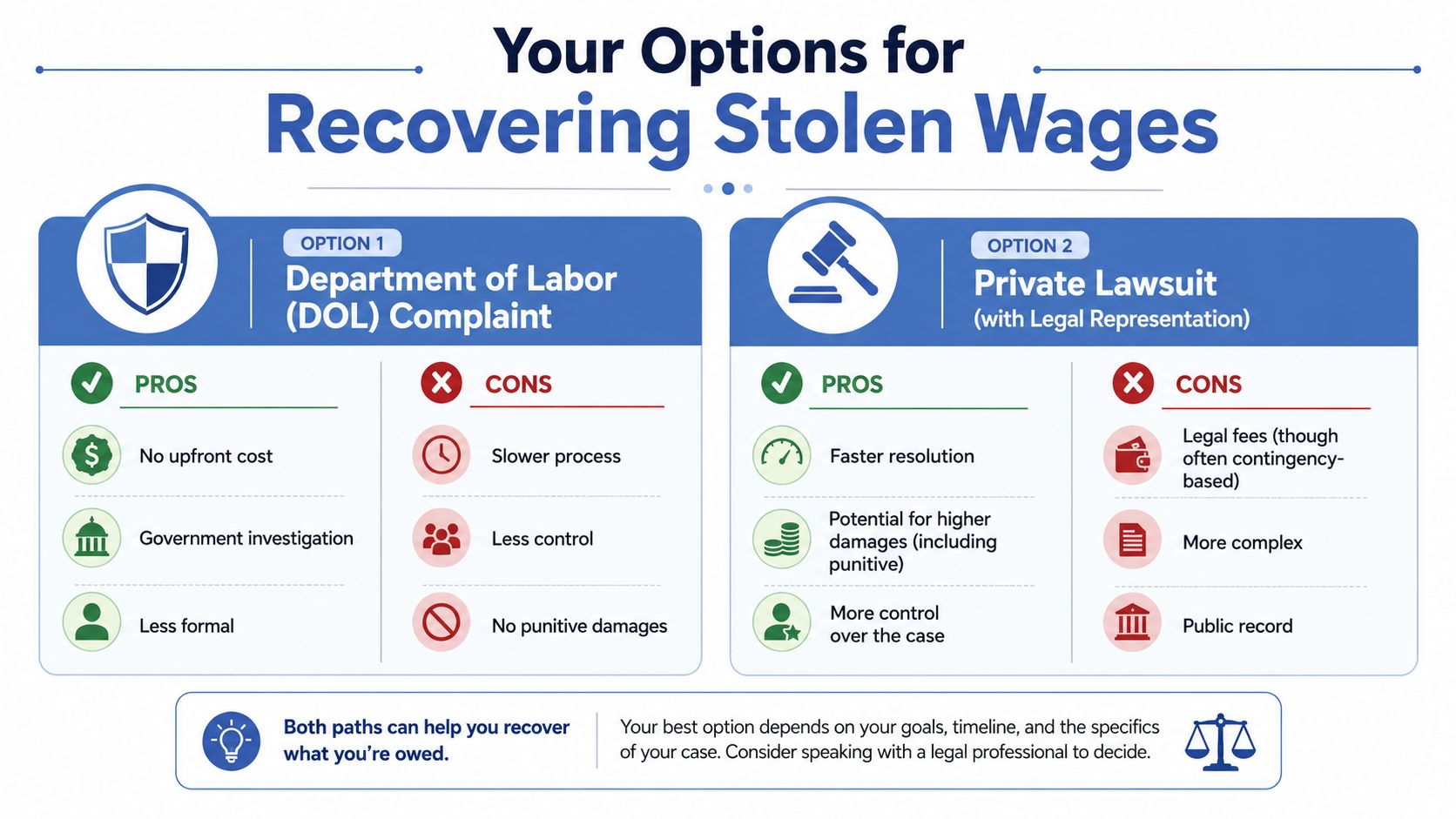
You open your paycheck, and the numbers are short again. In Mississippi, you usually will not get much help from state law. Your real options are federal. For most workers, that means one of two paths under the Fair Labor Standards Act: file a complaint with the U.S. Department of Labor's Wage and Hour Division, or bring a private wage case in federal court.
The right choice turns on practical facts. How much pay is missing? Do you have texts, time records, or pay stubs? Are other workers getting shorted too? Is the employer likely to fix the problem, or bury it?
Option one through the Department of Labor
A DOL complaint costs you nothing upfront. The agency can investigate payroll practices, demand records, interview witnesses, and seek back wages. For a clear, smaller claim, that may be enough.
But you need to be realistic. The government controls the timing, the scope of the investigation, and the settlement approach. If your employer disputes the facts, if the records are a mess, or if several workers were underpaid in different ways, the process can feel slow and limited.
Here is the practical difference:
| DOL complaint | Private federal case |
|---|---|
| No upfront filing cost for the worker | Usually pursued with counsel |
| Government investigator controls the file | You and your lawyer control case strategy |
| Can work for straightforward payroll violations | Often better for disputed facts, larger claims, or group claims |
| Less control over timing and resolution | More control over evidence, pressure, and settlement decisions |
Option two through a private federal case
A private FLSA case gives you more control and usually more pressure. Your lawyer can move fast to preserve evidence, calculate unpaid wages, identify whether the violation affected other workers, and push the employer to deal with the claim directly.
If you want a clearer picture of that process, this guide on how to sue for unpaid wages in federal court explains the steps in more detail.
For many Mississippi workers, it makes sense to talk with a wage and hour lawyer such as Nick Norris, P.A. before choosing a path. That conversation can tell you whether a DOL complaint is enough or whether a private federal case gives you a better chance to recover the full amount.
Retaliation is real, and you should plan for it
Workers delay wage claims for one reason more than any other. They are afraid the boss will cut hours, change schedules, write them up, or fire them. That fear is justified.
As discussed in NELP's analysis of retaliation protection gaps, many workers live in states with weak protection against retaliation for reporting wage theft. Mississippi is one of the places where state-level worker protections are limited. That is exactly why federal law matters here.
You also need to be careful about assuming every complaint creates the same legal protection. Mississippi law does not give workers a retaliation claim for filing a workers compensation claim. Different workplace claims follow different laws, and mistakes at the start can weaken an otherwise good case.
Document first. Keep your records at home. Get legal advice before you make a report that gives your employer time to clean up the paperwork or shape the story.
Damages Penalties and Critical Deadlines
If your employer stole wages, the point of a claim is simple. Recover what you're owed and use the law's penalties to make the employer pay attention.
What you may be able to recover
Under the FLSA, many workers can seek:
- Back pay: The unpaid minimum wages or unpaid overtime.
- Liquidated damages: In many cases, an amount equal to the unpaid wages. That can effectively double the wage recovery.
- Attorney's fees and costs: The statute allows recovery of fees and litigation costs in successful cases.
That fee-shifting matters. Most workers can't afford to pay a lawyer by the hour to chase a wage claim. In private practice, the average contingency fee is 40-50%. The ability to recover attorney's fees under federal law can make representation realistic even when a worker has been underpaid for a relatively modest amount of time.
The deadline can kill a strong claim
You cannot sit on a wage case forever.
The FLSA generally gives workers two years to bring a claim, or three years if the violation was willful. Waiting is expensive. Every pay period that passes can mean more records disappear, memories fade, supervisors move on, and payroll systems get “updated.”
Deadlines matter more than outrage. A strong claim filed too late is still a lost claim.
Don't assume the employer's records are complete
Employers often act like their time records are the final word. They aren't. If the company failed to keep accurate records, your own reasonable evidence can matter a great deal.
That's especially important when workers are told to clock out and keep working, or when meal breaks are deducted automatically whether the break happened or not.
Delay usually helps the company
Workers often wait because they want to keep the peace. I understand that. But delay usually helps the employer, not you.
If your pay has been wrong for more than one pay period, start treating it like a legal problem, not an office misunderstanding.
Building Your Case An Evidence Checklist
A wage case gets stronger when the facts are organized. You don't need a perfect file cabinet. You need to gather the records your employer hopes you never save.
Start with the documents you already have
Pull together the basics first:
- Pay stubs: Keep every stub you can find.
- Bank records: Save statements or screenshots showing deposits.
- Work schedules: Take screenshots of posted schedules, scheduling apps, and shift changes.
- Time records: Preserve clock-in and clock-out entries if you can access them.
- Tax forms: W-2s or 1099s can help frame how the company classified you.
Build your own timeline
If the employer's records are incomplete, your own notes matter.
Write down:
- The days you worked.
- When you started and stopped.
- Any meal breaks you missed.
- Any prep work, cleanup, or after-hours calls you handled.
- What your supervisor told you about timekeeping or overtime.
A notebook works. A calendar works. Notes on your phone can work. The important thing is consistency.
Save the facts while they're fresh. Specific dates, specific shifts, and specific supervisors carry weight.
Don't ignore messages and witnesses
Many wage claims become clearer once the worker gathers communications.
Look for:
- Texts from supervisors: Messages telling you to come in early, stay late, or work through lunch.
- Emails: Payroll complaints, schedule changes, or pay explanations.
- Handbooks and policies: Especially rules about breaks, overtime approval, uniforms, or deductions.
- Coworker names: Other workers who saw the same practices or had the same problem.
Keep these records somewhere your employer can't control. Use a personal email account or secure storage you own. Don't alter anything, and don't take records you have no right to access. Preserve what you already lawfully have.
How Nick Norris PA Fights for Mississippi Workers
You look at your paycheck, know the hours are wrong, and get the same answer from payroll every time. "We'll fix it next check." In Mississippi, waiting on the company to do the right thing is usually a mistake.
Mississippi gives workers very few state-level tools to force payment. That is why the main fight usually turns on federal law, especially the Fair Labor Standards Act. A good wage theft case starts by identifying the federal violation clearly and picking the forum that can get results.

Nick Norris, P.A. represents Mississippi workers in employment cases, including wage and hour claims under federal law. The job is straightforward. Examine the pay records, compare them to the hours worked, spot the FLSA issue, and decide whether the better move is a Department of Labor complaint or a federal lawsuit.
That work usually comes down to three things:
- Naming the violation correctly: Unpaid overtime, off the clock work, illegal deductions, and misclassification are different claims with different proof problems.
- Locking down the evidence early: Pay stubs, schedules, text messages, emails, and witness names matter most before records disappear or stories change.
- Using the right federal path: Some workers are better served by a DOL wage investigation. Others need direct federal litigation to recover what they are owed.
This matters more in Mississippi than in many other states. Workers here often do not have strong state wage enforcement to fall back on, so a weak federal strategy can cost real money.
If your employer has been trimming hours, refusing overtime, or blaming "policy" for missing pay, act now. Get your records together. Get a legal assessment. Make the employer answer under the federal law that still protects Mississippi workers.
If you're dealing with missing wages, unpaid overtime, off the clock work, or paycheck deductions that do not add up, contact Nick Norris, P.A. for a confidential review of your Mississippi employment claim. You should get a direct answer about your federal options and a practical plan to pursue the pay you earned.
This article has been reviewed for legal accuracy by Nick Norris. For employment law matters in Mississippi, consult with an attorney licensed to practice in your state.
Leave a Reply