

You may be reading this after a shift where a supervisor brushed against you again, a coworker sent another text that crossed the line, or a customer said something vile and everyone acted like you should just tolerate it. Many in that position aren't thinking about legal procedure. They're trying to keep their job, get through the week, and decide whether speaking up will make things worse.
That uncertainty is common. Nearly 1 in 4 employed people worldwide have experienced violence or harassment at work, and in the United States more than 85% of people who experience sexual harassment never file a formal legal charge according to Gallup's summary of the joint global analysis. Mississippi workers face a specific problem that many national articles miss. This state does not have its own human rights commission, so the path runs through the EEOC, and the deadline is shorter than many people expect.
If you're trying to stay calm enough to think clearly, practical support matters. Alongside legal steps, many people benefit from learning how to reclaim your peace while they deal with a hostile workplace. And if you're still deciding how to make an internal report, this guide on how to report workplace harassment can help you do that without guessing.
Your First Steps After Workplace Harassment
The first mistake many employees make is waiting for one more incident, one more witness, or one more sign that the behavior is "bad enough." That delay can hurt a valid workplace harassment lawsuit. Harassment cases often turn on details that seem small at first and become important later.
Start with the facts you can control today. Keep your focus narrow. What happened, who did it, who saw it, and what proof exists right now.
Stabilize the situation first
If the conduct includes threats, stalking, assault, or anything that makes you fear immediate harm, put safety first. Leave the area if you can, call someone you trust, and seek medical help or law enforcement help when needed. Employment law and personal safety are separate issues, and one doesn't need to wait on the other.
If the conduct is ongoing but not physically dangerous, avoid informal confrontations that leave no record unless you have a clear reason to do it. A hallway argument often helps the harasser more than the employee. A documented complaint usually matters more.
Practical rule: Don't try to win the argument in the moment. Preserve the evidence for later.
Make a short action list for the next day
Write down three things and do them in order:
- Record the last incident. Put the date, time, place, and exact words or actions in a private log.
- Preserve proof. Save emails, texts, chat messages, photos, schedule records, or voicemails.
- Check your reporting path. Review the handbook, complaint policy, and reporting chain.
That may feel mechanical. That's the point. Harassment creates confusion, and confusion causes missed deadlines and weak records.
A lot of employees also ask whether they should quit right away. Sometimes resignation becomes necessary. Often it isn't the best first move. Leaving before you've documented events, reported through available channels, or spoken with counsel can make a difficult case harder to prove.
How to Document Harassment Incidents
Good documentation isn't a diary of feelings alone. It's a timeline of facts that another person can follow months later. The stronger your record, the less your case depends on memory alone.
Build a clean timeline
Use one private document stored on a personal device or in a personal account you control. Don't use your work computer to keep notes for a possible claim. Each entry should answer the same core questions:
- When it happened. Include date and approximate time.
- Where it happened. Office, break room, parking lot, work chat, text message, business trip, client site.
- Who was involved. Name the harasser, witnesses, supervisors told about it, and anyone who responded.
- What was said or done. Use direct language and quote exact words when you can remember them.
- What happened next. Did you report it, walk away, ask it to stop, lose a shift, get written up, or get reassigned?
A useful entry reads like this: "May 4, lunchroom, around 12:15 p.m. John said [exact words]. Maria and Devon were present. I told him to stop. At 2:00 p.m. I emailed my supervisor." That is much stronger than "John harassed me again."
Preserve digital evidence the right way
Screenshots help, but don't stop there. Save the full email thread if possible. Export messages when the platform allows it. Keep the original voicemail. If a social media post is involved, capture the post, the account name, the date, and any comments.
Use a simple evidence folder structure:
| Folder | What to save |
|---|---|
| Emails | Full message chains and attachments |
| Texts and chats | Screenshots plus message exports if available |
| Reports | Internal complaints, HR replies, handbook pages |
| Work records | Schedules, write-ups, performance reviews, pay records |
Don't alter files, rename them in misleading ways, or crop screenshots so tightly that context disappears. Authenticity matters.
Save first. Interpret later. Employees sometimes spend too much time trying to explain evidence and not enough time preserving it.
Document the employer response
In many harassment cases, the employer's reaction matters almost as much as the original conduct. Write down when you reported the issue, who received the complaint, and what happened afterward. If HR says it will investigate, note that. If a supervisor shrugs it off, note that too.
A short follow-up email can be powerful. Example: "I'm following up on my report from yesterday regarding comments made by [name]. Please confirm receipt and advise what steps will be taken." That creates a dated record without turning the email into a legal brief.
If witnesses support you verbally, ask whether they'd be willing to confirm what they saw in writing. Some will say no. That's common. Still write down their names while the memory is fresh.
Filing with the EEOC in Mississippi
Mississippi employees need to know one point immediately. Mississippi lacks a state-level human rights commission, so workers must file a Charge of Discrimination directly with the EEOC within a strict 180-day deadline from the discriminatory act as explained in this overview of civil rights deadlines in Mississippi. If you miss that deadline, your claim may be barred.
That is why generic national advice often fails Mississippi workers. In some places, a state agency changes the timing. In Mississippi, you should assume the shorter federal timetable controls and act quickly.

What a Charge of Discrimination actually is
A Charge of Discrimination is the formal administrative filing that starts the federal process. It identifies the employer, describes what happened, states the protected basis involved, and gives the EEOC enough information to open a case.
This isn't the place for a rambling narrative. It needs to be accurate, concise, and complete enough to preserve the claim. Dates matter. Names matter. The last discriminatory act matters.
If you want a clearer sense of how that administrative stage unfolds, this explanation of the EEOC investigation process is a useful companion.
What usually happens after filing
After intake and charge filing, the EEOC may notify the employer and may offer mediation. In some matters, mediation is productive because it gets both sides to the table early. In others, it isn't useful because the employer denies the basic facts or the relationship is already too damaged.
The EEOC can investigate, request documents, ask for statements, and eventually issue a determination or a Notice of Right to Sue. That right-to-sue notice is often the document that allows a federal lawsuit to move forward.
A few practical points matter here:
- Don't wait for perfect proof. Many employees delay filing because they think they need every witness lined up first.
- Don't file carelessly. A rushed charge with wrong dates or missing allegations can create problems later.
- Don't assume HR is the deadline. Internal reporting does not replace the EEOC filing requirement.
The 180-day deadline is short enough that people lose claims while still deciding whether what happened "counts."
What works and what doesn't
What works is early action, a documented timeline, and a charge that matches the actual events. What doesn't work is treating the EEOC intake like an informal complaint line where details can be fixed whenever convenient.
Another mistake is assuming every ugly workplace conflict is illegal harassment. The law doesn't cover all unfair behavior. The conduct generally must connect to a protected basis and be serious enough to support a legal claim. That's one reason careful framing at the charge stage matters so much.
Understanding Damages Costs and Attorney Fees
A workplace harassment lawsuit isn't just about whether you were treated badly. It's also about what remedy the law can realistically provide and what it costs to pursue it.
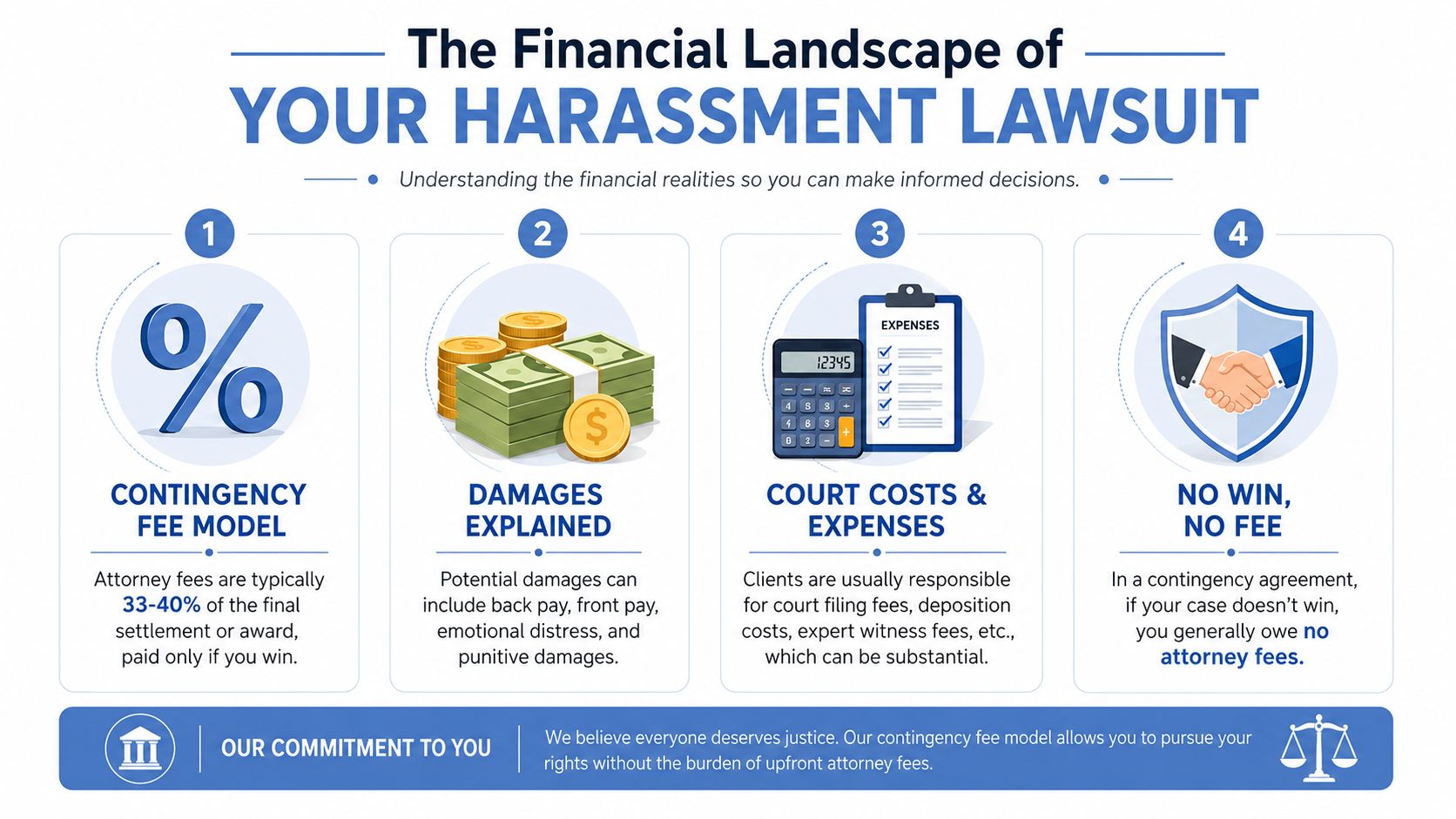
The fee structure matters up front. In these cases, the average contingency fee is 40-50%. That usually means you don't pay attorney fees unless there is a recovery, but you still need to ask how costs are handled. For a general consumer-oriented explanation of fee structures, this piece on understanding personal injury settlement fees gives a basic framework. Employment cases have their own wrinkles, but the questions about percentages, expenses, and net recovery are still the right questions to ask.
What damages may be available
Depending on the facts, a harassment case may involve:
- Back pay. Lost wages from missed work or termination.
- Front pay. Future wage loss in some cases.
- Emotional distress damages. Compensation tied to the actual human impact of the harassment.
- Punitive damages. Sometimes available, but not something to assume.
- Other relief. Policy changes, training, references, or separation terms can matter too.
If you're trying to think through the non-economic side of the case, this discussion of how emotional distress damages are calculated is worth reading.
The numbers clients should understand
The public often sees the rare headline verdict and thinks that's the standard outcome. It isn't. The EEOC recovered approximately $664 million for victims of harassment in 2023, but individual charging parties average around $24,700 in monetary compensation, and 68% of complainants face some form of retaliation according to the data summarized by UMass Amherst on employer responses to sexual harassment.
That doesn't mean a claim isn't worth pursuing. It means expectations should be grounded. A sound case can still involve difficult trade-offs, especially if the employee wants accountability, a job reference, insurance continuity, or a clean exit more than a prolonged fight.
A case can be legally valid and still produce a modest financial result. That's frustrating, but it's part of honest case evaluation.
Questions to ask before signing a fee agreement
Ask these before hiring anyone:
| Question | Why it matters |
|---|---|
| What percentage applies if the case settles early versus later? | Some contracts change by stage |
| Who pays litigation costs? | Costs can affect your net recovery |
| Is the fee calculated before or after expenses? | That changes what you take home |
| What outcome is the lawyer pursuing? | Strategy should match your goals |
Clarity at the beginning prevents resentment later.
Navigating Settlement Negotiations vs Trial
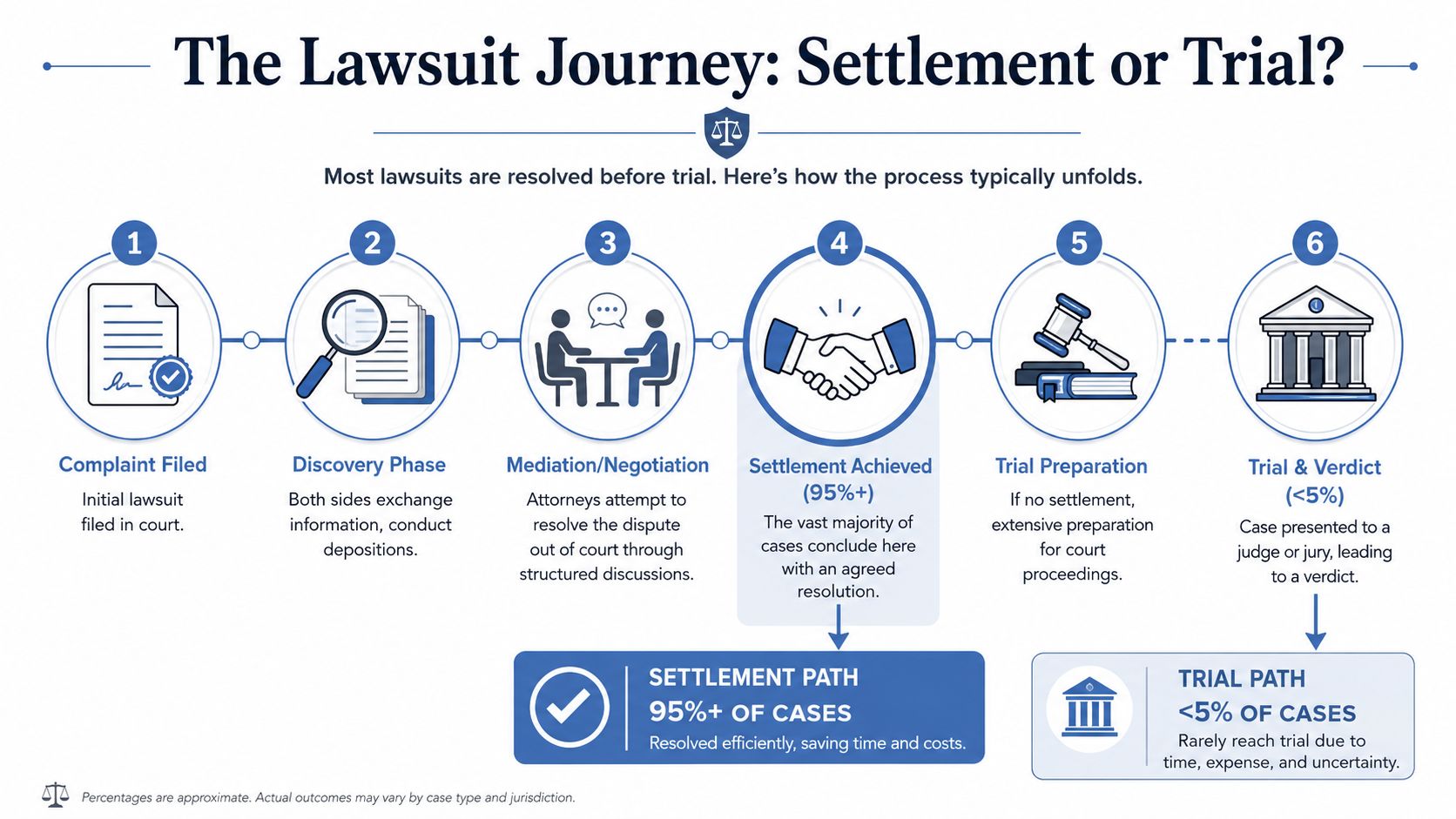
Most employees imagine their workplace harassment lawsuit ending with testimony in a courtroom. That is not the most likely path. Federal employment harassment trials have only a 1% success rate for plaintiffs on the merits, while 75% of cases settle before trial, with a median resolution time of under one year compared to over two years for cases that go to trial according to the analysis summarized in this report on employment discrimination lawsuit outcomes.
Those numbers shape strategy. They don't dictate it, but they matter.
Why settlement is often the practical goal
Settlement gives both sides control they lose at trial. The employee may secure money, a neutral reference, confidentiality terms, or separation language that protects future job searches. The employer limits risk and expense.
That doesn't make settlement a surrender. In many cases, it is the smartest way to convert a strong record into a result that helps the client move forward.
A useful way to think about it is this:
| Path | Main advantage | Main drawback |
|---|---|---|
| Settlement | Faster, more predictable | Usually involves compromise |
| Trial | Public ruling and potential full vindication | Slow, stressful, uncertain |
When trial becomes necessary
Some cases don't settle because the employer refuses to admit obvious facts, offers too little, or misreads the evidence. Sometimes the dispute is really about credibility, and both sides believe a judge or jury will see it their way. Sometimes the client's goal is public accountability and they understand the risk.
Trial also means discovery, depositions, motions, and repeated scrutiny of your work history, medical records in some cases, and communications. That process can be exhausting even when the claim is strong.
Strong facts do not guarantee a trial win. Weak facts do not always prevent a settlement. Strategy is about leverage, proof, and timing.
What actually helps in negotiation
Three things usually drive serious settlement talks.
- A coherent story supported by records. Timelines, complaints, texts, and witness names matter.
- Credible damages. Lost wages, treatment records, and documented impact matter more than inflated demands.
- An employer problem. Inconsistent investigations, ignored complaints, and retaliatory actions increase pressure.
What usually hurts negotiation is overstatement. If every rude comment is labeled a major legal violation, the case loses force. The better approach is disciplined. Focus on the conduct that is provable and legally significant.
Hiring a Mississippi Workplace Harassment Lawyer
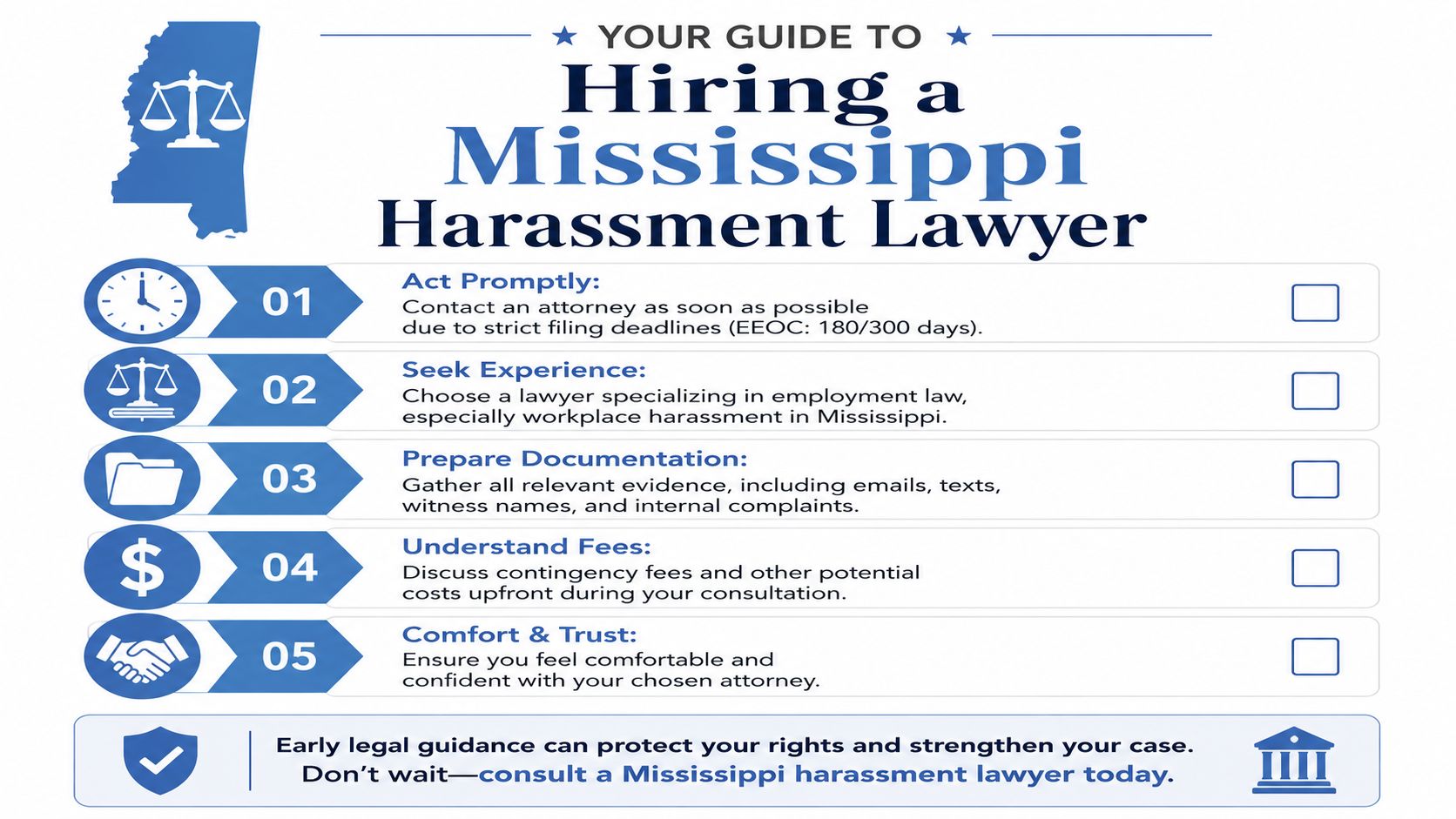
Timing matters more than is commonly understood. In Mississippi, employees often wait until HR "finishes looking into it," then discover precious time has passed. If you're considering legal advice, earlier is usually better, not because every case should become litigation, but because early guidance helps you avoid preventable mistakes.
What to look for in counsel
Not every lawyer who handles general civil matters is a good fit for a workplace harassment lawsuit. You want someone who understands EEOC charges, federal employment claims, retaliation issues, and how documentation problems affect proof.
Ask direct questions:
- How often do you handle EEOC-based employment claims in Mississippi?
- Who will draft or review the charge?
- How do you evaluate retaliation risk while the client is still employed?
- How do you approach settlement versus trial?
A good consultation should leave you with a clearer view of your options, not just a vague invitation to "stay in touch."
What you should bring to the first meeting
Bring your timeline, screenshots, emails, handbook, write-ups, performance reviews, and any severance or disciplinary papers. Put them in date order if you can. If you don't have everything, bring what you have and identify what may still exist.
Nick Norris, P.A. represents Mississippi employees in employment law matters, including workplace harassment claims, and can evaluate the EEOC path, documentation issues, and federal litigation posture based on the facts presented.
Comfort matters too
This area of law is personal. You may need to discuss humiliating facts, mental health treatment, job loss, and fears about references or blacklisting. If you don't feel heard in the first conversation, that matters.
The lawyer doesn't need to promise victory. In fact, that would be a bad sign. But the lawyer should be able to explain what is promising, what is weak, and what you need to do next in plain language.
One more Mississippi-specific point is worth saying clearly. Mississippi does not provide a retaliation claim for filing a workers compensation claim. If your issue involves workers compensation, don't assume it creates the same retaliation protections as a harassment complaint. The legal theory has to match the facts.
Frequently Asked Questions About Harassment Claims
Employees often worry their situation is too unusual to count. Sometimes the difficult cases are not unusual at all. They just don't fit the clean examples people see online.
Can I sue if a customer or client was the harasser
Sometimes, yes. But this area has become more complicated. A recent federal appeals decision raised the bar for employer liability in client-based harassment cases by requiring proof that the employer intended for the client to harass the employee, as discussed in this analysis of third-party harassment by clients.
For Mississippi workers in retail, healthcare, hospitality, and service jobs, that means a complaint involving customer conduct needs careful legal analysis. The facts still matter a great deal. What did the employer know, what did it do after learning of the problem, and did it continue putting the employee in harm's way?
What if the conduct happened off-site or after hours
Off-site conduct can still matter, but not every ugly interaction outside the building creates a legal harassment claim. Courts often focus on whether the conduct was sufficiently work-related. At the same time, employers may still have a duty to investigate complaints even when the conduct happened away from the office if the behavior affects the workplace and the employer knows about it.
That means text messages after work, comments during work travel, and conduct at employer-related events shouldn't be dismissed just because they happened outside a normal shift. The details matter.
Should I report internally if I plan to file a charge
Usually yes, unless there is a concrete reason it would be unsafe or pointless. Internal reporting can create a record that the employer knew about the harassment and had a chance to respond. It can also expose whether the employer takes complaints seriously or protects the wrong people.
Still, internal reporting is not a substitute for meeting the EEOC deadline. Those are separate tracks.
What if I was fired after complaining
That can strengthen the case, but it doesn't make the case automatic. The timing, stated reason, prior performance record, and what the employer did to other employees all matter. Save termination paperwork, write down who gave the reason, and preserve any earlier positive evaluations or messages.
Do I need perfect evidence to move forward
No. Many real cases start with incomplete records. What you need is enough reliable information to evaluate the legal claim and enough discipline to stop losing proof from this point forward.
Some of the strongest cases began with one good text thread, one witness, one email to HR, and a timeline built carefully after the fact.
If workplace harassment has left you trying to protect your paycheck, your health, and your dignity all at once, speaking with counsel can bring order to the situation. Nick Norris, P.A. advises Mississippi employees on EEOC deadlines, harassment claims, retaliation issues, and the practical choices that come before a federal case is filed.
This article has been reviewed for legal accuracy by Nick Norris. For employment law matters in Mississippi, consult with an attorney licensed to practice in your state.
Leave a Reply