
A hostile work environment lawsuit usually turns on unwelcome conduct tied to a protected characteristic that is severe or pervasive enough to make the workplace abusive. In the EEOC's 2015 harassment data, the agency received about 90,000 discrimination charges and roughly 28,000 of them alleged harassment, so this is not a fringe problem.
Is what you're experiencing a hostile work environment lawsuit, or just a bad job? If you're in Mississippi, the answer starts with whether the conduct is based on race, sex, religion, disability, national origin, or another protected trait, and whether it has crossed from ordinary conflict into something that materially changes your working conditions.
A Mississippi employee often reaches me after months of bad comments, isolation, or pressure from a supervisor and still isn't sure if the law applies. That uncertainty is normal. A toxic boss, unfair discipline, and even a miserable culture are not automatically illegal. The law looks for conduct that a reasonable person would view as abusive, plus a legal basis to hold the employer responsible.

A good way to think about it is this, if the conduct would still be objectionable even if it happened in a different office, but it becomes legally actionable because it targets a protected trait, you may be in hostile-work-environment territory. If the situation is already affecting your sleep, concentration, or confidence, counseling can help you stay steady while you document what's happening. For some people, counselling for trauma survivors is part of getting through the process without losing perspective.
If you need a plain-language Mississippi walkthrough on responding to harassment, this guide on how to handle hostile work environment issues gives a useful starting point.
When a Difficult Job Crosses Into a Hostile Work Environment Lawsuit
A warehouse worker in Jackson might be written up for attendance, passed over for assignments, and spoken to harshly by a supervisor. That's unpleasant, but it still might just be a hard job. The question changes fast if the same supervisor is also making race-based jokes, mocking a disability, or excluding the employee because of sex or religion.
The legal line is about more than bad manners
Federal courts ask whether the conduct was unwelcome, tied to a protected characteristic, and severe or pervasive enough to create an abusive atmosphere for a reasonable person, while also being subjectively hostile to the employee. That standard comes through clearly in the Ninth Circuit's hostile-work-environment instruction, and it matters because the law does not punish every rude interaction, only conduct that crosses the legal threshold. The Tulane overview makes the same point, that harassment must be tied to protected status and be serious enough to alter the terms and conditions of employment. Ninth Circuit jury instruction on hostile work environment, Tulane guide to hostile work environment lawsuits
Practical rule: repeated humiliation can matter as much as one explosive incident, but only if the evidence connects it to the protected trait and shows the workplace changed in a real way.
The law also does not require that the bad conduct be constant. A single serious episode, or a pattern of smaller episodes that build up over time, can be enough. That's where many employees misread the situation, because they wait for one dramatic event before taking action.
A Mississippi worker should ask three questions. Was the conduct based on a protected trait? Did it make work feel abusive or intimidating? Can I prove it with dates, messages, witnesses, or complaint records? If the answer is yes to all three, the claim starts to look real.
For people dealing with trauma from workplace mistreatment, practical support can matter as much as legal strategy. The legal case and the emotional recovery often move at different speeds.
The Four Elements Every Federal Case Has to Prove
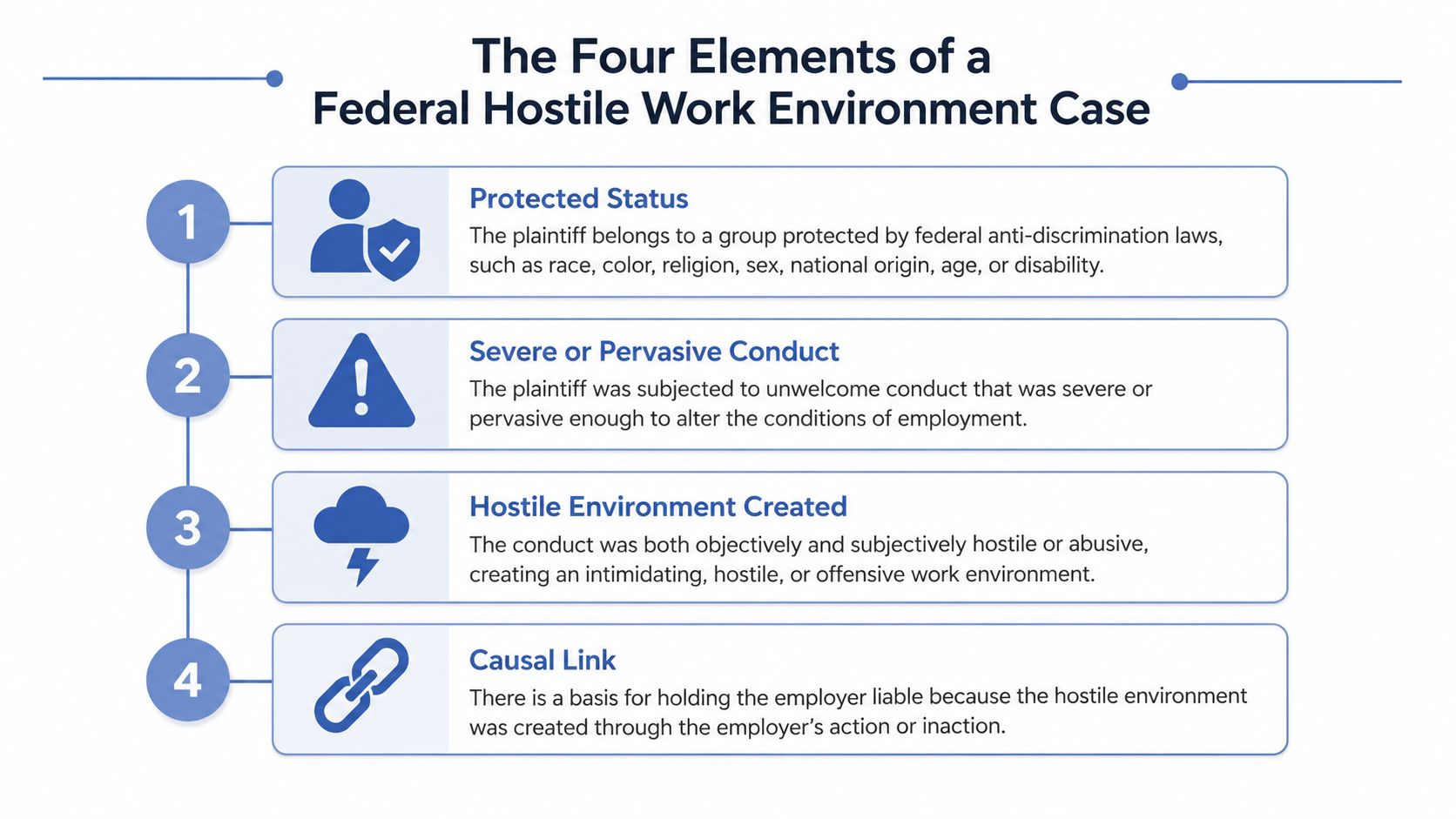
Every hostile-work-environment case has the same basic structure, even when the facts look different on the ground. If one piece is missing, the claim usually weakens fast. The first job is not to dramatize the situation, but to fit it into the four-part federal framework.
The four building blocks
1. Unwelcome conduct. The employee did not invite it, want it, or encourage it. A pattern of sexual comments after objections, or racial jokes after repeated requests to stop, fits more easily than a mutual personality clash.
2. Based on a protected characteristic. The conduct has to be linked to race, sex, religion, disability, national origin, or another legally protected trait. General bullying is not enough by itself. That distinction matters because a rude manager is not automatically a civil-rights defendant.
3. Severe or pervasive enough to create an abusive workplace. The Ninth Circuit's instruction uses both subjective and objective hostility, which means the employee must feel abused and a reasonable person must also see the environment that way. One very serious incident can matter, and so can repeated smaller incidents. There is no magic number of incidents that controls the case. EEOC harassment study
4. A basis for employer liability. The employer has to be legally connected to the conduct through its supervisors, its response, or its failure to correct what it knew about. The response matters because process often decides the outcome.
A complaint that reaches HR and disappears without action is often more important than the original insult.
A missed detail can sink a case. If the conduct is ugly but not tied to a protected trait, it may be a workplace dispute instead of a hostile work environment lawsuit. If it is tied to protected status but not serious enough, the claim may never get past the threshold.
The key is to match facts to elements, not feelings to labels. That discipline saves time and prevents false hope.
Why Mississippi Workers File Through the EEOC Instead of a State Agency
Mississippi does not have a human rights commission, so there is no state fair-employment agency to start with. For most Mississippi workers, the doorway into a hostile work environment lawsuit is the EEOC charge and the federal process that follows. That procedural reality shapes everything, especially the deadline.
The 180-day clock matters immediately
In states without a qualifying state agency, the EEOC charge-filing window is generally 180 days from the last discriminatory act. That means the calendar starts running from the most recent event that is part of the hostile environment, not from the day you finally decide the situation is intolerable. A delay can erase the claim before anyone reviews it. Mississippi EEOC filing discussion
The EEOC does more than collect forms. It receives the charge, investigates, may try conciliation, and can issue a notice of right to sue that allows the lawsuit to move forward in federal court. Mississippi workers should not assume that waiting for an internal fix pauses the deadline. It usually doesn't.
What federal procedure looks like in practice
A federal filing path typically starts with incident documentation, then internal reporting if that channel is safe and sensible, then the EEOC intake process, then the formal charge. After that, the agency investigates and may issue a determination or a right-to-sue notice. The litigation review of nearly 72,000 employment cases summarized by the ABA and Lex Machina found that about 75% settled before trial, about 13% were dismissed in the employer's favor, only 1% of plaintiffs won on the merits at trial, the median settlement resolution time was less than one year, and the median time to reach trial was two years. ABA and Lex Machina litigation study summary
That's why timing and documentation matter so much. If the case settles, it usually settles because the record is strong enough to force a serious conversation. If it doesn't, the timeline can stretch.
Real-World Examples That Cross and Fail to Cross the Legal Line
A lot of readers can tell when something feels wrong. The harder part is knowing whether the facts fit the law. Side-by-side comparisons help, because the same conduct can be just annoying in one setting and legally significant in another.
| Conduct at the Hostile Work Environment Threshold | Often Actionable | Usually Not Actionable |
|---|---|---|
| Race-based slurs, sexual comments, or religion-based insults | A supervisor repeats the conduct after objections, or the comments are tied to discipline, assignments, or exclusion | One isolated rude remark with no protected-trait link |
| Unwanted touching, intimidation, or threats | Physical conduct that creates fear or changes how the employee works | Ordinary awkwardness, bad tone, or a tense meeting |
| Group chats, DMs, memes, or screenshots targeting a protected trait | Digital harassment that can be preserved and tied to frequency and notice | A stray joke in a private chat with no protected basis |
| Repeated small incidents that build a pattern | Low-grade conduct that becomes abusive over time | General personality conflict or ordinary criticism of work |
| Exclusion from meetings or opportunities because of protected status | The pattern reflects bias, not just poor management | Being left out for reasons unrelated to protected traits |
One common mistake is assuming harassment must be direct and loud to matter. It doesn't. Recent legal commentary notes that racial harassment need not be personally targeted to one employee to contribute to a hostile environment, which matters in modern workplaces where side comments, coded language, and group messages often carry the bias. Littler harassment guidance
The opposite mistake is overreading ordinary workplace tension. Bad annual reviews, a single snappy email, or a tough supervisor don't automatically become a hostile work environment lawsuit. If the conduct is not linked to a protected trait, or if it never rises to abusive severity, the claim may fail even if the workplace feels miserable.
A Mississippi employee should also think digitally. Harassment today often shows up in texts, collaboration tools, and shared threads. Those records can become the most persuasive part of the case when the words are preserved exactly as they were written.
The strongest cases usually look cumulative. The facts add up, the records line up, and the employer's explanations start to look thin.
Reporting Internally and Filing the EEOC Charge Step by Step
The cleanest cases usually start with a paper trail. That does not mean every employee has to march into HR immediately, but it does mean the law rewards people who can show what happened, when it happened, and who knew about it. Internal reporting can help, but only if the process is real.
The order that usually works
- Document the incidents. Keep the date, time, place, exact words, witnesses, protected trait targeted, and your response.
- Use a reporting channel if it's safe. Many employers have more than one path, and that matters when the harasser is a supervisor.
- Make the EEOC intake contact. This starts the formal administrative process.
- File the charge. The charge is the document that puts the claim on the agency's docket.
- Track the agency response. Investigation, conciliation, and the right-to-sue notice all matter. EEOC investigation process overview

The usual money remedies in a federal hostile work environment case can include back pay, front pay, compensatory damages, punitive damages where permitted, and attorneys' fees. The case often resolves through settlement, not trial, which is why the quality of the record matters from the beginning. If the employer sees a clean, time-stamped chronology and credible corroboration, the settlement conversation changes.
What not to do
Don't wait for the problem to “blow over.” Don't assume a verbal complaint is enough if the employer later denies it. Don't leave texts on an old phone if you can preserve screenshots or exports. And don't skip the EEOC step in Mississippi, because there is no state fair-employment agency to pick up the claim for you.
The office procedures on the employer side often matter just as much as the harassment itself. Weak complaint handling, no follow-up, or a supervisor who is part of the problem can make the employer's position much harder to defend.
Evidence That Builds and Breaks a Hostile Work Environment Lawsuit
A hostile work environment case is won or lost in the details. Memory fades, supervisors deny conversations, and employers often reconstruct events in their favor. A contemporaneous record cuts through that.
What to preserve right away
- Incident log entries. Write the exact date, time, location, exact words, who was present, what protected trait was targeted, and how you responded.
- Digital records. Save emails, texts, screenshots, portal submissions, and DMs before they disappear.
- Management responses. Keep notes of who you reported to, what they said, and whether anything changed.
- Context evidence. Preserve schedules, write-ups, reassignment messages, and anything that shows the pattern over time.
Contemporaneous logs are persuasive because they're hard to impeach later. A note written the same day as the event usually carries more weight than a summary created months afterward after lawyers get involved. Digital evidence matters too, especially in cases built around messaging apps and collaboration tools where harassment happens in fragments.
If a conversation felt important enough to upset you, it was important enough to record.
Employees sometimes worry that preserving employer communications is improper. The safer approach is to keep records of messages you received, screenshots of what you can lawfully access, and any complaint records you created yourself. If the documents live only on an employer device, talk to counsel before trying to retrieve them in a way that could create a new problem.
For people dealing with trauma after workplace harassment, insights into trauma's impact can help explain why the memory of events may feel fragmented while the emotional reaction stays strong. That's another reason a contemporaneous log is so useful, it anchors the facts while the experience is still fresh.
Retaliation Protections and the Limits of Reporting
“Just report it” is incomplete advice. Reporting can help, but it can also change the way management treats you if the employer is already hostile to complaints. Federal law protects employees from retaliation for opposing discrimination or participating in EEOC proceedings, and retaliation can show up as termination, demotion, schedule changes, exclusion from assignments, or write-ups tied to the complaint.
The employer's process matters here. A complaint channel that goes nowhere, a supervisor who is also the harasser, or a culture that punishes reporters can shape liability just as much as the original conduct. If the employer says it has a policy but never investigates, that gap becomes part of the case.
Mississippi workers also need to keep separate legal theories separate. Mississippi does not provide a standalone retaliation claim for filing a workers' compensation claim, so that issue should not be confused with a hostile work environment lawsuit. Those are different doctrines, and mixing them only muddies the analysis. The Mississippi-specific point is important, but it is not the same as federal anti-retaliation protection for discrimination complaints. Retaliation and hostile work environment discussion
A weak complaint process does not protect an employer just because a policy exists on paper.
If the complaint goes to HR and nothing changes, that silence can become evidence. If a supervisor retaliates after a protected complaint, that retaliation may strengthen the overall claim. The safest move is to report in writing, preserve the response, and keep documenting after the complaint is filed.
When and How to Talk With Nick Norris, P.A.
Call when the conduct is escalating, when retaliation starts after you complain, when the EEOC deadline is getting close, or when you already have a right-to-sue notice in hand. Those are the moments when delay hurts most, because the paperwork and the timeline can move faster than the workplace politics.
Bring a written timeline, screenshots or printed messages, the names of witnesses, any write-ups or schedule changes, and any EEOC materials you've received. If you reported internally, bring that too. A consultation goes farther when the facts are organized, because the first job is usually to separate what is unfair from what is legally actionable.
Employment cases are often handled on contingency, and the average contingency fee in this kind of work is typically 40% to 50%. That structure matters because it tells you the financial shape of the case before you decide whether to move forward.
Quick questions I hear often
Can I wait to see whether HR fixes it? Sometimes, but don't let internal discussion run past the EEOC deadline.
Do I need a perfect case before I call? No. A good consultation starts with the facts you already have.
What if I only have texts and no witnesses? That can still matter a lot, especially if the messages are time-stamped and tied to the protected trait.
Nick Norris, P.A. helps Mississippi workers sort out hostile work environment claims, retaliation issues, and the federal EEOC process with a focus on practical next steps. If the situation is still unfolding, the safest move is to get the deadline and the evidence reviewed now, not after the record goes cold.
If you think you may have a hostile work environment lawsuit in Mississippi, contact Nick Norris, P.A. for a direct case review before the EEOC clock runs out. Visit Nick Norris, P.A. to get help organizing your timeline, preserving evidence, and deciding whether to move forward.
Leave a Reply