

Hostile Work Environment Retaliation Guide: Mississippi 2026
You complained about harassment, discrimination, leave interference, or another workplace problem. A week later, your supervisor starts criticizing everything. Meetings happen without you. Your schedule changes. A write-up appears for something that used to be ignored. Nobody says, “We’re punishing you for speaking up.” They usually don’t. But the message is clear.
That pattern is what many Mississippi workers mean when they say, “My job turned hostile after I reported it.” Sometimes that feeling reflects ordinary workplace conflict. Sometimes it reflects hostile work environment retaliation, which is a real legal problem under federal law. In Mississippi, the path for that kind of claim is different from what many people assume, and getting the process right matters early.
Understanding Hostile Work Environment Retaliation in Mississippi
A Mississippi employee might report sexual harassment to HR, complain that a supervisor is treating Black employees differently, or object to FMLA interference after a medical issue. The complaint goes in. Then the temperature changes.
The employee isn’t necessarily fired that same day. Instead, the supervisor stops speaking to them except to criticize. Coworkers are told to route work around them. Their mistakes suddenly get documented. They get left out of the very meetings they need to do their job. That’s often how retaliation looks in real life.

What the phrase actually means
Hostile work environment retaliation combines two ideas.
First, a hostile work environment means workplace conduct becomes intimidating, abusive, or severe enough to interfere with your ability to work. If you want a plain-language breakdown of that concept, this explanation of a hostile work environment definition is a helpful starting point.
Second, retaliation means the employer punishes you for doing something the law protects. That protected act might be reporting discrimination, participating in an investigation, or opposing unlawful conduct at work.
When those two meet, the claim is that your employer responded to your protected complaint by making your work life intolerable.
Practical rule: The law doesn’t require an employer to announce retaliation. Most cases are built from changed treatment, timing, and records.
This isn’t rare. The EEOC says retaliation has become the dominant issue in enforcement actions, and it is the most common issue alleged by federal employees and the top discrimination finding in federal sector cases, according to the EEOC’s discussion of retaliation as a widespread workplace problem.
Why Mississippi workers need to look at federal law first
Mississippi workers often assume there must be a state agency that handles this. There isn’t. For most employees dealing with discrimination-based retaliation, federal law drives the process. That means the details of what you reported, when you reported it, and what happened next matter from the beginning.
You don’t need to know every legal term on day one. You do need to recognize the pattern early enough to preserve your options.
Proving Your Case What Legally Constitutes Retaliation
Most retaliation claims rise or fall on proof. Not suspicion. Not a bad feeling. Proof.
A workable claim usually depends on three connected points. If one is missing, the case gets much harder.
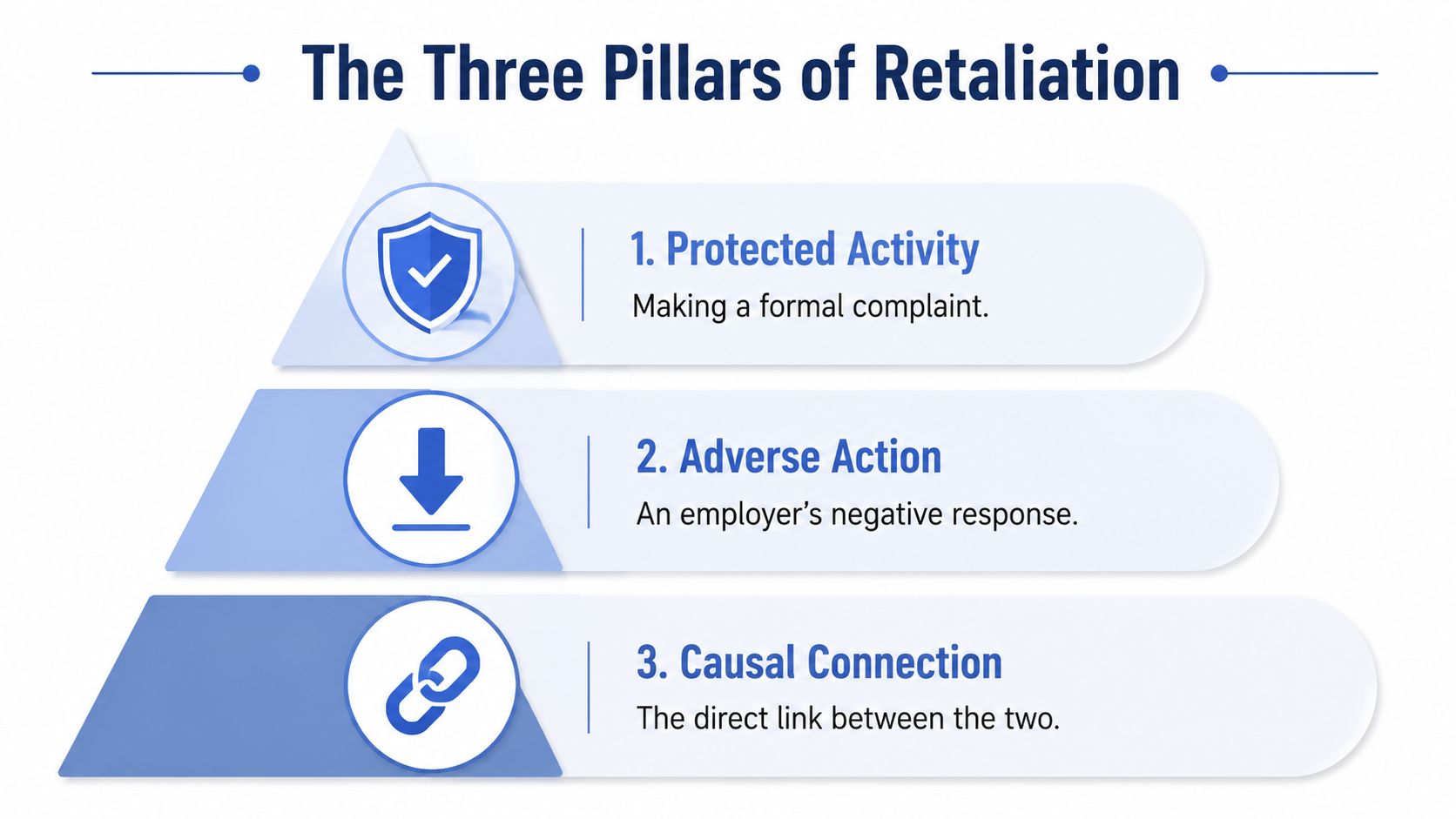
Protected activity
The first question is whether you did something the law protects.
That often includes reporting discrimination or harassment, complaining to HR, answering questions in an internal investigation, or opposing conduct you reasonably believed was unlawful. The key point is that you must have engaged in some activity the law shields from retaliation.
A lot of employees get tripped up here because they made a workplace complaint, but not every workplace complaint is legally protected. Complaining that your manager is rude, unfair, or disorganized usually isn’t enough by itself. Complaining that your manager is treating you differently because of sex, race, religion, disability, or another protected reason is different.
Materially adverse action
The second question is whether the employer did something serious enough in response.
Termination is obvious. So is demotion. But retaliation isn’t limited to firing someone. Courts look at whether the employer’s action would discourage a reasonable employee from speaking up.
That can include:
- Job loss or pay harm: Firing, suspension, pay cuts, lost hours, denied promotion.
- Career damage: A transfer to worse duties, removal from important projects, blocked advancement.
- Pressure tactics: Discipline that suddenly begins after a complaint, heavier scrutiny, or write-ups that don’t match your actual record.
Some hostile work environment retaliation claims are built on a series of smaller acts rather than one dramatic event.
Causal connection
The third question is causation. Many valid-feeling claims become difficult cases at this stage.
Federal courts often apply a but-for causation standard. In plain terms, you must show the protected activity was the decisive reason for the materially adverse action. The EEOC’s discussion of facts about retaliation and causation standards also notes that employers sometimes use “papering the file,” meaning they start documenting minor or exaggerated issues after a complaint, and that tactic appears in an estimated 40% of viable retaliation claims.
Think of causation like a switch. If the complaint had never happened, would the demotion, write-up, exclusion, or termination still have happened when it did and in the same way? If the answer is probably no, you’re in the right territory.
A strong retaliation case often looks ordinary on the surface until you line the dates up side by side.
What tends to help and what usually doesn’t
Good evidence often includes timing, changed treatment, inconsistent explanations, and records showing your performance was fine until you complained. Witnesses matter. Emails matter. Calendar invites matter. Performance reviews before and after the complaint matter.
Weak evidence usually sounds like this: “I just know they were mad.” That may be true, but it won’t carry a legal claim by itself.
A practical checklist helps. This guide on how to prove retaliation at work addresses the kinds of documents and timeline details employees should gather early.
| Legal element | What it means in practice | Example |
|---|---|---|
| Protected activity | You reported or opposed unlawful conduct | Complaint to HR about sexual harassment |
| Adverse action | Employer responded with meaningful harm | Demotion, discipline, exclusion, reduced hours |
| Causal connection | The harm happened because of the complaint | Sudden write-ups right after the report |
What doesn’t work is waiting for the employer to become explicit. They almost never will.
Recognizing Retaliation Common Workplace Examples
Many employees expect retaliation to look dramatic. Sometimes it does. More often, it shows up as a series of changes designed to make you back off, quit, or look like the problem.
A supervisor may stop giving you information everyone else gets. A manager who never cared about your timecards suddenly audits every minute. A team lead starts assigning impossible deadlines, then criticizes you for missing them. Those facts can matter even if your title never changed.
The obvious forms
Some examples are clear from the start:
- Termination after a complaint
- Demotion or loss of supervisory duties
- Cuts to pay, hours, or preferred shifts
- Denial of promotion after protected activity
Those are easier to spot, but employers know that. That’s why many retaliation cases involve subtler conduct.
The quieter forms
Hostile work environment retaliation often grows through daily friction.
One employee is moved away from their team. Another is excluded from meetings tied to performance goals. Another starts receiving criticism for minor issues that coworkers regularly get away with. Some employees suddenly lose training, support, or access to decision-makers.
I’ve seen workers describe this as feeling “managed out.” That phrase isn’t a legal standard, but it captures the experience well.
If your workplace treatment changed right after you complained, don’t focus only on whether you were fired. Focus on what changed, who changed it, and when.
Common subtle patterns include:
- Exclusion: Left off emails, meetings, shared calendars, or project decisions.
- Micromanagement: Daily monitoring that wasn’t there before.
- Pretext discipline: New write-ups over small issues after years without trouble.
- Isolation: Desk moves, schedule changes, or reassignment away from normal support.
- Reputation damage: Managers suggesting you’re difficult, unstable, or disloyal after a complaint.
Digital retaliation in Mississippi workplaces
Remote and hybrid work created another version of the same problem. A recent trend is digital retaliation, where hostility happens on platforms like Slack or Teams. That can include mass-excluding whistleblowers from channels, using AI monitoring to nitpick their activity, or repeated public shaming in online meetings. A discussion of hostile work environment examples including digital retaliation also notes a 2025 Fifth Circuit decision, which covers Mississippi, ruling that repeated Zoom shaming could be pervasive enough to support a claim.
That matters in Mississippi because modern retaliation doesn’t have to happen in a break room or on a factory floor. It can happen in chat logs, video meetings, access permissions, scheduling software, and performance dashboards.
If your employer controls the digital tools that control your work, those tools can become part of the retaliation story.
Mississippi Rules for Hostile Environment Claims
Mississippi workers need to know three things early, because bad assumptions can cost you a claim.

There is no Mississippi human rights commission
Mississippi does not have its own state human rights agency where you can file a discrimination or retaliation charge as an alternative path. For most employees with hostile work environment retaliation tied to discrimination, harassment, or related protected activity, the EEOC is the administrative doorway.
That catches people off guard. They spend valuable time searching for a state office that doesn’t exist, or they report internally and assume that’s enough. It usually isn’t.
At-will employment doesn’t give employers a free pass
Mississippi is an at-will employment state. Employers often rely on that phrase, and workers hear it so often they assume they have no rights.
At-will employment means an employer can usually end employment for many reasons, or no stated reason at all. It does not mean the employer can retaliate for protected conduct under federal law. A company can be wrongfully motivated even if it says the decision was just “business judgment.”
Workers’ compensation retaliation is a common misunderstanding
This point matters because employees hear bad advice all the time. Mississippi does not provide a retaliation claim for filing a workers’ compensation claim. If that is the only protected act you are relying on, you need to be very careful before assuming you have a retaliation case.
That doesn’t mean injured workers never have other claims. It means you shouldn’t force a workers’ comp complaint into a legal theory Mississippi doesn’t recognize.
Why people wait too long
Fear keeps many employees silent. A whistleblower resource discussing hostile environment reporting barriers states that 46% of employees who experience or witness misconduct do not report it primarily because of fear of retaliation, and 42% of incidents go unreported for that reason, according to this discussion of fear of retaliation and underreporting.
That fear is understandable. In Mississippi, where there is no state agency to absorb early confusion, delay can be especially costly. If you’re waiting to see whether things “settle down,” your deadline may keep running while the evidence gets worse.
How to File a Retaliation Charge with the EEOC
Filing with the EEOC isn’t just paperwork. It’s the gateway step for many Mississippi retaliation claims. If you miss it, or if you describe the claim badly, you can damage the case before it starts.

Step one is documentation
Start collecting evidence before the employer controls the narrative.
Save emails, write-ups, schedules, performance reviews, text messages related to work, screenshots of meeting removals, and the names of witnesses. If digital retaliation is involved, preserve the screen, date, and context. Keep a timeline that shows the complaint and every meaningful change that followed.
Retaliation frequently begins after an employee reports misconduct. Emtrain’s discussion of anti-retaliation tracking states that 82% of employees who report misconduct experience some form of retaliation afterward, which is why immediate recordkeeping matters, as noted in this analysis of post-report harassment and documentation.
Best practice: Write down events the same day. Memory fades. Contemporaneous notes are often more persuasive than reconstructed recollections months later.
A useful file usually includes:
- Your complaint record: The email to HR, hotline report, manager text, or meeting note showing what you reported.
- Before-and-after proof: Reviews, attendance records, praise, project history, and schedules from before the complaint and after it.
- Retaliation details: Dates of write-ups, exclusions, transfer decisions, investigation interviews, or pay changes.
- Witness list: Coworkers who saw the treatment shift, heard statements, or observed different treatment of others.
Step two is filing on time
In Mississippi, the filing deadline is usually 180 days from the retaliatory act. That’s a short window. Employees often think the clock starts only when they are fired. Sometimes the last retaliatory act is earlier than they realize, or a series of acts has to be framed carefully.
When in doubt, assume the deadline is closer than you want it to be.
What happens after filing
After a charge is filed, the employer gets notice and usually responds. The EEOC may offer mediation. In some cases, mediation is useful because it can produce an earlier resolution. In others, it gives the employer a preview of your claim before enough evidence is developed. That’s a strategic call, not an automatic yes or no.
The EEOC may investigate, request documents, or interview witnesses. Sometimes the agency issues a dismissal and notice of rights. Sometimes it continues the investigation. Sometimes it issues a Right to Sue notice, which is what allows the case to move forward in federal court.
For a closer look at that stage, this overview of the EEOC investigation process walks through what employees can expect once the charge is on file.
A short explainer can help if you’re trying to get your bearings before you file:
What works and what doesn’t
What works is a clean timeline, preserved documents, and a charge that matches the actual facts.
What doesn’t work is filing a rushed charge with vague statements like “my boss retaliated against me” and hoping the details will come later. They might not. The EEOC process is important enough to treat seriously from day one.
What You Can Win and How Employers Fight Back
Employees usually want two answers. What can I recover, and what is the company going to say in response?
On the remedy side, a successful retaliation claim may seek reinstatement, back pay, and other available damages under the governing federal law. In the right case, a claim may also include compensation for the harm caused by the employer’s conduct and, in some situations, punitive damages meant to punish especially wrongful behavior.
But a claim’s value depends on facts, documentation, the legal theory involved, and whether the evidence shows retaliation rather than ordinary workplace conflict. That’s why quick assumptions about case value usually do more harm than good.
The defenses employers commonly use
Employers rarely admit retaliatory motive. They usually argue there was a legitimate, non-retaliatory reason for what happened.
Common defenses include:
- Performance problems existed already: The company says discipline was underway before your complaint.
- Business restructuring explains it: They claim the transfer, schedule change, or termination had nothing to do with you speaking up.
- No protected activity occurred: They argue your complaint never raised unlawful discrimination or retaliation issues.
- No real harm happened: They say the changed treatment was minor, temporary, or not materially adverse.
Some employers are more strategic. They do not react immediately. They wait, create paperwork, build a record, and later say the decision was inevitable. Those cases can still be won, but they require more careful proof.
The fee question most people ask
Most employment lawyers handling these cases work on a contingency fee. A typical range is 40% to 50%. That usually means the lawyer is paid if money is recovered, subject to the fee agreement and case expenses.
Nick Norris, P.A. represents Mississippi employees in retaliation and related employment matters, among other options workers may consider when deciding whether to pursue counsel.
A consultation should include a frank discussion about risk, timing, likely defenses, and whether the expected recovery justifies the fight.
Why You Should Consult a Mississippi Employment Attorney
Hostile work environment retaliation cases are harder than many employees expect. The facts may feel obvious to you because you lived them. The legal system still requires proof, deadlines, and a claim framed under the right law.
In Mississippi, the process is narrower than people think. There is no state human rights commission to fall back on. The EEOC step matters. The deadline matters. The wording of the charge matters. And some claims people assume exist, including a retaliation claim based only on filing workers’ compensation, are not available the way many believe.
A Mississippi employment attorney can evaluate whether your complaint qualifies as protected activity, identify the strongest evidence, help preserve records, prepare the EEOC charge, and deal with the employer’s legal explanations before they harden into the official story. That kind of early analysis can change the direction of a case.
Trying to handle a serious retaliation claim alone is risky. Waiting is riskier.
If your workplace turned hostile after you reported harassment, discrimination, protected leave issues, or other legally protected conduct, get legal advice before more time passes.
If you’re dealing with hostile work environment retaliation in Mississippi, Nick Norris, P.A. offers confidential consultations for employees who need help evaluating their rights, preserving evidence, and navigating the EEOC process.
This article has been reviewed for legal accuracy by Nick Norris. For employment law matters in Mississippi, consult with an attorney licensed to practice in your state.
Leave a Reply