

A lot of Mississippi workers search “what is the right to work law” because someone told them it protects their job. That advice sounds reassuring, but it's usually wrong. Right-to-work is about union dues and union membership, not a blanket promise of job security, and confusing those two ideas can leave a worker looking in the wrong place for protection.
By Nick Norris, P.A.
Last updated: July 28, 2026
Reviewed by Nick Norris
Phone: 601-641-4897
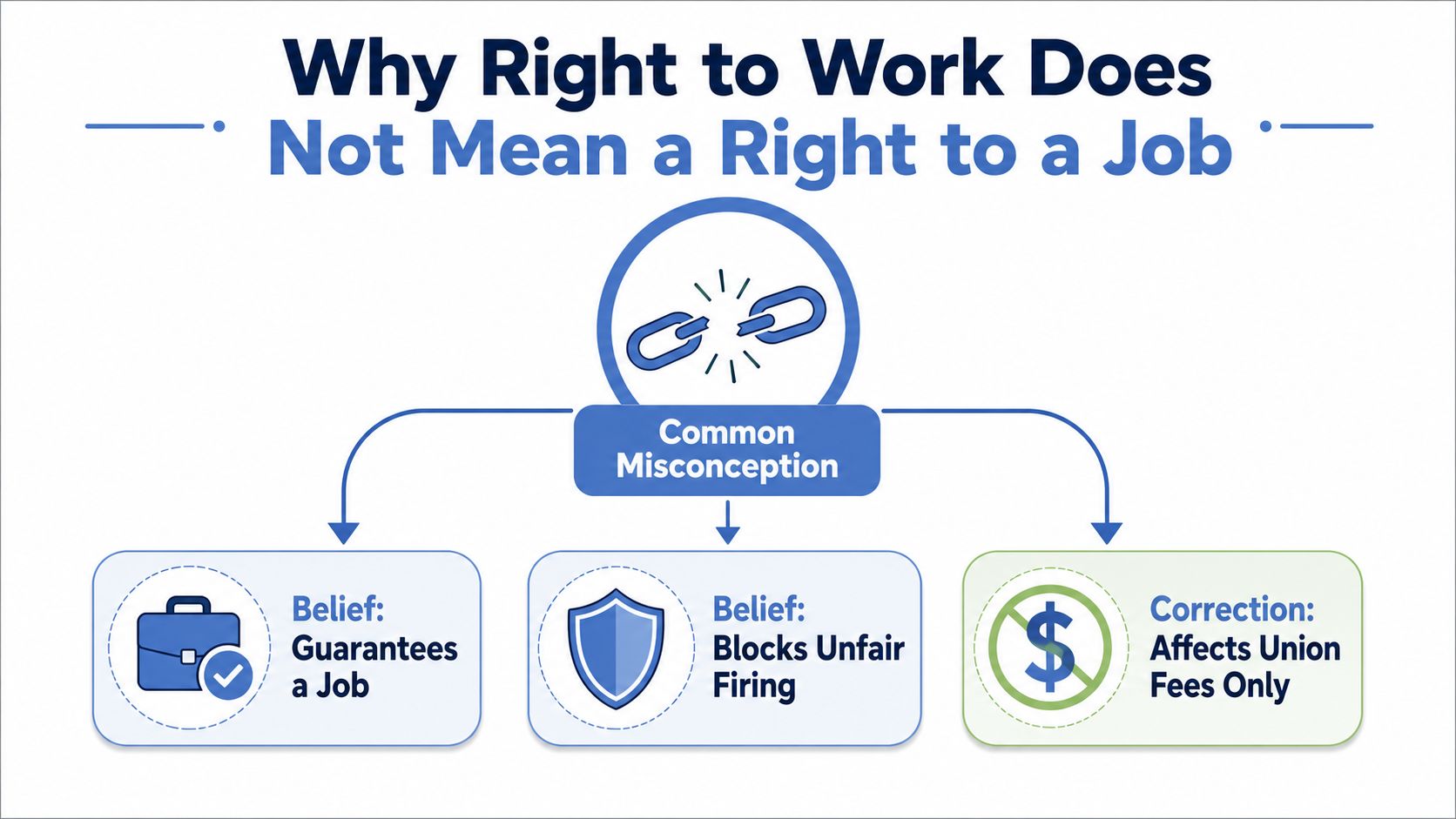
Why Right to Work Does Not Mean a Right to a Job
The phrase right-to-work causes trouble because it sounds like job protection. In ordinary speech, people hear “right to work” and assume it means they can't be fired unfairly or laid off at all. That is not what the law means in U.S. labor law. According to the federal labor-law explanation in the verified materials, “a right-to-work statute does not create a general right to a job; it specifically bans union-security agreements that require workers to join a union or pay dues or fees as a condition of employment” (AACC explanation of right-to-work law).
A worker in a unionized plant might hear the phrase and think it blocks a layoff. It doesn't. If the employer has a legitimate business reason to reduce staff, right-to-work law does not stop that decision. If the employer fires someone for a reason covered by another law, the worker still has to look to the correct statute, not to right-to-work.
Practical rule: If your question is “Can they make me join or pay a union?” right-to-work may matter. If your question is “Can they fire me for this reason?” right-to-work usually is not the statute you need.
That distinction matters in Mississippi because the name is misleading. A lot of people stop at the label and never get to the part that affects them. If you want a broader explanation of employment status rules, see this related post on employment at will doctrine.
The cleanest way to remember it is this, right-to-work changes union-security rules, not the employer's general power to hire, fire, or lay off. That's why Mississippi being a right-to-work state tells you something important, but not nearly enough by itself.
How the Right to Work Law Actually Works
The legal root comes from the Labor Management Relations Act of 1947, better known as Taft-Hartley. The National Bureau of Economic Research summary explains that this federal framework allowed states to ban mandatory union-dues or agency-shop requirements for covered workers (NBER digest on right-to-work laws). That's the federal hook. States then decide whether to adopt the rule.
In plain English, right-to-work laws block agreements that make union support compulsory as a condition of a job. They do not abolish unions. They do not erase collective bargaining. They change whether a worker can be forced to pay dues or fees to keep working in a unionized setting.
The pieces people mix up
There are a few union-security arrangements that sound similar, and that's where confusion starts. A closed shop is the strongest form, where the employer only hires union members. A union shop requires a worker to join after being hired. An agency-fee or financial-core setup makes the worker pay a fee for representation costs even if the worker does not join the union.
Right-to-work statutes block those compulsory arrangements in the states that adopt them. The result is simple, the worker can choose whether to join the union or pay dues, and the employer can't make that choice a condition of employment.
In a unionized workplace, the employee may decline dues, but the union still has to represent that worker in collective bargaining if the worker belongs in the bargaining unit.
A paycheck example makes this concrete. If a worker's union dues are normally deducted from pay, right-to-work changes that deduction only if the worker opts out under the state rule. The hourly wage stays the same unless some other law or contract term changes it. The law is about the deduction and the membership condition, not about creating a new wage rate.
If you want a deeper labor-law concept that often sits beside this one, see this related post on protected concerted activity. The point is simple, labor law has several different rules, and right-to-work covers only one narrow slice.
What the Research Says About Wages and Union Density
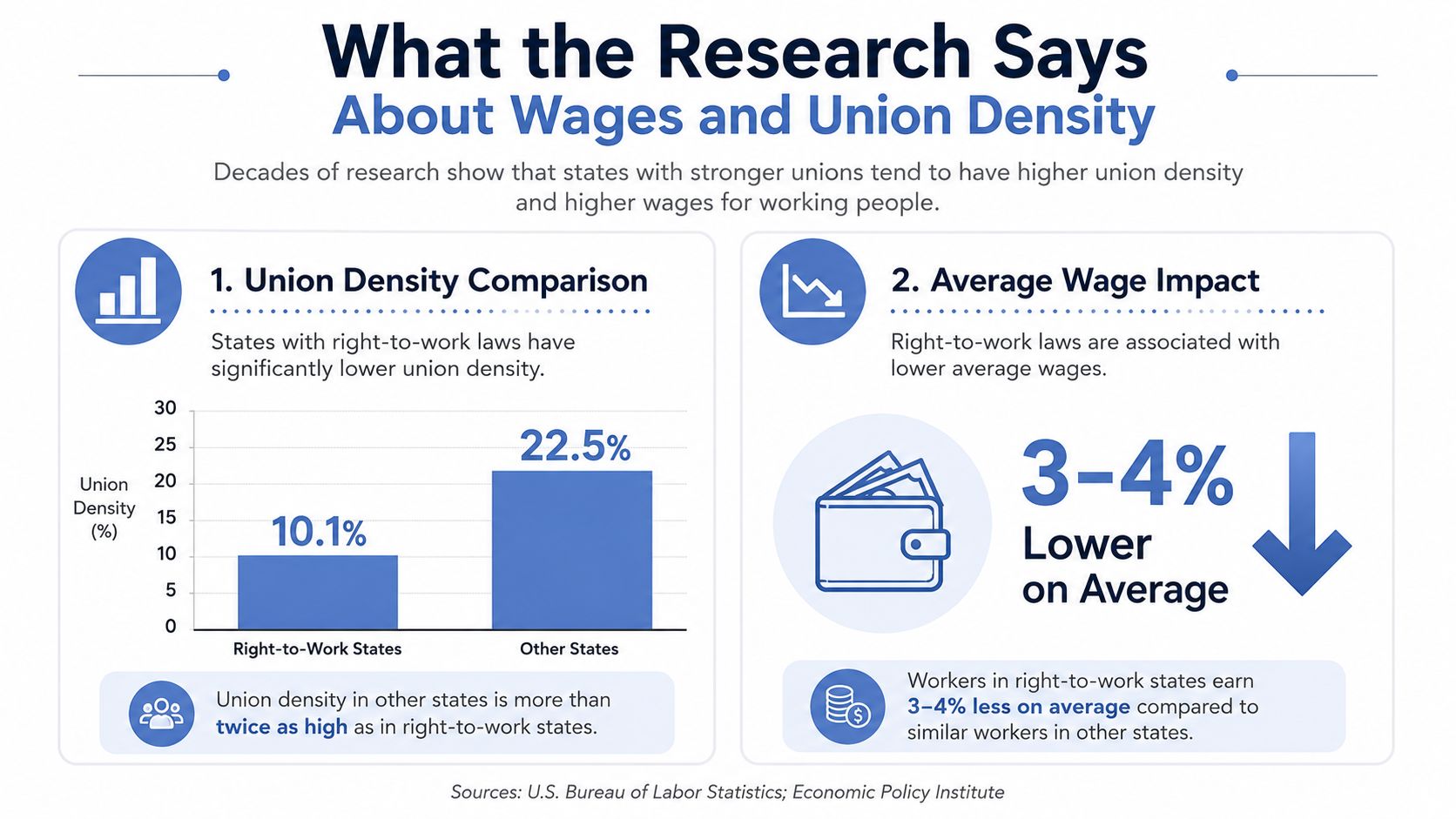
Workers often hear right-to-work described as a freedom measure. The research question is narrower and more practical, what happens to bargaining power, union membership, and pay after a state adopts it. The verified materials point in one direction, lower union density and lower wages in right-to-work states, even after analysts account for worker and state differences.
Union strength tends to fall after adoption
A summary drawing on NBER-based research found that right-to-work adoption is associated with a drop of about 4 percentage points in unionization rates within five years. In high-union sectors such as construction, education, and public administration, unionization fell by almost 13 percentage points over five years, with wages down by more than 4% in those sectors. The EPI discussion of right-to-work impacts links those changes to weaker bargaining power, not just lower dues collection.
That distinction matters. Union density is like the number of people at the bargaining table. When fewer workers are in the room, the union has less pressure behind it, and that can affect wages, benefits, and contract terms.
Wages are lower on average in RTW states
The verified EPI wage analysis reports that workers in right-to-work states are paid about 3.2% less, or roughly $1,670 less per year for a full-time worker, compared with similar workers in non-RTW states (EPI wage analysis). That is a pattern, not a claim about every paycheck. A Mississippi worker may still earn more or less for many reasons, but the broad comparison in the research does not support the idea that right-to-work is a wage-raising rule.
The picture is not one-sided. The verified materials also note that the Federal Reserve found a small employment increase of about 1 percentage point after adoption, so the research does not point to one simple effect in every category. Some analyses connect right-to-work with modest job growth, while others find weaker union density and lower pay. A worker trying to understand the law needs both parts, because the slogan and the pay effect are not the same thing.
| Research point | Verified finding |
|---|---|
| Unionization after adoption | About 4 percentage points lower within five years |
| High-union sectors | Almost 13 percentage points lower unionization over five years |
| Wage comparison | About 3.2% lower, or roughly $1,670 less per year |
For a Mississippi worker, the practical takeaway is blunt. If someone says right-to-work protects wages, the strongest neutral evidence in the record does not support that claim. The law addresses union-security arrangements, while the research most often cited on wages points in the other direction.
Mississippi workers who want the state-by-state legal frame can also review this overview of Mississippi labor laws.
Right to Work in Mississippi and What It Means at Work
Mississippi is a right-to-work state, which means workers in unionized workplaces cannot be required as a condition of employment to join a union or pay union dues or fees, and there is no federal right-to-work law that creates this rule nationwide (Investopedia's Mississippi right-to-work overview). That's the state-level rule in one sentence. It does not mean a worker has no union representation, and it does not mean a union contract disappears.
A Mississippi shop-floor example
Take a production worker in the Jackson area. The plant has a union contract, and the contract sets wages, overtime rules, grievance procedures, and seniority terms. Under right-to-work, that worker can usually choose not to join the union and not to pay union dues as a condition of keeping the job. The worker still benefits from the contract terms the union negotiated, because the union represents the bargaining unit as a whole.
That is the part many people miss. The legal change is about whether money can be compelled for union support, not whether the union contract exists. So the payroll stub may show dues check-off for workers who choose membership, while another worker in the same bargaining unit takes home pay without that deduction.
Mississippi sits inside a larger right-to-work map
The policy is not a one-off Mississippi oddity. By 2019, 27 states and Guam had adopted right-to-work laws, and later summaries noted 26 states after legal changes in West Virginia. Mississippi is part of a larger Southern cluster that includes Alabama, Arkansas, Louisiana, and Texas. That context matters because the rule has become a durable state-level labor policy in many places, not just a local quirk.
The phrase sounds national, but the rule itself is state-made. Mississippi chose it, and workers in the state live with that choice every day at the bargaining table and on the pay stub.
If you're comparing your workplace rules with broader Mississippi labor guidance, this related post on Mississippi labor laws is a useful companion. Right-to-work is only one part of the employment picture. It sits beside overtime rules, leave rights, discrimination protections, and other statutes that can matter more than union dues in a real dispute.
What Right to Work Does Not Do for Mississippi Employees
A right-to-work statute is easy to oversell. It does not guarantee a job, it does not create a right to be rehired, and it does not protect a worker from unfair firing. The verified materials also make clear that these laws stop employers and employees from negotiating agreements requiring workers who benefit from a collective bargaining agreement to pay a share of representation costs, but they do not themselves create broad firing protection (CSJB Union explanation of right-to-work limits).
The better statute depends on the problem
If the issue is unpaid overtime, the federal Fair Labor Standards Act is usually the place to look. If the issue is discrimination or sexual harassment, statutes like Title VII are more relevant. If the issue is leave, the Family and Medical Leave Act may matter. If the issue is military service, USERRA comes into play. If a company is shutting down or laying off a large group, the WARN Act can require advance notice. Each of those laws addresses a different harm.
A right-to-work law doesn't fix retaliation, unpaid wages, leave interference, or discrimination. It also doesn't create a private retaliation claim for filing a workers' compensation claim in Mississippi. Workers often land on the wrong label because someone used the phrase “right to work” as if it were a general employment shield. It isn't.
Mississippi workers usually need a different legal lens
That's the hard part of employment law. The statute that sounds closest to the problem is often the wrong one. If the facts involve discipline after a complaint, missed final wages, a denial of protected leave, or a layoff without proper notice, the right-to-work statute is probably not the focus.
For Mississippi employees, the practical rule is blunt. Right-to-work is about union-security arrangements, not a universal anti-retaliation law and not a job-guarantee law. If your workplace problem sits outside dues and membership, the right statute may be a wage law, a leave law, an anti-discrimination law, or a discharge claim.
When to Talk to a Mississippi Employment Attorney
Right-to-work questions often show up next to other workplace problems, and that's where a lawyer can help sort the facts. If you're missing overtime, dealing with harassment, facing discrimination, or worried about FMLA interference, the union-dues issue may be a sideshow. The central question is which law matches the harm you suffered.

Signs the problem is bigger than right-to-work
- Protected complaint followed by discipline: If you complained about discrimination, harassment, unsafe pay practices, or leave issues, then got written up, demoted, or terminated soon after, that timing can matter.
- Pay problems that keep growing: Missing overtime, shorted final pay, or repeated wage errors usually point to a wage-and-hour issue, not a union-security issue.
- Leave problems: A sudden schedule change, refusal to restore your position, or pressure to abandon leave after FMLA use can signal a leave-law problem.
- Layoff or shutdown concerns: If your employer is closing a site or trimming a large group and gave no meaningful advance warning, the WARN Act may be the relevant law.
- Military service or reemployment problems: If your job changed because of service obligations, USERRA may protect you.
- Retaliation fears: If you think you were punished for speaking up, the key facts are the complaint, the timing, and the employer's stated reason.
The average contingency fee for an employment case is roughly 40% to 50%, which means most Mississippi employees can pursue claims without paying an attorney up front (EPI discussion of contingency fees). That fee structure matters because many workers assume they can't afford help. In practice, representation is often tied to whether there's a recovery.
If you want to understand how staffing and document review support these cases, a useful outside resource is this guide to hiring a paralegal. Good support work helps organize pay records, emails, schedules, and policy documents before a claim ever gets filed.
If any of this sounds familiar, get your papers together and call. The sooner a Mississippi worker documents dates, witnesses, pay stubs, and emails, the easier it is to separate a right-to-work issue from a wage, leave, retaliation, or discharge claim.
Key Takeaways for Mississippi Workers
Right-to-work is narrow. It controls union dues, union membership, and union-security agreements. It does not guarantee a job, stop a lawful layoff, or block every firing.
Mississippi's rule is state-level, not federal. There is no national right-to-work law that protects everyone the same way. Mississippi chose the rule for workplaces in this state.
Most real workplace protections come from other laws. Wage claims, discrimination claims, leave issues, military reemployment rights, and layoff notice rules live in other statutes, not in right-to-work.
If you think your rights were violated, write down what happened, keep your pay stubs and messages, note dates and witnesses, and get advice before the record goes cold.
By Nick Norris, P.A.
Reviewed by Nick Norris
Last updated: July 28, 2026
Phone: 601-641-4897
If you're dealing with a Mississippi workplace problem, Nick Norris, P.A. can help you sort out whether the issue is right-to-work, unpaid wages, retaliation, discrimination, or another employment-law claim. Visit Nick Norris, P.A. to learn how the firm helps Mississippi workers protect their rights and decide what to do next.
Leave a Reply