
What Is Employment at Will Doctrine and How It Affects Mississippi Workers
At its core, the American workplace operates on a principle known as the employment-at-will doctrine. In simple terms, this means an employer can fire you for any reason—or even no reason at all. It’s a two-way street; you, the employee, can also quit for any reason without notice.
However, this rule isn't a free-for-all for employers. Powerful legal exceptions exist to protect workers from being fired for the wrong reasons.
What Is the Employment at Will Doctrine?
Think of at-will employment as a flexible, open-ended agreement. The company can end the relationship at any time, and so can you. There's no requirement for a "good cause" or a two-week notice, as long as no contract or collective bargaining agreement says otherwise.
This is the default employment status for most private-sector jobs across the United States. To get a handle on the official definition, you can review this overview of Employment at Will. But while it might sound like employers hold all the cards, the exceptions are what truly matter.
To help clarify this, the table below breaks down the main ideas of at-will employment.
At-Will Employment at a Glance
| Principle | What It Means for Employees | What It Means for Employers |
|---|---|---|
| Termination Freedom | You can be terminated at any time, for any reason (or no reason), as long as it's not illegal. | You can terminate an employee at any time, without cause or advance notice. |
| Quitting Freedom | You can quit your job at any time without a specific reason or notice period. | You must accept an employee's resignation, regardless of the reason or timing. |
| Modification Freedom | Your employer can change the terms of your job (pay, duties, hours) at any time. | You can alter employment terms, but you must do so legally and not in a discriminatory way. |
This table shows the basic framework, but the real-world application is always shaped by federal and state laws that create crucial guardrails.
The Foundation of US Labor Law
The concept of at-will employment isn't new; it has been a cornerstone of the American legal system since the late 19th century. The idea is that both parties should have the freedom to end the work relationship when they see fit.
But here’s the most important takeaway: "any reason" can't be an illegal reason. Federal and state laws have carved out significant protections for employees. For instance, an employer cannot fire you because of your:
- Race or skin color
- Religion
- Gender or sex
- Age (specifically if you are 40 or older)
- Disability
- National origin
Crucially, your boss is also forbidden from firing you as payback for exercising your legal rights. This is called retaliation, and it includes things like reporting discrimination, taking protected medical leave, or blowing the whistle on illegal activity within the company.
Why This Doctrine Matters to Mississippi Workers
Understanding this concept is especially critical for anyone working in Mississippi. Our state is a strong follower of the at-will rule, which gives employers very broad power when it comes to hiring and firing.
Unlike some other states, Mississippi doesn't have a dedicated state agency for handling discrimination claims. This means if you believe you were fired illegally, you generally have to file a claim with a federal agency like the Equal Employment Opportunity Commission (EEOC).
This puts the burden on you to know the difference between a firing that feels unfair and one that is actually illegal. Getting fired because you and your manager just didn't get along is probably unfair, but it's likely legal. Getting fired the day after you reported sexual harassment, however, crosses the line into illegal territory.
You can find more details on how these rules apply specifically in our state by reading our guide to employment law in Mississippi.
The Major Exceptions Protecting At-Will Workers
While the at-will doctrine gives employers a lot of leeway, it’s not a blank check to fire someone for any reason imaginable. Think of it as the default setting for employment, but one that comes with some very important exceptions that act as legal guardrails. These protections are what separate an unfair firing from an illegal one.
At the end of the day, protection from wrongful termination comes down to three key areas: public policy, implied contracts, and of course, federal anti-discrimination laws. Each one puts a crucial limit on an employer’s power, ensuring that the at-will rule isn't used to trample on your basic rights. Understanding these is the first step in figuring out if your termination crossed a legal line.
The Public Policy Exception
The most common and widely understood exception is rooted in public policy. Simply put, an employer cannot fire you for a reason that society itself has an interest in protecting. Your boss can't legally terminate you for doing something the law requires or for exercising a right the law specifically grants you.
This usually comes up in a few key scenarios:
- Refusing to Break the Law: You can't be fired for refusing your manager's directive to do something illegal, like cook the books or falsify safety reports.
- Filing a Workers' Compensation Claim: It is against the law for an employer to retaliate against you just because you got hurt on the job and filed for workers' comp.
- Performing a Public Duty: An employer can’t fire you for fulfilling a civic duty, such as taking time off to serve on a jury.
If you suspect you were let go for any of these reasons, you might have a strong case for wrongful termination. You can dive deeper into these protections by reading more about the various exceptions to at-will employment.
Implied Contracts and Promises
Even without a formal, signed employment agreement, a binding implied contract can still exist. This exception comes into play when an employer's own words, written policies, or past actions create a reasonable expectation of job security.
For example, if your company handbook lays out a clear, multi-step disciplinary process that must be followed before anyone is fired, terminating you on the spot could be a breach of that implied promise. Even verbal assurances, like a manager saying, "As long as you hit your numbers, your job is safe," could weaken the at-will relationship and create a contractual obligation.
Key Takeaway: An employer’s own policies, handbooks, and even spoken promises can create legally binding commitments. If your company has a clear pattern of only firing employees for "just cause" or after a series of warnings, a sudden firing that ignores this practice might be unlawful.
Federal Anti-Discrimination Laws
By far, the most powerful exceptions to at-will employment are the federal laws that prohibit discrimination and retaliation. These laws make it flat-out illegal for an employer to fire you because of who you are or for asserting your rights under the law.
For example, one of the most significant federal protections that overrides the at-will doctrine are the federal Family and Medical Leave rules, which secure your job if you need to take leave for qualifying health or family reasons.
This flowchart can help you see how these exceptions work in practice.
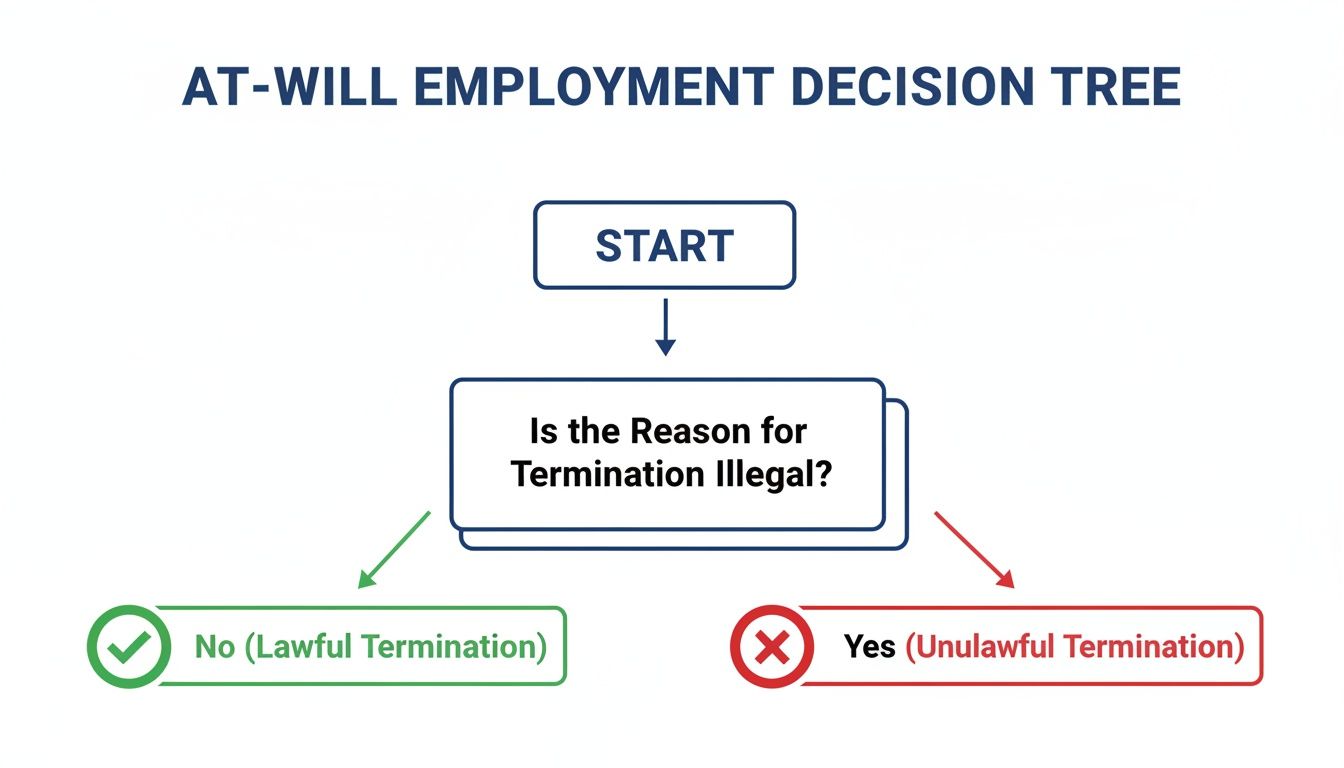
As the decision tree shows, the core question is always whether the real reason for your termination was illegal, as defined by these powerful statutory exceptions.
How At-Will Employment Works in Mississippi
When you hear lawyers talk about the "employment at will doctrine," it's crucial to know how that plays out on the ground here in Mississippi. Our state courts have a long history of strongly backing this principle, which gives employers a tremendous amount of leeway to let an employee go for almost any reason—or even for no reason at all.
This firm stance makes Mississippi what we call a traditional at-will state. But that doesn't mean your employer holds all the cards. Mississippi law has carved out a couple of very specific, but very important, exceptions to protect workers from being put in an impossible position.
The Limited State-Level Protections
For Mississippi employees, the only real shield the state provides against wrongful termination is one designed to keep you from being forced to break the law. The Mississippi Supreme Court has made it clear that an employer cannot legally fire you for two things:
- Refusing to commit an illegal act for your employer.
- Reporting an illegal act that your employer has committed.
In legal circles, these are known as the McArn exceptions, named after the landmark case that created them. A classic example would be if your supervisor told you to illegally dump hazardous waste, and then fired you on the spot when you refused. That firing would almost certainly be a violation of this public policy exception.
It's important to realize just how narrow these protections are, though. They are strictly limited to these situations.
Important Note: Unlike many other states, Mississippi does not have a human rights commission or a similar state agency to handle employment discrimination complaints. This is a critical distinction because it means that for most claims of discrimination or harassment, your fight will be waged using federal law, not state law.
The Power of Federal Law for Mississippi Workers
While Mississippi’s own exceptions are few and far between, the strongest protections for employees actually come from federal laws. These powerful federal statutes act as a trump card, overriding the at-will doctrine and forming the basis for the vast majority of wrongful termination cases filed in the state.
At its core, federal law makes it illegal for an employer to fire you because of who you are or for standing up for your rights. This federal shield is your best defense against being fired for the wrong reasons.
Federal protections make it illegal to terminate an employee based on their:
- Race or skin color
- Religion
- Sex (this includes pregnancy, sexual orientation, and gender identity)
- National origin
- Age (specifically, if you are 40 or older)
- Disability
On top of that, federal laws strictly prohibit retaliation. An employer can’t fire you as payback for reporting discrimination, asking for a reasonable accommodation for a disability, or taking legally protected time off under the FMLA.
For most workers in Mississippi, understanding these federal rights is the key to knowing when a firing crosses the line from just being unfair to being illegal. If you think you were terminated wrongfully, your next step should be to speak with an employment lawyer who is an expert in these federal claims. Many work on a contingency fee basis, which can range from 40-50%, meaning you only pay them if they successfully win your case.
Real Examples of Illegal Termination in Mississippi
Legal definitions can feel abstract. To really grasp the limits of employment-at-will, it helps to see how it works in the real world. Even in a state like Mississippi, which strongly favors at-will employment, an employer’s power to fire an employee isn't absolute.
These stories show what it looks like when a firing crosses the line from unfair to illegal.

Let's walk through a few scenarios that help connect the legal exceptions to situations you might actually encounter.
Retaliation After Reporting Harassment
Take Sarah, who has been a solid employee for three years. A supervisor starts making unwelcome advances, and after it continues, she does the right thing: she follows the company handbook and reports the sexual harassment to HR. Two weeks later, she's let go. The reason? "Department restructuring."
But here’s the catch: no one else was laid off, and she later finds out a new person was hired to fill her exact role. The timing is a huge red flag. In legal terms, the "restructuring" excuse looks like a pretext—a fake reason invented to cover up the real, illegal one.
The real reason is retaliation. Federal law, specifically Title VII of the Civil Rights Act, prohibits an employer from punishing an employee for reporting discrimination or harassment. Because the firing happened right after her complaint, there's a strong argument it was illegal retaliation, not a legitimate business decision.
Firing After a Medical Leave Request
Here’s another classic example. Michael is a long-time employee whose wife is diagnosed with a serious illness. He requests intermittent leave under the Family and Medical Leave Act (FMLA) to drive her to medical treatments. His manager seems irritated by the paperwork.
About a month later, Michael is fired for being late twice. This is strange, especially since other employees are often late without any serious consequences. The company's defense is that they are simply enforcing their attendance policy.
This has all the markings of FMLA retaliation. It's illegal to fire someone for using their right to protected medical leave. The fact that the company suddenly decided to selectively enforce a minor policy against him just after his FMLA request points directly to an unlawful motive.
Whistleblower Retaliation for Safety Concerns
Let's look at one more case. David, a factory worker, sees that a crucial safety guard has been removed from a piece of heavy machinery. He reports it to his supervisor, who brushes him off, telling him to "just be careful." When nothing changes, David files a formal complaint with the Occupational Safety and Health Administration (OSHA).
A week later, he's fired for a small infraction that management had always overlooked in the past. This is a textbook case of whistleblower retaliation. It is illegal for a company to fire an employee for reporting a valid workplace safety hazard to a government agency like OSHA.
If you're trying to figure out where the legal line is drawn, our guide on what qualifies as wrongful termination offers a much deeper dive.
While Mississippi law is heavily tilted toward the employer, these federal protections are powerful and create crucial exceptions. It’s a national trend—43 states recognize public policy exceptions, and 42 allow for implied contract exceptions. In fiscal year 2023 alone, the EEOC received 72,675 charges under laws like Title VII, showing just how often these rights come into play.
First Steps After a Suspected Wrongful Termination
Getting fired is a gut punch. Your head is spinning, you’re probably angry, and the future feels uncertain. But if you have a nagging feeling that your termination wasn't just unfair but was actually illegal, it’s time to push through the initial shock and take a few critical steps. Even in an at-will state, you have rights, and what you do right now can make all the difference.

It’s easy to feel overwhelmed, but the best thing you can do is focus. The goal is to start gathering the pieces of the puzzle that will form the basis of a potential wrongful termination case.
Preserve Every Piece of Evidence
Your memory is a starting point, but solid proof is what wins cases. The absolute first thing you must do is collect and save every scrap of information related to your job and your firing. You have to assume you’ll be locked out of your company email and accounts immediately—don't count on being able to get back in later.
Start by writing down a detailed timeline of what happened. Go all the way back to when you were hired and jot down key moments, promotions, positive feedback, and especially any incident that felt off, discriminatory, or like retaliation. Be specific: include dates, times, who was there, and where it happened.
Next, round up every document you can get your hands on. This means:
- Performance Reviews: Grab every single one, especially those that show you were a competent and valued employee.
- Emails and Messages: Save any emails, texts, or chat messages that back up your story. This could be anything from a manager’s praise to a conversation about a complaint you filed.
- Pay Stubs and Offer Letters: These documents officially prove your employment history and pay rate.
Keep all of these materials organized and in a safe place where you can easily access them. This collection of evidence is how you’ll build a clear story and push back against a company’s claim that you were let go for performance reasons.
Resist Pressure and Understand Deadlines
In the chaos after being let go, your former employer might slide a severance agreement across the table. Whatever you do, don’t sign it on the spot. These agreements almost always contain a clause where you sign away your right to take any legal action in exchange for a severance payment.
Crucial Warning: Signing a severance agreement without having a lawyer review it can permanently kill your ability to file a wrongful termination claim, no matter how strong your case is. You have the right to take it home and think about it.
Finally, you need to be aware of the clock. There are strict deadlines for filing a claim with the federal Equal Employment Opportunity Commission (EEOC). In most situations, you have only 180 days from the date of the discriminatory act to file your charge. Because Mississippi doesn’t have its own state-level agency for these issues, the EEOC is your main path forward.
Filing with the EEOC is a mandatory first step before you can ever file a lawsuit in federal court. An experienced employment lawyer can walk you through this entire process, ensure you meet every critical deadline, and will often work on a contingency fee basis, which typically ranges from 40-50% of whatever compensation is recovered.
When to Contact a Mississippi Employment Lawyer
Trying to figure out a wrongful termination claim by yourself can be incredibly stressful and confusing. You're trying to follow the right steps, but it’s easy to feel like you're in over your head. This is where knowing when to bring in a professional makes all the difference. The laws around the what is employment at will doctrine have so many exceptions and nuances that an experienced lawyer often becomes your most critical asset.
Take federal claims, for instance. For many discrimination cases, you're required to start by filing a charge with the Equal Employment Opportunity Commission (EEOC). But a good employment lawyer does so much more than just fill out forms. Their real job is to build your case from the ground up, fight to get the evidence your employer holds, and act as your voice in negotiations.
When Legal Help Is Essential
So, when is it time to make that call? Some situations are such clear red flags that you shouldn't hesitate. If your firing feels suspiciously close to any of the events below, it’s a strong signal that you should get a legal consultation right away.
You should definitely contact a lawyer if you were terminated:
- Shortly after you reported illegal activity or refused to do something you believed was illegal.
- After you made a formal complaint about sexual harassment or any form of discrimination.
- Immediately after requesting FMLA leave or an accommodation for a disability.
- For a flimsy reason that doesn't add up, or for breaking a rule that other employees break without getting fired.
An employer will almost never admit they fired you for an illegal reason. It’s the lawyer's job to prove it anyway. We look for the patterns—the suspicious timing, the inconsistent excuses, the sudden write-ups—and piece them together to expose the true motive behind your termination.
Understanding the Financial Commitment
One of the first questions people ask is, "How can I possibly afford a lawyer when I've just lost my job?" It's a completely valid concern, but the way most employment lawyers work should put your mind at ease.
The vast majority of employment lawyers in Mississippi take cases on a contingency fee basis. This structure is simple: you pay nothing upfront. The lawyer’s fee is a percentage of the money they win for you through a settlement or a court verdict. If you don't get paid, they don't get paid. This average contingency fee for these cases typically ranges from 40-50% of the total recovery.
This arrangement gives you access to justice without needing a pile of cash. Since Mississippi has no state-level agency for these claims, you're often left navigating the federal system. Having an attorney who knows that process inside and out isn't just helpful—it's essential for protecting your rights. If you have even a gut feeling that your firing was illegal, don't wait.
Frequently Asked Questions About Employment at Will
Even after you grasp the basics of the employment at will doctrine, a lot of practical questions tend to pop up. It’s one thing to know the rule, but it's another to see how it plays out in the real world, especially here in Mississippi. Let's walk through some of the most common questions I hear from workers trying to make sense of their rights.
Can I Be Fired for No Reason in Mississippi?
Technically, yes. The core idea of at-will employment is that an employer can fire you for a good reason, a bad reason, or no reason at all. They don't even have to tell you why.
But here’s the crucial catch: the real reason can’t be an illegal one. For instance, they can't fire you because of your race, gender, or religion, and they certainly can't fire you as payback for reporting harassment. While an employer might not give a reason for the termination, if the true motive breaks the law, the firing is unlawful.
What Should I Do if My Boss Creates a Hostile Work Environment?
First thing's first: document everything. Start a detailed, private log of every incident. Note the dates, times, what happened, who said what, and anyone who might have witnessed it. Then, report the behavior to your Human Resources department in writing, making sure to follow the company’s official complaint policy to the letter.
If the company fails to act and the toxic behavior continues, you need to know what to do next. Mississippi does not have a state agency to handle these claims, so your next step is to speak with an employment lawyer about filing a claim with the federal Equal Employment Opportunity Commission (EEOC).
How Much Does It Cost to Hire a Wrongful Termination Lawyer?
This is a huge concern for most people, but the answer is often reassuring. The vast majority of Mississippi employment lawyers work on a contingency fee basis. In simple terms, this means you don't pay any attorney's fees out of your own pocket for them to take your case.
Instead, the lawyer's fee is a percentage of the final settlement or court award they win for you. This fee usually falls between 40% and 50%. You only pay if—and when—your lawyer secures a financial recovery for you.
If you believe you were terminated illegally or are facing discrimination at work, you don't have to fight this battle alone. The team at Nick Norris, P.A. is here to help you understand your rights and pursue the justice you deserve. For a dedicated evaluation of your case, get in touch with our office by visiting us online at https://www.nicknorris.law.
This article has been reviewed for legal accuracy by Nick Norris. For employment law matters in Mississippi, consult with an attorney licensed to practice in your state.
Leave a Reply