

You're sitting at work trying to do your job, and your boss has already decided your disability is the problem. Maybe they cut your hours after you asked for an accommodation. Maybe they started acting cold after you disclosed a diagnosis. Maybe you've been told, directly or bluntly, that you “just aren't a fit” anymore. That's not just bad management. In Mississippi, it can be disability discrimination in employment, and you need to treat it like a legal problem now, not after it gets worse.
Mississippi is different from a lot of places people read about online. We do not have a state human rights commission, so workers usually have to rely on the federal system, especially the EEOC, instead of a state agency with a local complaint track. That changes how you document things, how fast you move, and where you put your energy.
If you need a practical starting point, this guide is built for everyday application, not a law-school outline. For a useful resume example that shows how workers and HR teams think about documenting work history, see this effective HR assistant resume.
What Disability Discrimination at Work Looks Like in Mississippi
A disability case at work usually does not begin with a firing. It starts with a decision that looks small on paper, then changes your work life in a real way. A supervisor ignores your medical restriction, a recruiter stops calling after learning you use a cane, or human resources treats your request like an inconvenience instead of a lawful accommodation request.
Mississippi workers need to see that clearly, because the federal path is the main road here. There is no state human rights commission waiting to take the problem off your hands. Your first job is to identify the conduct, save the proof, and move before deadlines start closing.
Read the conduct, not the employer's excuse
Employers rarely admit they are discriminating. They say the schedule changed, the role was restructured, or your performance was “not meeting expectations.” Those explanations can be real. They also get used to cover discrimination when the timing lines up with your disability disclosure, medical leave, or accommodation request.
Practical rule: if the employer's story changed after you disclosed your condition, start collecting records immediately.
That matters in Mississippi because the federal system runs on evidence. The core question is whether the employer made a job decision because of a disability, a medical history, or a perceived limitation. Your manager's attitude matters less than the paper trail, the timing, and the consistency of the employer's explanation.
For workers in HR-facing roles, it helps to understand how employers present themselves on paper, too. A polished effective HR assistant resume often shows the formal side of workplace decision-making, but your case turns on what happened to you, not how clean the paperwork looks.
Know the system that applies to you
What protects you in Mississippi is the Americans with Disabilities Act, enforced through federal channels. There is no Mississippi human rights commission process you can use first. If your rights were violated, you have to protect your timeline, your documents, and your witness names from the start.
That is why this area of law is so unforgiving. A worker who waits too long or relies on verbal promises gives the employer room to rewrite the story later.
How the ADA Defines Disability Discrimination
The ADA is the core federal rulebook for disability discrimination employment. It reaches private employers with 15 or more employees, state and local governments, employment agencies, and labor unions. In plain English, if a covered employer makes job decisions based on disability, it can't hide behind labels, assumptions, or convenience.
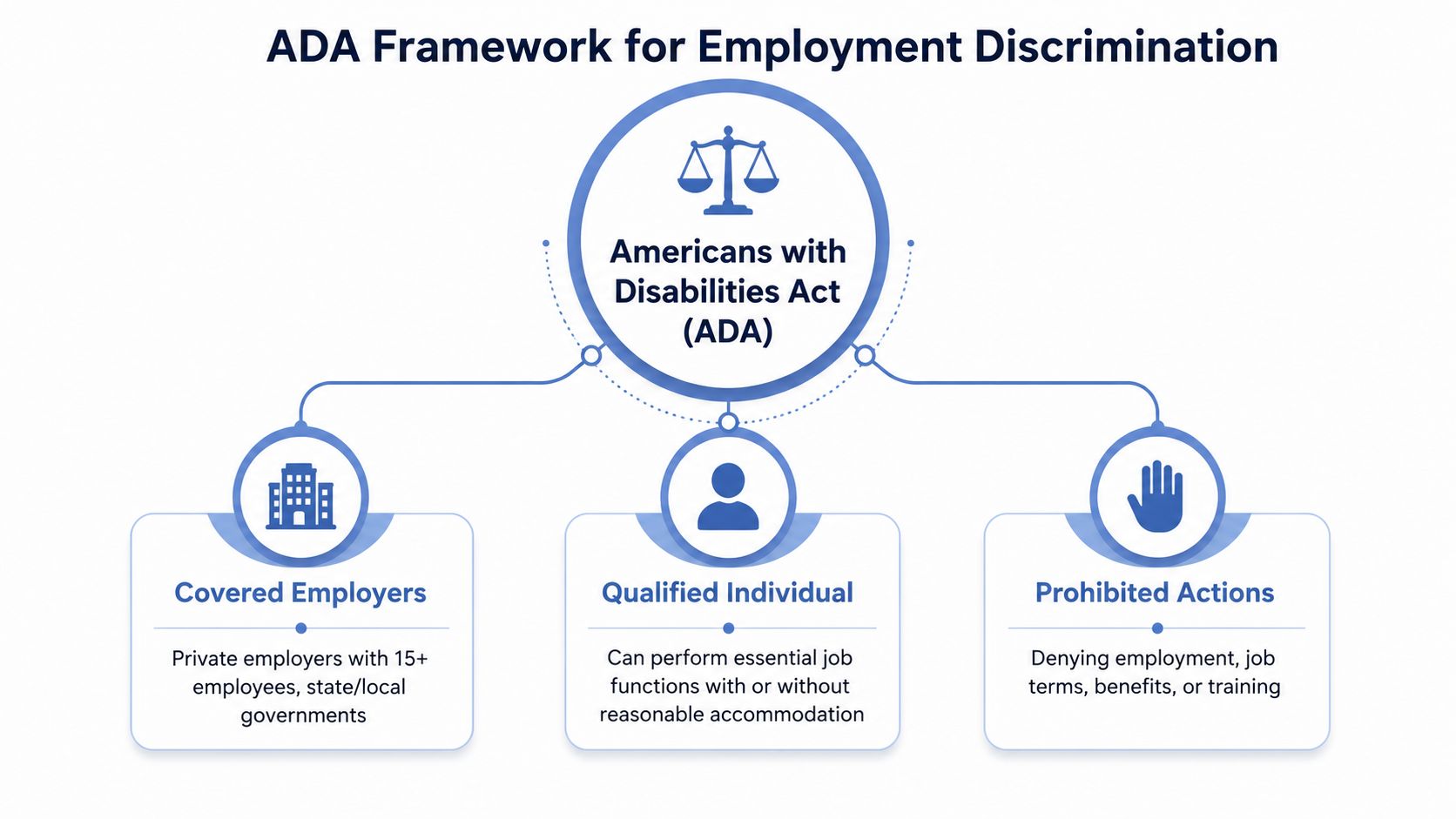
The law turns on a few practical questions. Do you have an actual disability, a record of one, or are you being treated as if you have one? Are you qualified for the job? And did the employer make a decision about hiring, firing, pay, assignments, promotions, layoffs, training, fringe benefits, or other working conditions because of that disability?
Qualified individual is the pivot point
The ADA protects a qualified individual, which means a person who can do the job's essential functions with or without reasonable accommodation. That phrase matters more than most workers realize. If the function is essential, the employer can defend it. If the function is just routine, convenient, or easily shifted, the employer has less room to say no.
So ask yourself the right question. Could you do the actual job, not the fantasy version of it, if the employer made a lawful adjustment? If the answer is yes, the ADA may protect you.
Disability is broader than many managers admit
Disability under the ADA is not limited to obvious physical conditions. It can involve a present impairment, a history of impairment, or being regarded as disabled. That means a worker can have a case even when the employer acts on fear or stereotype instead of a formal medical diagnosis.
The legal mistake many employers make is assuming a disability case only exists when the employee is visibly limited. That's not how the ADA works.
If your problem was a denial of a promotion, a refusal to interview, or a sudden change in duties after disclosure, the legal hook may be one of those covered decisions. The facts matter more than the title the employer puts on its action.
Common Examples Mississippi Workers Actually See
The most common disability cases are not mysterious. They're ordinary workplace decisions that became unfair once the employer learned something about your health. A hiring manager sees a wheelchair and decides the job is “too physical.” A supervisor hears about epilepsy, diabetes, depression, PTSD, or a back injury and starts treating the worker like a liability. None of that needs to be overt to be illegal.
The pattern is often gradual
A worker may be fine for months, then suddenly gets written up, moved off a schedule, or excluded from training after asking for help. That can look like housekeeping on the employer's side. It can also be the moment discrimination begins.
The same thing happens after leave. A person returns from treatment and finds their duties stripped away, their territory reassigned, or their job “reorganized” in a way that conveniently pushes them out. If the employer uses restructuring as cover, the core question is whether the stated reason is credible or just convenient.
Watch for these recurring fact patterns
- Refusal to hire after disclosure: A candidate tells the truth about a disability, then never gets called back.
- Withdrawal of an offer: The employer says the condition is a risk and pulls the job before the start date.
- Denied accommodation: The worker asks for a change that would let them do the job, and the employer refuses without real discussion.
- Punishment after leave: Duties, shifts, or reporting lines change right after medical treatment or disability-related leave.
- Harassment tied to disability: Coworkers mock medication, mobility aids, or invisible symptoms, and management does nothing.
- Pressure for medical details: The employer pushes far beyond what it needs to know to handle the job.
Each one points to a different legal issue, but they all share the same core problem, the employer is making employment decisions around disability instead of around actual job performance.
If the company says it was just performance, look closely. If the criticism started only after disclosure, or if other workers are not treated the same way, that is not a coincidence you should ignore.
Reasonable Accommodation and the Interactive Process
Reasonable accommodation is where many Mississippi workers win or lose their case. The employer does not get to sit back and guess. It has to talk with you, identify the barrier, and look for an effective adjustment. That process is called the interactive process, and a bad-faith version of it can become the problem itself.

A good accommodation removes a barrier. It does not erase the job. That's the distinction employers like to blur. A schedule change, a modified workstation, assistive equipment, leave for treatment, reassignment of marginal duties, telework where the job allows it, or a move into a vacant position can all be reasonable depending on the facts.
Put the request in writing
Do not rely on a hallway conversation. Send an email or a written memo that says you need an accommodation for a medical condition, explains the work limitation, and identifies the adjustment you're asking for. Keep it short, direct, and professional.
That written request does two things. It starts the paper trail, and it forces the employer to respond instead of pretending it never heard you.
Know what the employer can ask
The employer can ask for enough information to understand the disability-related limitation and the accommodation issue. It cannot use that as a fishing expedition to pry into your entire medical life. Your task is to give the employer what it needs to assess the request, not every detail in your medical history.
If the employer claims undue hardship, make it show its work. That defense is supposed to be about real difficulty, not annoyance or habit. Most employers lose their credibility when they say “too hard” without looking at alternatives.
For a Mississippi worker, the smart move is to keep the conversation narrow. Ask for what helps you do the essential functions, confirm everything in writing, and stay on the record. If your employer refuses to engage at all, that refusal may matter as much as the accommodation itself.
Use this internal resource if you want a deeper breakdown of the process, ADA interactive process.
How to Document Disability Discrimination the Right Way
Your memory is not enough. By the time an EEOC charge gets read, the employer will have its version of the story, and that version will be cleaner than the actual one. Your job is to build a record that shows what happened, when it happened, and who was there.
For a private check on emotional impact and treatment history, some workers also look for outside support. If mental health symptoms are part of the issue, a resource like find a therapist in Phoenix for evaluation may help you think through care and documentation, but it is not a substitute for preserving workplace evidence.
Keep the proof in one place
Save emails, text messages, voicemails, schedules, performance reviews, disciplinary notices, accommodation requests, employer responses, and names of witnesses. Keep a running journal with dates, locations, the people involved, and the exact words you remember. If the supervisor said, “We can't have someone like you on this team,” write that down right away.
Best habit: write the incident down the same day if you can. Your future self will not remember the exact wording unless you capture it now.
Use a simple folder structure on your own device or cloud storage. Separate the timeline, the correspondence, the medical records, and the witness list. That makes it easier to hand materials to counsel without losing key details.
Don't create new problems while collecting evidence
Do not access systems you aren't allowed to use. Do not record conversations unless you know the legal risk and have gotten advice. Do not post angry social media comments that can be taken out of context later.
Medical records should stay private and tightly controlled. Share them with your doctor, your lawyer, and the employer only when needed for the accommodation process. The more disciplined you are now, the harder it is for the employer to twist your evidence later.
Filing an EEOC Charge in Mississippi
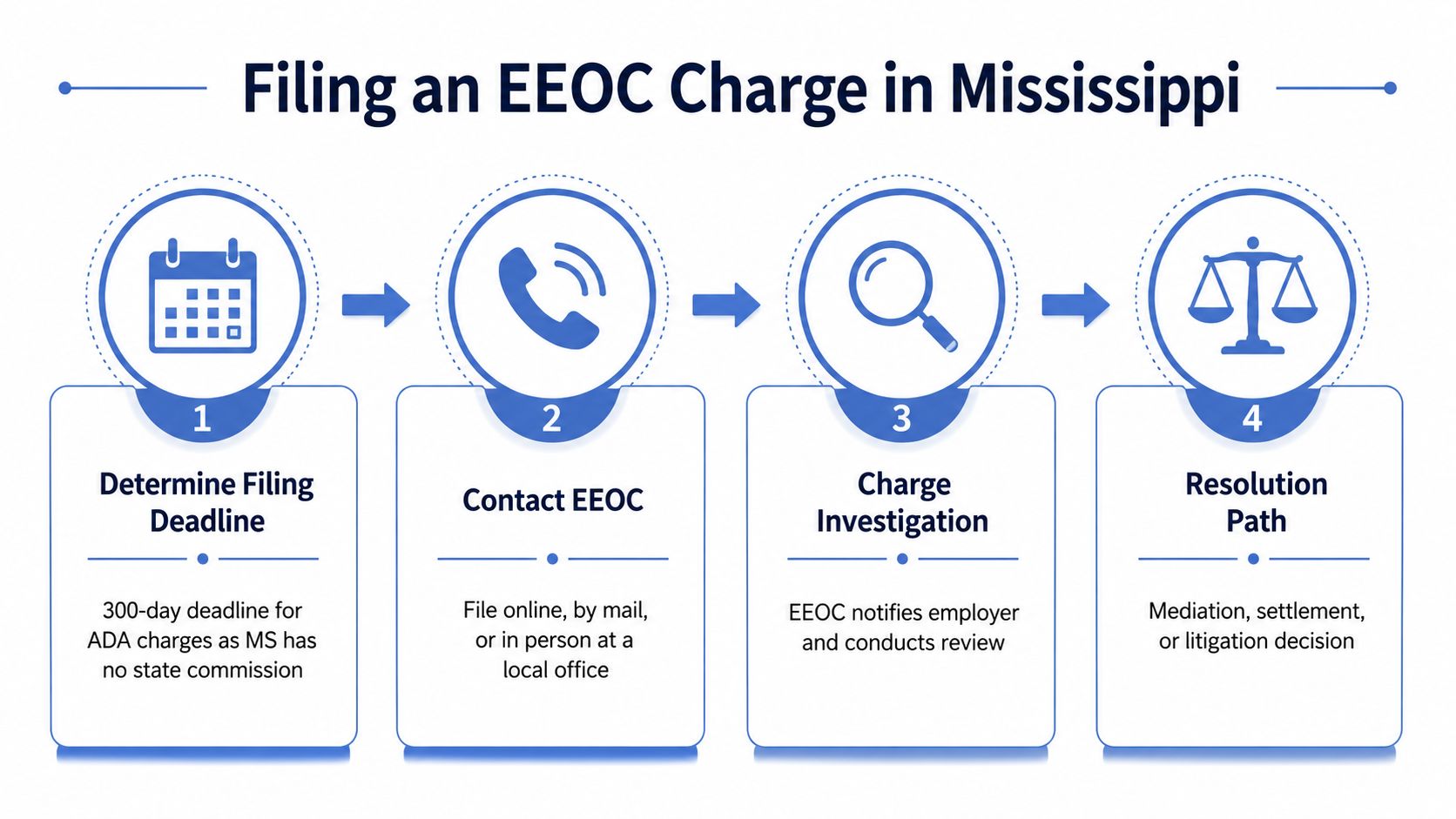
Because Mississippi does not have a state human rights commission, the EEOC is the main administrative path for a disability discrimination claim. If you miss the filing window, you can lose standing fast. The deadline is often the first trap workers fall into, especially when they're trying to keep the job instead of starting a legal fight.
Start the charge, not a rant
You can initiate the process online, by mail, or by contacting the office that serves Mississippi. The intake stage usually asks for the basics, who you are, who the employer is, what happened, and when it happened. Keep your explanation tight and factual.
The charge itself should track the key dates. That's the point. You are building a record the EEOC can use.
Know what happens after filing
Once the charge is filed, the employer gets notice, and the EEOC may investigate, ask for information, and try to resolve the matter through conciliation or mediation. If the agency issues a right-to-sue letter, that is the document that opens the door to the next stage in federal court. If you are also dealing with another type of federal employment claim, there may be dual-filing consequences, so don't guess your way through it.
The worker mistake I see too often is posting about the case online while the investigation is open. Don't do that. Anything public can be screenshot, misread, and used against you.
For a deeper look at what the investigation stage feels like in practice, review this EEOC investigation process.
The clock matters more than people think
If you are still employed and hoping the company will fix it, you can't let that hope erase the deadline. The administrative window is not forgiving, and waiting for a manager to “make it right” often costs workers the cleanest path they had.
Remedies, Fees, and What a Case Is Worth
A disability discrimination case is not a windfall. It is a claim for compensation when an employer violates the law and the worker loses wages, benefits, or dignity because of it. In a strong case, the remedies can include back pay, front pay, compensatory damages, punitive damages in limited circumstances, and reasonable attorneys' fees and costs.
Typical remedies in federal disability discrimination claims
| Remedy | What It Covers | Key Limits |
|---|---|---|
| Back pay | Lost wages and benefits caused by the unlawful action | Usually tied to what you can prove you lost |
| Front pay | Future lost earnings when reinstatement is not realistic | Courts use it cautiously |
| Compensatory damages | Emotional harm and related losses | Subject to federal limits |
| Punitive damages | Punishment for especially bad conduct | Available only in limited circumstances |
| Attorneys' fees and costs | Legal work and case expenses | Usually depends on the result and fee agreement |
The number people talk about at the start is often not the number that matters at the end. Federal damage caps, proof gaps, and weak records can cut a case down fast. If the paperwork is thin, the settlement usually follows that weakness.
Good documentation is what gives the claim weight. That means medical notes, accommodation requests, emails, write-ups, and anything else that shows what the employer knew and when it knew it.
Fee structure should be discussed upfront
In Mississippi employment cases, the average contingency fee is 40 to 50 percent. That fee usually covers attorney time, litigation risk, and case costs, especially when a worker cannot pay hourly rates out of pocket. Ask whether expenses come off the top or after the fee is calculated, because that changes what lands in your pocket.
Some cases use hourly or hybrid arrangements instead. Ask the firm exactly how it bills, what happens if the case resolves early, and who advances costs. If the dispute also touches leave or insurance issues, resources on managing long-term disability benefits for employees can help you understand the benefits side, but your employment case still needs its own legal plan.
If you want to get ready before you call, read this guide on preparing for your first conversation with an employment lawyer.
When to Call an Employment Attorney and What to Bring
Call a lawyer before the employer controls the narrative. If you've been retaliated against after disclosure, hit with sudden write-ups, denied an accommodation that seems plainly reasonable, or pushed out after medical leave, you're already in the zone where self-help stops being enough. That is especially true in Mississippi, where there is no state human rights commission to absorb the first blow.
Bring a clean packet, not a pile of chaos
Before your consultation, gather these items:
- Timeline of events: dates, names, and what happened in order.
- Accommodation papers: your request, any doctor notes, and the employer's response.
- Discipline records: warnings, PIPs, write-ups, and termination notices.
- Employment documents: offer letter, handbook, job description, and evaluations.
- Witness information: names, job titles, and how they know what happened.
If you have texts or emails, bring them. If you only have screenshots, bring those too. A lawyer can sort the relevance, but you need to preserve the raw material.
Mississippi workers also need to be clear on retaliation. There is no retaliation claim for filing workers' compensation claims under Mississippi law, so don't let anyone confuse that issue. Retaliation protection for disability-related activity comes from federal law, not a Mississippi commission process.
If you want to prepare the right way before you call, read this guide on how to prepare for your first talk with an employment lawyer.
Nick Norris, P.A. handles Mississippi employment matters, including disability discrimination, accommodation disputes, and EEOC charge guidance. Last updated: July 30, 2026. Reviewed by Nick Norris. If you need to talk through what happened, call 601-641-4897 and bring your timeline and documents. By Nick Norris, Attorney
If your employer has treated you differently because of a disability, don't wait for the next bad decision to make the case harder. Nick Norris, P.A. helps Mississippi workers sort out disability discrimination employment issues, document the record, and move through the EEOC process with a clear plan. Visit Nick Norris, P.A. and set up a consultation so you can protect your position before the employer does more damage.
Leave a Reply