

You report repeated sexual comments to your supervisor. Within days, your schedule shrinks, a manager writes you up for conduct that was previously ignored, and coworkers are told not to include you in meetings. You may wonder whether the employer can call each event a coincidence. In Mississippi, the answer depends on what you reported, who knew about it, what changed afterward, and which law applies.
Protected activity retaliation is separate from the original discrimination or harassment. Even if an investigation later fails to prove the underlying complaint, federal law may still protect you from punishment for raising it in good faith. Mississippi employees also face a distinctive enforcement path because Mississippi doesn't have a state human rights commission. For many discrimination and retaliation concerns, the Equal Employment Opportunity Commission, or EEOC, is the primary administrative route.
This guide explains what protected activity means, how retaliation can appear without termination, what evidence connects the complaint to the punishment, and which Mississippi-specific assumptions can lead employees astray. It also addresses an important limit directly: Mississippi doesn't provide a standalone retaliation claim for filing a workers' compensation claim.
Introduction to Protected Activity Retaliation in Mississippi
A worker in Jackson reports that a supervisor is treating women differently and making sexual remarks. The worker doesn't demand special treatment. She asks management to stop unlawful conduct and documents what happened. Soon afterward, her hours are reduced, her manager scrutinizes ordinary mistakes, and she receives a disciplinary warning for conduct that had never previously drawn criticism.
That sequence doesn't automatically prove retaliation. It does create questions that deserve careful attention. Did the employer know about the complaint? Did the manager who changed the schedule know? Was the discipline consistent with how the employer treated similar conduct before the complaint? Did the employer's explanation change over time?
Retaliation is a distinct legal injury because employees need protection when they report discrimination, participate in an investigation, or support someone else's complaint. If an employer could punish a worker solely because the original complaint was difficult to prove, many employees would stay silent. Federal law focuses on preventing that chilling effect.
The central question: Did the employer take action because the employee engaged in protected activity, rather than because of a legitimate, documented workplace reason?
Mississippi's system requires particular care. Because the state doesn't have an active human rights commission, employees generally rely on federal administrative remedies for discrimination and retaliation complaints, as discussed in this Mississippi employment discrimination resource. The EEOC process, the applicable federal statute, and the filing deadline can shape what options remain available.
This guide is for Mississippi workers who have reported harassment or discrimination, requested an accommodation, participated in an investigation, or supported a coworker. It's also useful for someone who hasn't been fired but has experienced a sudden schedule cut, demotion, transfer, write-up, or hostile treatment after speaking up.
What Counts as Protected Activity Under Federal Law
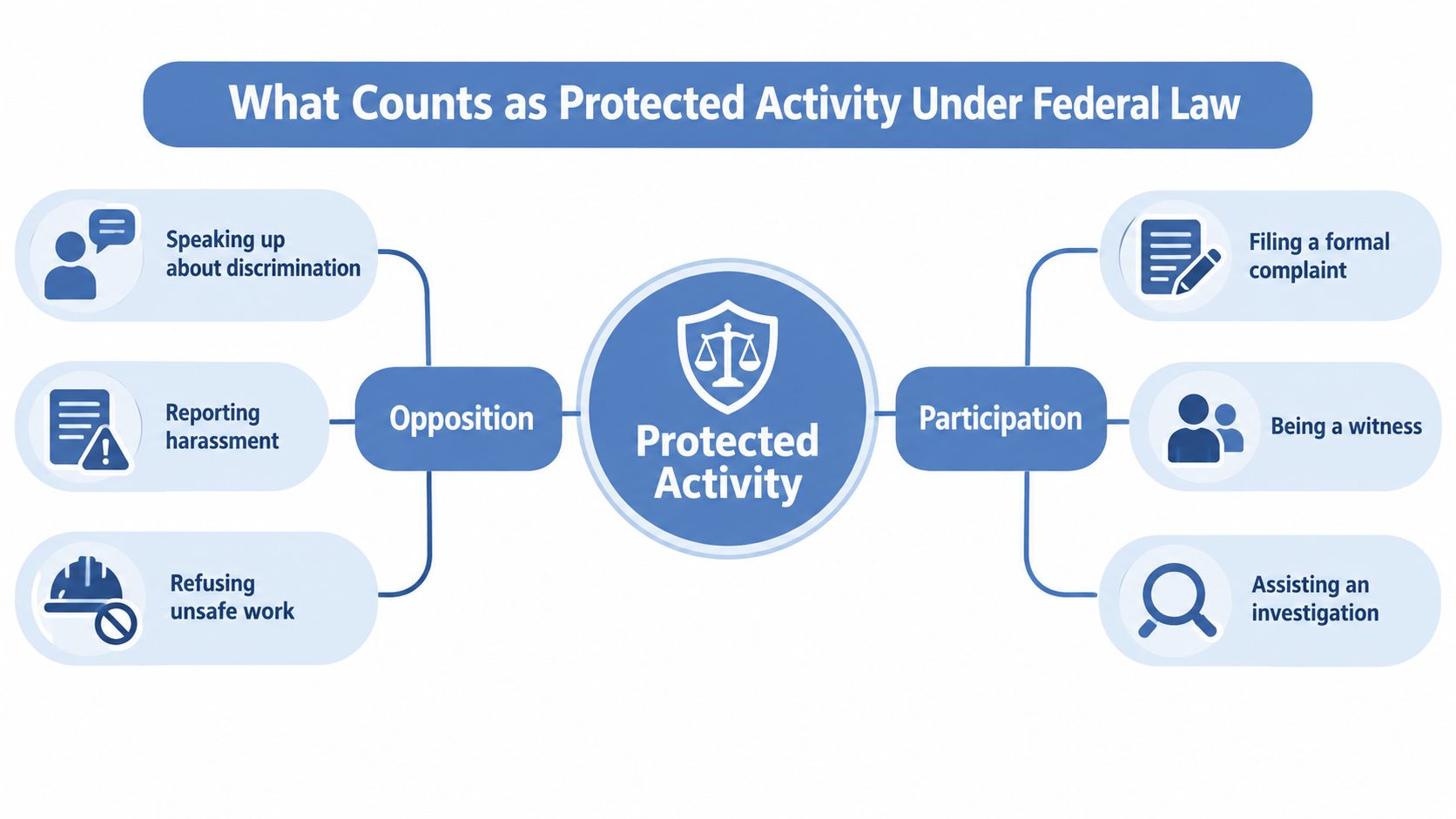
Protected activity generally falls into two legal buckets, opposition and participation. Think of opposition as raising a flag when you believe workplace conduct violates an employment law. Participation is joining an official inquiry after someone has raised that flag.
Opposition includes telling a supervisor, human resources representative, owner, or compliance officer that you believe discrimination or harassment is occurring. The complaint doesn't need formal legal language. Saying that a manager repeatedly directs racial slurs at Black employees, or that a supervisor is making sexual comments, can communicate a legal concern even if you never use the words “Title VII” or “hostile work environment.”
A complaint about general unfairness usually needs more detail. Disliking a schedule, objecting to favoritism, or describing a manager as difficult doesn't necessarily connect the concern to discrimination or another protected legal right. The substance matters more than the label.
Participation covers taking part in an investigation or proceeding. Examples can include:
- Filing a formal complaint: Submitting an EEOC charge can qualify as participation in a protected process.
- Serving as a witness: Giving an account about harassment or discrimination may protect the witness from retaliation.
- Assisting an investigation: Providing documents, answering questions, or supporting a coworker's complaint can fall within the participation category.
- Supporting a coworker: An employee who confirms what happened or refuses to change an accurate account may be protected.
- Requesting an accommodation: Asking for a disability, pregnancy, or religious accommodation can be protected activity under applicable federal law.
The complaint doesn't have to be proven later. The U.S. Department of Labor explains that retaliation can exist even when an employer acts on a mistaken belief that a worker engaged in protected activity, and causation can still be satisfied when the adverse action was based on that belief, as described in its official retaliation guidance. That principle matters when a supervisor believes an employee complained, even though the employee's actual report was different or never occurred in the way management assumed.
Mississippi employees should also distinguish protected activity under federal discrimination law from other workplace rights. A useful comparison appears in this article about protected concerted activity, because different statutes protect different forms of employee conduct.
How Retaliation Can Look Beyond Getting Fired
Termination is the clearest form of retaliation, but it isn't the only one. An employer may punish a worker through a collection of smaller decisions that make the job harder, reduce income, damage advancement prospects, or discourage a reasonable employee from speaking up.
A Mississippi employee reports racial harassment to HR. The company doesn't fire him. Instead, it removes him from preferred shifts, transfers him to an inconvenient location, excludes him from meetings, and gives him a negative evaluation for supposedly lacking teamwork. Each decision may have an innocent explanation. Together, the pattern may tell a different story.
Common examples include:
- Demotion: A worker loses title, authority, responsibilities, or advancement opportunities after making a complaint.
- Reduced hours: A schedule is cut, desirable shifts disappear, or overtime opportunities stop.
- Undesirable reassignment: The employee moves to a less favorable location, role, route, or work assignment.
- Increased scrutiny: A manager begins documenting minor issues or enforcing rules that were previously ignored.
- Social exclusion: Supervisors isolate the worker, remove access to meetings, or instruct coworkers to avoid contact.
- Discipline: A warning, suspension, or performance plan follows closely after protected activity.
- Hostile treatment: Managers use threats, insults, intimidation, or unusually aggressive supervision.
The legal question isn't whether every unpleasant workplace event is unlawful. Courts and agencies examine whether the employer's action might deter a reasonable employee from making or supporting a discrimination complaint. A small inconvenience can matter more when it affects pay, advancement, job security, or the employee's ability to work effectively.

The employer doesn't need to admit retaliatory intent. A manager may say, “We had to address performance,” while the surrounding facts show that the same performance issues existed for months without discipline. Compare the timing, treatment of coworkers, changes in explanation, and whether the decisionmaker knew about the complaint. This guide to signs of retaliation at work provides a practical way to organize those warning signs.
Legal Tests for Proving Retaliation and Why Timing Matters
A federal retaliation claim usually turns on three connected questions:
- Protected activity: Did the employee oppose discrimination, participate in an investigation, support a complaint, request an accommodation, or engage in another activity protected by the applicable federal law?
- Adverse action: Did the employer take action that could discourage a reasonable worker from speaking up?
- Causation: Is there evidence that the employer acted because of the protected activity?
The third question often carries the most practical difficulty. Timing can help connect the dots, especially when discipline or a termination follows soon after a complaint. Timing alone may not resolve the claim, but it becomes more meaningful when combined with prior positive evaluations, inconsistent explanations, unusual scrutiny, statements by supervisors, or different treatment of comparable employees.
The employer may respond with a legitimate, non-retaliatory reason, such as documented performance problems, attendance concerns, misconduct, or a restructuring decision. The employee then has to show that the stated reason may be pretext, meaning it was not the primary reason or was applied inconsistently.
| Evidence Factor | Strong Causation Signal | Weak Causation Signal |
|---|---|---|
| Timing | Discipline follows closely after the complaint | The action occurs much later with no related events |
| Prior record | Positive reviews change only after protected activity | Similar concerns were documented before the complaint |
| Employer explanation | Management gives shifting or conflicting reasons | The employer gives one consistent, supported reason |
| Decisionmaker knowledge | The manager knew about the complaint before acting | No evidence connects the decisionmaker to the complaint |
| Comparator treatment | Others avoided discipline for similar conduct | Comparable employees received similar discipline |
| Workplace statements | A supervisor references the complaint or expresses anger about it | No retaliatory comments or unusual reaction appear |
Keep the evidence in sequence. An investigator may understand the case differently after seeing the complaint, the manager's response, the schedule change, the write-up, and the employer's explanation arranged on one timeline.
A prima facie case explanation can help you understand how the initial elements fit together, but the facts still control. Your notes should preserve exact dates, names, language, and documents rather than relying on a general memory that “everything changed after I complained.”
Mississippi Specific Limits Every Employee Should Understand
Mississippi employees often assume that filing a workers' compensation claim automatically creates a state retaliation claim. It doesn't. Mississippi doesn't provide a standalone retaliation claim for filing a workers' compensation claim, and Mississippi Supreme Court authority has been described as rejecting a common-law action for discharge based solely on filing that claim. Mississippi sources also state that no specific state anti-retaliation statute covers that act, as explained in this Mississippi workers' compensation retaliation article.
That rule doesn't mean every action connected to an injured worker is lawful under every possible federal statute. It means you shouldn't assume that the filing itself supplies a Mississippi retaliation claim. Other facts may matter, but they need separate legal analysis.
Mississippi also doesn't have an active state human rights commission. Employees generally use federal administrative remedies, with the EEOC serving as the main administrative route for discrimination and retaliation complaints. An employee who waits for a Mississippi state agency that doesn't exist may lose valuable time.

Federal law may protect opposition to discrimination, participation in an investigation, and support for a coworker's complaint. It doesn't convert every workplace dispute into protected activity. A complaint about a rude supervisor, an unpopular schedule, or ordinary favoritism may require a connection to discrimination, harassment, accommodation rights, wages, leave, or another protected legal category.
Mississippi retaliation discussions commonly identify reporting harassment or discrimination, participating in an internal or EEOC investigation, and supporting a coworker's complaint as protected activity, while recognizing the EEOC's central administrative role. The distinction is explained further in this resource on hostile work environment retaliation.
Documentation and Timing Strategies That Strengthen Your Claim
Start a private, dated record while events are fresh. Write what happened, who was present, what each person said, and how the employer responded. Avoid conclusions such as “my boss is retaliating” without recording the underlying facts that let someone else evaluate the conclusion.
Save documents you're authorized to possess. Keep copies of emails, text messages, schedules, performance reviews, disciplinary notices, and written complaints. Don't access files or systems you're not authorized to use, and don't remove confidential or privileged material without legal advice.
A short follow-up email can clarify a verbal conversation. For example, after reporting harassment to a supervisor, you might write a factual summary of what you reported and ask the supervisor to correct any misunderstanding. Keep the message professional, accurate, and limited to the issue.
Build a timeline that another person can follow
Use one entry for each important event. Include the date, the people involved, the action taken, and the document that supports it. Mark the date of the complaint separately from the date of each later schedule change, write-up, transfer, exclusion, or threat.
Track what the employer says at the time of discipline. Later explanations can become important if they differ from the original reason. Record whether the employer followed its usual procedure and whether comparable employees received similar treatment.
Protect the record without escalating the conflict
Continue performing your work carefully. Follow written policies, respond to legitimate instructions, and avoid arguments that allow the employer to characterize your conduct as insubordination. If management asks you to sign a document, you can ask for time to review it before signing anything that might affect your rights.
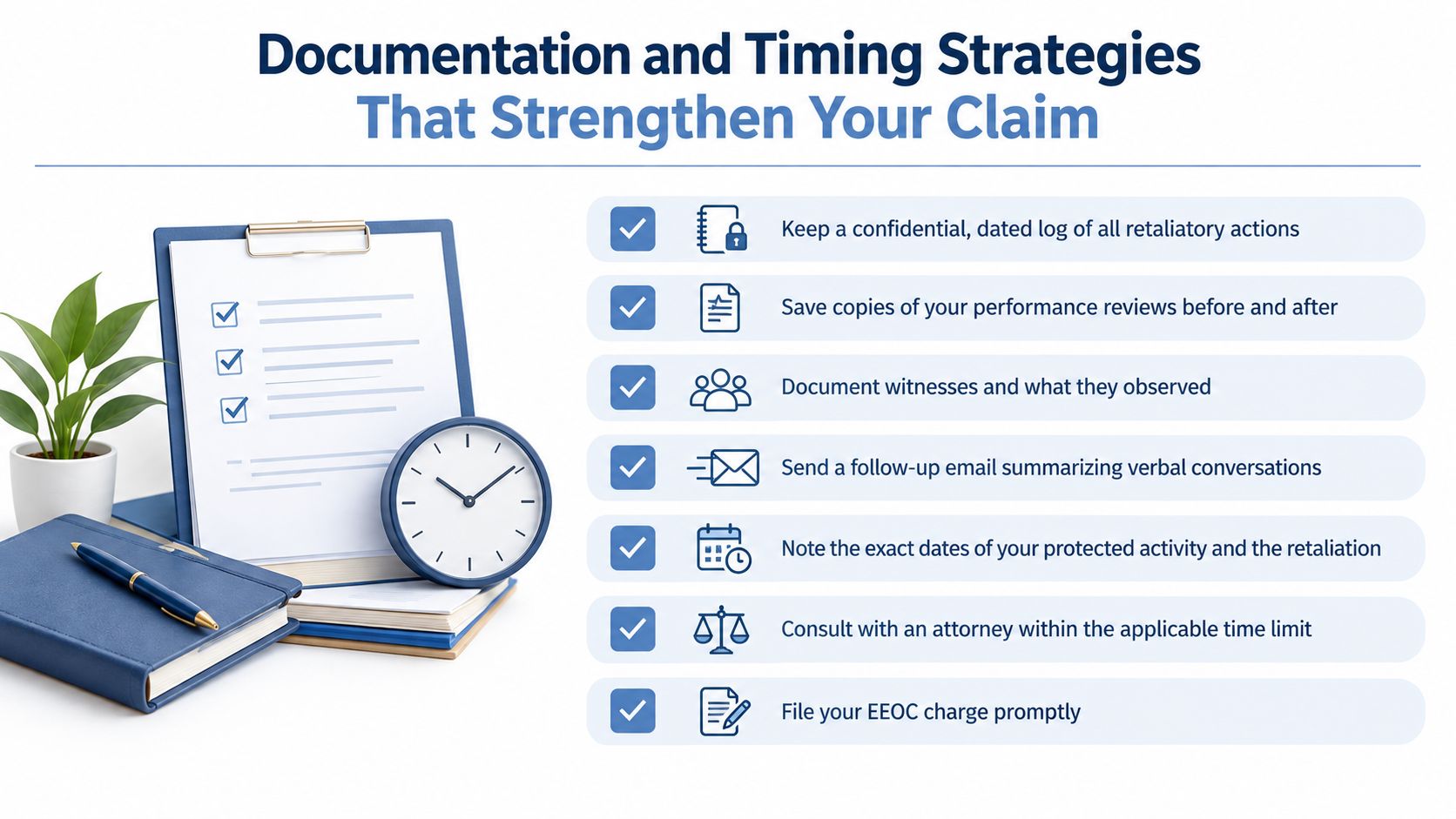
The most useful record is consistent and contemporaneous. A dated note made shortly after an incident usually gives a clearer account than trying to reconstruct months of events from memory. Preserve the timeline before resigning, signing a release, or making a new complaint that could alter the employer's response.
Remedies Costs and Next Steps for Mississippi Employees
When federal retaliation is established, possible remedies can include back pay, reinstatement, compensatory damages, and injunctive relief. The available relief depends on the statute, the evidence, the employer, and the harm shown. No remedy is automatic, and a consultation should identify which federal law fits the facts.
Cost concerns shouldn't prevent you from learning whether a claim is viable. Mississippi employment lawyers commonly work on contingency, and the reported average contingency fee in Mississippi is about 40% to 50% of the recovery, according to this Mississippi employment-law contingency fee discussion. A broader range of roughly 33% to 50% may apply, with higher percentages sometimes used when a matter becomes more complex or proceeds later in litigation. The written fee agreement should explain the percentage, expenses, and when the fee is calculated.
Before contacting the EEOC, take practical steps:
- Preserve evidence: Save complaints, messages, schedules, evaluations, write-ups, and your dated timeline.
- Review policies: Find the employer's harassment, discrimination, accommodation, complaint, and reporting procedures.
- Protect deadlines: The EEOC has filing requirements, and the deadline depends on the claim and circumstances.
- Avoid impulsive decisions: Don't resign, sign a release, or accept a separation agreement before understanding the consequences.
- Seek a confidential evaluation: A Mississippi employment attorney can assess whether your complaint was protected, whether the action was adverse, and what evidence supports causation.
Nick Norris, P.A. represents Mississippi employees in workplace retaliation matters and can evaluate the facts, preserve the relevant timeline, and explain federal options. If you reported discrimination or harassment and your job changed afterward, visit Nick Norris, P.A. to request a confidential consultation about your next step.
Nick Norris, P.A. offers Mississippi workers guidance and representation in protected activity retaliation matters, including complaints involving discrimination, harassment, and EEOC-related proceedings. Visit Nick Norris, P.A. to discuss your timeline, preserve important evidence, and understand the federal options available to you.
Leave a Reply