

There is no single Department of Labor attorney you can call for a workplace problem. In practice, the U.S. Department of Labor's Solicitor's Office has approximately 500 attorneys nationwide and supports enforcement of more than 180 federal statutes, while Mississippi workers usually need a private employment lawyer to move fast on their own claim, because the clock is already running.
You're probably here because something went wrong at work and nobody is giving you a straight answer. Your pay is short, your hours were cut after you complained, your medical leave got tangled up, or your employer is acting like your only option is to wait and hope it gets better. That's a bad strategy. In Mississippi, waiting too long usually means your evidence gets weaker, your deadlines get tighter, and your options shrink.
Understanding the Role of Department of Labor Attorneys
A lot of Mississippi workers search for a Department of Labor attorney when they really want someone to take charge and fix the problem. That search is understandable, but it starts in the wrong place. Federal Department of Labor lawyers enforce labor laws for the government, while a private employment lawyer stands in your corner and handles your individual dispute.
The federal lawyer is not your lawyer
The Department of Labor's Office of the Solicitor handles legal work tied to agency operations, including legislation, Executive Orders, ethics advice, administrative procedure, and other public-law matters. It also works across wage-and-hour issues, safety rules, benefits questions, and other areas covered by more than 180 federal statutes. That breadth explains the role, government labor lawyers spend much of their time on legal interpretation and enforcement strategy, not one worker's personalized case.
If you want to see how fragmented this search really is, browse DOL USCIS updates for examples of how federal labor guidance shifts by issue area rather than by one all-purpose contact point.
Practical rule: If your question is, “Who prosecutes the law?” the Department of Labor may matter. If your question is, “Who is going to handle my claim and protect my deadlines?” you usually need private counsel.
Why Mississippi workers get tripped up
Here's the mistake I see over and over. A worker assumes “Department of Labor attorney” means a single government person will take over, investigate everything, and solve the dispute. That expectation burns time. You must decide whether your issue belongs with a government complaint, a private claim, or both in sequence.
The Department of Labor's own worker-facing guidance points people toward subject-specific resources and local offices, not one universal attorney contact. That matters in Mississippi, because the wrong first step can leave you chasing the wrong office while your proof gets stale. If you're missing pay, dealing with retaliation, or trying to preserve leave rights, you need to identify the right lane now, not after the paper trail has gone cold.
Common DOL-Related Claims Mississippi Workers Face
A Mississippi worker usually doesn't need abstract labor-law theory. They need to know whether the problem is a wage issue, a leave issue, a safety issue, or a retaliation problem, because each one follows a different path. The faster you label the claim correctly, the faster you can decide whether to go to the Department of Labor, a different agency, or a private attorney.

Wage, hour, leave, and safety problems
Mississippi workers often deal with unpaid overtime, off-the-clock work, missed meal or rest time, leave interference under the FMLA, reemployment issues under USERRA, and notice problems tied to the WARN Act. Safety complaints and license issues can also trigger Department of Labor involvement, especially when the employer's conduct overlaps with a regulated workplace or administrative process. A worker who got sent home early and lost wages may need a different route than a worker who was denied reinstatement after military service.
For a practical wage example, review how to report unpaid wages. That kind of issue often looks simple on the surface and gets complicated fast once records, schedules, and employer explanations come into play.
Here's the clean way to understand it.
- Unpaid wages or overtime: Check your time records, pay stubs, and any policy that changed how you were paid.
- Leave interference: Save the medical paperwork, leave notices, and any message where your employer questioned your absences.
- Military reemployment issues: Keep your deployment or service documents and the dates you tried to return.
- WARN-related layoffs: Save the layoff notice and anything showing how much advance notice you got.
- Safety complaints: Keep incident reports, photos, and the names of anyone who saw the condition.
The Mississippi workers' compensation retaliation gap
Mississippi is different in a way that surprises people. Mississippi does not provide protection from retaliation for filing workers compensation claims. That means if your employer pushed back after a workers' comp filing, you cannot assume the state gives you a retaliation remedy just because the employer acted badly. You need advice from someone who understands the actual Mississippi and federal options, not a generic answer copied from another state.
In Mississippi, the label on the problem matters. Call it wrong, and you can miss the right forum before you even start.
That is why workers should gather proof before they start making calls. Internal complaints, pay records, time logs, emails, texts, witness names, and any notice letters are often the difference between a strong claim and a weak one. If you walk into a consultation with dates and documents, you're already ahead of many who wait until the story gets fuzzy.
Critical Timelines and Deadlines That Affect Your Rights
Deadlines are where people lose otherwise good claims. Mississippi workers often focus on whether they were mistreated, but the law cares just as much about when they acted. If you wait too long, a valid problem can become a dead one.

The clocks do not all run the same way
For discrimination claims in Mississippi, the EEOC charge deadline is often 180 days, so that clock starts moving fast after the adverse action. The BLS also projects 4% employment growth for lawyers from 2024 to 2034, with about 31,500 openings each year on average, which tells you the legal market is active, but it doesn't pause your deadlines while you wait. For wage claims, the FLSA typically gives workers a two-year window, though some violations can stretch farther when a willful violation is proven under the law.
For broader legal-occupations data, BLS projects about 83,800 openings annually and a median annual wage of $99,990 in May 2024 for the wider category, but your personal claim is still controlled by the deadline tied to your statute. The employment-law statute of limitations overview is useful if you need to compare the different filing windows side by side.
Why timing changes strategy
An FMLA problem can become urgent because the evidence often lives in short messages, shift logs, and leave notices that get deleted or buried. WARN issues are time-sensitive for a different reason, because advance notice is the whole point of the law. USERRA and wage claims also demand early action, since employers can lose records, shift explanations, and internal approvals quickly.
If you think something illegal happened, save the evidence first and sort out the legal label second. Waiting to “see what happens” helps the employer, not you.
The best habit is simple. Write down the date of the incident, the date you complained, the date you were punished, and the date you first realized something was wrong. Then preserve texts, emails, schedules, badge records, pay stubs, and names of witnesses. That paper trail is what lets a lawyer tell you whether you still have room to act.
When to Contact the DOL versus Hiring Private Counsel
A Mississippi worker who just got hit with unpaid wages, a leave denial, or retaliation needs a clear decision fast. The Department of Labor can help in the right situation, but it does not replace a lawyer who can shape the case around your facts and your deadline. If you point yourself toward the wrong path, the employer gets time and you lose influence.

The DOL route and the private route serve different jobs
Use the Department of Labor when you need a government investigation, help identifying the right office, or a complaint process tied to wages, leave, safety, or retaliation. The DOL's own materials show that workers often need help finding legal representation, and its resources are split by topic and office. That setup explains a lot of the confusion. It is built for enforcement, not for giving every worker a full legal strategy.
Private counsel fits better when your case needs a specific plan, a damages review, deadline control, or direct talks with your employer. A lawyer can decide whether the administrative route is worth pressing or whether the facts call for a harder move. That judgment comes from your situation, not from a hotline script.
If you want a clearer view of what a labor department lawyer does, guidance on hiring a labor department lawyer lays out the divide between agency help and private representation. That split matters because workers usually need the right lawyer identified before the clock runs out.
For firms trying to help workers find them, how to vet an SEO agency for is a useful reminder that legal help has to be findable before it can do any good. Workers face the same problem in a different form. If you cannot quickly identify the right lawyer, the system works against you.
What matters most for Mississippi workers
Start with the DOL when the problem looks systemic, when you need a complaint on the record, or when you want the agency to press a public enforcement path. Start with private counsel when the employer has already retaliated, when the facts are messy, or when the filing window is closing. Those are separate choices, and the wrong one wastes time.
If you are deciding between a Department of Labor lawyer and a private Mississippi employment lawyer, focus on the next move, not just the last bad act. Do you need the government to investigate, or do you need someone to build a claim from your records and push it forward? That answer usually tells you where to begin.
Nick Norris, P.A. handles Mississippi employment disputes for workers who need direct advice on unpaid wages, retaliation, discrimination, FMLA issues, WARN matters, and USERRA claims. That kind of representation often gives you more control than waiting on a government office to act on your file.
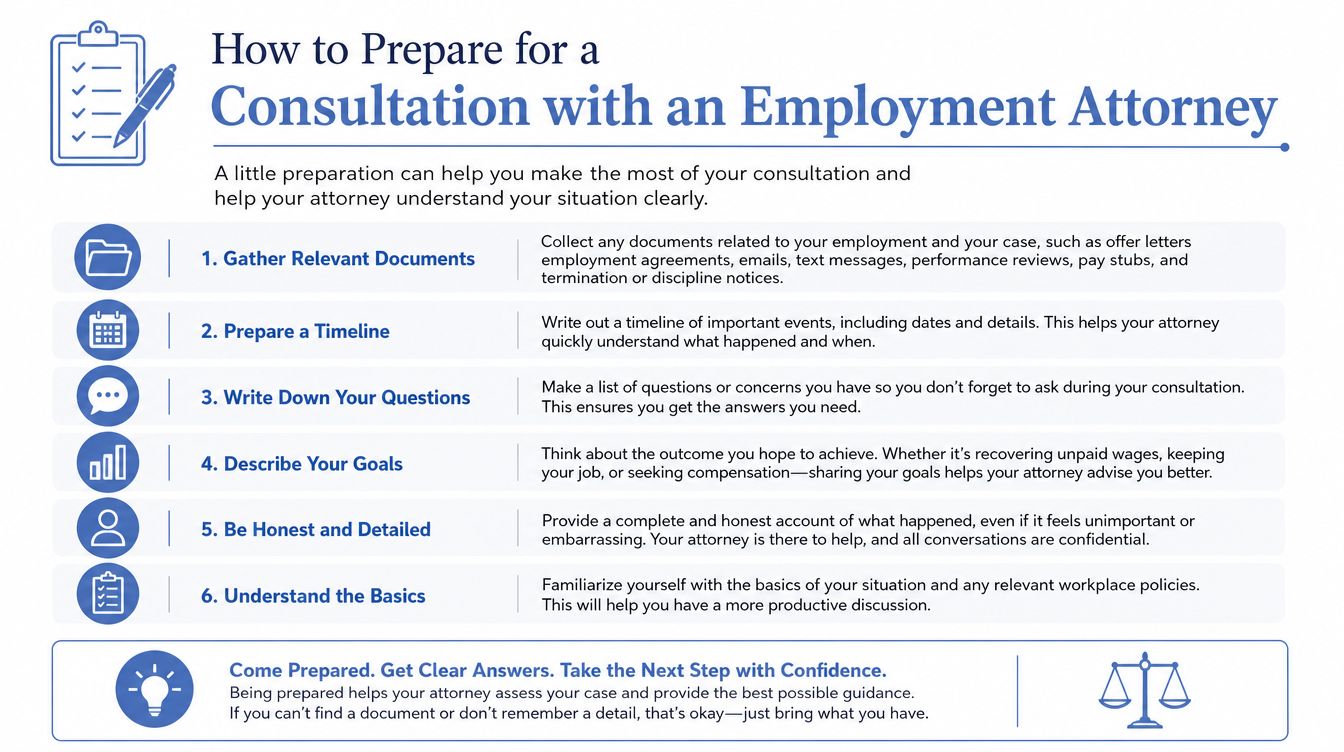
How to Prepare for a Consultation with an Employment Attorney
A good consultation is built on documents, not vague frustration. If you show up organized, the lawyer can tell you faster whether you have a real claim, what deadline is looming, and what kind of strength your facts create. If you show up empty-handed, you'll probably spend the whole meeting reconstructing basic history.
Bring the right paperwork
Start with your employment agreement, offer letter, handbook, recent pay stubs, time records, and any written discipline. Add emails, texts, screenshots, leave requests, HR complaints, and any response from management. If you complained to a supervisor or HR, bring the dates and names, because those details matter.
You should also write a short timeline before the meeting. Include when the problem started, what the employer did, who saw it, and how you were punished. A lawyer can work with a rough but honest chronology much faster than a fuzzy oral summary.
Ask the lawyer direct questions
You do not need to sound polished. You need clear answers.
- Experience with your claim: Ask whether the lawyer handles wage, leave, retaliation, discrimination, USERRA, or WARN matters like yours.
- Case assessment: Ask what facts would make your claim stronger or weaker.
- Communication: Ask how often the office updates clients and who you'll speak with.
- Fees: Ask how the contingency fee works and when costs get deducted.
- Timeline: Ask what happens first and what outcome is realistic.
The average contingency fee in employment cases is commonly in the 40% to 50% range, especially when the lawyer is taking the risk and only gets paid if there's a recovery. That doesn't mean every case is priced the same, because complexity and timing matter, but it's the right number to have in your head before you hire anyone.
A lawyer who can't explain the fee, the deadline, and the next step in plain English isn't doing you any favors.
Mississippi-Specific Resources and What to Expect from Representation
Mississippi is not a generic employment-law state. It has structural gaps that change the way a claim gets filed and the way an attorney has to think about your case. If you ignore those differences, you can end up using the wrong roadmap from the start.
No state human rights commission means federal filing matters
Mississippi does not have a human rights commission. For discrimination claims, that means workers generally have to rely on the federal EEOC process instead of a state commission that does not exist here. That alone changes how quickly you need to move, because the filing path and the paperwork are different from what many national articles assume.
A Mississippi employment lawyer should tell you which agency, if any, fits your facts, and whether you need to preserve a claim before anything else. You should not hear vague advice that sounds right in another state but fails in Mississippi. If your lawyer can't explain the local filing strategy, keep looking.
What contingency representation usually looks like
Employment cases in Mississippi commonly use a 40% to 50% contingency fee structure. That means you usually pay nothing upfront, and the lawyer takes a percentage of the recovery if the case succeeds. It also means the lawyer has to evaluate the strength of the claim early, because no one wants to invest time into a case that has no recovery path.
From there, representation usually follows one of three routes. The lawyer may negotiate directly with the employer, prepare an administrative charge or agency complaint, or push the case into litigation if the facts justify it. Communication should stay concrete. You should know what the lawyer is doing, why it matters, and what the next decision point is.
Mississippi workers often do best when they get help early, before the employer has time to rewrite the record or shape the story. That is especially true in wage disputes, retaliation claims, leave disputes, and military reemployment cases. The first good conversation can save months of guessing.
Taking the Next Step in Protecting Your Workplace Rights
You do not need a mythical one-size-fits-all Department of Labor attorney. You need the right path for the claim you have, and in Mississippi that usually means acting early, saving records, and getting a lawyer to map the deadlines before they run out. The state's lack of a human rights commission and the absence of a retaliation claim for filing workers' compensation make fast, Mississippi-specific advice even more important.
If your pay is wrong, your leave was denied, your job changed after a complaint, or your employer punished you for asserting your rights, don't wait for the problem to sort itself out. Get your documents together, write down the dates, and call a lawyer who works in this area every day. For Mississippi workers who need direct help, contact Nick Norris, P.A. at 601-641-4897 or visit https://www.nicknorris.law.
Nick Norris, P.A. helps Mississippi workers with wage disputes, retaliation, discrimination, FMLA issues, WARN problems, and USERRA claims. If your employer has already crossed the line, talk with a Mississippi employment lawyer who can tell you what the DOL can do, what it can't do, and what you should do next. Visit Nick Norris, P.A. to take the first step.
Leave a Reply