

Labor Department Lawyer: A Guide for Mississippi Workers
You get fired on a Friday. Or your paycheck is short again. Or your supervisor starts treating you differently after you ask for medical leave. By that night, you're searching for answers and typing in phrases like “labor department lawyer” because you know something is wrong, but you may not know who actually helps.
That confusion is common in Mississippi. People use “labor department lawyer” to mean several different things. Sometimes they mean a government lawyer connected to an agency. Sometimes they mean a private employment lawyer. Those are not the same role, and picking the wrong path can cost time, advantage, and evidence.
A government agency may investigate a wage or discrimination complaint. A private lawyer represents you. That difference matters most when your paycheck, job, reputation, or benefits are on the line.
When Your Job Becomes a Legal Problem
A Mississippi worker usually doesn't start with legal vocabulary. The problem starts with something concrete. The overtime never shows up on the check. The write-ups begin right after a complaint. Leave gets denied, then discipline follows. A layoff happens and the explanation doesn't add up.

Individuals seeking a labor department lawyer are usually trying to solve one urgent question: who can help me right now? That phrase often points them in the wrong direction. A government labor agency handles enforcement and complaints in certain areas. A private worker-side employment lawyer gives advice to you, protects your evidence, evaluates claims, and presses your case based on your goals.
Two very different jobs
A government lawyer does not become your personal attorney just because you filed a complaint. The agency decides what it will investigate, how far it will go, and whether your case fits its priorities.
A private employment lawyer owes duties to you. That lawyer can assess facts the way a worker experiences them, not just the way an agency screens them.
Existing content often misses this distinction, even though workers dealing with unpaid overtime, retaliation, layoffs, or discrimination often need a worker-side attorney and not just an agency contact. Legal aid organizations also report that employment matters frequently involve overlapping issues such as wage violations, discrimination, leave, and unemployment insurance, which makes the choice of forum more complicated than it first appears, as noted by Legal Aid NYC's employment law unit.
What Mississippi workers usually need first
Many individuals don't need theory first. They need direction.
That usually means figuring out four things:
- What happened: unpaid wages, discrimination, harassment, leave interference, retaliation, or a mass layoff issue.
- Who can hear it: a federal agency, a private lawyer, or both.
- What proof exists: texts, emails, handbooks, time records, write-ups, witness names.
- What deadline is already running: because workplace claims rarely wait for you to feel ready.
If you want a plain-language overview before deciding what to do, this guide on legal employment law advice is a useful starting point.
The Role of a Private Employment Lawyer in Mississippi
In Mississippi, a private employment lawyer is often the person who turns a stressful workplace story into a legal claim with structure, proof, and a plan. That role matters because many worker protections here depend on federal law, not a broad state-level system.

The simplest way to think about it is this. A government agency is closer to a referee. A private lawyer is your advocate. The referee watches the rules of the league. Your advocate is responsible for your side of the case.
What that lawyer actually does
A private employment lawyer for Mississippi workers often handles matters such as:
- Discrimination claims based on race, sex, religion, national origin, age, or disability under federal law.
- Harassment cases when workplace conduct becomes severe enough to change the terms of employment.
- Retaliation matters tied to protected activity under federal statutes.
- FMLA disputes involving denied leave, interference, or discipline tied to leave.
- Wage and hour claims involving unpaid overtime, off-the-clock work, or misclassification.
- WARN and USERRA issues when layoffs or military-service rights are part of the dispute.
The broader legal market reflects how central this work is. IBISWorld estimates the U.S. Employment Law Firms industry at $25.5 billion in 2026, with core work that includes wrongful termination, employment discrimination, sexual harassment, compliance, and litigation, according to its industry profile for employment law firms.
What works and what doesn't
What works is early case framing. A lawyer identifies the legal theory, preserves evidence, and decides whether the matter belongs in an agency process, a negotiated resolution, or federal litigation.
What doesn't work is treating every bad workplace event as a lawsuit. Some facts are unfair but not illegal. Some strong emotional cases are weak legal cases. Some modest-looking wage records become serious claims once the timekeeping pattern is examined.
Practical rule: The best employment cases are usually built from documents, dates, comparators, and clear protected activity. They aren't built from assumptions.
A private lawyer also helps a worker avoid unforced errors. That includes resignation emails written in anger, social media posts about the dispute, or turning over original evidence to the employer.
If you want a clearer sense of what counsel does day to day, this explanation of what an employment lawyer does lays it out well. For firms that publish educational material, this framework on optimizing law practice content is also a useful example of how legal guidance can be made easier for clients to understand.
Two Paths to Justice Agency Complaint or Federal Lawsuit
When Mississippi workers say they need a labor department lawyer, they're usually standing at a fork in the road. One path is an agency complaint. The other is a private federal lawsuit with a lawyer. Sometimes those paths interact. Sometimes one should come first. Sometimes the agency route is necessary before a lawsuit can move forward.
Agency complaints
An agency complaint is often the lower-cost entry point. For example, a worker may file with a federal agency handling discrimination or wage issues. The agency receives the complaint, requests information, may investigate, and may try to resolve the matter.
That process can help when a worker needs a formal channel but can't immediately fund litigation expenses. It can also create a record and, in some cases, lead to a notice that opens the door to federal court. If you're trying to understand that step, this explanation of a right-to-sue letter is worth reading.
Still, there are trade-offs. You don't control the investigation the way you would control a private case strategy. The agency decides how much attention the matter gets, which issues it focuses on, and whether it will pursue broader enforcement goals instead of your preferred outcome.
Private federal lawsuits
A private federal lawsuit gives you more direct representation and more control over legal strategy. Your lawyer can decide what evidence to pursue, how to frame claims, when to negotiate, and whether litigation pressure is necessary.
That path is not free. In Mississippi, workers often hire employment counsel on a contingency fee, and the author's brief here notes that the average contingency fee is 40 to 50%. That fee structure can make representation possible for people who can't pay hourly, but it also means you should ask hard questions up front about costs, scope, and expectations.
A private lawsuit can also be the better fit when the employer has already lawyered up, key evidence is in the employer's hands, or the case involves overlapping federal theories that need one coordinated strategy.
If your main goal is personal representation and legal advice tailored to your facts, an agency complaint and a private lawyer are not interchangeable.
Side-by-side comparison
| Feature | Agency Complaint (EEOC/DOL) | Private Lawsuit (with a lawyer) |
|---|---|---|
| Cost to start | Usually no filing cost to the worker | Often contingency-based, with fee terms set by agreement |
| Who controls the case | The agency controls investigation choices | You and your lawyer control strategy |
| Primary role | Enforcement and administrative review | Direct advocacy for your interests |
| Speed | Can move slowly and depends on agency process | Also takes time, but strategy is more tailored |
| Evidence development | Limited by agency resources and priorities | Can be built more aggressively through litigation tools |
| Best fit | Screening, administrative review, some settlement channels | Complex disputes, stronger individual advocacy, coordinated claims |
Which path tends to fit which problem
Different problems usually call for different first moves.
- Unpaid overtime may justify an agency wage complaint, a private FLSA case, or both, depending on the records and the employer's practices.
- Discrimination or harassment often starts with an administrative filing because federal law may require that step before suit.
- Layoff issues can turn on notice requirements, severance communications, or whether the employer's stated reason is a cover for unlawful conduct.
- Leave disputes often need quick legal analysis because discipline, attendance points, disability issues, and return-to-work demands can overlap.
The mistake I see most often is not choosing the “wrong” path. It's waiting too long to choose any path at all.
Navigating Employment Law in Mississippi
Mississippi workers need to understand one hard truth early. This state is not built around a broad employee-protection system at the state level. If your job becomes a legal problem, your strongest rights often come from federal law.
At-will employment is the baseline
Mississippi follows at-will employment in most work relationships. In practical terms, that means an employer can often end employment for a bad reason, a mistaken reason, or no stated reason at all, so long as the reason isn't illegal under a recognized law.
That catches people off guard. They know the firing felt unfair, humiliating, or dishonest. That may all be true. But the legal question is narrower. Was the action tied to discrimination, federally protected retaliation, unpaid wages, protected leave, military-service rights, or another recognized legal protection?
Mississippi's gaps matter
Mississippi does not have its own human rights commission. For many discrimination claims, workers are pushed toward the federal system rather than a separate state administrative process.
Mississippi also does not provide a retaliation claim for filing a workers' compensation claim. That point is important because many workers assume there must be a state-law retaliation remedy if they were fired after a work injury claim. In Mississippi, that assumption can lead people in the wrong direction.
A Mississippi worker can have a serious workplace problem and still have no stand-alone claim under state law. That's why issue-spotting under federal statutes matters so much.
Why federal detail matters so much here
In a state with fewer local protections, technical federal claims become more important. Wage-and-hour law is a good example. Employment lawyers working in that area focus on how flawed timekeeping can lead to underreported hours, unpaid overtime, and related pay-record problems, as described in this discussion of labor and employment wage practices.
That kind of analysis matters in Mississippi because a lot of cases rise or fall on records, classifications, and payroll practices, not just on what a supervisor said out loud.
Workers should also be careful with labels. “Wrongful termination” in everyday speech often just means “I was fired unfairly.” In legal practice, the core task is identifying the actual statute or theory behind the firing.
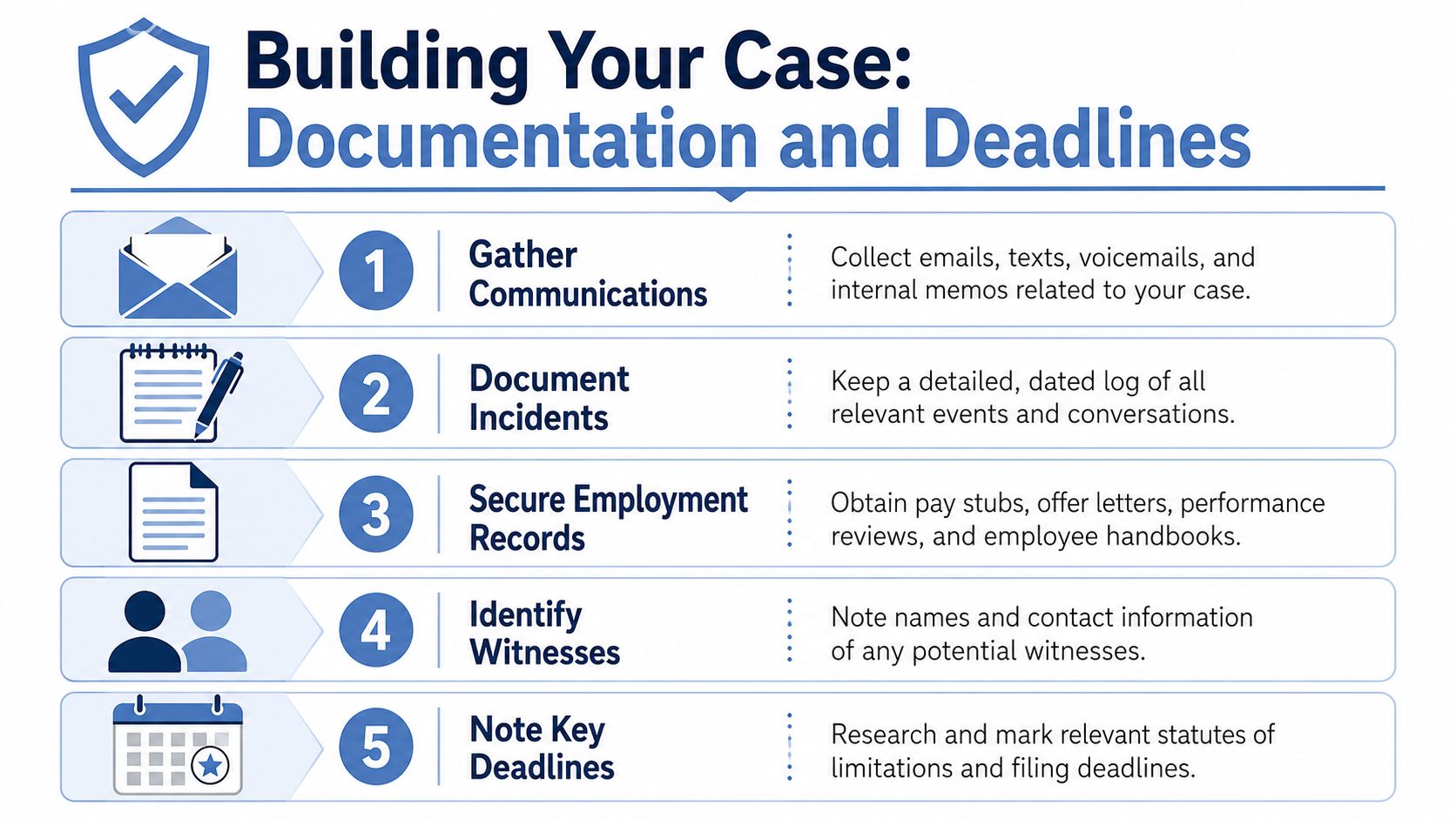
Building Your Case Documentation and Deadlines
If you think your employer broke the law, your next move is not to write a long social media post or confront management in anger. Your next move is to build your file.
What to gather now
Start with the documents you can lawfully access and already have. Keep them organized by date.
- Communications such as emails, texts, voicemails, and meeting messages that mention complaints, schedule changes, discipline, leave, or pay.
- Pay records including pay stubs, time entries, schedules, bonus records, and anything showing hours worked.
- Employment documents like handbooks, attendance policies, offer letters, evaluations, write-ups, and termination paperwork.
- Witness list with names, job titles, and contact information for anyone who saw or heard the events.
- Your timeline in a notebook or digital file. Write down dates, times, who was present, what was said, and what happened next.
Don't “clean up” your timeline after the fact. A rough but honest timeline made close to the events is usually more useful than a polished version written months later.
Documentation is especially important in leave cases
Leave disputes are often messier than workers expect. A leave request can involve federal FMLA rights, disability-accommodation issues, payroll handling, medical certification, notice requirements, and return-to-work decisions all at once. California HR guidance describes this kind of work as an integrated review across FMLA, disability issues, wage-and-hour practices, and workplace complaints, which shows why sequencing and documentation matter so much in practice, as reflected in CalHR's legal guidance page.
Keep every leave form, doctor note, attendance point notice, and text about your absence. In leave cases, small paperwork details often become the whole case.
Deadlines can end a claim
Employment law runs on deadlines. Miss one, and a strong claim may never get heard.
For some discrimination claims, workers may face an EEOC filing window measured in 180 or 300 days, depending on the claim framework. For unpaid wage claims under the FLSA, workers may face two-to-three-year limitations periods. Those aren't technical footnotes. They shape what can still be recovered and what is already lost.
If you're not sure which deadline applies, assume the clock is already running and get advice quickly. Waiting for “more proof” is one of the most expensive mistakes workers make.
How to Get Help from a Mississippi Employment Lawyer
When you're under pressure at work, the first win is clarity. You need to know whether you're dealing with an agency matter, a private federal claim, or a problem that feels wrong but may not fit a legal cause of action. That analysis is where a Mississippi employment lawyer adds value.

The legal market is active and competitive. Robert Half reported 159,600 legal job postings in 2025, and 61% of legal leaders said finding skilled talent was more difficult than a year earlier, according to its report on legal roles in demand. For Mississippi workers, that's one more reason not to wait if you think you need focused counsel.
What to ask when you call
A useful consultation should answer practical questions, not just legal labels.
Ask things like:
- Do my facts point to a federal claim
- Should I file an agency charge first
- What documents should I preserve
- What deadlines may apply
- Is this a wage case, leave case, discrimination case, or something else entirely
Nick Norris, P.A. represents Mississippi employees in matters involving discrimination, harassment, retaliation, unpaid overtime, FMLA issues, WARN matters, and USERRA disputes. If your problem fits one of those categories, a consultation can help you understand whether the facts support action and which route makes sense.
For a closer look at how employment claims are evaluated, this video gives helpful context:
A good first call should feel confidential, direct, and grounded in your facts. Bring your timeline. Bring your documents. Bring your questions. You do not need to have the legal theory figured out before you ask for help.
If you're dealing with discrimination, unpaid overtime, retaliation, harassment, FMLA problems, or a sudden termination in Mississippi, Nick Norris, P.A. can help you evaluate your options and decide on a practical next step. A confidential consultation can give you a clearer picture of your rights, your deadlines, and whether your case belongs with an agency, in negotiation, or in federal court.
This article has been reviewed for legal accuracy by Nick Norris. For employment law matters in Mississippi, consult with an attorney licensed to practice in your state.
Leave a Reply