

Marcus is standing on a loading dock in Jackson, staring at his phone after another shift change he never asked for. He complained about racial slurs in the break room, and now his supervisor is nitpicking every late clock-in and every small mistake. If that sounds familiar, you're not overreacting, and you don't need to guess your way through the next move.
In Mississippi, you don't have a state human rights commission to give you a second administrative lane. If you have a discrimination, harassment, or retaliation problem at work, the EEOC is usually the main administrative route. That makes the eeoc mediation process worth taking seriously, because for a lot of workers it's the fastest real shot at getting money on the table or getting the problem fixed before it drags on for months.
When Discrimination Happens at Work
Marcus did what a lot of workers do. He complained first, hoping management would correct the behavior, and then the workplace got colder, more tense, and more punitive. That pattern is common, and it's exactly why a Mississippi worker needs to think clearly about EEOC mediation before assuming the only path is a long investigation.
Mississippi workers also need to understand the local reality. There isn't a state human rights commission here, so the federal process matters more than it does in some other places. If you're trying to figure out whether your problem is the kind of workplace treatment that may belong in the EEOC system, a general explainer on illegal workplace treatment in CA can still be useful for spotting the basic categories of unfair conduct, even though Mississippi workers have to pursue their claims through the proper federal channel.
Practical rule: If the employer already knows you complained, every new write-up, schedule change, or sudden discipline decision needs to be documented right away.
That's the trap Marcus is in. He's worried that mediation means giving up bargaining power, but the opposite can be true when the employer would rather settle quickly than spend time and money on a formal response. Mediation gives both sides a controlled place to talk before the dispute hardens into a full investigation.
A Mississippi worker should ask three questions immediately. First, what exactly happened and when. Second, did the employer know about the complaint or protected issue. Third, is this a situation where a quick, confidential resolution would help more than a slow paper fight. If the answer to that last question is yes, mediation deserves real attention, not a shrug.
What Is EEOC Mediation and How Does It Work
A worker files a charge, the employer gets notice, and the EEOC may offer mediation before the agency starts a full investigation. That offer matters. Mediation gives both sides a fast, confidential chance to settle the dispute without turning the case into a long paper fight. A neutral mediator helps the worker and employer talk through the problem and see whether a deal is possible. It is not a mini trial, and it is not a ruling on who is right or wrong.
For Mississippi workers, that first shot at resolution matters even more because there is no state human rights commission to pick up the slack. If you want a case resolved without waiting on the agency backlog, mediation is usually the best place to start. It is the EEOC's main early settlement track, and it often gives you a real answer sooner than the investigative route.
The modern EEOC mediation program began in 1999, and the agency's own history shows how quickly it grew. From FY 1999 through FY 2020, the EEOC conducted more than 212,500 mediations and resolved more than 153,400 charges, a success rate of over 72%. The agency also reported that the first year of the expanded program, from April 1, 1999 through March 31, 2000, handled over 11,700 mediations and resolved more than 7,500 charges. See the EEOC's historical materials on the history of the EEOC mediation program for the long view.

The basic sequence
- Charge filed. The worker starts the EEOC process by filing a charge.
- Mediator assigned. The EEOC selects a neutral mediator and invites both sides to participate.
- Voluntary resolution. If the parties reach agreement, they put the deal in writing and close the matter.
That is the whole structure. The process is simple on purpose, and it works best when both sides want a quick, confidential resolution instead of months of back-and-forth. For a Mississippi worker, that can mean the difference between getting relief while the dispute is still fresh and waiting on a slower agency process.
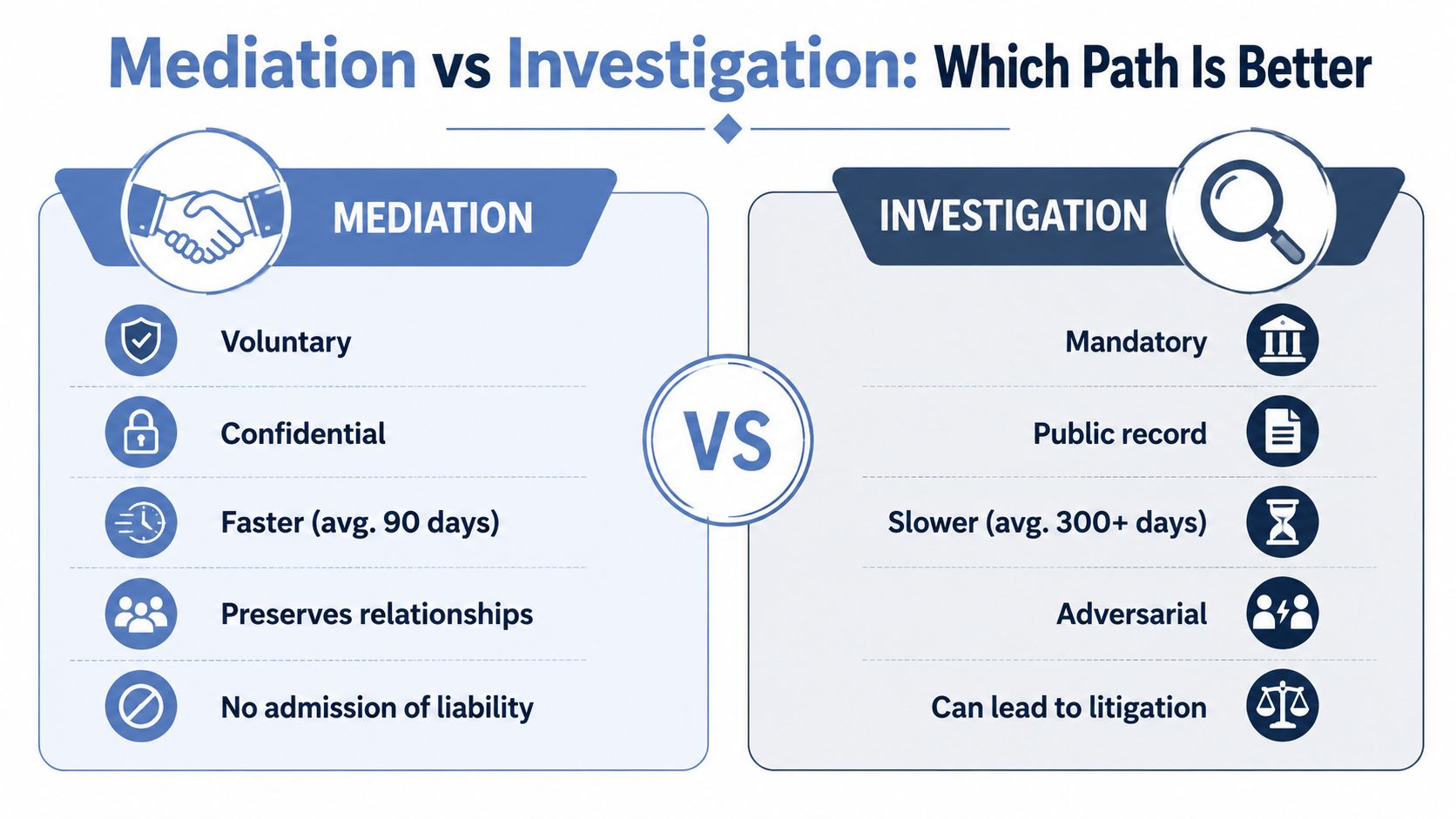
Mediation vs Investigation Which Path Is Better
If you want speed, mediation wins. In the EEOC's early study, mediations averaged 67 days from charge filing to completion, while traditional charge resolution in 1994 averaged 328 days. Later EEOC guidance says the average processing time for mediation is 84 days, and FY 2008 materials reported mediations were resolved in an average of 97 days versus more than 200 days for the traditional investigative process. For a worker in Jackson, Tupelo, or Gulfport who's already under pressure, that time difference is not academic, it's the difference between getting relief this season or waiting on the agency's calendar.
The newer numbers show the process still works at scale. In FY 2024, the EEOC conducted 11,998 mediations and successfully resolved 8,543 of them, a 71.2% resolution rate, producing more than $243.2 million in benefits for charging parties. The EEOC's evaluation materials on the eeoc investigation process make clear that investigation is a different animal altogether, slower and more document-heavy.
What that means in real life
- Mediation is usually the right call when you want a fast, confidential answer and the facts are already fairly clear.
- Investigation makes more sense when you need the agency to dig into broader patterns, documents, or witness issues.
- Mediation can still lead to meaningful money or workplace changes without forcing the employer into a long public fight.
- Investigation is slower, but it can be the better lane if the employer is stonewalling and you need the agency to press for records.
My view is blunt. If the facts are strong enough to make an employer nervous, start with mediation unless there's a strategic reason not to. You can't get back time you spend waiting, and Mississippi workers often need a result before a case becomes a year-old headache.
How to Prepare for Your EEOC Mediation Session
EEOC mediation is usually short, informal, and front-loaded. The agency says it typically takes about 3 to 4 hours, and it is generally offered early in the process before a full investigation. That matters because the employer hasn't always gone through the expense of a position statement and related discovery responses yet, which gives both sides room to settle before positions get hardened. See the EEOC's own questions and answers about mediation.
Start with your documents. Save the complaint, the emails, the text messages, the write-ups, the attendance records, the schedule changes, and anything that shows the timeline. Then organize them in the order they happened, not the order you found them. A mediation session is short, so you want your strongest facts ready to hand, not buried in a phone gallery.
Before you go in, use a clean checklist. The practical approach is to set a minimum goal, a preferred goal, and a walk-away point. If you don't know those three numbers, you're not ready to negotiate.
A Mississippi worker preparing for mediation should also think about format. EEOC materials indicate mediations are often conducted virtually, and the agency has published participant-experience research comparing online and in-person mediation. That question matters because remote sessions can change how people talk, how they read the room, and how comfortable an unrepresented worker feels pushing back. For a worker outside a major metro area, virtual mediation can be a real access benefit, but it can also make it easier to get rushed or talked over if you're unprepared. A useful outside resource on prepare your client for mediation with Ares reinforces the same practical point, preparation drives outcomes.
Be ready to say, in plain English, what happened, why it was unfair, and what would actually fix it.
Use the internal planning guide on how to prepare for mediation if you want a sharper framework for organizing your points before the session. If you show up calm, documented, and realistic, you give yourself a much better shot at a deal.
The EEOC Mediation Timeline From Filing to Resolution
The timeline starts when you file the charge and the EEOC decides mediation is a fit. The respondent is generally given 15 days to respond to the initial invitation to mediate, although that period can be flexible. If the employer agrees, the usual deadline for the employer's initial position statement is waived while mediation is pending. That's a big deal, because it changes the normal pace of the case immediately. See the EEOC's guidance on reasons for lack of employer participation in the EEOC mediation program.
From there, the session gets scheduled. The mediator usually prepares both sides for a short, confidential discussion, then helps narrow the issues and test possible settlement terms. Most workers should expect the session to focus on practical fixes, money, separation terms, references, policy changes, or some combination of those items.
After the session, two things can happen. If the parties settle, the agreement gets reduced to writing and the dispute is done. If they don't, the charge goes back into the EEOC's investigative track. The charge does not disappear, and the mediation discussion does not get handed to the investigator like a shortcut transcript.
What to watch for
- The invitation window. The employer usually has a short time to decide whether to mediate.
- The pause in paperwork. A mediation agreement can stop the usual position-statement fight while the parties talk.
- The session itself. Expect a quick, structured conversation, not a courtroom argument.
- The after-effect. If there's no deal, the claim continues through the agency process.
The best way to think about this timeline is simple. Mediation is the front door, not the end of the road. If you enter it prepared, you keep more control over how long the case takes and how expensive it gets.
Mediation Outcomes and What Happens Next
When mediation works, the parties sign a written mediated settlement agreement, and that agreement is binding. That means the deal matters, and you should read every line before signing. A good settlement can resolve the charge, but it can also include release language that affects other claims, so a worker should never treat the paperwork like a formality.
When mediation fails, the case goes back to the EEOC's investigative process, and the mediation discussions are not shared with investigators. That confidentiality rule is one of the program's best features, because it lets both sides talk freely without turning the conversation into later evidence. The confidentiality point is explained in the program materials summarized by Mediation Authority's EEOC mediation overview.
A settlement should be judged on the whole package, not just the dollar figure. Sometimes the better result is a corrected record, a neutral reference, or a clean separation on terms that keep the worker moving. Other times, holding out for more makes sense. The right answer depends on the facts, the employer's appetite for risk, and whether the worker can live with the trade-offs in the proposed release.
Don't sign a settlement because the room feels tense. Sign it because the deal actually solves the problem.
That's the honest rule. Some mediations end without resolution, and that's not a failure if the employer came in unreasonable or the offer was too thin. It just means the charge keeps moving through the system, and the worker still has options.
When to Involve an Employment Attorney in Mississippi
A worker doesn't always need a lawyer to get through mediation, but smart workers know when it's wise to get advice early. If the facts are messy, if the employer has counsel, or if you're being asked to sign a release you don't fully understand, get legal help before you agree to anything. The average contingency fee is 40 to 50 percent, so you need to know what that covers and whether the likely recovery justifies the cost.
Mississippi workers also need to be realistic about retaliation issues outside the EEOC lane. Mississippi does not provide protection from retaliation for filing workers compensation claims, and there is not a retaliation claim for filing workers compensation. That gap makes federal employment rights more important in the right case, especially where the facts support an EEOC charge and mediation may be the quickest path to a resolution.
If you're weighing whether to hire counsel, read how to find an employment lawyer and use it as a checklist, not a sales pitch. You want someone who has handled settlement talks, understands what the employer is likely to push for, and knows when to tell you to walk away.
In my view, the best time to involve a lawyer is before the employer starts framing the deal. Once the first offer hits the table, the tone of the negotiation changes fast. A worker who understands the power dynamics, the risks, and the release language is in a much stronger position than someone trying to decode it alone.
If you're facing discrimination, harassment, retaliation, or a settlement offer tied to the EEOC process, Nick Norris, P.A. helps Mississippi workers make the right move before they sign away their negotiating power. Visit Nick Norris, P.A. or call 601-641-4897 to talk through your EEOC mediation options with a Mississippi employment lawyer who handles these disputes every day.
Leave a Reply