
You've probably got the notice sitting on your desk, and your stomach just dropped. Maybe it came after a hard conversation at work, maybe after termination, maybe while an HR dispute was already brewing. Either way, the next step can feel bigger than it should, because a deposition sounds formal, and many people have never been in one before.
In a Mississippi employment case, a deposition is where the other side asks you sworn questions about the facts of your claim or defense. It happens during discovery, not in front of a judge, and the answers can shape settlement talks, summary judgment, and trial strategy. The room may look ordinary, but what happens there can lock in testimony that both sides use for the rest of the case.
By Nick Norris, P.A.
Last updated: August 9, 2026
Reviewed by Nick Norris
The Day a Deposition Notice Arrives
A deposition notice usually lands like a hard deadline because it is one. For a Mississippi employee, it means the employment dispute now has a fixed date, a location, and a sworn questioning session attached to it. If the case involves discrimination, retaliation, FMLA leave, unpaid wages, or a WARN claim, the notice can feel personal fast, especially when you are already trying to keep up with work, bills, and the stress of a pending lawsuit.

What a deposition really is
A deposition is sworn testimony taken outside the courtroom during discovery, and under the federal framework it is usually limited to seven hours in one day unless the parties agree to more time or the court orders otherwise source on the federal seven-hour framework and why it matters. That time limit shapes the whole day. Lawyers have to choose their questions carefully, because they cannot spend forever on side issues and still cover the facts that matter.
A deposition is not trial testimony, but it still carries real weight. What you say can shape settlement talks, influence summary judgment, and give the other side a roadmap for trial. In an employment case, that matters because the record often turns on details about who said what, when a complaint was made, what HR knew, and whether the employer's reason for its decision holds up.
It also works differently from written discovery. Interrogatories and document requests build the paper trail, but a deposition lets the other side hear your answers live, ask follow-up questions, and test how consistent your story is. That is why the room feels heavier than a stack of forms, even though it may look ordinary.
What the setting is usually like
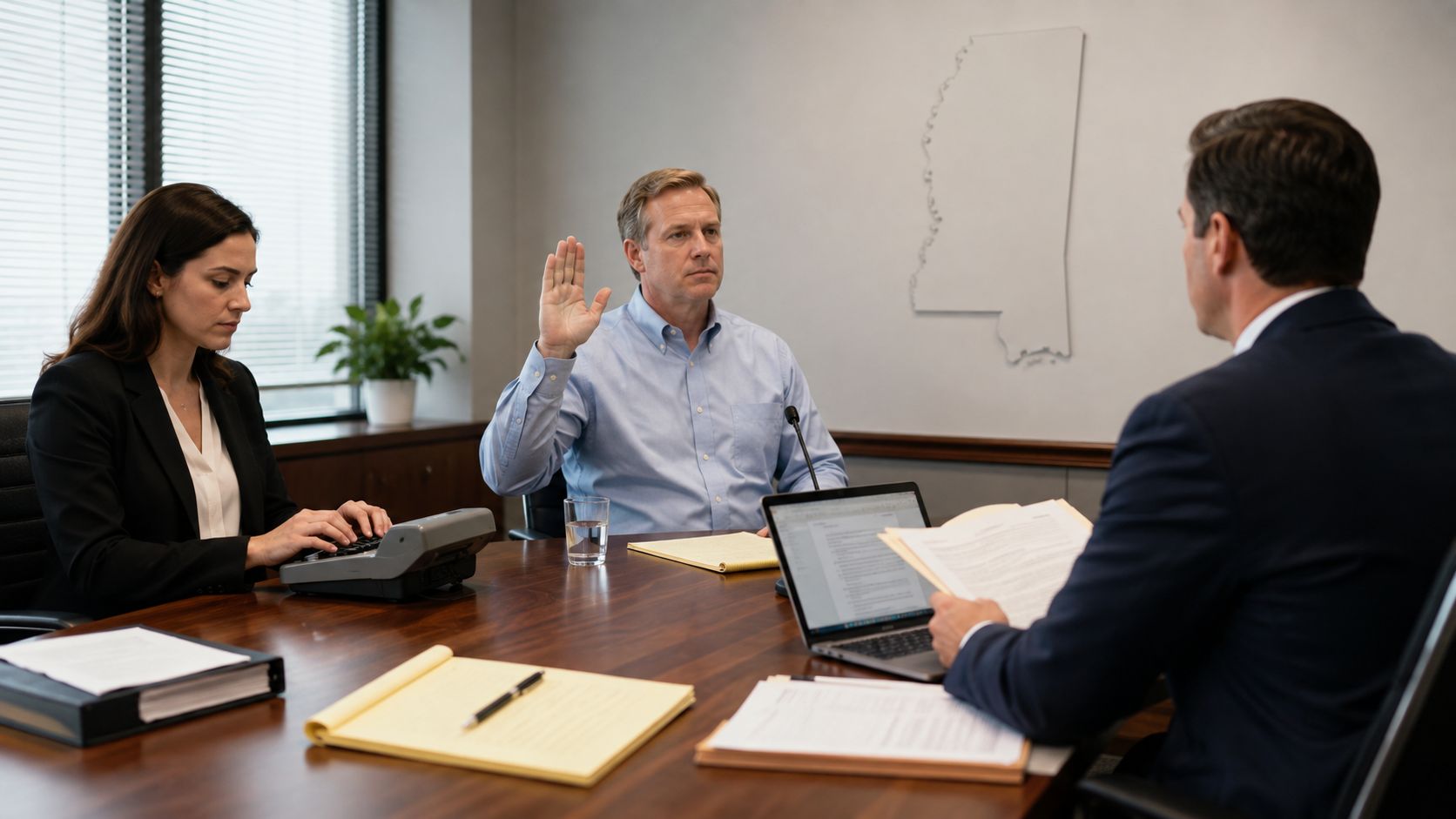
Most Mississippi employment depositions happen in a lawyer's conference room, not a courtroom. There usually is no judge sitting there to rule on disputes as they come up. The court reporter administers the oath and prepares the transcript, which becomes the official record of what was said court reporter and transcript function.
The practical reality is straightforward. You are not walking into a trial. You are walking into a controlled question-and-answer session where the other side is trying to pin down the facts, and your own lawyer may be thinking ahead to how the testimony fits with the rest of the case. In a Mississippi employment matter, that may include whether the employer followed its own policies, whether the employee reported protected conduct, or whether the proof lines up with the claims in the complaint. If the case calls for testimony from someone with specialized knowledge, the lawyer may also prepare that witness separately, which is one reason a deposition often overlaps with issues discussed in employment expert witness preparation.
For a Mississippi worker, one more point matters in the background. There is no state human rights commission to step in and manage the case for you. Once the lawsuit is filed, the deposition is part of the process the lawyers use to build the record, and if you are handling the case on a contingency fee, often around 40 to 50 percent in practice, that same record can affect settlement value and trial risk in a very real way.
Who Is in the Room and What Each Person Does
A deposition room usually has fewer people than clients expect, but every person there has a job. The setup is calm on the surface, and that's part of the point. No jury is watching, no judge is ruling in real time, and the focus stays on the witness's words.
The people you'll meet
The deponent is the witness being questioned. In a Mississippi employment case, that's often the employee, though it can also be a supervisor, HR representative, or company witness depending on the claims. The noticing attorney is the lawyer who scheduled the deposition and asks most of the questions.
The other side's lawyer may step in with follow-up questions after the main questioning. Your own lawyer is usually present too, sitting beside you, ready to object when needed and to protect the record. The court reporter swears you in and creates the verbatim transcript, and sometimes a videographer records the testimony if demeanor or credibility may matter later.
A deposition feels informal because people sit around a table, but the transcript carries real legal weight. That's why even a quiet room can become the most important room in the case.
How the room is arranged
The deponent usually sits where the camera and court reporter can see and hear clearly. The attorneys sit nearby with documents, exhibits, and notes. If your lawyer is there, you should expect to confer during breaks, not while a question is pending.
In many Mississippi employment cases, the deposition is taken on a record only, meaning the transcript is the main product. In other cases, counsel may order video because a witness's tone, pauses, or facial reactions may matter later. If you want a useful example of how these witness-facing roles get used in practice, the discussion of expert witness preparation in employment cases shows how much attention lawyers give to testimony before anyone walks into a hearing room.
Expect water, short breaks, and a setting that feels more like a meeting than a courtroom. Still, don't let the casual furniture fool you. The transcript is the room you're building.
How the Deposition Actually Unfolds
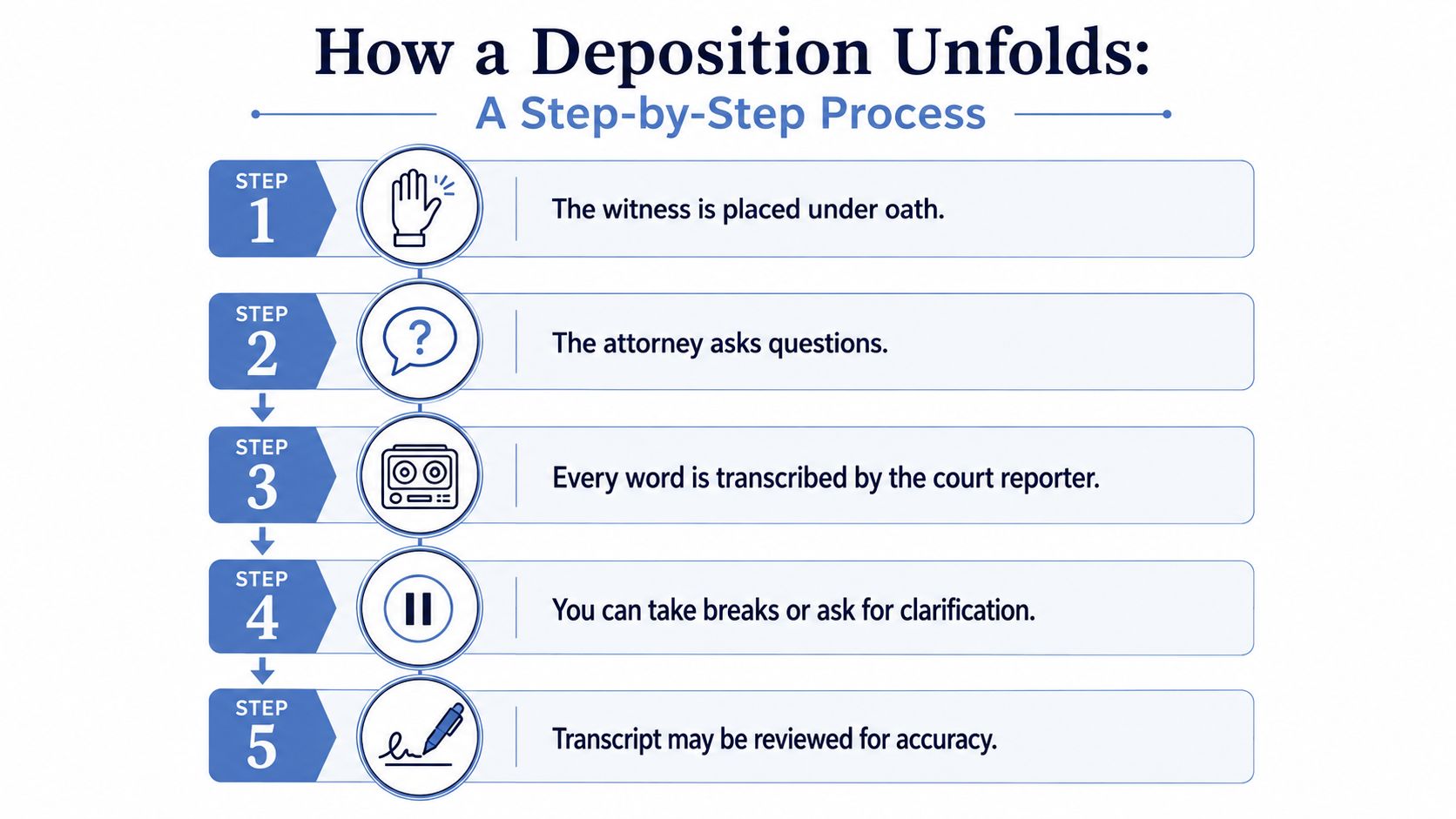
The first few minutes are slower than most clients expect. That's useful, because it gives you time to settle in, find your voice, and hear the ground rules before the questioning becomes more pointed. The court reporter swears you in, and from that point forward every answer is given under oath.
The opening sequence
The questioning usually starts with background. Your name, job history, education, how long you worked there, who supervised you, and what the workplace structure looked like. Those questions help the lawyer orient the record before moving into the dispute itself.
From there, the attorney shifts to the events at issue. In a Mississippi employment case, that might mean termination, harassment, retaliation, leave disputes, discrimination, unpaid overtime, or the way a schedule change affected your job. A good questioning lawyer often starts broad and narrows down to dates, words, and documents.
Objections, exhibits, and breaks
If your lawyer objects, it's often to preserve an issue for later rather than to stop the question altogether. Many objections are short and procedural, because the transcript needs to show the objection without turning the deposition into an argument. That can feel odd if you're the witness, but it's normal.
Documents also come out during the deposition. Emails, texts, performance reviews, attendance records, leave paperwork, and payroll records may be marked as exhibits and handed to you one by one. The court reporter notes the exhibit number, and the questioning attorney asks what you recognize, when you saw it, and what it means in context.
You can take breaks. You should, if you need to think, use the restroom, or regroup. Just don't treat every break as a chance to restart the case in your head. The record is still waiting when you come back.
Afterward, the court reporter prepares the transcript. In many depositions, you'll later have a chance to review it and make corrections to transcription errors within the agreed window. That transcript becomes the version of your testimony the lawyers will study line by line.
Questions You Are Likely to Be Asked
Employment depositions are not built around legal arguments. They're built around facts, memory, and consistency. The other lawyer wants to know what happened, what you saw, what you reported, and how you reacted. That means the questions often sound simple at first, then get more detailed fast.
The main question categories
You should expect questions about your background and employment history. That may include prior jobs, your position, your schedule, your duties, and who you worked with. The lawyer is building a baseline so later answers make sense in context.
Then comes the timeline. In a discrimination or retaliation case, the attorney may ask who said what, when it happened, where it happened, and who else was present. A single text message can lead to several follow-ups about what led up to it, how you interpreted it, and whether anyone else saw it.
Medical issues can come up too, especially if you're claiming damages tied to stress, treatment, or time away from work. In cases involving wage loss or leave disputes, the lawyer may ask about missed work, income changes, and any steps you took to keep working or find other work.
Fact over argument: the deposition is designed to develop a detailed factual record, not to decide who has the better legal theory.
Why the questions seem broad
The questions are broad because the lawyer is trying to lock in testimony. If you say one thing today and something different later, the transcript can be used to challenge credibility. That's why the attorney may circle back to the same event from multiple angles, especially in a case involving written complaints, HR meetings, or a termination decision.
You may also be asked how the events affected your daily life. That can sound personal, and it is, but it's part of the damages picture. The goal is to understand the actual impact, not just the paperwork.
The safest way to hear those questions is to treat each one as a request for a single, specific fact. Answer the question that was asked, not the one you wish had been asked.
Your Rights and Limits as a Witness
A lot of nervous witnesses try to be too helpful. That usually backfires. Your job is not to fill silence or rescue the lawyer's question. Your job is to answer accurately, carefully, and only to the extent you know the fact.

What you can do
You have the right to understand every question before you answer it. If a question is unclear, compound, or uses a word you do not recognize, ask for clarification. You also have the right to ask for a break, and your lawyer can raise objections, especially on privilege issues.
Privilege comes up often in employment cases. A conversation with a treating therapist is not the same thing as a communication with a hired expert, and your lawyer will need to sort out what is protected and what is not. In a Mississippi discrimination, retaliation, FMLA, WARN, or wage-and-hour case, that distinction can matter when the other side asks about stress, treatment, or the reasons you stopped working. That is one reason preparation matters before you ever sit down.
What you should not do
Do not guess. Do not speculate. Do not let the other lawyer pull you into an answer that sounds more certain than it really is. If you do not know, say so. If you do not remember, say that instead of inventing a memory to make the room feel more comfortable.
You also cannot be coached during live testimony. If you need to consult your attorney, ask for a break. That is the proper way to slow the room down without breaking the rules.
Here is the cleanest way to think about it. Your answers must be your own, and they must be honest. The transcript can later be used to compare your deposition with later testimony, so accuracy matters more than sounding polished.
The practical limits that matter most
A federal deposition is typically limited to seven hours in one day. That limit shapes pacing, not just scheduling. It also makes the transcript review process important, because the written record can lock in what happened in the room.
The witness can usually review the transcript and note errors in the agreed correction process. That is not a chance to rewrite testimony. It is a chance to fix mistakes in the record so the transcript reflects what was said. A reliable real-time transcription guide can help you understand how live recording tools affect the pace of testimony, but it does not change the duty to answer carefully.
Remote Depositions on Zoom and Other Platforms
Remote depositions are now common enough that most Mississippi employment lawyers treat them as routine. The basic structure stays the same, but the medium changes the pressure. You're still under oath, still on the record, and still expected to answer carefully.
What changes on a screen
Instead of a conference room table, you're looking into a camera on a video platform. Exhibits may be shared through screen-sharing, and the court reporter may administer the oath remotely while capturing a separate audio feed. A remote deposition reporter still creates the record, but the logistics are more dependent on stable tech.
That makes preparation more technical. Your camera should be steady, your background neutral, and your phone out of reach. Water should be nearby. No one else should speak into the room, even if they think they're whispering.
The etiquette is stricter than it looks
Treat the screen like the conference room. That means looking at the camera when answering, not down at your phone, notes, or another screen. It also means pausing if the connection lags, because a small delay can make two people talk over each other and muddy the transcript.
A useful outside resource on real-time transcription guide can help you understand how modern recording and captioning tools change the pace of a live record, even though the legal rules stay the same.
The biggest risk in a remote deposition is distraction. It's easier to drift, easier to check something off-camera, and easier to forget that every facial expression is still being observed. A witness who stays focused online usually comes across as more credible than one who keeps breaking eye contact with the camera.
How to Prepare and Avoid Common Pitfalls
The best deposition prep doesn't sound dramatic. It looks like calm review, repetition, and a few disciplined habits. The witnesses who do best are usually the ones who slow the room down, tell the truth, and resist the urge to explain everything at once.

What preparation should look like
A prep meeting with your lawyer should cover your prior statements, the key documents, and the likely lines of questioning. If you gave HR a written complaint, sent emails, or texted a supervisor, those records need to be reviewed before the deposition starts. If you want a practical checklist for that process, the guide on how to prepare for deposition is a useful place to start.
Good preparation also includes rehearsal out loud. You do not need memorized answers. You do need to get comfortable pausing, listening to the full question, and answering only what was asked.
Best habit: pause, breathe, and make the lawyer finish the question. Most bad answers start before the question is done.
Mistakes that hurt real cases
Guessing is the fastest way to create problems. So is volunteering extra facts, especially when the question was narrow. If you don't know the answer, say so plainly.
A few other mistakes come up over and over:
- Unsanctioned notes: don't bring stacks of private notes and start reading them unless your lawyer has cleared that use.
- Social media venting: a post made out of frustration can create a new problem that has nothing to do with the original case.
- Coaching other witnesses: if someone else in the case will also be deposed, don't rehearse their story or shape their answers.
Clothing and pacing matter too. Wear something clean and neutral, sleep the night before, eat before the session, and be ready for a long stretch of focus. If opposing counsel gets repetitive or sharp, stay steady. The transcript records composure better than it records frustration.
What Happens After the Deposition and When to Call an Attorney
After the questioning ends, the case doesn't stop. The transcript gets prepared, reviewed, and compared against the other evidence. Both sides then use it to decide what comes next, including whether to push toward settlement, prepare for summary judgment, or tighten trial strategy.
Why the transcript matters so much
In many Mississippi employment matters, including discrimination, retaliation, FMLA, WARN, USERRA, and wage-and-hour claims, the deposition is where the case becomes real in the eyes of both lawyers. That doesn't mean the case is over that day. It means the story has been fixed into a sworn record, and weak spots are harder to hide later.
If you need a broader sense of how that attorney-client choice fits into the bigger picture, the guide on how to find an employment lawyer is a good companion read.
You should also expect the transcript review process. If there are transcription errors, you can usually note corrections in the agreed window. That's an accuracy step, not a do-over. The point is to make sure the written record matches what was said.
Mississippi-specific realities
Mississippi does not have a human rights commission, so employment disputes here follow a different practical path than workers often assume. That makes early strategy more important, because there's no state agency to handle the job for you in the way some people expect.
The fee structure matters too. In many Mississippi employment cases, the typical contingency fee arrangement runs 40 to 50 percent, and that reality affects how people choose counsel and how they weigh the cost of a case. If you're serious about protecting your rights, it pays to understand those economics early instead of after the deposition is already on the calendar.
If your deposition notice has you worried, call 601-641-4897 and speak with Nick Norris, P.A. about your Mississippi employment case. The right preparation can make the room feel smaller, the questions feel clearer, and the transcript less dangerous.
If you're facing a deposition in a Mississippi discrimination, retaliation, FMLA, WARN, or wage-and-hour case, Nick Norris, P.A. can help you prepare with a clear plan and practical guidance. Visit Nick Norris, P.A. to get started, and don't wait until the night before to figure out what the other side is likely to ask.
Leave a Reply