

You return from drill or deployment expecting to resume your Mississippi job, only to learn that your shift changed, your promotion went to someone else, or your position supposedly disappeared. Your supervisor may call it a business decision. If military service influenced that decision, however, the problem may involve national guard employment rights under federal law.
The controlling law is the Uniformed Services Employment and Reemployment Rights Act, commonly called USERRA. It protects National Guard members from discrimination connected to military service and creates reemployment rights after qualifying service. The practical rules can be technical, and Mississippi's enforcement structure creates additional complications. By Nick Norris, P.A.
What National Guard Employment Rights Actually Protect
A Mississippi Guard member shouldn't have to choose between serving and keeping a civilian career. USERRA, signed into law on October 13, 1994, and codified at 38 U.S.C. §§ 4301–4335, applies to National Guard members and other uniformed service members. It protects workers from discrimination in hiring, retention, promotion, or any other employment benefit because of past, present, or future military service. The statutory framework and protections are summarized here.
Suppose an employer stops scheduling you for desirable shifts after learning about annual training. Suppose a manager says your Guard obligations make you unreliable, then denies you a promotion. Suppose you return from activation and discover that another employee received your duties, pay progression, and advancement opportunity. Those facts can raise separate questions under USERRA, not merely a disagreement about scheduling.
Who the law covers
USERRA's reach is broad. It covers:
- Employment status: Full-time, part-time, temporary, and probationary workers can qualify.
- Employer size: The law applies regardless of the employer's size.
- Employment decisions: Hiring, retention, promotion, pay, benefits, and other employment advantages cannot be denied because of service.
- Reemployment: A qualified returning service member generally must be restored promptly to the position the person would have attained with reasonable certainty if continuously employed.
Your employer doesn't need to approve military service before you leave. The law recognizes that military necessity can affect notice, and verbal notice may satisfy the requirement in appropriate circumstances. Still, written notice is the safer practice because it creates a record.
Practical rule: Treat every drill, training period, activation, and deployment as a personnel event that deserves clear written documentation.
USERRA isn't a promise that every employee will receive identical treatment regardless of legitimate performance issues. It is a prohibition against using military service as a reason to disadvantage the employee, combined with a reemployment system designed to preserve the career path that service interrupted.
A separate resource about VA home loan eligibility for reservists can help with a different part of military life, but it doesn't replace employment-rights advice. For a Mississippi-focused discussion of the federal employment framework, review USERRA rights for service members.
The Escalator Principle and Reemployment Rights
USERRA's reemployment rule is known as the escalator principle. Your civilian career should continue from the point it would have reached with reasonable certainty if you had remained continuously employed. Military service pauses your work, not the career progression tied to your position.

Returning you to the same title may fall short. The employer must examine seniority, status, pay, promotions, merit-based increases, and other advancement that likely would have occurred during your absence. Compare your post-service position with the career path you would have followed, not merely with the job you held before deployment.
What the employer must evaluate
A sound reemployment analysis asks four practical questions:
- What position would you probably hold now? Look at the progression of similarly situated employees and the employer's established promotion practices.
- What pay and status come with that position? Restoration may require more than returning you to your former hourly rate or salary.
- Is the exact position available? If it is not, USERRA generally points toward the pre-service position or a comparable role, depending on the circumstances.
- What training is necessary? The Department of Labor says employers must provide refresher training and other necessary training to update a returning employee's skills. The DOL Pocket Guide explains the reemployment and training obligations.
An employer cannot end the analysis by saying, “Your old job is gone.” Restructuring may affect the available position, but the employer must connect that explanation to the legal standard and the facts surrounding your return.
Service-related disability creates a separate duty. If the disability prevents you from qualifying for the position you otherwise would have held, the employer must make reasonable efforts to accommodate you and help you become qualified. If those efforts do not work, the employer must consider a position with similar seniority, status, and pay for which you are qualified.
Your return should be measured against the career you would have had, not merely the desk you occupied before deployment.
Build the comparison with records. Keep pre-service pay statements, performance reviews, promotion announcements, job descriptions, training records, and communications about your return. These documents can show whether the employer restored your career path or placed you on a lower step.
How the 2025 Dole Act Changed Enforcement and Damages
A Guard member requests military leave, returns, and then faces worse shifts, exclusion from meetings, or pressure to resign. Under the 2025 Dole Act, those actions can raise a retaliation claim even without termination or a clear pay reduction. Older summaries that say USERRA only requires an employer to hold a job leave out the amendments' broader protection and financial consequences.

Retaliation covers more workplace conduct
The amendments removed the requirement that retaliation qualify as a “materially adverse action.” They also expanded the types of retaliatory conduct that may support a claim. Threats, pressure, exclusion, punitive scheduling, or similar conduct tied to asserting USERRA rights now deserves close review.
Pay attention to timing and communications. A supervisor's response after a service member requests leave, challenges a reemployment decision, or participates in an investigation can provide important evidence. The analysis does not stop at whether the employer fired the employee or imposed a major pay cut.
How fee awards and damages strengthen enforcement
For a prevailing plaintiff, attorney-fee awards are mandatory under the stated 2025 amendments. Willful violations also carry a minimum liquidated-damages floor of $50,000 or lost wages and interest, as described in the 2025 Dole Act analysis. The calculation still depends on the facts and the violation, so every dispute will not produce the same recovery.
USERRA places the burden on the employer to prove a statutory excuse, including impossibility, unreasonable reemployment, a temporary job not expected to continue, exceeding the service limit, or undue hardship involving accommodation. Contemporaneous records matter. An explanation created after the dispute begins carries less weight than records made when the employer acted.
Enforcement remains active
The Department of Labor's Veterans' Employment and Training Service opened 862 new unique USERRA cases in fiscal year 2021 after complaints were submitted on Form 1010, according to the DOL FY 2021 report. The 2025 legal analysis linked above also identifies 1,256 new unique USERRA cases reviewed in the DOL's FY 2025 report.
Those figures do not decide an individual claim. They confirm that USERRA violations receive enforcement attention. Employers should preserve relevant records, and Guard members should document retaliation or reemployment problems promptly. In Mississippi, where there is no state human rights commission handling these disputes, choosing the correct federal enforcement path and preserving proof from the outset matters even more.
Reemployment Procedures and Required Documentation
Your rights are stronger when you follow a disciplined process. Before service, give notice as early as practical. USERRA doesn't require a specific amount of advance notice in every situation, and verbal notice can qualify, but written notice protects you from a later dispute about whether the employer knew your absence was military-related.
Keep the notice factual. Identify the service, expected dates if available, and the fact that the absence is for military duty. Attach orders when appropriate, but don't assume an employer can use missing paperwork as a reason to delay legitimate rights.
Build the record before returning
Create a file containing:
- Military orders and amendments: Preserve the original orders and every later change.
- Leave communications: Save emails, text messages, letters, and scheduling records.
- Employment records: Keep pay statements, job descriptions, performance reviews, and benefit information.
- Return request: Submit your reemployment request in writing and retain proof of delivery.
- Employer response: Save the offered position, compensation details, schedule, and any explanation for a change.
- Training and accommodation records: Document requests for refresher training or disability-related assistance.
- Timeline notes: Record dates, speakers, statements, and witnesses while events remain fresh.
The USERRA return-to-work requirements guide provides additional Mississippi-focused context. Don't rely on a verbal conversation with a supervisor when an email can confirm the same point.
A major boundary is the cumulative five-year service limit with a particular employer, subject to statutory exceptions. The limit helps determine whether reemployment rights remain intact. Keep a running service record rather than trying to reconstruct it after an employer challenges your eligibility.
If the employer delays your return, offers an inferior job, or restores you without the seniority and pay progression you should have received, object promptly and in writing. State that you are seeking reemployment under USERRA, identify the specific problem, and request the records supporting the employer's decision. Don't sign a release, separation agreement, or revised job arrangement before obtaining advice.
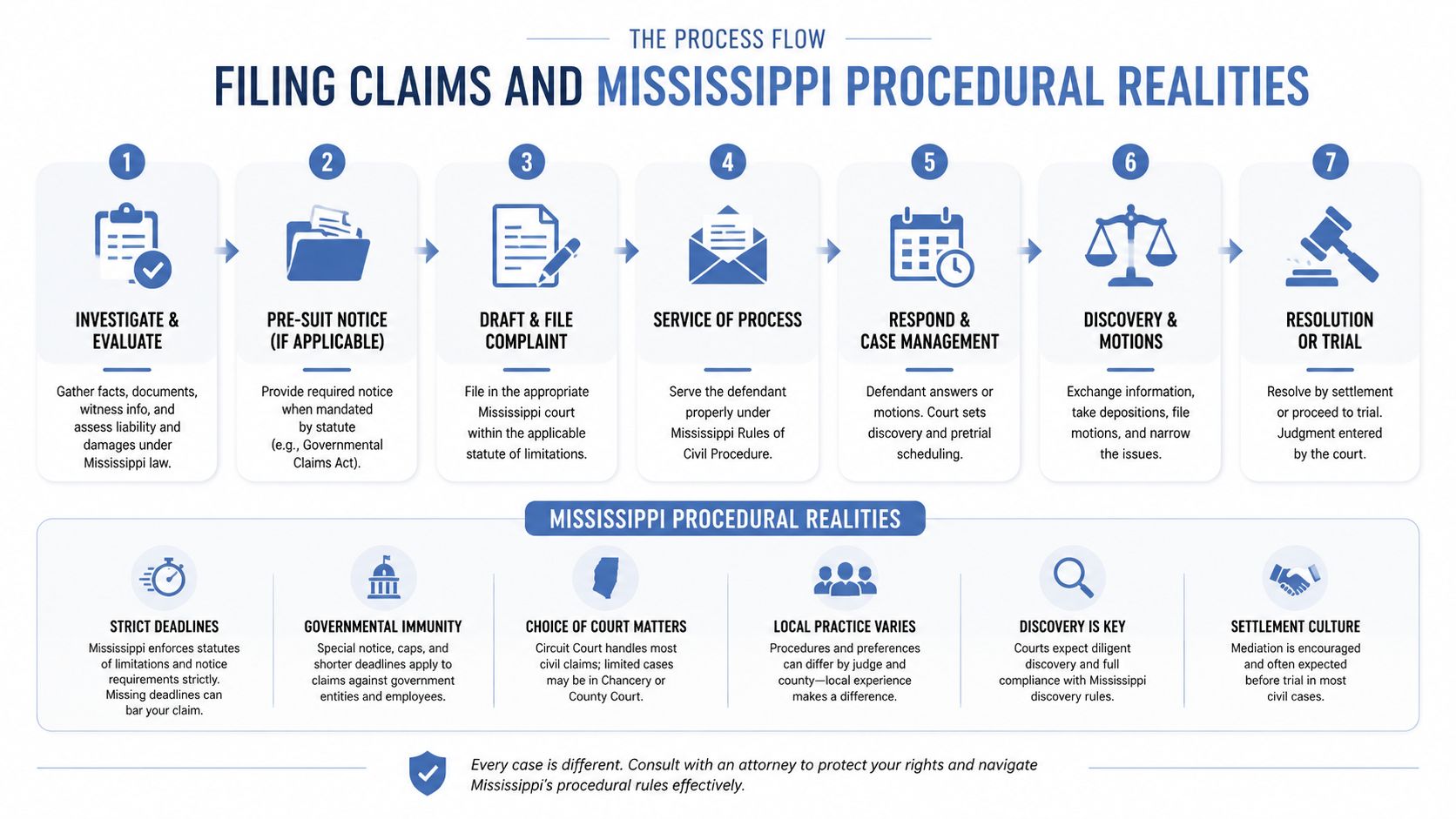
Filing Claims and Mississippi Procedural Realities
Mississippi's process differs from what many general employment articles imply. Mississippi doesn't have a state human rights commission. Discrimination and retaliation complaints are typically routed through the federal Equal Employment Opportunity Commission rather than a Mississippi human-rights agency, as explained in this Mississippi employment-law discussion.
That absence doesn't eliminate your rights. It means you need to identify the correct federal channel. For USERRA complaints, the Department of Labor's Veterans' Employment and Training Service is the principal administrative starting point. A service member can submit a complaint using Form 1010. VETS investigates, communicates with the parties, and may pursue resolution or referral when appropriate.
Choose the path based on the claim
| Workplace problem | Primary issue to evaluate | Initial focus |
|---|---|---|
| Denied reemployment | Escalator principle and eligibility | Orders, service history, return request, offered position |
| Lost promotion or benefit | Service-based discrimination | Decision timeline, comparators, supervisor statements |
| Punishment after asserting rights | Retaliation | Protected activity and subsequent conduct |
| Disability-related return problem | Accommodation and qualification | Medical restrictions, training, and employer efforts |
The administrative route can help create an investigation record, but it isn't a substitute for case-specific legal strategy. A lawyer can evaluate whether the employer's explanation is supported by contemporaneous evidence and whether the available remedies justify further action.
USERRA is separate from Mississippi workers' compensation law. Mississippi doesn't provide protection from retaliation for filing workers' compensation claims, and there isn't a retaliation claim based solely on filing a workers' compensation claim under that state rule. That issue mustn't be confused with USERRA retaliation, which concerns military service or the exercise of rights under the federal statute.
Common Mistakes That Weaken Your USERRA Claim
A valid claim can become harder to prove when the employee creates avoidable gaps. The goal isn't to blame service members for employer misconduct. The goal is to prevent an employer from exploiting uncertainty about notice, timing, or what happened after the return.
The errors I see most often
- Relying only on verbal notice: Tell the employer verbally when circumstances require it, then confirm the notice in writing as soon as possible.
- Waiting to challenge a lower position: If the employer offers less pay, status, seniority, or responsibility, object promptly. Silence can give the employer an argument that you accepted the arrangement.
- Keeping complaints private: A conversation in a hallway leaves no reliable record. Send a concise follow-up email identifying the concern and requested correction.
- Ignoring deadlines and delay: Don't allow an unresolved reemployment dispute to drift. Preserve evidence and seek advice while records and witnesses remain available.
- Signing separation documents too quickly: A release can affect your ability to pursue rights. Have counsel review it before signing.
- Assuming every absence qualifies automatically: Military-related absences still involve notice, service, return, and eligibility requirements. Confirm the facts rather than relying on a broad assumption.
- Posting workplace disputes online: Social media posts can distract from the legal issue, expose private information, or create statements an employer may use against you. Keep the dispute private and factual.
- Sending inconsistent explanations: Use consistent dates and descriptions in communications with supervisors, human resources, VETS, and counsel. Contradictions invite unnecessary attacks on credibility.
A strong case usually has a clean timeline. Write down the service dates, notice, employer responses, return request, offered position, pay difference, and every retaliatory event. Preserve original messages instead of relying on screenshots alone when the original account remains available.
When to Contact Nick Norris P.A. for Legal Representation
Handle a simple scheduling question directly when the employer is cooperative and restores your work without dispute. Contact counsel once the employer refuses reemployment, cuts your pay or status, denies a likely promotion, escalates punishment after you assert rights, or claims that a service-related disability makes return impossible.
Representation becomes especially important when the dispute involves multiple decision-makers, a restructuring explanation, lost career progression, accommodation issues, or a proposed release. Those cases require more than proving that military service occurred. They require connecting the service or protected complaint to the employment decision and testing the employer's documented defense.
Prepare for the initial evaluation
Bring:
- Military orders, amendments, and discharge or release records.
- Written notice to the employer and proof it was received.
- Pay records and benefit information from before and after service.
- Job descriptions, schedules, evaluations, and promotion materials.
- Emails, text messages, and letters concerning leave or reemployment.
- Names of witnesses and a dated chronology.
- Any separation agreement or proposed settlement document.
Contingency representation can allow an employee to pursue an employment claim without paying hourly fees at the outset. The average contingency fee is 40% to 50%, but the actual agreement depends on the lawyer, the case, expenses, and the written engagement terms. Mississippi also regulates contingency fees for state-hired outside counsel in tiers, including 25% of the first $10 million, 20% of the next $5 million, 15% of the next $5 million, 10% of the next $5 million, and 5% above $25 million, with an aggregate cap of $50 million, exclusive of reasonable costs and expenses, under Mississippi Code Section 7-5-8. That statute concerns a defined state-counsel context, so it shouldn't be treated as a universal private employment-fee rule.
Nick Norris, P.A. evaluates Mississippi employment matters involving USERRA, retaliation, discrimination, and reemployment disputes. Review USERRA lawyer services for Mississippi employees to understand the type of representation available from initial evaluation through negotiation, litigation, or appeal.
By Nick Norris, Attorney
Last updated: 2026
Reviewed by Nick Norris
If your employer denied reemployment, reduced your position, or retaliated after you asserted National Guard rights, Nick Norris, P.A. can evaluate the timeline, documents, and available remedies. Call 601-641-4897 or visit Nick Norris, P.A. to request a Mississippi employment-law consultation.
Leave a Reply