

You've told your supervisor that a medical condition is making part of your job harder. Instead of discussing solutions, your employer asks for more paperwork, stops responding, or says the requested change isn't practical. In Mississippi, that silence can feel especially isolating because the state doesn't have a human rights commission to process workplace accommodation complaints. You'll generally need to understand the federal system and preserve your own record from the start.
A strong disability accommodation request is specific, written, and tied to a workplace barrier. It doesn't need to reveal every detail of your medical history. It needs to explain what you can't do, what adjustment would help you perform the essential functions of your position, and how your employer can respond. The guidance below is practical, Mississippi-focused, and designed for employees who need a clear path forward.
By Nick Norris, Attorney
Last updated: August 24, 2026
Reviewed by Nick Norris
Understanding Your Rights Under Federal Law in Mississippi
A Jackson employee with a chronic condition may notice that a full shift on the warehouse floor causes a serious limitation. A Gulfport employee may need a schedule adjustment to manage treatment. A remote employee in Hattiesburg may need a quieter workspace or written instructions because a health condition affects concentration. The legal question isn't whether the employee has used a particular diagnosis label. The question is whether a disability creates a workplace limitation and whether a reasonable adjustment could help the employee perform the job.
The federal framework is the starting point
Mississippi doesn't operate a state human rights commission. For private employees, the principal protection is the Americans with Disabilities Act, or ADA. An employer with 15 or more employees must provide reasonable accommodation for a known disability unless the accommodation creates an undue hardship, and the employer can't retaliate against an employee for requesting accommodation or asserting ADA rights. Mississippi ADA guidance on medical accommodations explains this federal framework in the Mississippi employment context.
A disability can include a physical or mental impairment that substantially limits a major life activity, a record of such an impairment, or being regarded as having one. You don't have to use legal terminology in your request. You do need to identify the functional problem clearly.
Reasonable accommodation can take many forms, including modified schedules, equipment changes, written instructions, reassignment of nonessential tasks, leave related to a disability, or remote work when the position's essential duties can be performed remotely. An employer doesn't have to remove essential job functions or excuse legitimate performance problems. The adjustment must help you work, not eliminate the job's basic requirements.
Practical rule: Ask for the workplace change you need, not a broad exemption from workplace expectations.
Don't wait for a crisis
A request made before attendance problems, missed deadlines, or discipline gives everyone a better chance to address the barrier. Put the request in writing to human resources, your supervisor, or another designated accommodation contact. Keep a copy outside your work account.
If your condition may eventually prevent you from working for an extended period, disability benefits may also deserve separate review. A resource on how to protect your team with LTD can help explain long-term disability coverage, but insurance benefits and workplace accommodations are different issues. One doesn't replace the other.
For a focused explanation of what employers may need to do, review what reasonable accommodation means under the ADA. Your request should start the conversation early, before an avoidable workplace dispute becomes the central issue.
Preparing Your Documentation and Request Letter
A weak request says, “My condition makes work difficult.” A useful request identifies the exact task creating the barrier and proposes a workable adjustment. Employers can evaluate functional limitations and accommodation options. They generally don't need your entire medical file, unrelated treatment history, or every detail of your diagnosis.
Build a focused documentation package
Ask your healthcare provider for documentation that addresses:
- Functional limitation: Explain whether you have difficulty standing, lifting, concentrating, communicating, driving, hearing, sitting, sleeping, or performing another work-related activity.
- Workplace connection: Identify the job task affected, such as extended standing, unscheduled interruptions, fluorescent lighting, open-office noise, or a fixed start time.
- Effective adjustment: Describe an accommodation that would address the limitation. The provider should explain the connection between the limitation and the proposed change.
- Duration and review: State whether the limitation is temporary, recurring, permanent, or subject to reassessment, if that information is medically appropriate.
Your employer may request reasonable medical documentation when the disability or need for accommodation isn't obvious. That request should be related to the limitation and accommodation issue. You can ask the employer to identify what information remains necessary rather than sending unrestricted records.
Write the request so a manager can act on it
A practical letter can follow this structure:
- State that you're requesting a reasonable accommodation under the ADA.
- Briefly identify the medical condition or disability, if you're comfortable doing so.
- Describe the functional limitation and the job duty it affects.
- Propose a specific accommodation.
- Offer to discuss effective alternatives.
- Ask for written confirmation and a meeting.
For example:
I'm requesting a reasonable accommodation under the ADA. A medical condition limits my ability to remain on my feet continuously, which affects extended floor assignments. I'm requesting the ability to alternate between standing and sitting and to use a stool when performing desk-based portions of the shift. My healthcare provider's documentation is attached. I'm available to discuss an effective alternative that allows me to perform the essential duties of my position.
Choose a request that solves the barrier without asking the employer to guess. Deloitte's 2024 survey found that commonly accepted accommodations included working from home when needed, flexible schedules, frequent breaks, and private workspaces, while alternative communication methods and assistive software were more frequently rejected. Deloitte's disability inclusion findings support a practical point: explain the need precisely and show how the adjustment can be implemented.
Place your request in an email or letter. Save the sent message, attachments, responses, and dates of every conversation. Don't rely on a verbal promise.
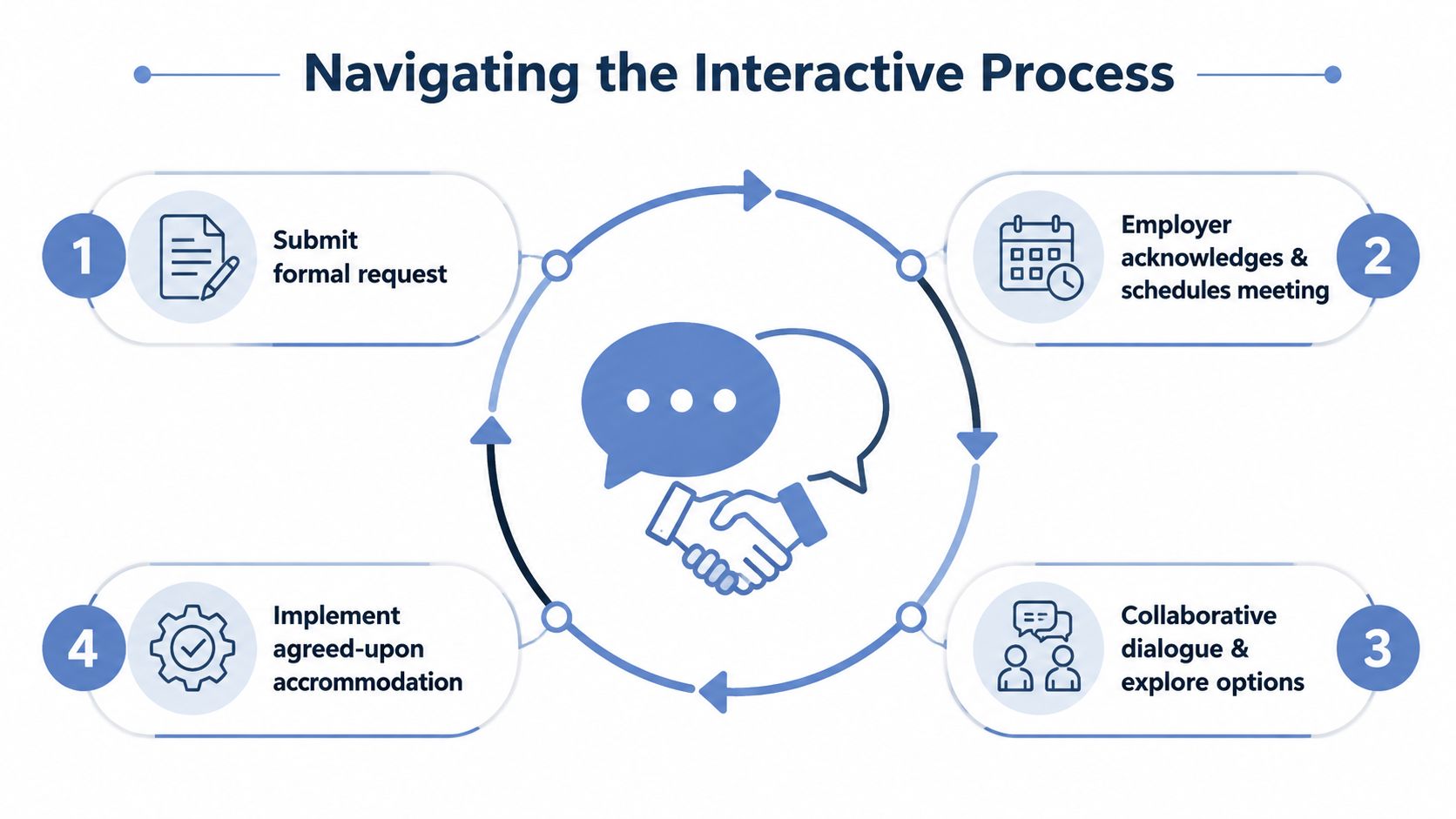
Navigating the Interactive Process With Your Employer
The interactive process is a working conversation, not a one-time approval form. You identify the barrier, your employer evaluates the request, and both sides discuss effective options. An employer may ask for limited medical information, consult human resources, or propose a different accommodation.
Keep the discussion tied to essential duties
Suppose you request remote work because commuting and an open office worsen a documented condition. Your employer says the position requires collaboration. A productive response would be:
I understand collaboration is essential. Can we identify which duties require physical presence and discuss whether meetings, document review, and routine communication can be performed remotely, with scheduled in-person attendance for tasks that genuinely require it?
That answer doesn't demand automatic approval. It forces the discussion toward job duties and workable design.
If the employer proposes a different adjustment, ask how it addresses the limitation. You can respond, “I'm willing to consider that option, but my provider explained that it won't address the concentration barrier because the interruptions remain. Can we evaluate a private workspace or a structured schedule instead?”
Document each stage
After every meeting, send a short confirmation email:
- Record the date: Identify when the conversation occurred and who attended.
- Summarize proposals: State what you requested and what the employer offered.
- Identify open questions: Note missing medical information, equipment decisions, or scheduling issues.
- Set a follow-up point: Ask when the employer expects to respond or test the option.
Employers may use a trial period. That can be reasonable if the employer defines the trial's length, performance measures, privacy protections, and review process. Don't agree to an undefined trial that lets management declare failure without explaining the standard.
Implementation matters as much as approval. In a Canadian federal public-sector follow-up survey, 72% of respondents said their accommodation request had been approved, but only 64% of approved accommodations were fully in place when surveyed. The Canadian follow-up survey illustrates why you should track the person responsible for ordering equipment, changing schedules, installing software, or communicating the arrangement to supervisors.
For more detail on employer and employee responsibilities, review the ADA interactive process. Stay cooperative, but don't let “we're looking into it” replace a documented plan.

Why Accommodation Requests Get Denied and How to Respond
Denials often use broad language. “Too expensive,” “too hard,” and “not reasonable” may be genuine concerns, but those words don't end the analysis. You need to ask what specifically creates the burden and whether another effective option exists.
Deloitte's 2024 survey reported that 74% of workers who requested accommodations had at least one request rejected, and almost 20% had every request rejected. The survey identified cost as the stated reason in 41% of denials, implementation difficulty in 30%, and an assertion that the request was unreasonable in 29%. Deloitte survey findings on accommodation requests make the response strategy clear. Don't argue only that you deserve help. Address the employer's stated obstacle with a narrower, documented solution.
| Denial Reason | Employer's Claim | Your Response Strategy |
|---|---|---|
| Cost | “The equipment or schedule change costs too much.” | Ask for the specific cost analysis. Propose a lower-cost alternative, existing equipment, a phased option, or a change that addresses the same limitation without the disputed expense. |
| Implementation difficulty | “We can't reorganize the department to do this.” | Identify the exact operational problem. Suggest a defined schedule, limited remote days, written procedures, or a trial with objective review points. |
| Unreasonable request | “This would give you special treatment.” | Connect the request to a documented functional limitation and explain how it allows you to perform essential duties. |
| Essential duties | “You can't perform the job this way.” | Ask which essential duty cannot be performed and whether a different accommodation would preserve that duty. |
| No medical support | “We need more information.” | Ask for the precise information needed and provide focused documentation addressing the limitation and proposed adjustment. |
Separate a real hardship from a reflexive rejection
Undue hardship depends on the accommodation and the employer's circumstances. A request for a private workspace may be easier to implement than specialized software. A remote-work request requires analysis of the actual position, essential duties, supervision needs, security requirements, and available technology. A blanket return-to-office policy doesn't automatically answer whether remote work can accommodate a particular employee.
The ADA undue hardship discussion can help you evaluate whether your employer properly analyzed the request. Ask for the decision in writing. If the employer rejects your proposal, request an alternative that addresses the same limitation.
Don't respond with anger or an unsupported accusation. State the problem, answer the stated objection, and keep the record professional. A denial can be unlawful, but your documentation should show that you participated in finding an effective solution.
Next Steps When Your Request Is Denied or Ignored
A denial isn't the end of the process, but ignoring the denial is a mistake. First, request the decision in writing. If the employer hasn't responded, send a concise follow-up identifying the original request, the date submitted, the medical documentation provided, and the accommodation still needed.
Escalate in a controlled sequence
Use this order:
- Ask for internal review: Send the denial to human resources or the company's designated accommodation contact. Ask the employer to identify the reason, the information considered, and any alternative accommodation it evaluated.
- Preserve the record: Save emails, text messages, policies, job descriptions, medical paperwork, meeting notes, disciplinary notices, schedules, and pay records. Keep a private chronology with dates and names.
- Evaluate retaliation: Watch for reduced hours, sudden discipline, exclusion, threats, or termination after your request. Retaliation for asserting ADA rights is prohibited under the federal framework.
- Use federal channels: Because Mississippi has no state human rights commission, workers generally must rely on federal enforcement channels for disability discrimination and retaliation complaints. The Equal Employment Opportunity Commission is the principal agency for those federal claims.
Deadlines can be decisive. The EEOC's filing period depends on the facts, employer coverage, the type of claim, and the location involved. Don't assume that an internal appeal pauses an EEOC deadline. Get advice promptly and confirm the applicable deadline directly with the EEOC or an employment attorney.
Don't confuse workers' compensation retaliation with ADA retaliation
Mississippi doesn't provide a dedicated state-law retaliation claim merely because someone filed a workers' compensation claim. Filing a workers' compensation claim alone doesn't create a separate retaliation cause of action under Mississippi law, and the Mississippi Workers' Compensation Act doesn't contain an anti-retaliation remedy, as described by Mississippi employment-law guidance on workers' compensation retaliation. That issue is distinct from retaliation for requesting a disability accommodation or asserting ADA rights.
Legal representation can help when the employer refuses to engage, demands excessive medical information, disciplines you after the request, or denies an accommodation without analyzing alternatives. Contingency arrangements are common in employment matters, and the average contingency fee is 40% to 50%. Ask about the fee agreement, expenses, deadlines, and whether the lawyer will evaluate the case before accepting it.
Your Action Plan for Requesting Accommodations in Mississippi
Treat your request like a project with an evidence trail. You don't need to threaten your employer. You do need to make the issue impossible to misunderstand.
- Identify the barrier. Write down the job task affected, the limitation you experience, and the adjustment that would let you perform the work.
- Gather focused documentation. Ask your healthcare provider to address functional limitations, workplace impact, recommended adjustments, and expected duration.
- Submit a written request. Use the phrase “reasonable accommodation under the ADA,” attach relevant documentation, and propose a specific solution.
- Participate in the discussion. Consider alternatives, but ask how each option addresses the limitation and preserves essential duties.
- Track completion. Record approval, the assigned owner, ordering or installation, the start date, and whether the accommodation works.

Watch for warning signs: an employer refuses to accept a written request, demands your complete medical history, never identifies a decision-maker, rejects the request without discussing alternatives, or takes negative action soon after you assert your rights. Those facts don't automatically prove a violation, but they justify a prompt legal review.
You can also review related guidance on ADA leave of absence requests and workplace discrimination protections. If you need to discuss a Mississippi employment issue, Nick Norris, P.A. offers case evaluations and guidance on documenting accommodation disputes, federal discrimination claims, and retaliation concerns. Call 601-641-4897 before a deadline or workplace decision limits your options.
If your Mississippi employer denied, delayed, or ignored your disability accommodation request, Nick Norris, P.A. can review the communications, medical documentation, and employment timeline with you. Visit Nick Norris, P.A. to request focused guidance about your rights and next steps.
Leave a Reply