

Most Mississippi employment lawyers work on contingency at roughly 33% to 50% of the recovery, so workers usually pay nothing upfront. The exact percentage depends on the agreement, the stage of the case, and whether the matter resolves before or after extensive litigation.
You may be reading this because your job ended suddenly, your employer ignored harassment, your hours went unpaid, or you were punished after reporting a workplace problem. At the same time, you may be facing medical bills, lost wages, and a basic question that feels difficult to ask: How could I possibly afford a lawyer?
A contingency arrangement is designed for that situation. Instead of paying an attorney by the hour as the case develops, you generally agree that the lawyer will receive a percentage of money recovered for you. But the percentage isn't the only term that matters. Case expenses, settlement timing, statutory fee-shifting, and Mississippi's administrative path can all affect what you ultimately receive.
This guide walks through the money step by step, using Mississippi employment-law examples and plain language. It also addresses an important limitation: Mississippi doesn't provide a retaliation claim because a worker filed a workers' compensation claim. That issue requires separate analysis, not an assumption borrowed from another state's law.
How Mississippi Workers Actually Pay for an Employment Lawyer
Maria leaves work in Jackson after her supervisor fires her soon after she reports repeated harassment. Rent is due, medical bills are accumulating, and she has no savings for hourly legal bills. Her first question for an employment lawyer is practical: What will I owe before this case ends?
With a contingency arrangement, Maria generally owes nothing in attorney fees upfront. The lawyer reviews the facts, investigates, contacts the employer, and pursues a recovery. If the case produces no recovery, the lawyer generally receives no contingency attorney fee. If money is recovered, the lawyer receives the agreed percentage from that recovery. This shifts the financial risk of the legal work from the employee to counsel, as explained in this Mississippi employment-law discussion of no-win, no-fee arrangements.
Case expenses are a separate question. Filing fees, records, expert work, copying, and other costs may be handled differently from attorney fees. The written agreement should say whether the firm advances those costs, whether they are repaid from the recovery, and what happens if the claim produces no payment.
Practical rule: Do not judge an agreement by its percentage alone. Read the provisions about expenses, settlement authority, ending the representation, and what “recovery” includes.
Mississippi also affects the route your claim may take. The state has no human rights commission, so discrimination and retaliation complaints typically go through the federal EEOC rather than a Mississippi agency. That process can affect deadlines, documentation, and when a lawyer evaluates settlement.
A contingency contract and statutory fee-shifting can also interact. If a law allows a prevailing employee to seek attorney fees from the employer, the contract should explain how any fee award affects the lawyer's percentage and your share. Ask that question before signing, because the answer can change the final distribution.
What a Contingency Fee Really Means
Think of a contingency fee like a commission paid after selling a house. A real-estate agent usually doesn't ask the seller to pay the full commission every week while the property is listed. The commission becomes due when the sale closes. In an employment case, the “sale” is a settlement or award, and the lawyer's payment depends on money being recovered.
The basic arrangement works like this:
- You sign a written agreement. It identifies the percentage and explains expenses.
- The lawyer works on the claim. That may include reviewing records, preparing an administrative filing, negotiating, or litigating.
- The case resolves. A settlement or award creates a recovery.
- The funds are distributed. The fee and approved expenses are handled according to the agreement, and you receive the remaining balance.
The lawyer isn't paid because time passes. That differs from hourly billing, where the client pays for legal work as it occurs, often through a retainer. A contemporary U.S. employment-law fee summary places hourly employment work around $250 to $600 per hour, with retainers around $5,000 to $25,000 in some arrangements, as reported in this employment-law contingency fee overview. Those figures aren't a Mississippi quote for every lawyer or matter, but they illustrate why employees often consider contingency representation when they can't fund ongoing hourly work.
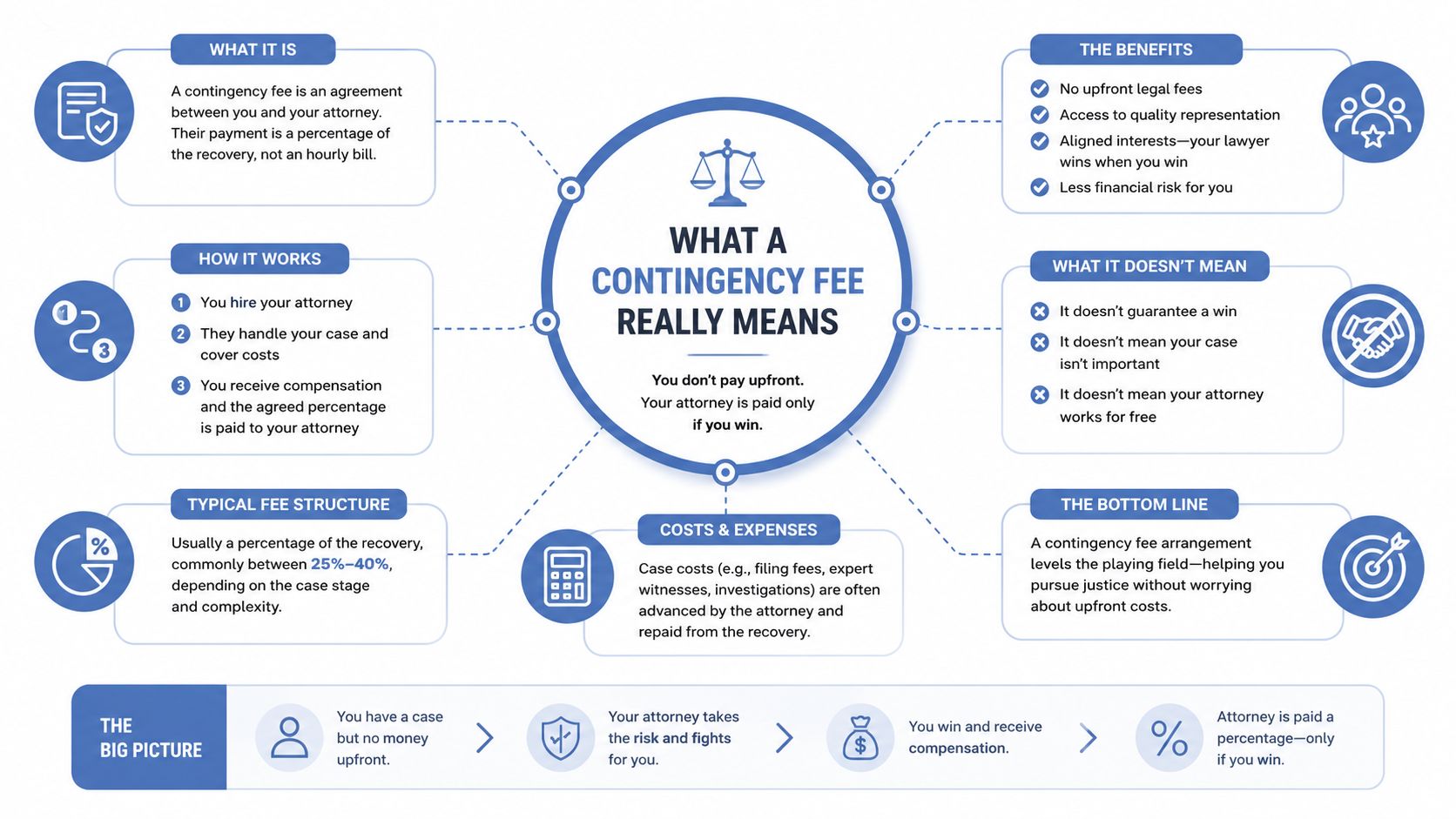
“No recovery, no fee” usually refers to attorney compensation, not necessarily every possible case expense. Filing charges, records, depositions, expert work, and other litigation expenses may be treated separately. Ask for the answer in writing before signing.
The most important point is simple: the lawyer is paid only if money is recovered under the contingency contract, while you should understand exactly what happens to expenses in both a successful and unsuccessful matter.
How the Percentage, Costs, and Stages Actually Work
The percentage is only the first line in the calculation. A fee agreement should tell you whether the percentage applies to the gross recovery or to the amount left after approved expenses are deducted. That distinction can change your net payment.
In U.S. employment cases handled on contingency, the commonly reported range is about 33% to 40%, and the percentage can rise to 50% in some cases depending on risk, litigation stage, and whether the dispute settles early or after extensive discovery, according to this contingency-fee explanation for employment lawyers. Many agreements use a sliding scale. The percentage is often lower before formal litigation and higher after a complaint is filed because discovery, depositions, motions, and trial preparation require more work and expose the lawyer to greater risk.
A simple recovery example
Suppose a Mississippi worker recovers $60,000. At 33%, the attorney fee is $19,800, leaving $40,200 before case expenses. At 45%, the attorney fee is $27,000, leaving $33,000 before expenses. If the agreement deducts $2,000 in approved expenses after calculating the fee, those amounts would fall to $38,200 and $31,000, respectively.
Those numbers are illustrations, not a prediction of any case value or a standard Mississippi charge. The point is to show why you should ask whether expenses are deducted before or after the percentage.
A typical stage structure may look like this:
| Stage | Typical percentage | Why it changes |
|---|---|---|
| Pre-suit settlement effort | Lower end of the agreed range | The lawyer may resolve the matter without filing a complaint or conducting extensive discovery. |
| Filed complaint and discovery | Middle or higher tier | The case requires formal pleadings, document exchange, depositions, and motion practice. |
| Trial or appeal | Highest tier in some agreements | Preparation, risk, and attorney time increase substantially. |
Before signing, compare the agreement with this Mississippi employment lawyer cost guide and ask four direct questions: What is the percentage at each stage? Who advances costs? Are costs deducted before or after the fee? What do I owe if there is no recovery?
The fee agreement should answer those questions without requiring you to decode legal jargon.
Statutory Fee-Shifting and How It Changes the Math
A contingency contract and statutory fee-shifting are two different arrangements. The contract governs the relationship between you and your lawyer. A fee-shifting statute may allow a successful employee to seek attorney's fees from the employer.
That framework appears in federal employment laws including Title VII, the ADA, the ADEA, and the FLSA. If an employee prevails, the applicable law may permit recovery of reasonable attorney's fees from the employer. This is separate from the percentage in your contract, and your lawyer should explain how the two interact in the specific claim.
Consider a simplified example. You recover money for a discrimination claim, and your agreement provides for a contingency percentage. If the applicable statute also supports an attorney-fee award, the employer may be ordered to pay some or all of the reasonable fees recognized by the court. Depending on the agreement and the result, that may reduce the amount taken from your damages, change the final accounting, or affect how the lawyer is compensated. It doesn't automatically mean you receive every dollar of the recovery or that every requested fee will be awarded.
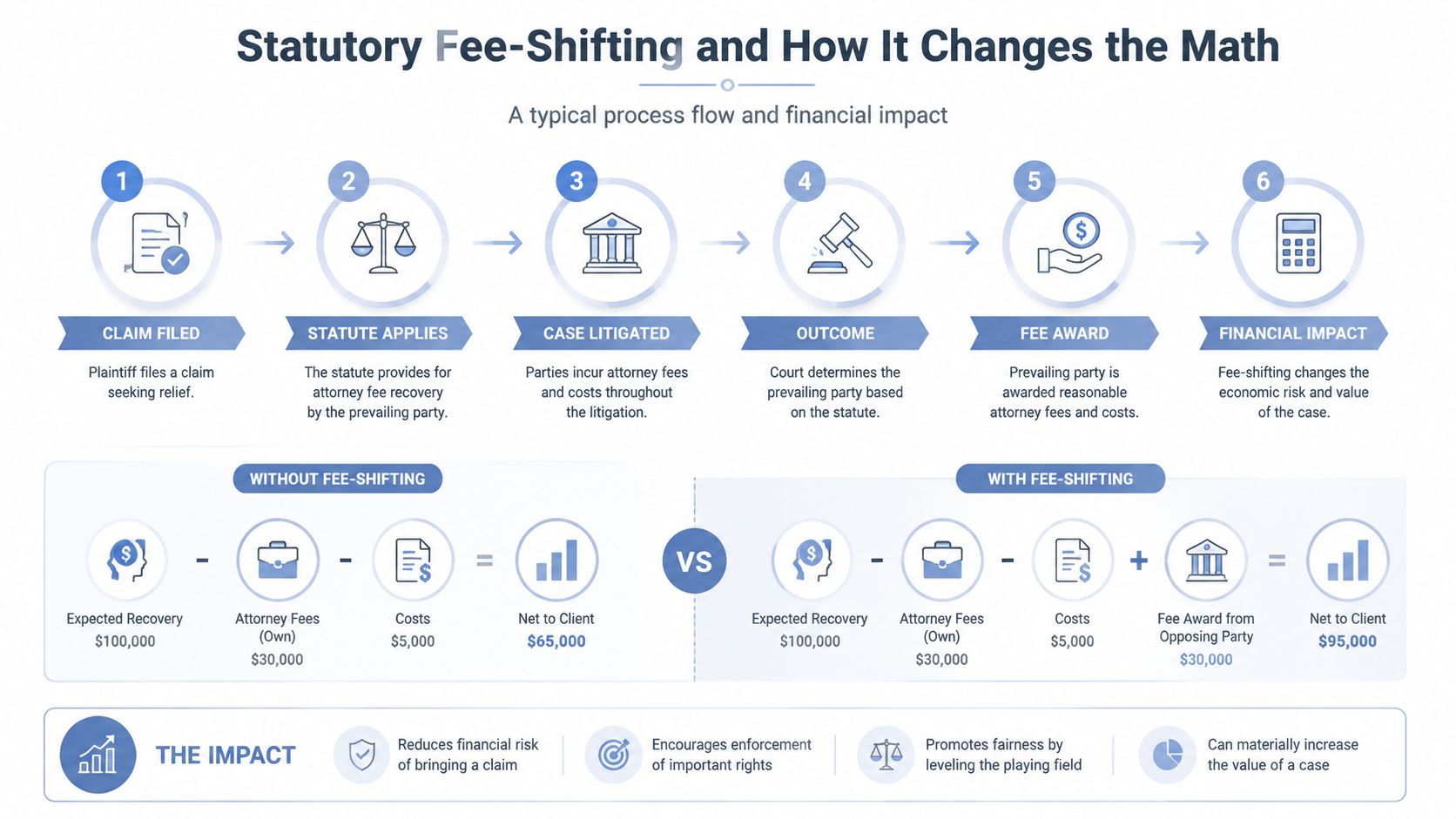
The practical question is not merely, “Is this contingency?” Ask instead:
- Which law applies? Fee-shifting depends on the statute supporting the claim.
- What does the contract say? The agreement may explain how an employer-paid fee affects the contingency calculation.
- What happens if the award is limited? A court may award less than the amount requested.
- Are fees separate from damages? Sometimes the legal framework treats fees as an additional component, but the precise result depends on the claim and ruling.
This interaction helps explain why plaintiff-side employment representation can be economically viable even when an employee lacks money for hourly billing. A Mississippi discrimination settlement guide can help you identify the broader settlement questions that should be discussed with counsel.
Pros and Cons for Mississippi Employees
After a firing, harassment, discrimination, or unpaid-wage dispute, your paycheck may already be under pressure. Contingency representation can let you pursue legal advice without paying ongoing attorney fees from each paycheck. The lawyer is generally paid from a recovery rather than through hourly invoices as the case develops.
The arrangement also connects the lawyer's compensation to the result. Counsel has a reason to examine the evidence, possible damages, and settlement offers carefully. For a worker with limited savings, shifting much of the attorney-fee risk to the lawyer may determine whether the claim receives a serious review.
What works in your favor
- No routine hourly invoices: You generally do not pay attorney fees while the lawyer works.
- Shared financial risk: Counsel may spend substantial time without guaranteed compensation.
- Access to resources: The lawyer can assess records, witnesses, settlement positions, and litigation needs without requiring hourly payment at the outset.
- A clearer endpoint: The fee is usually calculated when the matter produces a recovery.
The tradeoff is the percentage. A large recovery can mean a substantial fee, particularly if the agreement uses a higher percentage at a later stage. Case expenses may remain your responsibility. Depending on the contract, you may also owe reimbursement for those expenses even if the case produces no attorney fee.
The lowest percentage is not automatically the best arrangement. Clear terms and sensible expense provisions may matter more than a small difference in the headline number.
You may have less control over strategy than expected. Your lawyer can recommend accepting a settlement, but you should know who has final authority to accept or reject it. Before signing, ask how disagreements will be handled, how often you will receive updates, and what happens if you end the relationship.
A simple example can clarify the choice. One agreement may offer a lower percentage but leave more expenses with you. Another may charge a higher percentage while covering more work at the outset. Compare the full contract, not just its headline fee.
The arrangement should fit the claim, the expected work, your finances, and what you can afford if the matter ends without a favorable recovery.
Mississippi Rules, Ethics, and Practical Realities
A Mississippi worker may report discrimination to management and still need to use the federal EEOC process. Mississippi doesn't have a state human rights commission. Discrimination and retaliation complaints therefore typically go through the EEOC rather than a Mississippi human-rights agency. That routing affects deadlines, records, and the order of the next steps.
Keep the evidence in one place: messages, schedules, performance reviews, pay records, medical documentation, witness names, and complaints made to management. An internal report does not automatically replace any required federal administrative filing. An attorney can review the facts and help identify the applicable route and timing.
Workers' compensation retaliation has a different limitation. Mississippi doesn't provide a retaliation claim for filing a workers' compensation claim. Filing a workers' compensation claim alone does not create a dedicated state retaliation cause of action. Depending on the employer's conduct and the surrounding facts, counsel may need to examine another theory, such as tortious interference.
What that means in practice
- A workers' compensation filing isn't automatically protected from retaliation under a dedicated Mississippi claim.
- The employer's reason for an adverse action still matters.
- Timing alone may not establish a claim.
- Other facts may support a different theory, but that requires legal analysis.
The Workers' Compensation Act contains no remedy for retaliatory discharge, a limitation also discussed in this Mississippi workers' compensation retaliation analysis.

Common Employment Cases Handled on Contingency
A contingency arrangement usually makes the most sense when the claim involves a legally recognized violation, evidence that can be investigated, and a potential monetary recovery. In Mississippi, common employee-side matters include the following.
Discrimination and harassment
Claims under Title VII, the ADA, and the ADEA may involve adverse treatment connected to protected characteristics. The facts might include termination, demotion, unequal discipline, failure to accommodate, or discriminatory hiring and promotion decisions. Sexual harassment and hostile-work-environment claims may also involve unwanted conduct, management knowledge, repeated incidents, or retaliation after a complaint.
These matters often require a careful timeline. Keep the original messages and write down who said what, when it happened, and how management responded. A contingency lawyer evaluates both liability and damages before deciding whether the case fits the model.
Retaliation and protected activity
Retaliation claims can arise when an employer punishes an employee for engaging in legally protected activity, such as reporting discrimination or participating in an investigation. The alleged retaliation may include termination, schedule changes, discipline, demotion, or other materially harmful treatment.
Don't treat every unfair workplace reaction as unlawful retaliation. The protected activity, the employer's knowledge, the adverse action, and the connection between them all require analysis. A workers' compensation filing alone doesn't create a Mississippi retaliation claim, as discussed earlier.
Wrongful termination and leave issues
A termination may support a claim when it violates a federal employment statute or another recognized legal protection. Related matters can involve the Family and Medical Leave Act, including interference with protected leave or retaliation for using rights under that law.
Employees affected by layoffs may also need advice about the Worker Adjustment and Retraining Notification Act, while service members may have issues under the Uniformed Services Employment and Reemployment Rights Act. Each law has its own requirements, so bring the termination notice, leave records, military-service documentation, and employer communications to a consultation.
Unpaid wages and overtime
The Fair Labor Standards Act can apply to unpaid overtime and other wage-and-hour disputes. A worker may need to organize time records, paystubs, schedules, texts, and information about how the employer classified or tracked working time.
Fee-shifting under the FLSA can be important because a prevailing employee may seek attorney's fees from the employer. That statutory feature can make a contingency arrangement more practical, but it doesn't guarantee a recovery. The strength of the records and the legal classification of the work still matter.
Your consultation checklist
Bring a short timeline and ask:
- Percentage: Is the fee lower before a complaint and higher afterward?
- Calculation: Does the percentage apply before or after case expenses?
- Advances: Who pays filing, deposition, record, and expert costs as the case proceeds?
- Loss: If the case ends without recovery, do I owe any expenses?
- Settlement: Who decides whether an offer is accepted?
- Communication: How will the lawyer update me, and who will answer routine questions?
- Deadlines: What administrative or legal deadlines could affect the claim?
- Documents: What evidence should I preserve, and what should I avoid deleting or discussing publicly?
Nick Norris, P.A. evaluates Mississippi employment matters involving discrimination, harassment, retaliation, unpaid overtime, wrongful termination, FMLA, WARN, USERRA, and related workplace disputes. The office can be reached at 601-641-4897.
By Nick Norris, Attorney
Last updated: August 15, 2026
Reviewed by Nick Norris
Frequently Asked Questions About Contingency Fees in Mississippi
Do I owe case expenses if the claim loses?
Maybe. A no-recovery, no-fee provision usually addresses attorney compensation, but expenses are controlled by the written agreement. Ask whether the firm advances costs and whether you must reimburse them if the matter ends without a recovery.
Can I change lawyers during the case?
You can ask to end the relationship, but changing counsel can affect deadlines, costs, liens, and the fee owed for work already performed. Review the termination clause before taking action, and don't assume a new lawyer can step in without examining the existing agreement.
Are settlement proceeds taxable?
Possibly. Tax treatment depends on what the payment represents, such as wages, emotional-distress damages, interest, or other categories. Your employment lawyer can explain the legal characterization, but a tax professional should address your individual filing obligations.
Does contingency make sense for a small back-wage claim?
Not always. A small wage claim may be easier to document, but the amount at issue, available fee-shifting, record quality, and expected work all affect whether a lawyer can accept it on contingency. Discuss the economics rather than assuming the answer.
For additional consultation questions, review this Mississippi employment lawyer question guide. Before the meeting, gather pay records, schedules, written complaints, termination documents, medical or leave records, and a dated account of what happened.
Ask for a written explanation of the percentage, expenses, settlement authority, termination terms, communication process, and deadlines. Those answers will tell you far more than a promise that you won't pay upfront.
Nick Norris, P.A. offers initial consultations for Mississippi employment matters and handles many qualifying cases on a contingency basis, with no attorney's fee unless the client recovers. If you've experienced discrimination, harassment, retaliation, unpaid overtime, wrongful termination, or a leave-related problem, visit Nick Norris, P.A. or call 601-641-4897 to request a case evaluation.
Leave a Reply