

By Nick Norris, P.A.
Last updated: August 27, 2026
Reviewed by Nick Norris
Your employer tells you that you weren't selected because the job requires a “certain type of person.” Maybe you're a 58-year-old applicant in Flowood and the hiring manager says the warehouse needs someone “young and energetic.” Maybe you're a female nurse who was denied a night-shift assignment at a rural hospital because management claims patients will only accept care from men.
The explanation sounds operational. The facts may tell a different story. A job requirement can be a legitimate safety or privacy rule, but it can also be a polished excuse for excluding workers based on stereotypes.
That's where the bona fide occupational qualification, commonly called a BFOQ, matters. Federal law recognizes this defense only in exceptionally narrow circumstances. Mississippi workers must understand what the defense permits, what it doesn't permit, and how to challenge an employer that uses it as a shortcut around discrimination law.
When an Employer Claims Only Certain People Can Do the Job
The warehouse applicant from Flowood asks what “young and energetic” means. The employer doesn't identify a lifting test, response-time requirement, medical standard, or essential duty that the applicant couldn't perform. It points to age and treats age as proof of ability.
That should concern you.
A similar problem arises in healthcare. A hospital may have legitimate privacy concerns when an employee must provide intimate physical care to undressed patients. But “patients prefer women” or “the staff is more comfortable with men on nights” doesn't automatically transform a preference into a lawful job qualification.
The warning signs
A claimed BFOQ deserves scrutiny when the employer:
- Uses adjectives instead of standards: Words such as “young,” “energetic,” “strong,” or “presentable” may conceal an assumption rather than describe a measurable job duty.
- Relies on preference: Customer, patient, coworker, or supervisor preference generally isn't enough.
- Applies a blanket rule: Excluding an entire protected group without examining individual ability is a major warning sign.
- Changes the explanation: If the employer gives one reason during hiring and another after you complain, preserve both versions.
- Can't identify the essential duty: The employer should be able to explain what core task requires the exclusion and why a neutral qualification won't work.
The federal rule is demanding because discrimination is normally prohibited. The Equal Employment Opportunity Commission describes the BFOQ exception as extremely rare and strictly construed in its explanation of Title VII's statutory language.
Practical rule: If the employer can't connect the protected characteristic to a specific, central job duty, treat the BFOQ explanation as a claim to test, not a conclusion you must accept.
Mississippi has no human rights commission. That doesn't leave workers without a federal enforcement route, but it does mean you shouldn't wait for a state agency to sort out the issue. The EEOC is usually the primary administrative door, and your records may be the evidence that shows the employer's stated qualification was only a stereotype.
What the Bona Fide Occupational Qualification Defense Actually Means
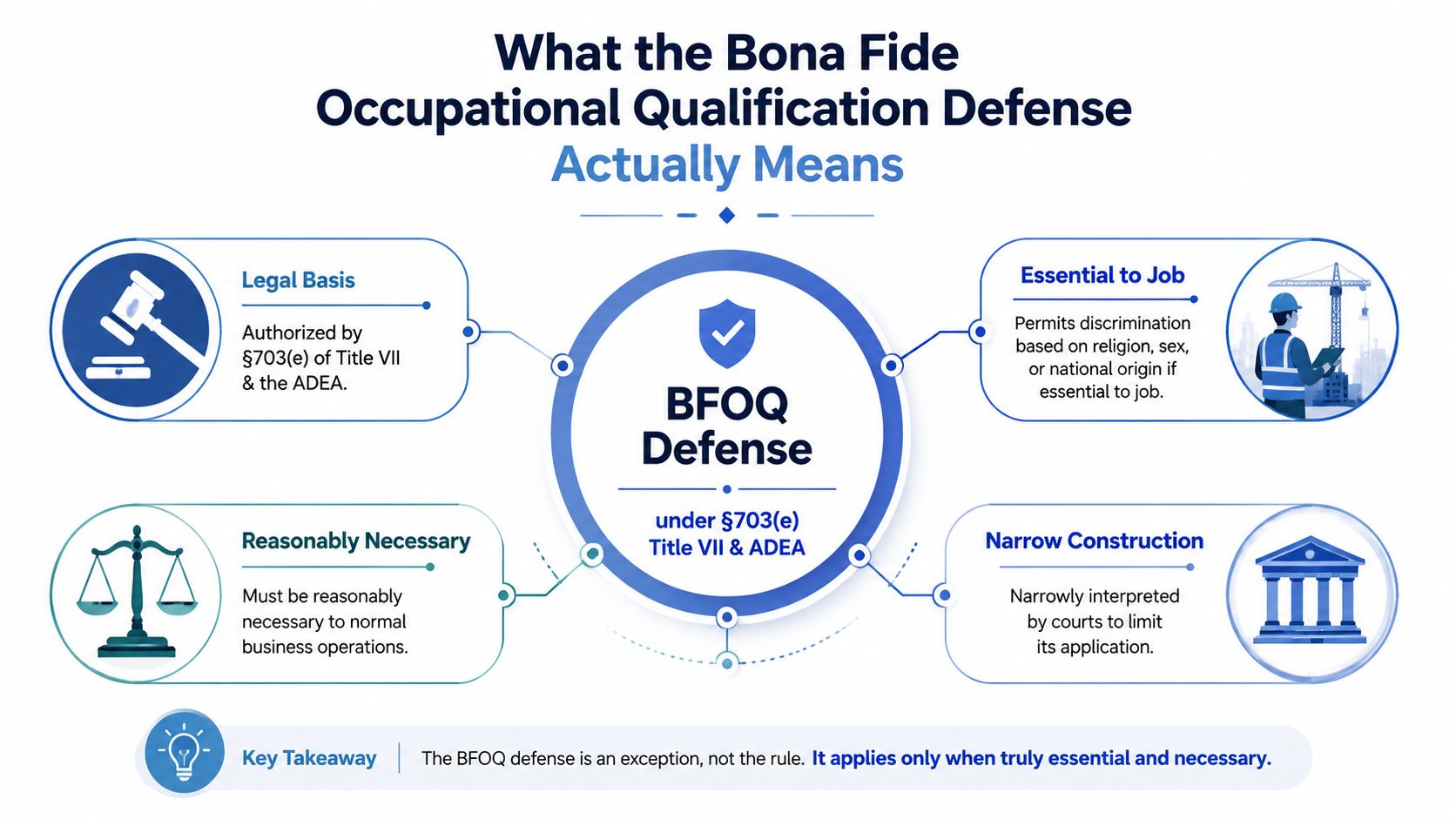
Section 703(e) of Title VII, codified at 42 U.S.C. § 2000e-2(e)(1), permits discrimination based on religion, sex, or national origin only in limited circumstances where the trait is a BFOQ “reasonably necessary to the normal operation” of the business or enterprise. The EEOC's BFOQ guidance emphasizes that this is a very narrow exception, not a general business exemption.
The Age Discrimination in Employment Act also contains a related BFOQ defense for age-based requirements. The age regulation places the burden on the employer to show that an age limit is reasonably necessary to the essence of the business and that excluded workers are either substantially unqualified or can't be evaluated individually in a practical way. The federal age-discrimination regulation captures that demanding standard.
Break the rule into three questions
First, what is the job's essence? The employer must identify the central operation of the business or position. A qualification tied to an intimate-care duty or a role requiring authentic portrayal may receive serious attention. A preference for a youthful image usually doesn't define the essence of a warehouse operation.
Second, why is the trait necessary? “Necessary” is stronger than useful, convenient, cheaper, or preferred. The employer needs a factual explanation connecting the protected characteristic to actual job performance.
Third, why can't the employer evaluate people individually? A broad exclusion becomes difficult to defend when testing, training, reassignment, scheduling, or another neutral process could determine who can perform the work.
Race and color cannot be BFOQ grounds under Title VII. An employer can't lawfully claim that customers prefer a particular race, that coworkers object to another race, or that racial exclusion improves the company's image.
A BFOQ is an affirmative defense. In practical terms, the employer raises the discriminatory classification and argues that the law excuses it under the narrow statutory exception. Courts and the EEOC construe that defense tightly. Mississippi's lack of a state human rights commission doesn't expand the defense or reduce the federal standard.
For a broader overview of the federal protections that may apply, review this explanation of workplace discrimination laws.
The Burden of Proof Employers Must Meet
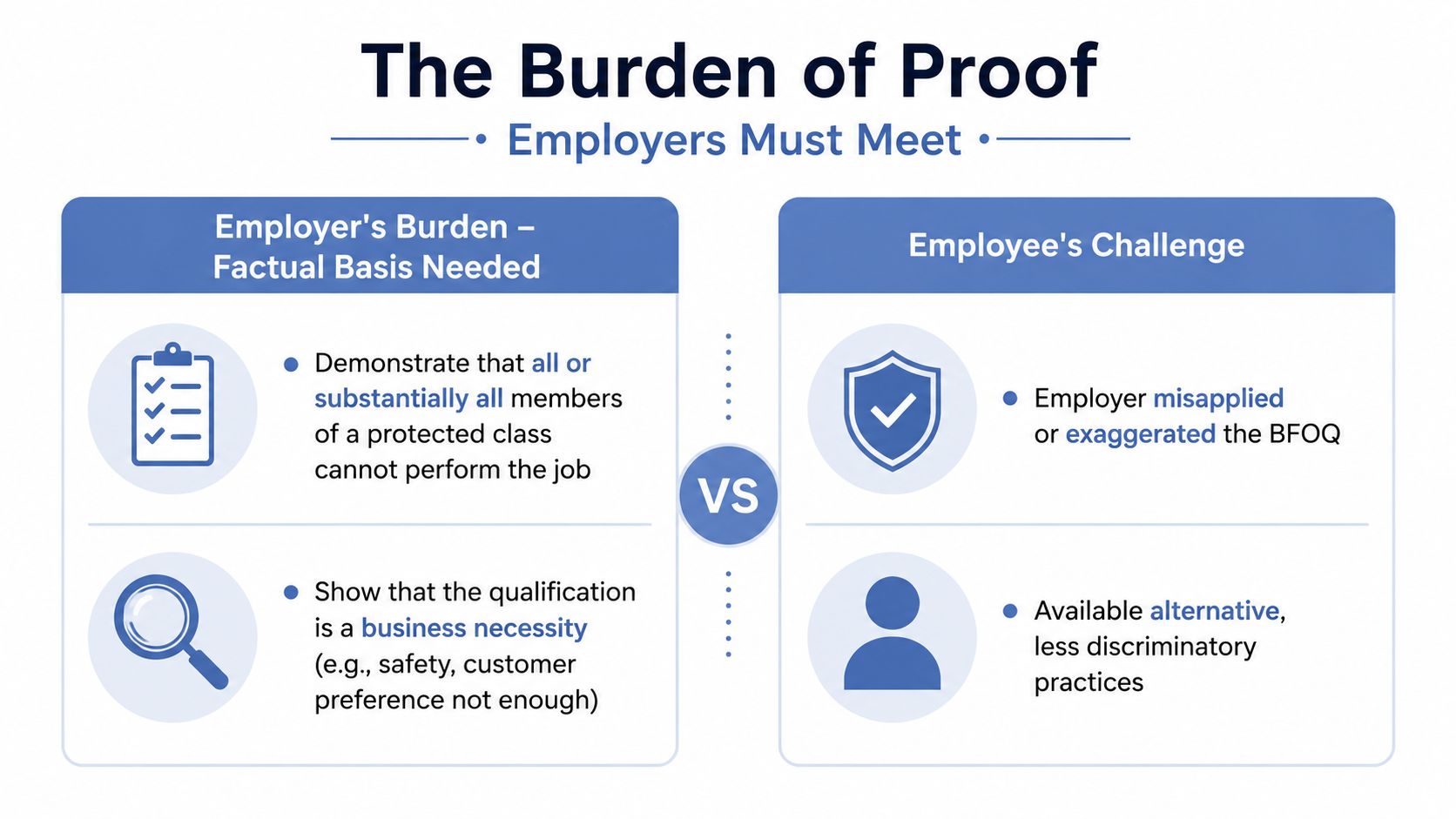
An employer invoking BFOQ carries the burden of proving the defense. It must present facts showing that the excluded group, considered as a whole or nearly as a whole, could not perform the job safely or efficiently, or that evaluating applicants individually would be impossible or highly impractical. The employer must also connect the qualification to the normal operation of the business, not merely to a preferred workforce.
What evidence matters
An employer's personal belief does not carry that burden. Examine the records behind the decision:
- Job-duty evidence: What specific task allegedly requires the exclusion, and how closely does it relate to the position's central work?
- Operational records: Do written policies, incident reports, training materials, or safety rules support the stated requirement?
- Individual-assessment evidence: Did the employer consider testing or another neutral method for evaluating applicants?
- Role-structure evidence: Could assignments or schedules be changed without eliminating the job's core function?
- Consistency evidence: Has the employer allowed members of the supposedly excluded group to perform the same work?
Federal doctrine rejects stereotypes about women's ability to perform strenuous work. It also rejects fetal-protection policies that exclude women based on generalized assumptions about reproductive risk. The employer must prove operational necessity with job-related facts. A group stereotype is not an individual assessment.
Customer preference and coworker discomfort do not satisfy that standard. Neither does a manager's assumption that men are stronger, younger workers respond faster, or a particular religion creates a better workplace atmosphere. Those beliefs may explain a decision, but they do not establish that the protected trait is required for the job.
Calling a rule “safety” does not turn convenience into necessity.
Your practical challenge is to identify a neutral alternative. If lifting ability matters, require the same lifting test for everyone. If response speed matters, define and measure the response standard. If privacy matters, determine whether assignments can be arranged around the private-contact duty. An employer that rejects workable neutral methods should explain why. Its refusal may weaken the BFOQ defense.
For Mississippi workers, preserve the policy, job posting, messages, schedules, and names of similarly situated employees. Then state the facts plainly. A prima facie case explanation can help organize the initial showing without requiring you to prove the entire dispute in the first complaint.
Legitimate Uses Versus Common Employer Misuse
The practical difference is simple. A legitimate BFOQ is tied to what the worker must do. A misuse is tied to what management, customers, or coworkers would rather see.
A female attendant may be necessary for a position requiring intimate physical contact with female patients or access to private areas where patients are undressed. A specific gender may also be relevant to an undercover role where the worker must credibly perform an identity-specific assignment. Those examples focus on the actual function of the position, not an employer's preferred workforce.
The table below shows the distinction.
| Legitimate BFOQ Use | Common Employer Misuse |
|---|---|
| A female attendant performs intimate care for female patients where privacy is inseparable from the assigned duty. | A hospital says women are more comforting and reserves ordinary nursing shifts for women. |
| A worker of a particular gender performs an undercover assignment requiring an authentic identity. | A restaurant hires only young women to create a preferred atmosphere. |
| A narrowly defined privacy rule controls access to undressed patients or inmates. | A supervisor says customers feel more comfortable with one sex or race. |
| An age restriction is supported by objective evidence showing that individual testing isn't practical for a genuinely safety-sensitive role. | A trucking company imposes an age cap because older drivers are assumed to be slower or less safe. |
| The job's essential duties cannot be separated without creating a materially different position. | A warehouse excludes women because management thinks training or equipment operation would be harder. |
| A documented operational rule applies consistently to the position. | A retail chain says male managers are needed to supervise male warehouse crews. |
Why the misuse fails
The restaurant's atmosphere is a business preference, not the essence of serving food. The trucking company's generalized assumption about age doesn't answer whether a particular applicant can meet a defined safety standard. The retail chain's concern about crew dynamics says nothing about whether a woman can supervise, enforce policies, or manage warehouse work.
Healthcare employers must be just as careful. Privacy can matter, but the employer should identify the contact or observation duty and explain why neutral scheduling or assignment practices won't solve it. Patient preference alone doesn't decide the question.
A BFOQ also can't be a disguise for racial exclusion. Title VII doesn't recognize race or color as permissible BFOQ categories. If an employer says a customer, patient, or crew wants a particular race, that statement points toward discrimination, not a defense.
Mississippi workers in hospitality, healthcare, logistics, retail, and industrial jobs should ask one question: Is the requirement attached to the work, or is it attached to a picture of who the employer wants doing the work? That distinction often exposes the weakness in a claimed qualification.
How BFOQ Claims Are Handled for Mississippi Workers
Mississippi has no state human rights commission. If an employer invokes BFOQ to justify discrimination, a private-sector worker generally takes the complaint to the federal EEOC rather than a Mississippi civil-rights agency, as explained in this Mississippi employment-law overview.

The federal pathway
Start by presenting the facts to the EEOC and filing a charge identifying the protected characteristic involved. For many Mississippi employment discrimination matters, the filing deadline is 180 days, according to the EEOC's federal enforcement information. An internal complaint does not automatically stop that clock.
The EEOC can investigate, request records, interview witnesses, and test the employer's explanation against the actual job duties. It may also attempt conciliation. If the administrative process ends with a right-to-sue notice, the worker may bring the claim in federal court, usually in the Northern or Southern District of Mississippi.
Mississippi's at-will rule does not permit discrimination. An employer may end an at-will relationship for a lawful reason, but it cannot use a BFOQ explanation to conceal discrimination prohibited by Title VII or the ADEA.
What the state-law gap means
Separate the federal question from the state-law question. Ask whether the employer's conduct violates federal law, then ask whether Mississippi offers a separate remedy for the same conduct. For private-sector discrimination, the federal route is often the main path because Mississippi lacks a state human rights commission and parallel state administrative process.
That gap makes preparation and timing matter. Review the EEOC investigation process so you understand what follows a charge, then calculate your own deadline from the relevant employment event. In your complaint, identify the job requirement, the protected classification, the employer's stated reason, and the facts showing that the requirement was not tied to the work.
Steps to Take When You Suspect a Wrongful BFOQ Defense
Don't argue with the label first. Build the factual record that tests it.
Start with evidence
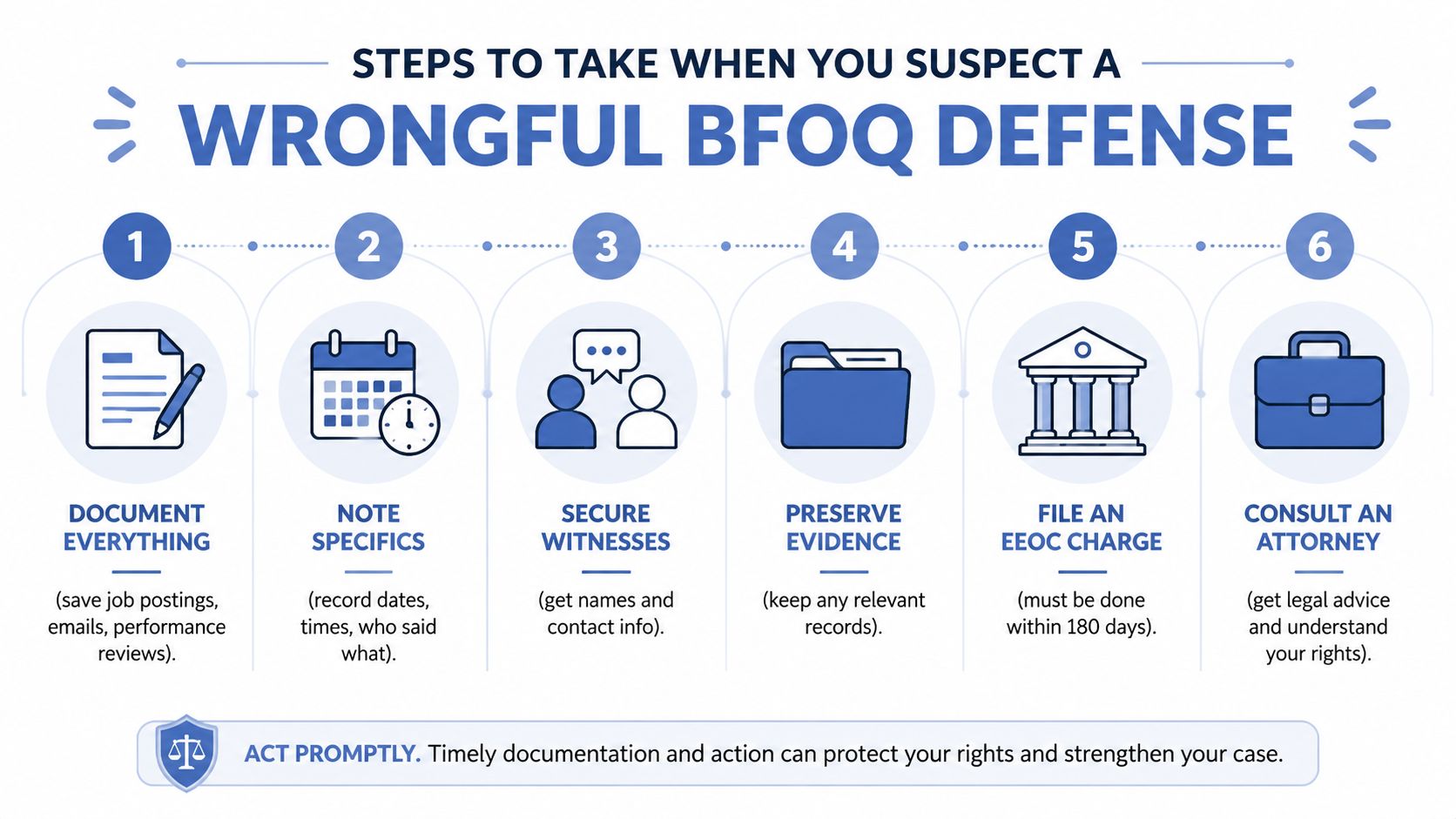
Save the job posting. Keep the original wording, application instructions, recruiting messages, and any later version. A phrase such as “young and energetic” can matter because it may reveal the employer's intended classification.
Record the explanation. Write down who spoke, what they said, when they said it, and who was present. Your notes should distinguish direct statements from your interpretation.
Collect written material. Preserve emails, text messages, policies, internal memoranda, performance reviews, schedules, and rejection notices. Don't alter the originals.
Identify comparators. Note workers outside your protected group who were hired, promoted, retained, assigned the shift, or allowed to perform the same duty. Record the facts that make the comparison fair.
Ask for clarification carefully. You can request the employer's written explanation through an internal process, but don't make accusations you can't support. A short, professional request may generate useful admissions.
Protect the deadline. A Mississippi worker generally has 180 days to file an EEOC charge for a covered federal discrimination claim, based on the federal enforcement framework described by the EEOC. Evidence disappears, job postings change, and witnesses move on. Act before the record becomes harder to prove.
Get advice before committing to a position
Bring an attorney a dated timeline, the job description, communications, names of witnesses, comparator information, and every document you preserved. Legal review before filing can help you identify the correct protected characteristic, describe the BFOQ issue accurately, and avoid making statements that conflict with your evidence.
If the dispute might benefit from a structured resolution discussion, M&N workplace mediation support may provide a useful non-court option for addressing an employer-employee dispute. Mediation doesn't replace an EEOC charge or eliminate a deadline, so protect your legal rights first.
Don't secretly take documents that belong to other employees or violate a confidentiality policy without legal advice. Preserve what you lawfully possess, keep copies of your own communications, and ask counsel how to handle sensitive records.
Sample Language for Your Complaint or Claim
A strong complaint uses facts, not conclusions. Identify the protected characteristic, the job, the decision, the employer's stated qualification, and the reason the qualification doesn't appear reasonably necessary.
You can adapt language like this:
I am [protected characteristic]. I applied for or held the position of [job title] on [date]. The employer stated that [specific characteristic] was required because [employer's stated reason]. The employer did not identify a specific essential duty that required excluding people with my protected characteristic, and it did not apply a neutral individual assessment. I believe the decision discriminated against me based on [religion, sex, national origin, or age] in violation of Title VII or the ADEA.
For a more direct BFOQ challenge, use observable facts:
The employer has asserted that [protected characteristic] is a bona fide occupational qualification for [position]. The stated duty is [specific duty]. I believe the qualification is not reasonably necessary to the normal operation of the business under 42 U.S.C. § 2000e-2(e), because [neutral test, assignment change, schedule adjustment, or individual assessment] could evaluate or address the duty without excluding the protected group. The employer instead relied on [customer preference, coworker preference, generalized safety assumption, convenience, or stereotype].
Make every sentence do work
Avoid writing, “My employer is unfair and hates older workers.” That may express your experience, but it doesn't identify the decision, evidence, or legal theory.
Write instead:
- Name the decision: “The employer rejected my application for the overnight warehouse position.”
- Quote the explanation accurately: “The hiring manager said the company needed someone young and energetic.”
- Identify the missing proof: “The employer did not give me a lifting test or explain why age prevented me from performing the listed duties.”
- Point to evidence: “The posting, rejection email, and witness statement support these facts.”
- State the legal issue: “The employer's explanation appears to rely on age as a proxy for safety rather than an objectively necessary job qualification.”
Have an employment attorney review the draft before filing when the employer already has counsel, the facts involve termination after a complaint, or the employer is asserting mixed reasons for its decision. Precision won't guarantee a successful claim, but vague accusations make it easier for the employer to avoid the question: what specific job duty required excluding you?
Nick Norris, P.A. evaluates Mississippi workplace discrimination claims, including disputes where an employer misuses a bona fide occupational qualification defense. Visit Nick Norris, P.A. or call 601-641-4897 to discuss your documents, deadlines, and practical next steps.
Leave a Reply