

You're at work, something has gone sideways, and you can feel it before anybody says it out loud. Maybe your shift changed after you asked for leave. Maybe a promotion went to someone with less experience. Maybe your manager's tone turned cold the day you complained, and now every mistake gets written up. If you're in Mississippi, don't sit there wondering whether this is “just politics” or something legal. It might be discrimination, and the clock may already be running.
By Nick Norris, Attorney
Last updated: August 2, 2026
Reviewed by Nick Norris
601-641-4897
When Something at Work Feels Wrong and You Start Looking for Answers
A Mississippi worker often comes to this issue after one sharp moment, not after some neat legal lesson. A demotion lands out of nowhere. A supervisor starts nitpicking attendance after a medical request. A younger employee gets the promotion, and nobody can explain why your record suddenly stopped mattering.
That kind of shift can make you question your own judgment. It shouldn't. When the pattern changes right after a protected complaint, a pregnancy disclosure, a disability request, or a race-based comment, you're not imagining the connection just because the company refuses to admit it.
Practical rule: if the timing feels wrong, write it down immediately. Memory fades fast, and discrimination cases are built on timing, comparison, and paper.
Mississippi workers need to understand one hard truth early. Workplace discrimination laws here are real, but they're driven mostly by federal law, not by a generous state system that swoops in to help. That means the first good move is usually not rage-texting your boss or quitting on the spot. It's slowing down, saving records, and figuring out which law may apply.
The next few hours matter more than many realize. If you can identify the event, preserve the evidence, and avoid making the situation worse, you've already done more than many do before they call a lawyer.
The Federal Laws That Actually Cover Mississippi Workers
Mississippi doesn't have a state human rights commission, so the practical backbone of workplace discrimination enforcement is federal. That means you need to think in overlapping safety nets, not one single rule. The same bad decision can touch hiring, pay, leave, discipline, and retaliation all at once.
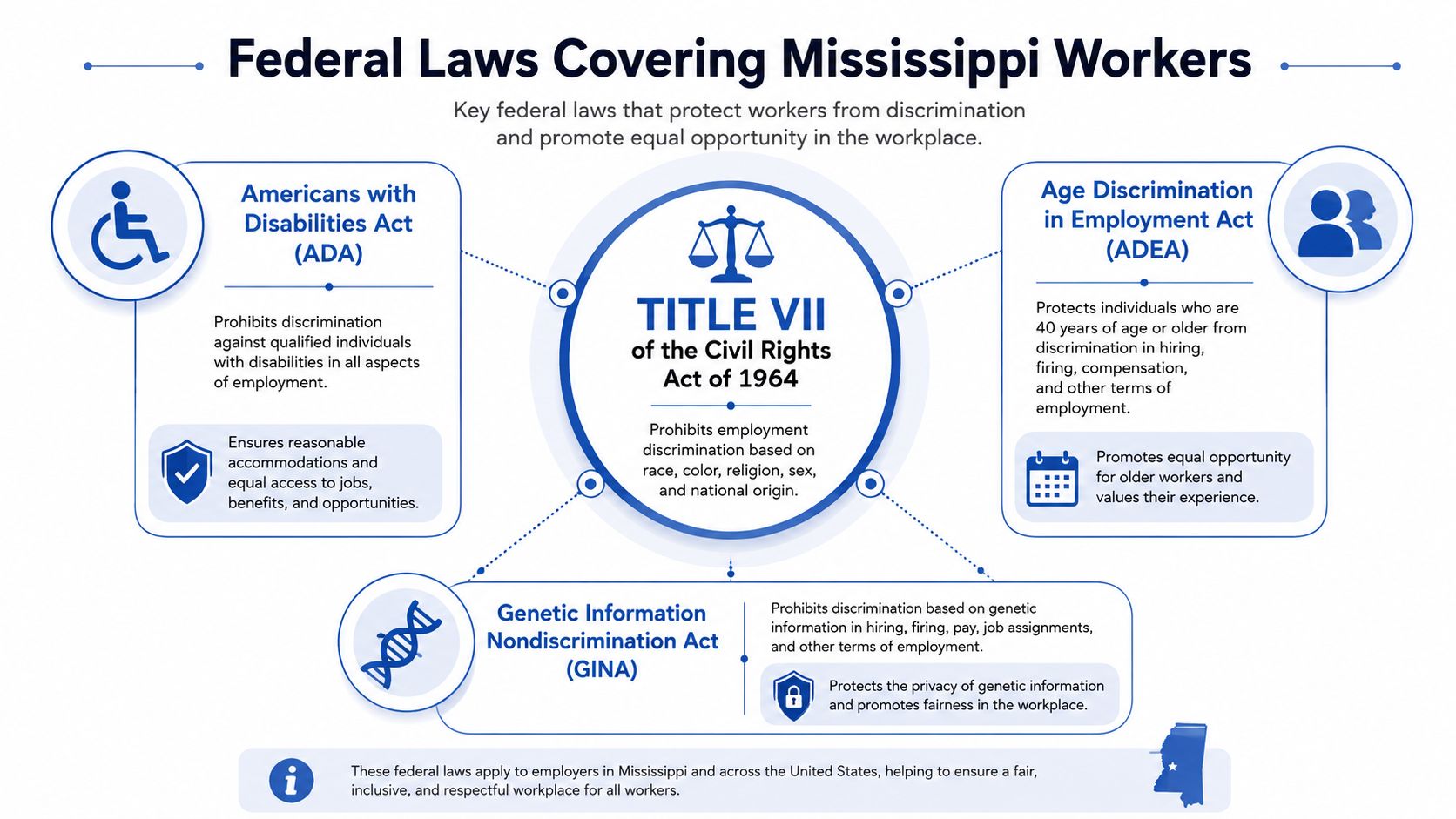
The first and most important statute is Title VII of the Civil Rights Act of 1964. It bars discrimination in compensation, terms, conditions, and privileges of employment because of race, color, religion, sex, or national origin, and it also bars limiting or classifying workers in ways that strip away opportunities under those protected traits (Title VII text). If you're dealing with hiring, promotion, scheduling, or discipline tied to one of those categories, start there.
Then layer in the rest. The ADA covers disability discrimination, the ADEA protects workers age 40 and older, and GINA bars discrimination based on genetic information (EEOC federal laws Q&A). The Equal Pay Act matters when the problem is unequal pay for equal work, and USERRA protects eligible service members from discrimination tied to military service.
One more law matters in Mississippi workplaces that handle onboarding and identity documents. The Immigration and Nationality Act's anti-discrimination rule reaches unfair documentary practices, citizenship or immigration-status discrimination in hiring, firing, and recruiting, and retaliation or intimidation tied to those rights (EEOC rights summary). If your employer is handling I-9 or E-Verify paperwork unevenly, that can become a legal problem fast.
For a Mississippi-specific overview of how these claims fit together, see the firm's Mississippi employment law guide.
What Counts as Discrimination in Day-to-Day Work
Discrimination rarely announces itself with a banner. It usually shows up in ordinary decisions that start to feel lopsided. A Black employee gets the rude jokes and the worst assignments. A pregnant worker gets pushed off the schedule. An older applicant keeps hearing the role is going to “someone who fits the culture better.”
Federal protections cover race, color, religion, sex, national origin, age 40 and older, disability, genetic information, and retaliation (EEOC rights summary). Under EEOC guidance, sex discrimination includes pregnancy, childbirth-related conditions, sexual orientation, and transgender status. That matters in Mississippi because employers sometimes try to split one problem into pieces and pretend it's ordinary management.
Disparate treatment versus disparate impact
Disparate treatment is direct bias. A supervisor says, in effect, “I'm not promoting you because you're pregnant,” or “We're passing you over because of your age.” Disparate impact is quieter. A policy looks neutral on paper, but it falls harder on a protected group. A rigid rule about shift changes or facially neutral testing can do that if it hits one group much harder than everyone else.
The EEOC's own enforcement data shows how often these protections get invoked. In fiscal year 2024, the agency reported 88,531 workplace discrimination charges (EEOC enforcement data). In fiscal year 2020, retaliation accounted for 55.8% of all charges filed, which tells you what workers are facing when they speak up or complain internally (EEOC enforcement data).
If you want a plain-English comparison of workplace bias scenarios, the employment discrimination examples guide is useful. For a broader definition of equal-opportunity language outside the U.S., the equal opportunity employer definition UK also helps sharpen the concept.
Retaliation is the move many employers make after the complaint, not before it. If your schedule, pay, or discipline changed after you raised a protected issue, treat that timeline as evidence.
Why Mississippi Feels Different From Other States
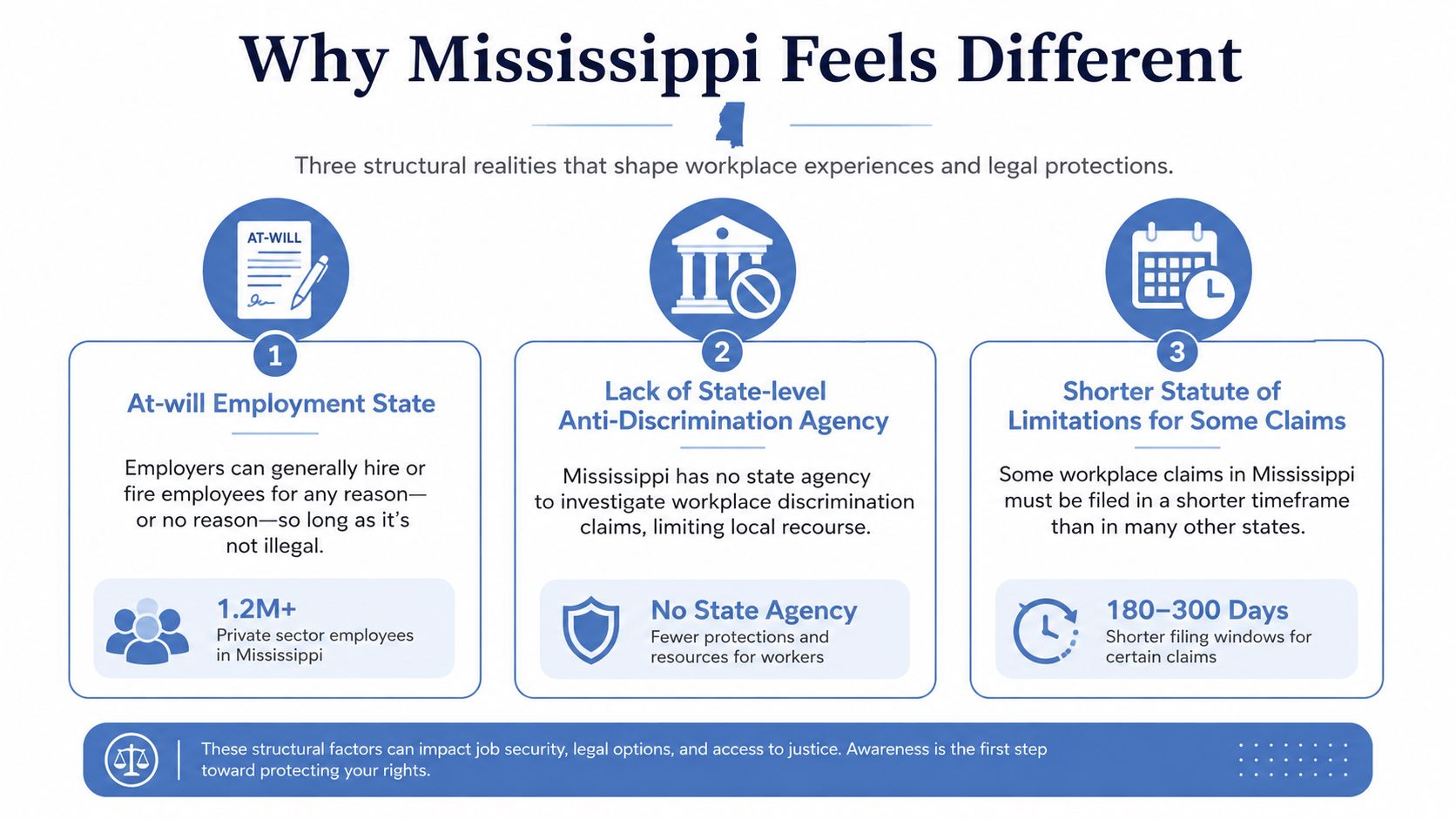
Mississippi is not like a state with a strong local enforcement agency waiting to take your side. There is no Mississippi human rights commission, so a discrimination charge does not get a second home with a state agency. For many workers, the EEOC is the only formal path to file a charge.
That matters because the federal filing deadline is not something you can casually ignore. Under EEOC guidance, the filing window is generally 180 days or 300 days depending on whether a state or local agency also covers the conduct (DOJ civil rights laws overview). In Mississippi, that shorter list of local options is exactly why people need to move early instead of waiting to see whether the problem “gets better.”
The retaliation risk is the real danger
Retaliation is not a side issue. It is the central risk in a lot of Mississippi claims because the worker has already spoken up, requested accommodation, complained to HR, or cooperated in an investigation. The employer may not call it retaliation, but the pattern often looks like punishment disguised as performance management.
Mississippi also has a high complaint volume per capita in the data that's been compiled. One source reports an average of 60.8 EEOC complaints per 100,000 residents from 2009 to 2018, second only to Alabama in that dataset (Mississippi employment law statistics). That doesn't prove any individual claim, but it does show that this state is not some quiet backwater where discrimination disputes never surface.
Here's the practical takeaway. If you're in Mississippi, you don't get the luxury of assuming a local agency will step in later. You need to think in terms of the EEOC timeline, the retaliation risk, and whether the evidence is being preserved now.
Filing Deadlines and the EEOC Process in Practice
Most discrimination claims don't die because the worker was wrong. They die because the worker waited too long. That's the blunt truth, and it's why the calendar matters as much as the facts.
A Mississippi employee usually has to file a charge with the EEOC within the applicable federal window, and in practice 300 days is often the number people focus on when there isn't a local agency in play (DOJ civil rights laws overview). Miss that deadline, and a strong story can still become a lost case. That is not fairness, but it is reality.
What the EEOC process usually looks like
A worker files a charge. The EEOC opens intake and gets the basic facts. The employer gets a chance to respond, and the agency may offer mediation, investigate, or both. If the case does not resolve, the EEOC can issue a right-to-sue notice, which is the document that opens the door to federal litigation after exhaustion.
That process sounds neat on paper. In real life, it's slower and more frustrating. Employers deny everything. HR narrows the story. Managers act like every bad decision was a coincidence. Your job is to keep your own record cleaner than theirs.
For a more detailed look at the agency side, see the EEOC investigation process guide.
Short version: file early, stay organized, and don't assume the employer's explanation will stay consistent.
And one thing is not part of the ordinary Mississippi path for these claims. You're not looking for a state-court shortcut here. The federal charge process is the gatekeeper, and after that, federal procedure usually controls.

Building a Strong Claim With the Evidence You Already Have
Your best evidence is probably already in your phone, inbox, or work account. The mistake people make is waiting until a lawyer asks for documents. By then, half the trail is gone, deleted, or buried.
Start with the basics. Save emails, text messages, chat logs, voicemails, performance reviews, schedules, disciplinary write-ups, and pay records. If your employer uses a portal, download what you can legally access and keep copies outside the company system.
What to preserve first
- Messages and emails: Save the exact wording, the sender, the date, and the time. Tone matters less than timing and content.
- Comparators: Write down who got treated better, who got the promotion, and what makes that person a useful comparison.
- Contemporaneous notes: Keep a running log of meetings, comments, and adverse actions with dates, times, and witnesses.
- Accommodation requests: Save the request, the response, and any follow-up after you asked for help.
- Retaliation timeline: Track every schedule cut, write-up, demotion, or termination after the protected complaint.
If HR interviews you, be careful. Stick to facts, don't guess, and don't fill silence by apologizing for things you didn't do. A sloppy internal statement can make an otherwise good claim harder to prove later.
The reason documentation matters is simple. Discrimination cases turn on whether the employer's story holds up against a timeline. If your record is detailed and theirs is vague, you're in a much stronger position when the charge gets evaluated.
Remedies, Costs, and When to Call an Employment Lawyer
If a discrimination claim has real traction, the remedies can include back pay, front pay, compensatory damages, punitive damages in some cases, attorneys' fees, and equitable relief like reinstatement or policy changes. The exact recovery depends on the statute, the facts, and how the proof comes together. None of that happens automatically just because the employer behaved badly.
The fee question matters too. In Mississippi, many employment lawyers handle these cases on contingency, and a common contingency range in this practice area is 40 to 50% of the recovery. That number should be discussed up front and put in writing before you sign anything. If a lawyer won't explain the fee structure plainly, keep looking.
For employers, it's also worth understanding that weak insurance can leave them exposed. The EPLI coverage risks discussion is a useful reminder that workplace claims don't stay hypothetical for long once a charge is filed.
Call a lawyer now if any of this is happening
- The deadline is getting close.
- You complained and got hit with discipline, a transfer, or a termination.
- HR asked questions that make your story feel shaky.
- Your documents are disappearing or getting harder to access.
Mississippi workers do not have a state human rights commission to rescue a missed claim, so early legal help is not a luxury. It's the difference between preserving a case and watching it fade.
If you're dealing with discrimination, retaliation, pregnancy-related accommodation problems, or a termination that followed a protected complaint, contact a Mississippi employment lawyer who handles these disputes every day. Nick Norris, P.A. represents workers in discrimination, retaliation, and related employment matters statewide, and you can reach the office at 601-641-4897.
If you're in Mississippi and you think your employer crossed the line, don't wait for the situation to sort itself out. Nick Norris, P.A. helps workers evaluate discrimination, retaliation, and EEOC charges with a straight answer about deadlines, evidence, and next steps. Call 601-641-4897 and get your facts in front of someone who handles these cases for a living.
Leave a Reply