

By Nick Norris, P.A.
Last updated: August 29, 2026
Reviewed by Nick Norris
You clock out for lunch, but the store manager still asks you to answer a register call. You eat beside the computer, keep an eye on patient monitors, or respond to a customer while your timecard says you're off the clock. By the end of the week, those minutes disappear from your paycheck.
Mississippi employees often ask, “Do I legally get a break?” That question matters, but it isn't the whole question. The more important issue is whether your employer is recording, classifying, and paying break time correctly, especially when unpaid meal periods are interrupted or short rest breaks are treated as unpaid.
What Mississippi Workers Usually Get Wrong About Breaks
Jamie is an hourly retail worker in Mississippi. The store schedules an unpaid lunch, but the manager keeps sending Jamie to the register, answering customer questions, and locating merchandise. Jamie clocks out, continues working, and later skips a short rest break because the store is busy. The timecard records an unpaid lunch and no paid rest break.
Calling that period “lunch” does not settle the wage question. Jamie may still be owed pay if the employer did not fully relieve Jamie from work duties. The same issue can arise when an employee must answer phones, monitor equipment, or remain ready to help while supposedly off the clock.
Practical rule: An employee who clocks out but keeps working may still be performing compensable work.
Mississippi generally relies on the federal Fair Labor Standards Act, or FLSA, rather than a broad Mississippi break statute for adult workers. For an overview of the federal law, see what the FLSA covers. The FLSA generally does not require an employer to provide lunch or coffee breaks to adult employees, but it does control how provided break time is treated for pay purposes.
Start with two separate questions:
- Was a break offered? Federal law generally does not guarantee an adult employee a meal or rest break.
- Was the break paid correctly? A short rest break provided by the employer generally counts as paid work time. A meal period may be unpaid only when the employee is free from duty.
That distinction matters more than the label on a policy or timecard. An employer can have a written break policy and still owe wages if supervisors require employees to work during unpaid meals or routinely record working time as off the clock. The practical issue is not whether Jamie received a break. It is whether the employer recorded and paid the time correctly, and whether the practice creates exposure for unpaid wages or overtime.
How Federal Law Actually Treats Meal and Rest Breaks
The federal baseline comes from the FLSA. The U.S. Department of Labor explains that federal law doesn't require employers to provide meal or rest breaks to adult workers, but it does regulate how employers must pay for breaks they choose to provide. The historical FLSA framework leaves most break mandates to state law, while establishing nationwide wage-and-hour rules. Mississippi employees therefore need to focus closely on the payment rule, not assume federal law guarantees a lunch period. The Department of Labor's overview is available in this explanation of federal break rules.
Short rest breaks are paid time
When an employer provides a short rest break, a period of roughly five to twenty minutes generally counts as hours worked and must be paid under federal wage-and-hour rules. The employee doesn't need to perform work during those minutes for the time to be compensable. The break remains part of the workday because the employer controls the time and provides it as a short rest period.
An employer can't usually solve that problem by requiring hourly employees to clock out for every brief bathroom, coffee, or recovery break. Whether a particular period qualifies depends on the facts, including its length and how the employer handles it, but the federal distinction is important for routine workplace scheduling.
A meal period must provide real relief
A bona fide meal period is generally thirty minutes or more and may be unpaid only if the employee is fully relieved from duty. The employee must be able to stop working rather than remain responsible for the employer's operations.
Think of the difference between a fuel stop and parking a vehicle while still driving it. At a genuine fuel stop, the driver is free to step away and isn't expected to operate the vehicle. At a so-called parking break, the driver remains responsible for the vehicle and must respond whenever needed. The second period looks like a break on paper, but the continuing duty can make it work time.
A Mississippi employee may be on duty during lunch if the employer requires the employee to:
- Answer customer calls or register pages.
- Monitor a phone, radio, patient display, or security system.
- Stay at a workstation and respond to problems.
- Attend a required meeting while eating.
- Remain available for immediate assignments.
The employee doesn't have to spend every minute actively working. A duty-bound period can be compensable because the employee isn't relieved from responsibility.
Paid Versus Unpaid Breaks at a Glance
The key question is whether the break was handled and paid correctly. Mississippi generally follows federal wage-and-hour rules, so the schedule, timecard, and actual duties must line up.
Paid vs Unpaid Breaks Under Federal Law
| Break Type | Typical Duration | Must Be Relieved? | Paid or Unpaid | Counts Toward Overtime? |
|---|---|---|---|---|
| Short rest break | About 5 to 20 minutes | No separate meal-duty requirement, but it remains a short rest period | Paid | Yes, because it counts as hours worked |
| Bona fide meal period | Generally 30 minutes or more | Yes, the employee must be fully relieved from duty | Usually unpaid if the employee is free from work | No, if it is genuinely unpaid and no work occurs |
| Interrupted meal period | Can be scheduled as a meal period | No, if the employee must work or remain duty-bound | Paid as work time | Yes, because the time counts as hours worked |
| Meal meeting or working lunch | Often scheduled as a meal period | No, when work duties continue | Paid as work time | Yes, because the employee remains working |
The clock does not decide the issue by itself. A short rest break is generally paid time. A meal period may be unpaid only when the employee is fully relieved from duty and performs no work. A scheduled lunch that includes customer service, monitoring, messages, paperwork, or other assigned responsibilities is work time.
A thirty-minute automatic deduction deserves particular attention. The deduction may be accurate when the employee is free to leave duties behind, even if the employee stays at the workplace. It may be wrong when the employee must remain available or handle interruptions.
A timecard entry is evidence, not a substitute for the facts of the shift.
Warning signs include an automatic thirty-minute deduction, a required lunch meeting, eating at a workstation, or a policy requiring employees to clock out while remaining available. Employers should compare the policy with supervisor instructions, workflow, schedules, and employee records. Employees who see these patterns can review this guide to wage-and-hour compliance for related pay and recordkeeping concerns.
Why Break Time and Overtime Are Connected
Break disputes often become overtime disputes because unpaid time affects the weekly total. For a nonexempt hourly employee, the FLSA generally calculates overtime after the employee works more than 40 hours in a workweek, as explained by the U.S. Department of Labor's break guidance. If an employer removes time that was worked, the employee's recorded total may be lower than the true total.
Suppose an employer deducts a thirty-minute lunch every shift. On one particular day, the employee answers vendor calls and processes customer requests during that deducted period. Those minutes are work time. If the employee's recorded total is just under the overtime threshold, restoring the unpaid lunch work can push the actual total above the threshold and change the overtime calculation.
The same analysis applies outside the scheduled shift. An employee may boot up a register, review assignments, complete a required handoff, answer messages, or finish reports at home before or after clocked time. The label “pre-shift” or “after-hours” doesn't erase compensability when the employee is performing work the employer knows about or permits.

The recordkeeping problem
Automatic deductions create a predictable mismatch. The payroll system records an unpaid meal period, while the employee's conduct shows continued work. That mismatch can affect regular wages, overtime, and the employer's potential back-pay exposure.
Employees should compare several kinds of evidence:
- Time records: Review punches, automatic deductions, edits, and missed-break entries.
- Schedules: Save posted schedules and later changes showing when coverage was expected.
- Work communications: Preserve texts, emails, calls, and system activity during alleged meal periods.
- Witness information: Record coworkers who saw the employee working or being required to remain available.
A break claim doesn't depend on proving that every employee worked every deducted minute. Patterns, instructions, repeated interruptions, and supervisor knowledge can help establish what the employer's process required.
Exemptions, Edge Cases, and Special Mississippi Notes
Break rights can look different when the employee isn't covered by the same overtime rules as a typical nonexempt hourly worker. The FLSA includes exemptions for qualifying executive, administrative, and professional employees, among other categories. A job title alone doesn't decide exempt status. The employee's pay arrangement and actual duties matter.
A salaried employee who satisfies an applicable exemption generally isn't entitled to FLSA overtime in the same way as a nonexempt hourly employee. That doesn't give an employer permission to misclassify an employee by calling the position “manager” or paying a salary. It also doesn't erase other wage obligations that may apply to the position.
Situations that need closer review
On-call and standby arrangements require a fact-specific analysis. If an employer requires an employee to remain on the premises or respond within a restrictive window, the employee may be working during that period. A worker who can use the time freely and face little practical restriction may have a different analysis, so the written policy and actual expectations should be examined together.
Minors also require special care. Mississippi's Youth Employment Act contains age-related work-hour limits and meal-period requirements for covered workers under eighteen. A minor's break issue shouldn't be evaluated solely under the adult federal baseline. Parents, young workers, and employers should preserve the employee's age, schedule, job duties, and break records when reviewing compliance.
| Worker Category | FLSA Break Treatment | Overtime Coverage | Mississippi Note |
|---|---|---|---|
| Nonexempt hourly employee | Short rest breaks are generally paid; a bona fide meal period can be unpaid when the employee is fully relieved | Generally covered | Federal rules commonly control adult break-payment questions |
| Salaried exempt employee | No automatic federal break entitlement simply because the employee is salaried | May be exempt if the applicable duties and pay tests are satisfied | Job title alone doesn't establish exemption |
| On-call or standby employee | Restrictions and required availability can make the period work time | Depends on whether the time is compensable and on exemption status | Examine actual response requirements, not only the policy |
| Worker under eighteen | Federal and Mississippi youth-work rules may add protections | Depends on coverage and classification | Mississippi's Youth Employment Act must be checked for covered jobs |
| Worker filing a workers' compensation claim | Mississippi doesn't provide a separate state-law retaliation claim for filing the claim | Break and wage rights remain separate issues | The workers' compensation system is administered through the Mississippi Workers' Compensation Commission, not a stand-alone retaliation cause of action |
Mississippi also doesn't have an active state human rights commission. Mississippi legislative materials show a proposed creation of a Mississippi Commission on Human Relations, but the state doesn't currently operate such a commission as an active civil-rights enforcement agency. That matters for enforcement planning. Break and wage complaints generally require attention to federal channels and private legal remedies rather than a Mississippi human rights commission.
Real Mississippi Examples of Break Problems
A Jackson retail associate clocks out for a scheduled lunch, but the manager still expects answers to register pages, customer questions, and checkout problems. The timekeeping system deducts the meal even though the associate never received complete relief from duty. The immediate issue is whether those minutes were paid correctly. If they also push the workweek into overtime, the employer may face a broader wage claim.
On the Gulf Coast, a restaurant server is told that payroll automatically deducts a meal period. The dining room remains open, tables keep filling, and the server continues taking orders and coordinating service. The record may label the period an unpaid lunch, while the actual work shows unrecorded straight-time work.
At a Hattiesburg hospital, a monitor technician eats at the workstation while watching patient readouts. She may not be moving constantly, but she remains responsible for the display and must respond to changes. Without complete relief from duty, the meal period may need to count as paid work time under the federal standard.
What these examples have in common
Retail service, restaurant work, and patient monitoring create different pressures. The legal question remains the same: could the employee disconnect from work?
That question also reframes the usual break complaint. The employer's exposure turns on more than whether a policy promises lunch. It may depend on whether the employee received an uninterrupted period, whether the time was recorded and paid, and whether unpaid minutes changed the overtime calculation.
An employer may call the arrangement a practical necessity. That explains how the practice developed, but it does not establish compliance. A written policy does not settle the issue if supervisors require work during the recorded break.
Mississippi generally relies on federal wage-and-hour rules rather than a separate state break statute for these ordinary situations. The facts on the ground therefore matter more than the label on the schedule. A deducted lunch, automatic timekeeping entry, or “working meal” policy can create exposure when the employee remains responsible for the job.
What to Do If Your Breaks Are Being Handled Wrong
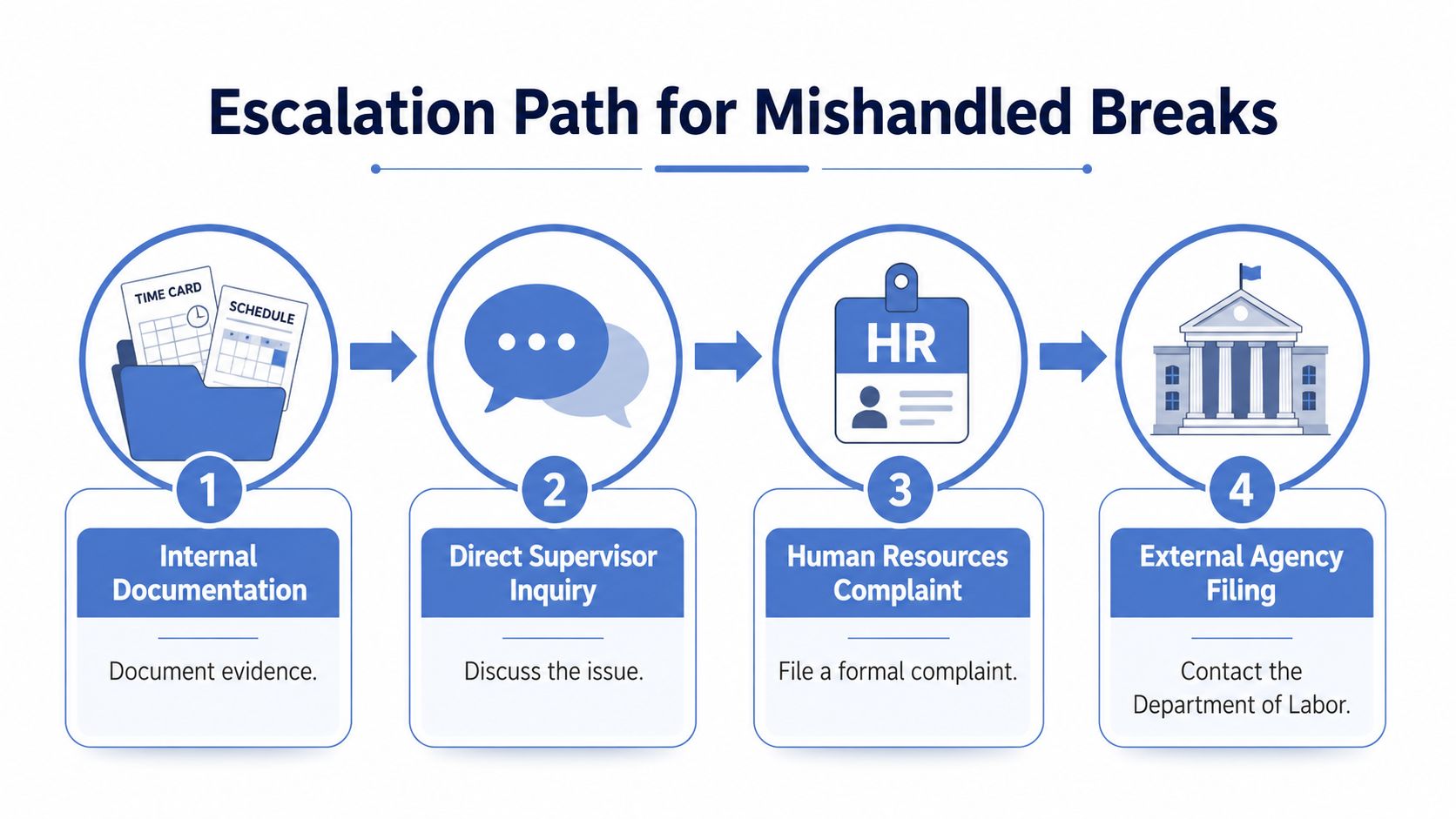
Start and preserve records. Don't rely on memory, especially if the problem has happened repeatedly. Save materials in a lawful way and avoid taking confidential customer, patient, or business information that you aren't entitled to keep.
Build a usable record
Create a simple timeline for each affected shift. Include the scheduled meal, the actual work performed, who gave instructions, when the employee clocked out and back in, and whether the timecard was later edited.
- Save time records: Keep pay stubs, timecards, punch histories, and screenshots of scheduling systems.
- Record witnesses: List coworkers who saw interruptions, working lunches, or automatic deductions.
- Preserve communications: Keep messages that show a supervisor expected responses during an unpaid period.
- Compare pay: Note whether the missing time affected the weekly overtime calculation.
If you're comfortable doing so, raise the issue internally in specific terms. “My lunch was wrong” may produce a vague response. “The system deducted lunch, but I answered register calls during that period on these shifts” gives HR or management something concrete to investigate.
External options in Mississippi
An employee can contact the U.S. Department of Labor's Wage and Hour Division about suspected FLSA violations. Investigators may ask about the employer, job duties, schedules, pay, timekeeping, deductions, supervisor instructions, and supporting records. A worker should provide accurate information and keep copies of anything submitted.
Mississippi doesn't have a state human rights commission handling these complaints. That makes the federal route and private legal advice especially important, but an employee should consider practical risks, deadlines, and the strength of the records before choosing a path.
A consultation can be more productive when you bring pay stubs, time records, schedules, written policies, a timeline, and witness names. If organizing those materials feels difficult, a virtual legal assistant may help with administrative organization, but legal advice must come from a qualified attorney.
Mississippi employment-law sources describe contingency fees in these matters as commonly averaging 40% to 50% of a recovery (Mississippi contingency-fee discussion). Ask how fees, expenses, agency complaints, negotiations, and any further legal work would be handled before signing an agreement.
Your Next Steps and How to Reach the Office
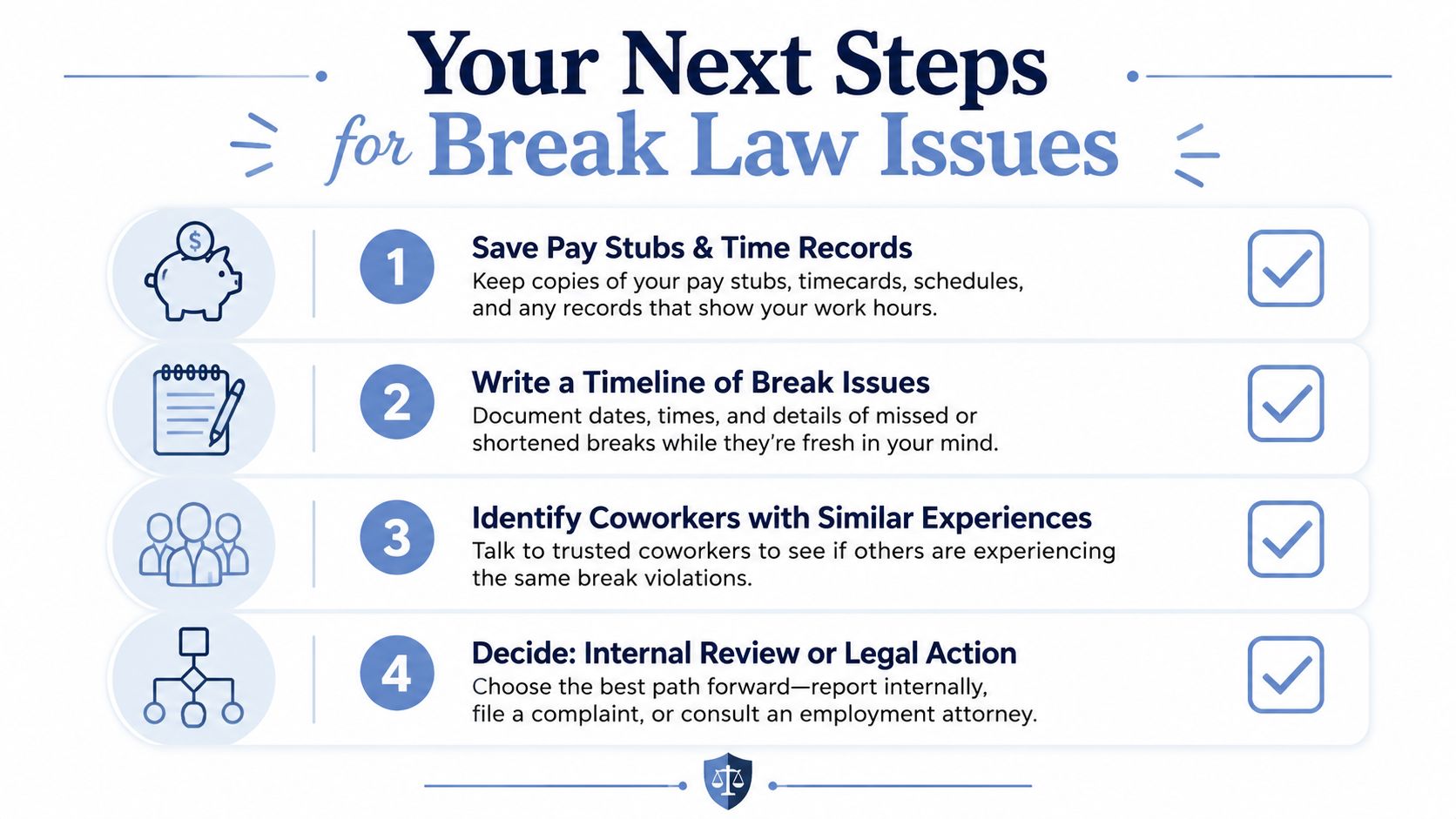
A clean file is helpful, but you can begin with the records available today. Save pay stubs and time records you can lawfully access, then write a timeline showing scheduled breaks, actual work, interruptions, and supervisor instructions. Note coworkers who experienced the same practice or saw you working during an unpaid period.
Choose an initial route based on the facts and practical risks. You may raise the issue internally, contact the Department of Labor, or consult a wage-and-hour attorney before taking action. Do not assume a scheduled lunch settles the question. The review should ask whether interrupted meal periods were paid, whether short rest breaks were treated correctly, and whether all compensable time entered the overtime calculation.
Nick Norris, P.A. represents Mississippi employees in employment matters, including wage-and-hour disputes involving unpaid work and overtime. For scheduling information, contact Nick Norris, P.A. at 601-641-4897. Bring your time records, pay information, schedule, and written timeline so the office can evaluate what happened and discuss practical options.
By Nick Norris, P.A.
Last updated: August 29, 2026
Reviewed by Nick Norris
If your Mississippi employer deducts interrupted meal periods or treats short rest breaks as unpaid, Nick Norris, P.A. can review the records and explain the wage-and-hour issues involved. Visit Nick Norris, P.A. to request a consultation about your break-pay concerns.
Leave a Reply