

Employment lawyers typically charge $200 to $600 or more per hour for hourly work, while contingency fees commonly run 33% to 40% of any recovery, with Mississippi contingency fees often averaging 40% to 50%. Your actual cost depends on the fee model, the strength and stage of the claim, the work required, and whether expenses are deducted separately.
That range is broad because “employment law” covers very different services. A lawyer may spend one hour reviewing a severance agreement, or many months handling a discrimination, retaliation, unpaid-wage, FMLA, or wrongful-termination matter. Mississippi's legal environment also affects case value and viability, so the right question isn't only how much does an employment lawyer cost. It's also, “What fee arrangement fits my claim, and what will I receive after fees and expenses?”
By Nick Norris, Attorney
Last updated: August 17, 2026
Reviewed by Nick Norris
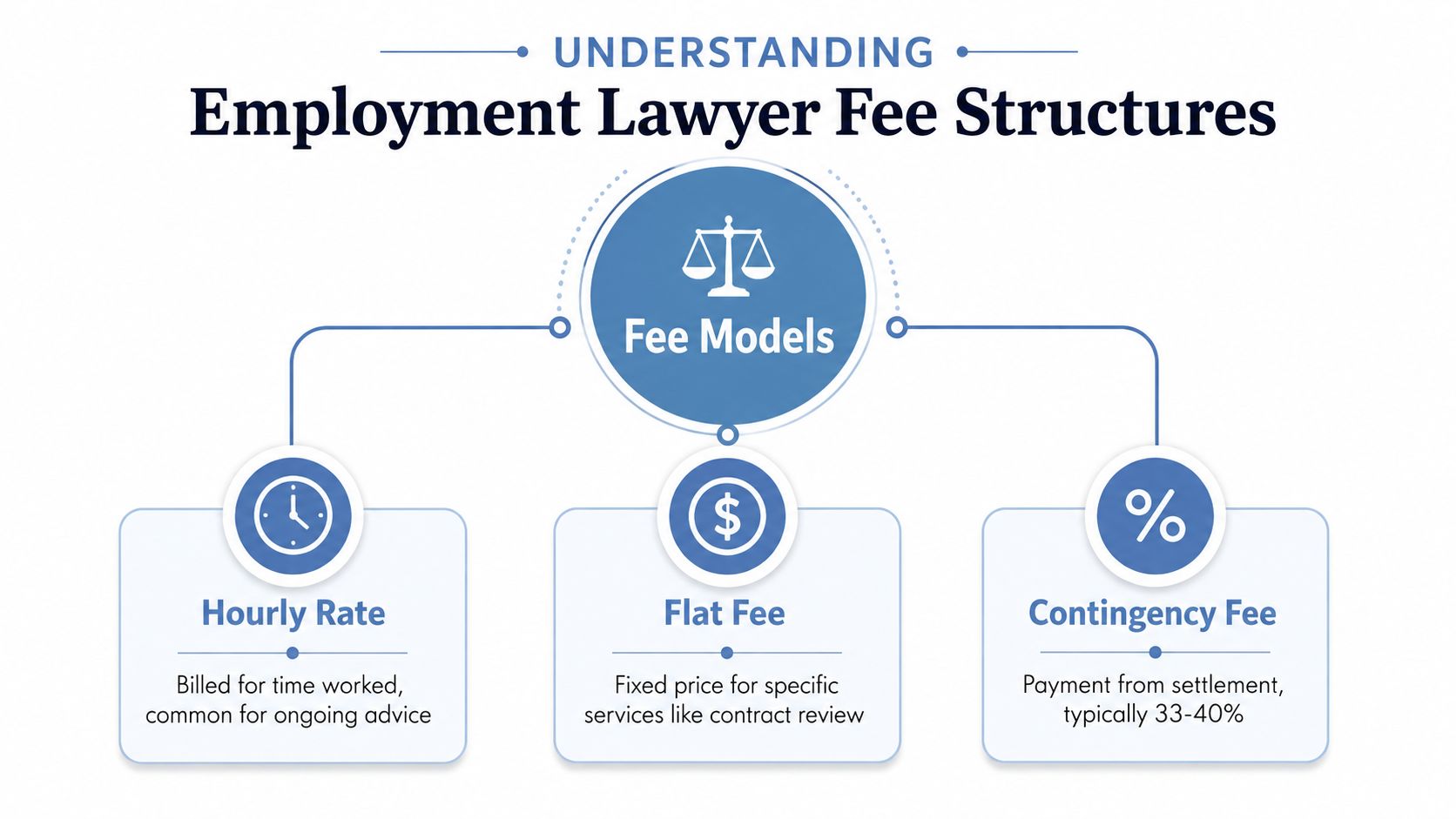
Understanding Employment Lawyer Fee Structures
A national fee dataset reports an average Employment/Labor lawyer rate of $387 per hour and a blended firm rate of $354 per hour (EL CMD national employment lawyer rate benchmark). Those figures offer a reference point, not a Mississippi quote. Attorney experience, local market conditions, urgency, and the work required can change the actual cost.
Mississippi's legal environment also affects which fee structure is realistic. The state has no human rights commission, so some employees must pursue administrative or court-based options without a state agency handling the claim. Mississippi also provides limited protection for workers alleging retaliation connected to workers' compensation. Those limits can affect case viability, available remedies, and whether a lawyer can accept the matter on contingency.
Hourly billing
Hourly billing fits advice, employment-contract review, severance negotiations, employer communications, or a defined issue that does not require full litigation. The client pays for time recorded by the attorney and, under the engagement letter, time from paralegals or other legal professionals.
A retainer commonly funds this work. Published employment-law pricing information describes retainers ranging from about $2,000 to $15,000, while narrower assignments may require smaller deposits. A retainer is usually an advance payment, not a fixed total. The firm deducts charges as work is completed and may require the balance to be replenished.
Contingency representation
With a contingency arrangement, the attorney's fee depends on a financial recovery. This model may fit discrimination, retaliation, wrongful-termination, or unpaid-wage claims with evidence, legally supportable theories, recoverable damages, and enough potential value to justify the time and risk.
The written agreement should identify the percentage, litigation expenses, settlement authority, and the result if the case ends without recovery. A client may still owe certain expenses even when no attorney fee is due, depending on that agreement.
Flat fees and limited scope
A flat fee can suit a clearly defined task, such as a severance review or focused consultation. The agreement should identify what the fee covers and what happens if the employer escalates the dispute or the client requests additional work. New services may be billed hourly or priced separately.
An unfair workplace event alone does not establish contingency eligibility. The claim must support a legal theory and provide evidence and potential damages that justify the lawyer's financial risk.
Hourly Rates and Retainer Costs Explained
Hourly work gives you a direct connection between time and cost. A lawyer may recommend it for contract review, severance negotiations, workplace advice, demand letters, or matters where the likely recovery is uncertain or too limited to support contingency representation.
The hourly rate can reflect experience, geographic market, subject-matter focus, urgency, and case complexity. Published benchmarks describe employment-law rates around $200 to $600 or more per hour, while senior lawyers in higher-cost markets may charge $500 to $800 or more per hour (employment-law pricing and retainer schedules). Mississippi clients should ask for the lawyer's actual rate rather than relying on a national average.
Comparing common hourly arrangements
| Service Type | Hourly Rate Range | Typical Retainer |
|---|---|---|
| Initial advice or narrow employment issue | $200 to $600+ | About $500 to $5,000 |
| Contract or severance review | $200 to $600+ | About $500 to $5,000 |
| Ongoing negotiation or executive representation | $500 to $800+ for senior counsel in higher-cost markets | About $10,000 to $15,000 in some hourly-only arrangements |
| Broader hourly employment matter | $200 to $600+ | About $2,000 to $15,000 |
The figures in this table are published market ranges, not a Mississippi quote. A separate benchmark describes cash retainers from $2,000 to $15,000 and notes that some matters involve much higher hourly rates depending on geography and seniority (employment-law fee survey).
Why the retainer isn't the total bill
Suppose a lawyer asks for a $5,000 retainer. That amount usually operates as a replenishing deposit, not a promise that the entire representation will cost $5,000. The firm deducts time charges and approved expenses, then may ask you to restore the balance.
Ask whether the firm bills in increments, whether paralegal time is charged, how travel and copying are handled, and whether filing, service, records, experts, depositions, or transcript expenses are separate. A clear engagement letter is more useful than a low initial retainer that later produces unexpected invoices.
Practical rule: Treat the retainer as the amount needed to begin the work, not as the final price, unless the agreement expressly says otherwise.
How Contingency Fees Work in Mississippi
Mississippi contingency agreements require close attention because the percentage determines the amount you keep from a recovery. Mississippi employment contingency fees often average 40% to 50%, according to the publisher's Mississippi-focused fee information, while broader employment-law sources commonly describe contingency fees around 33% to 40% (employment lawyer contingency fees in Mississippi).
The fee percentage isn't the only issue. Your contract should answer these questions:
- Is the percentage calculated from the gross recovery or after expenses?
- Are litigation expenses deducted before or after the attorney fee?
- Who pays expenses if the case ends without a recovery?
- Does the percentage change if the case settles early, proceeds through trial, or reaches an appeal?
- What happens if the employer makes payments over time?
A concrete recovery example
Assume a Mississippi employee receives a $100,000 recovery and the agreement uses a 40% contingency fee. The attorney fee would be $40,000, leaving $60,000 before expenses. If the agreement instead uses a 50% fee, the attorney fee would be $50,000, leaving $50,000 before expenses.
That example doesn't establish what any particular lawyer will charge, and it doesn't account for case expenses, taxes, liens, or other deductions. It shows why you must read the calculation language instead of focusing only on the headline recovery.
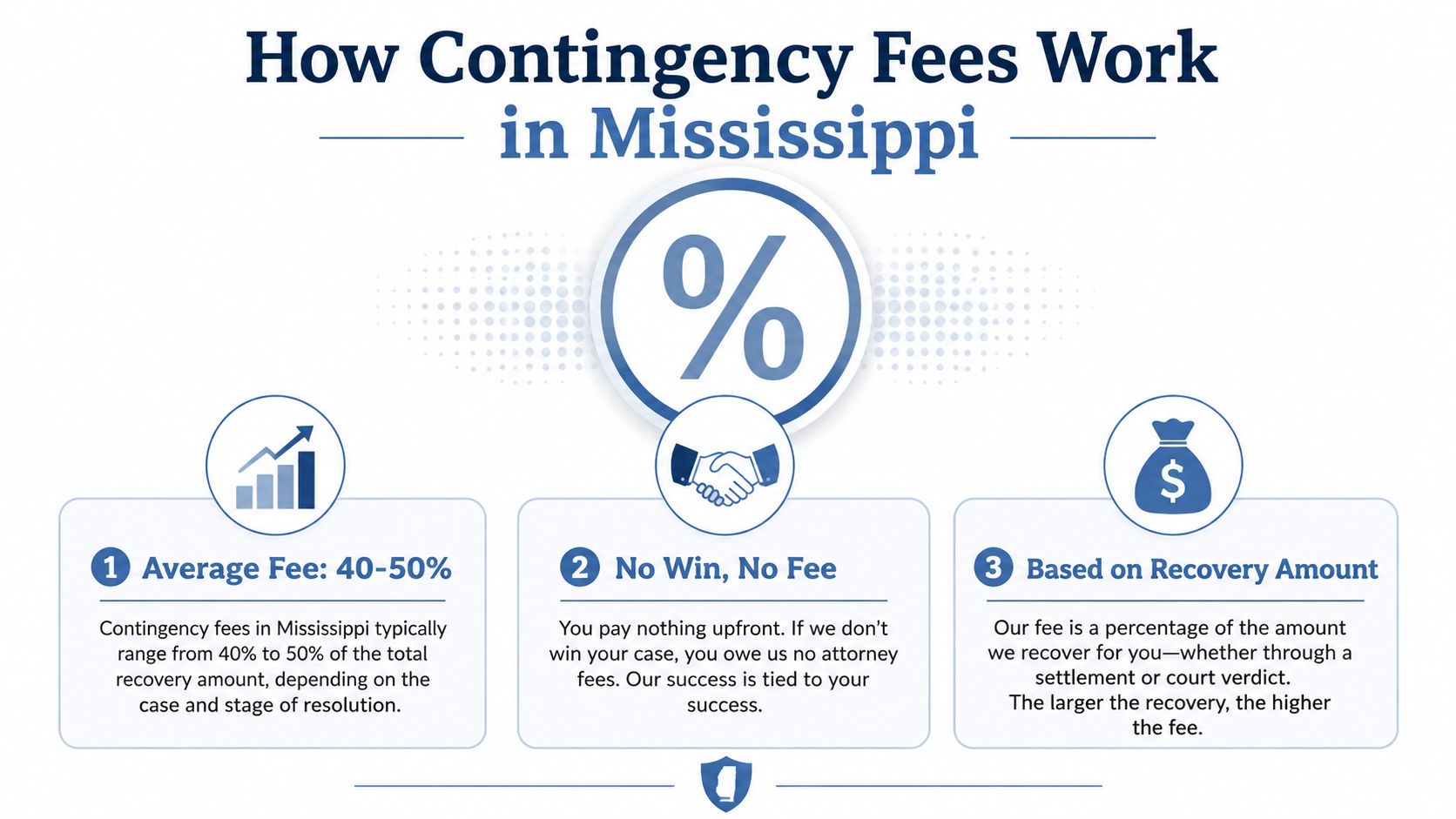
A contingency arrangement can reduce the client's immediate cash-flow burden, but the effective fee can be substantial when the case resolves successfully. It also shifts risk toward the lawyer, who may spend significant time without receiving an attorney fee if the claim fails.
The model often fits discrimination, retaliation, wrongful-termination, and unpaid-wage claims with meaningful recoverable damages. It may not fit a short severance review or a matter with limited damages, where hourly or flat-fee work may be more practical.
A hybrid agreement may combine a reduced hourly rate with a smaller contingency percentage. That can help share risk, but it can also make the calculation harder to understand. Get the formula in writing before work begins.
The following video provides additional background on contingency arrangements:
Factors That Affect Your Legal Costs
Two employees can describe similar workplace events and face very different legal bills. The difference often comes from the amount of proof required, the employer's response, and the point at which the matter resolves.
Case complexity
A focused wage dispute may involve a manageable set of time records and pay statements. A discrimination or retaliation claim may require personnel files, emails, text messages, policy records, witness interviews, medical information, and a detailed employment history. Multiple legal theories increase the need for factual development and careful written analysis.
The employer's conduct after receiving a demand can also change the cost. A prompt, serious negotiation may limit work. A hostile response, extensive motion practice, discovery disputes, or refusal to produce records can expand the assignment.
Timing and procedural stage
Pre-suit advice and negotiation generally require less work than a matter involving formal discovery, depositions, dispositive motions, trial preparation, or an appeal. Appeals require a separate review of the record and legal issues, so a client should ask whether the original agreement covers appellate work.
A useful planning tool is a court fee estimator, but an online calculator can't predict the legal merits or the amount of attorney time your particular employment dispute will require.

Mississippi employees should also consider the type of claim and its potential recovery before choosing a fee model. A claim involving federal employment protections may have a different procedural path and fee-shifting possibility than a narrow workplace dispute. For a focused discussion of evaluating an FMLA matter, review how an FMLA case may be valued.
What you can control
You can reduce unnecessary time by preserving relevant documents, creating a dated chronology, identifying witnesses, and keeping communications organized. Don't send a lawyer a disorganized archive with no explanation if a concise index can identify the important records quickly.
Mississippi Employment Law and Case Viability
Mississippi does not have a current state human rights commission. Legislative materials show a proposed Mississippi Human Relations Commission in 1999, but the available official material doesn't establish an active, current commission (1999 Mississippi legislative material).
That matters because an employee may need to evaluate federal protections and federal administrative procedures rather than relying on a Mississippi commission process. The lawyer must determine which law applies, whether an administrative filing is required, and whether deadlines affect the case. Those questions can influence both viability and price before the lawyer decides whether to offer contingency representation.
Mississippi also doesn't provide a specific state-law retaliation claim for filing a workers' compensation claim. Mississippi-focused legal sources explain that workers generally can't rely on a specific anti-retaliation statute under Mississippi law for that conduct (Mississippi workers' compensation retaliation analysis).
A Mississippi legal article further discusses the narrow remedies available to an employee terminated for exercising rights under the Mississippi Workers' Compensation Act, including the possibility that the employee may not state a wrongful-discharge claim on that basis (Mississippi Workers' Compensation Act discussion/fileattachment/81-miss–l-j–1563-(2012).pdf?rev=5f5f4fb83a664dafa8eb84186f21f031)).
Questions to raise during a consultation
- What law supports my claim? Ask whether the proposed claim arises under federal law, Mississippi law, a contract, or another legal theory.
- What deadline applies? A strong factual story can still be difficult to pursue if a required deadline has passed.
- What recovery is realistically available? The answer should account for proof, damages, defenses, and collection risk.
- Why does this fee model fit my case? The lawyer should explain why hourly, contingency, flat-fee, or hybrid billing makes sense.
- What happens if the legal theory changes? Ask whether the agreement allows the lawyer to revise the fee arrangement if new facts emerge.
Questions to Ask Before Hiring an Employment Lawyer
A consultation should produce more than a general opinion about whether the employer acted badly. You should leave knowing what the lawyer needs, what work will be performed, and how the proposed fee will be calculated.
Ask these questions directly:
- What is your fee structure? Confirm the hourly rate, contingency percentage, flat-fee scope, retainer requirement, and whether the fee changes at settlement, trial, or appeal.
- Which expenses are separate? Clarify responsibility for records, filing, service, experts, depositions, transcripts, travel, and other case costs.
- What happens if I don't recover money? A contingency agreement should state whether you owe expenses even if no attorney fee is earned.
- Who will handle the matter day to day? Find out whether the lawyer, an associate, or a paralegal will perform each type of work and how that time is billed.
- What information would change your assessment? This question helps identify missing documents, witnesses, deadlines, or facts that could affect case viability.
The engagement letter should match the conversation. Watch for unclear language about gross versus net recovery, unilateral changes to the fee, responsibility for expenses, withdrawal, or settlement authority.
For a longer preparation list, use these questions to ask an employment lawyer before comparing proposals. You can also ask whether the lawyer offers a free initial consultation, limited-scope assistance, or a flat fee for a defined task.
Before signing: Don't compare lawyers by percentage alone. Compare the percentage, expense rules, scope of work, communication plan, and the lawyer's explanation of the claim's risks.
Practical Ways to Manage and Reduce Legal Costs
Start by preserving evidence before paying for extensive attorney time. Save relevant emails, texts, pay records, schedules, policies, performance reviews, termination documents, and a dated chronology. Organize them by topic and identify the most important documents first.
Ask whether limited-scope representation can address the immediate need. A lawyer might review a severance agreement, prepare a demand letter, or advise you about a specific response without taking on the entire dispute. Flat-fee work can provide cost certainty when the assignment has clear boundaries.
Free consultations, legal-aid organizations, and pro bono resources may help you understand whether a claim is worth pursuing. Some federal employment statutes also contain fee-shifting provisions, which may allow a prevailing employee to seek attorney fees from the employer, but you shouldn't assume fee-shifting eliminates your immediate costs or guarantees recovery.
For a Mississippi case evaluation and a candid discussion of possible fee structures, call 601-641-4897.
Nick Norris, P.A. evaluates Mississippi employment matters involving discrimination, harassment, retaliation, unpaid wages, FMLA issues, and wrongful termination, with fee arrangements discussed based on the facts and scope of work. Visit Nick Norris, P.A. to request a case evaluation and learn what representation may cost before you commit.
Leave a Reply