

A worker in Mississippi can know something went wrong before knowing what the law calls it. Your employer may have praised your work for years, then changed the rules, withheld compensation, or ended your job immediately after you raised a concern. That sense of betrayal matters, but good faith and fair dealing isn't a general right to be treated fairly at work. In Mississippi, it's a narrow contract doctrine that can help in specific situations and lead nowhere in others.
The questions are practical. Did an employment contract, handbook, compensation plan, or established practice create a reasonable expectation? Did the employer deliberately undermine that expectation? Is the covenant the right legal theory, or does your situation fit discrimination, statutory retaliation, unpaid wages, or another claim? And what evidence can show what happened before important records disappear?
When Something Feels Off About How You Were Treated at Work
Tanya worked as a warehouse supervisor in Meridian. For two years, her managers praised her performance, trusted her with scheduling, and treated her as part of the operation's leadership team. Then she noticed a payroll error affecting employees' checks and reported it.
The response was abrupt. Tanya was demoted, told that management had concerns about her judgment, and escorted from the building that same afternoon. Her sister heard the same sentence repeatedly: “It felt wrong.” Tanya couldn't name the legal claim, but she knew the timing and explanation didn't fit the way the company had treated her before.
That instinct deserves investigation. It doesn't prove that the employer breached a contract, and it doesn't automatically create a wrongful-termination claim. Mississippi generally follows at-will employment principles, so an employer can often end the relationship without giving a reason unless a contract or recognized legal protection changes the analysis.
Practical rule: A bad feeling is a starting point for collecting facts, not a substitute for identifying a legal duty.
The implied covenant of good faith and fair dealing may be part of Tanya's map. The doctrine asks whether one party used a contract right or a contractual omission to destroy the other party's justified benefit under the agreement. It works best when a specific promise or established expectation exists and the employer's conduct appears designed to defeat it.
This article focuses on Mississippi employment disputes, including compensation, handbooks, benefits, complaints, and termination decisions. It also draws a firm boundary around what the covenant can't do. If your facts resemble Tanya's, the goal isn't to label every unfair workplace decision “bad faith.” The goal is to determine whether an enforceable promise existed, whether the employer undercut it, and whether another claim fits better.
What the Covenant of Good Faith and Fair Dealing Means
The covenant of good faith and fair dealing is an unspoken promise attached to a contract. Each party must avoid conduct that defeats the other party's reasonable ability to receive the bargain's benefit. An employer may violate that duty by using technical compliance with a contract term to strip away the compensation, opportunity, or protection the agreement was meant to provide.
The modern U.S. doctrine grew from a limited common-law concept into a recognized contract principle. The Uniform Commercial Code was first promulgated in 1951, and good faith gained broader recognition through codification and adoption by state legislatures. The American Law Institute included the duty as Restatement (Second) of Contracts § 205 in 1981, providing that every contract imposes a duty of good faith and fair dealing in performance and enforcement. See Fordham Law School's analysis of the doctrine's development and the Indiana Law Review discussion of its UCC and Restatement milestones.

The technical standard matters
The Restatement applies an objective standard. An employer's personal belief that its conduct was justified does not automatically defeat a claim. Subterfuges and evasions may breach the covenant when they frustrate the contract's common purpose, even without an outright lie or express breach. The Restatement commentary addressing the objective standard explains that framework.
Commercial agreements provide a useful comparison. Under the UCC, merchants must act in good faith and follow reasonable commercial standards of fair dealing. The inquiry focuses on fairness in context, not ordinary care alone, as described in the official UCC comments on good faith.
For a Mississippi employee, the practical limit matters most. Mississippi employment law treats the covenant as a narrow gap-filler, not a free-standing rule against unfair treatment. It does not replace a wrongful-termination, public-policy, discrimination, or statutory-retaliation claim. The covenant has value when a specific contractual promise exists and the employer uses discretion, procedure, or a technical loophole to defeat that promise. Without that contractual foundation, raising good faith is usually a dead end.
Where the Covenant Shows Up in an Employment Relationship
The covenant becomes worth examining when the employment relationship includes a concrete promise and the employer uses a decision or procedure to defeat that promise. It doesn't turn every workplace disappointment into a contract dispute.
Termination after a promise or established practice
A handbook may describe progressive discipline, performance review procedures, or conditions for termination. A signed offer letter may promise a defined role, term, or compensation structure. A clean record followed by sudden discipline can support careful scrutiny, especially when the employer's stated reason conflicts with written policies or prior treatment.
That doesn't mean a handbook always creates an enforceable employment contract. The exact language, disclaimers, and surrounding conduct matter. Mississippi courts generally won't use the covenant to second-guess an employer's ordinary at-will decision when no specific contractual expectation was defeated.
Compensation and benefits
Commission plans and bonus agreements create stronger questions because the employee can identify the promised benefit. A company that changes a formula before payment, reclassifies completed work, or withholds an earned amount may have more than a general fairness problem. The claim turns on the plan's language, when the compensation was earned, and whether the employer manipulated discretion to prevent payment.
Leave, retirement, and other benefits require the same analysis. An employer's refusal to provide a benefit promised by a written policy may support a contract theory. A benefit that was always discretionary, however, gives the employee less room to argue that the employer breached an implied obligation.
Post-employment conduct
A former employer's reference or communication with customers can create separate concerns if it violates an agreement or causes identifiable harm. The implied covenant isn't a universal defamation claim, and it won't automatically regulate every negative statement after termination. Preserve the evidence and identify the specific contractual benefit the conduct allegedly destroyed.
For a focused discussion of Mississippi employment agreements and disputes, review this employment contract dispute guide. The central question remains consistent: what did the employer promise, and what act prevented you from receiving it?
Real Mississippi Fact Patterns That Raise the Covenant
Consider a Mississippi employee who reports a wage problem to the Mississippi Department of Employment Security or makes a wage-and-hour complaint. Within days, the employer changes the explanation for the employee's discipline, removes duties, and ends the job. The timing may support a retaliation theory under an applicable statute, and it may also raise a covenant question if the employer used a contract power to defeat a defined employment expectation.
A second worker sells products under a commission plan. The plan describes performance metrics and payment conditions. As the worker approaches payment, management changes the metrics, assigns unattainable quotas, or reclassifies completed sales. The strongest covenant argument isn't that the new system was harsh. It's that the employer manipulated contractual discretion to prevent the worker from receiving compensation the agreement reasonably contemplated.
A third employee receives a promise of paid time off, retirement vesting, or accrued benefits. After raising a safety concern, the employee is told the benefit won't be paid. If the employer's conduct connects the complaint to the denial and the benefit was promised under a contract or policy, the facts deserve legal review.
Mississippi lawyers often analyze these situations through the reasoning associated with Cenac v. Murry and its progeny. The practical focus is the same: identify the contractual gap, define the expected benefit, and show how the employer's conduct interfered with it. A workers' compensation filing requires special caution. Mississippi doesn't provide a retaliation claim merely for filing a workers' compensation claim, so don't describe that filing alone as a protected retaliation activity.
| Fact Pattern | Employer Conduct | Covenant Element | Viability |
|---|---|---|---|
| Wage complaint followed by termination | Employer changes explanations and ends employment soon after the complaint | Possible interference with a contractual expectation, plus review for an applicable statutory claim | Depends on the contract, timing, and evidence |
| Commission near payout | Employer changes metrics or applies discretion to defeat payment | Contractual benefit and alleged manipulation of discretion | Stronger when the plan defines how compensation is earned |
| Safety complaint followed by benefit denial | Employer refuses promised PTO or accrued benefits after the complaint | Specific benefit and conduct that blocks receipt | Worth investigating when written terms support the promise |
| Workers' compensation filing followed by adverse action | Employer disciplines or terminates the worker after the filing | Covenant analysis may exist if a separate contract expectation was defeated | Filing a workers' compensation claim alone does not create a Mississippi retaliation claim |
How to Document a Suspected Breach Before You Call a Lawyer
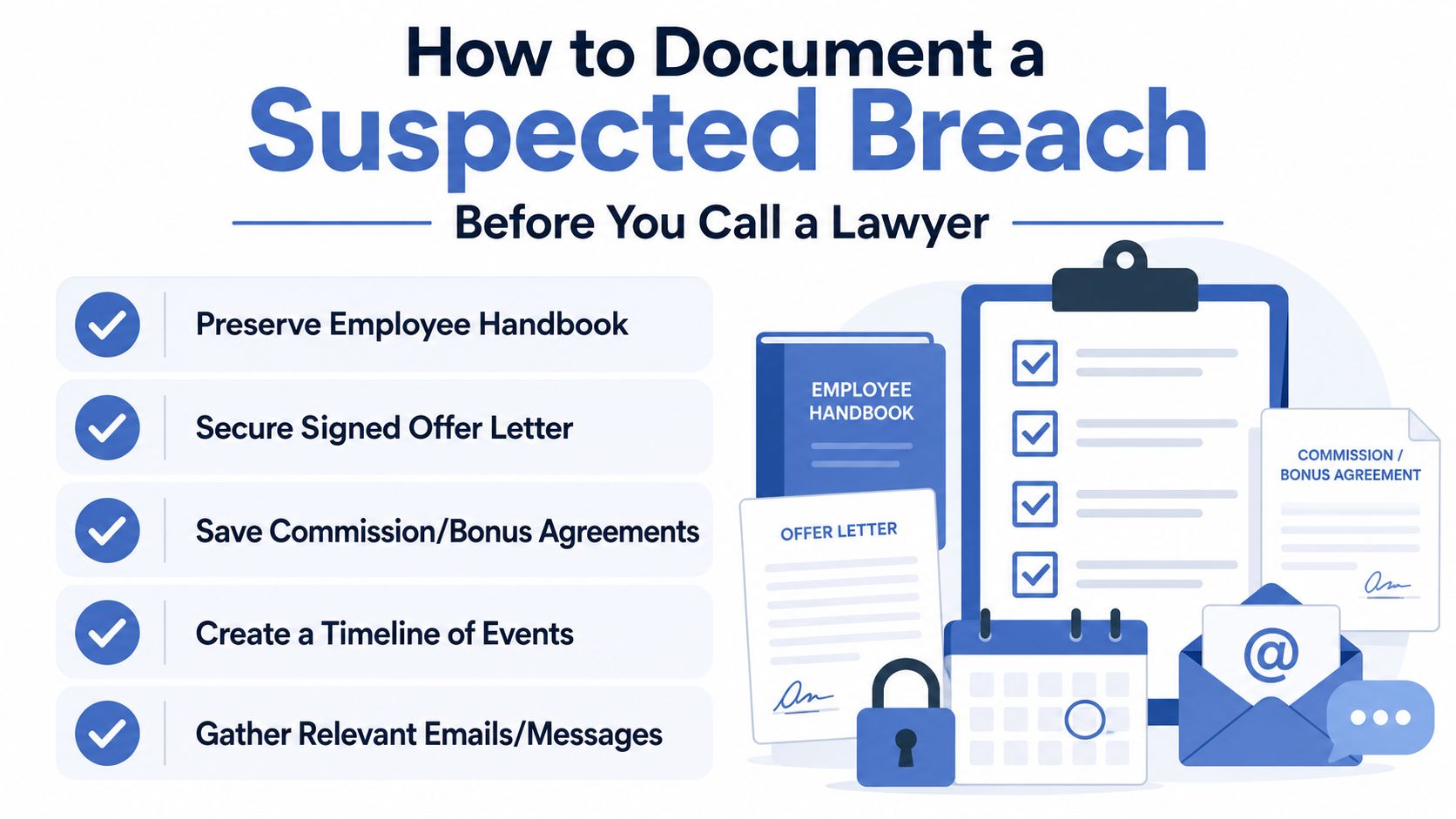
Start with the documents that define the relationship. Save the employee handbook, signed offer letter, employment contract, commission plan, bonus letter, benefit policy, and any written amendment. Keep the versions that were in effect when the disputed event occurred. Don't rely on an online portal that may later change or remove the documents.
Build a record that another person can follow
Save relevant emails, text messages, Teams conversations, Slack messages, and voicemails in a way that preserves the sender, recipient, date, and surrounding context. Write a private timeline while events remain fresh. Include dates, names of witnesses, exact wording as best you remember it, the contract term involved, and the action that followed.
- Preserve the trigger: Identify the complaint, request, report, or performance event that preceded the employer's decision.
- Record the response: Note who responded, what they said, and whether the explanation changed later.
- Identify witnesses: List coworkers who heard promises, saw the conduct, or received similar treatment.
- Protect your evidence: Don't alter screenshots or forward confidential business material to people who shouldn't receive it.
- Separate facts from conclusions: Write “manager changed the quota in the plan” rather than only “manager acted maliciously.”
Mississippi doesn't have a state human rights commission. Discrimination and retaliation complaints typically proceed through the federal EEOC rather than a Mississippi agency, which makes internal complaints and EEOC filings especially important evidence of what the employer knew and when. The process for making a workplace discrimination report is outlined in this guide to reporting workplace discrimination.
Don't secretly take records you aren't legally entitled to possess, and don't use work systems to organize your case if access may be revoked. A clean timeline and intact communications are usually more useful than a large folder of unexplained screenshots.
Where the Covenant Stops Working in Your Favor
The covenant won't rescue a claim that contradicts clear contract language. It can't create job security where the agreement reserves at-will termination, add a benefit the parties never negotiated, or rewrite a termination clause because the result feels unfair. Mississippi courts treat it as a narrow gap-filler, not a judicial power to improve a bargain after the fact.
Mississippi also hasn't adopted a general public-policy exception to at-will employment. That matters because many workers assume that an employer's bad motive automatically creates a lawsuit. It doesn't. A separate statute, contract, or recognized tort may be required. Read more about that boundary in this discussion of public-policy exceptions.
Workers' compensation requires an especially direct warning. Mississippi doesn't provide protection from retaliation for filing workers' compensation claims, and there isn't a retaliation claim based solely on filing one. The covenant might still matter if an employer breaches an independent contractual promise, but it can't manufacture a statutory protection that Mississippi law doesn't provide.
Cost also affects strategy. Mississippi generally follows the American Rule in contract cases, so each side may bear its own attorney fees unless a statute, contract, or other recognized exception changes the result. A contingency arrangement can shift how fees are paid, but case expenses, claim limits, and the strength of the evidence still matter.
The covenant can never create a job guarantee, override an express termination right, or replace a discrimination, wage, retaliation, defamation, or other separate claim. Treat it as one possible theory, not the entire case.
When to Contact an Attorney and What to Bring
Contact a Mississippi employment lawyer before signing a separation agreement, especially if the employer gives you a short deadline. A termination letter that misstates your performance, altered commission records, or a sudden benefits denial also warrants prompt review. Don't wait until you have a perfect file. Early advice can prevent you from signing away claims or losing evidence.
Bring the materials that let the lawyer test the contract theory:
- Employment terms: Bring the written contract, offer letter, handbook section, compensation plan, and benefit policies.
- Pay records: Include your last pay stubs and documents showing commissions, bonuses, deductions, or unpaid amounts.
- Chronology: Provide a dated timeline with names of witnesses and the language used in important conversations.
- Electronic proof: Bring screenshots or exports of relevant texts, emails, Teams messages, Slack messages, and voicemails.
- Personnel materials: Include your personnel file if you obtained it under Mississippi Code § 11-7-124.
- Agency records: Bring any EEOC or Mississippi Department of Employment Security responses and prior complaint materials.
Mississippi employment matters may be handled through contingency, hourly, flat-fee, or hybrid arrangements. The average contingency fee is 40 to 50 percent, but the agreement should explain the percentage, case costs, responsibility for expenses, and what happens if the matter ends before trial. Fee structures and statutory limits vary by claim, so ask for the terms in writing.
Venue and procedure also deserve a candid conversation. Employment disputes may involve county circuit court, federal court, administrative proceedings, or negotiated resolution, depending on the claim. Mediation can be useful when both sides need a controlled setting to evaluate documents and settlement positions, including mediation procedures available under Mississippi Chancery rules. No lawyer can promise a resolution date, and the path from intake to resolution depends on the claims, evidence, defenses, and court or agency schedule.
For employees who need help organizing legal facts into a coherent written presentation, AIDictation for legal drafting offers guidance on preparing a legal brief. It isn't a substitute for legal advice, but clear writing can help you present the timeline and supporting documents efficiently.
Putting It All Together and Taking the Next Step
Return to Tanya in Meridian. Her belief that the demotion and termination felt wrong doesn't prove a covenant claim. It does identify a sequence worth examining: a payroll concern, an abrupt change in treatment, a stated reason that may conflict with her record, and possible written policies governing discipline or compensation.
Use this checklist:
- Confirm an implied contract existed. Identify the handbook, offer letter, compensation plan, benefit promise, or course of dealing.
- Pin down the specific conduct. State exactly how the employer allegedly undermined the expected benefit.
- Gather documentary proof. Preserve the governing terms and records showing what happened.
- Save communications. Keep texts, emails, messages, and voicemails with dates and context.
- Check deadlines. Mississippi Code § 15-1-29 provides three years for contract claims sounding in the implied covenant, while tort and statutory claims may have shorter periods.
- Get advice before signing. Have a lawyer review any separation agreement or release before you sign it.
The covenant may not save the case by itself. Good documentation and disciplined analysis will let a Mississippi attorney decide whether pursuing it is worthwhile, whether another claim fits better, and how the facts should be presented.
Nick Norris, P.A. evaluates Mississippi employment disputes involving contracts, compensation, discrimination, retaliation, and wrongful termination, including whether good faith and fair dealing supports a viable claim. Visit Nick Norris, P.A. to request a case evaluation and discuss your documents before signing an agreement or giving up important rights.
Leave a Reply