

Mississippi Public Policy Exceptions to At-Will Employment
You just got fired, or you're about to be. Maybe your supervisor told you to “fix” records, ignore a safety problem, or keep quiet about conduct that looked criminal. You refused. Then your hours got cut, your write-ups started, and now you're out of a job.
That feels wrong because it is. But in Mississippi, “wrong” and “illegal” are not the same thing.
Mississippi is still an at-will employment state. That means an employer can usually fire an employee for a good reason, a bad reason, or no clear reason at all, unless a specific law says otherwise. The problem is that many workers assume the law protects any firing that seems unfair. It doesn't. Mississippi's protection is much narrower.
That narrow protection matters most when the firing doesn't fit a familiar category like race discrimination, sex discrimination, disability discrimination, or FMLA interference. Sometimes the issue is simpler and harsher: your employer wanted you to go along with something illegal, and you wouldn't. If you were fired for an illegal reason, our Mississippi wrongful termination lawyer page explains the at-will exceptions and the deadlines to act.
What Is a Public Policy Exception to At-Will Employment
Mississippi employees often come to me with the same question: “Can they really fire me for that?” Sometimes the answer is yes, even when the employer acted badly. Sometimes the answer is no, but only because the firing falls inside one of the narrow public policy exceptions to at-will employment.

At-will employment gives employers broad power to terminate workers. If you need the baseline rule, this explanation of the employment at-will doctrine in Mississippi is the place to start. The short version is simple: unless a contract or a law limits the employer, the employer usually controls the decision.
Why this exception exists
The law had to draw a line somewhere. Otherwise, an employer could demand illegal conduct and then fire the employee for refusing.
That's why the public policy exception became so important across the country. The public policy exception is the most widely recognized exception to the employment-at-will doctrine in the United States, explicitly recognized in 43 of the 50 states according to the U.S. Bureau of Labor Statistics Monthly Labor Review. That same source explains that the exception serves as a safeguard against unjust employment practices, including firing an employee for refusing to perform illegal acts.
Public policy exceptions exist to stop employers from forcing workers to choose between keeping a paycheck and following the law.
What that means in real life
A bookkeeper refuses to alter numbers.
A driver refuses to haul a load in violation of the law.
An office worker reports criminal conduct instead of helping cover it up.
Those facts don't always fit a discrimination statute. But they may fit a public policy claim if Mississippi law recognizes the conduct as protected.
Here's the practical point. A public policy exception isn't a general fairness rule. It doesn't punish every petty, dishonest, or mean-spirited firing. It targets a narrower category of terminations that conflict with the law's basic public interest.
The Mississippi reality
If you work in Mississippi, don't rely on internet advice that treats this as a broad employee-rights doctrine. Mississippi protection is narrower than generally understood. That's where many workers get blindsided. They assume “retaliation” covers any discharge after they objected to something improper. It doesn't.
You need to look at Mississippi's specific rule, not a generic article written for every state.
The McArn Exception Mississippi's Legal Standard
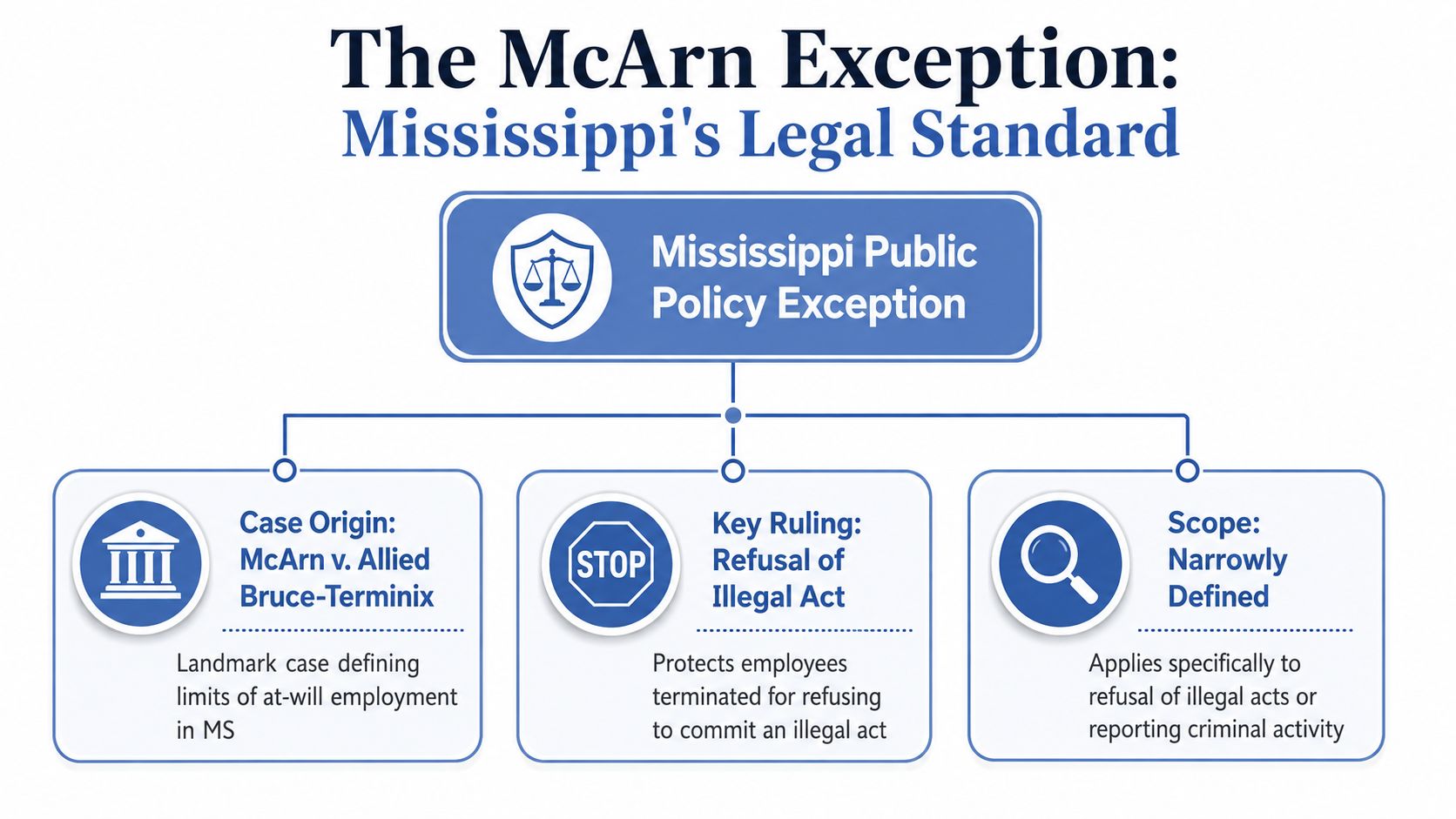
Mississippi's public policy rule comes from a court decision, not a broad worker-protection statute. The key case is McArn v. Allied Bruce-Terminix. If you're trying to figure out whether you have a real claim, this is the standard that matters.
The core rule
Mississippi recognizes a narrow exception to at-will employment for employees who are fired in connection with criminal conduct. In plain English, the rule protects two basic situations: refusing to participate in an illegal act, and reporting an employer's illegal act.
McArn rule in plain English: Mississippi may allow a wrongful termination claim when an employer fires an employee for refusing to commit a crime or for reporting the employer's criminal conduct.
That's much tighter than people expect. It is not a general whistleblower law for private employees. It is not a broad retaliation statute. It is not a catch-all claim for unethical business behavior that falls short of criminal conduct.
How courts tend to evaluate these claims
Courts often look for proof that the termination threatens a recognized public policy and that the firing happened because of the protected conduct. A commonly cited framework for public policy claims requires the employee to prove the jeopardy element, the causation element, and that the conduct involved society at large rather than a purely personal dispute, as explained in this discussion of how public policy exception claims are proved.
You should also review the evidence standard carefully. This guide on how to prove wrongful termination is useful because these cases rise or fall on proof, not outrage.
What that means for your evidence
You need more than your belief that the employer retaliated. Stronger cases usually involve facts like these:
- A direct instruction: Someone told you to do something illegal.
- A clear refusal or report: You said no, or you reported the conduct.
- Tight timing: The firing, suspension, or write-up followed soon after.
- Documents or witnesses: Emails, texts, notes, policies, or coworkers back up the story.
A weak McArn case usually sounds like this: “I complained a lot, then they got rid of me.” That may feel retaliatory, but if the complaint wasn't about criminal conduct, the claim may fail.
Why the rule is so narrow
Mississippi courts did not create McArn to supervise every bad personnel decision. They created it to prevent one specific abuse: using at-will employment as a weapon against employees who refuse to break the law or expose criminal behavior.
That narrowness frustrates people, but you're better off knowing the truth early. A realistic case assessment saves time, money, and false hope.
What Actions Are Protected in Mississippi
If your situation falls under Mississippi's public policy exceptions, it usually fits one of two lanes. Either you refused to commit an illegal act, or you reported your employer's illegal act. The details matter.
Refusing to commit an illegal act
This is the cleaner category. Your employer, supervisor, or someone with authority told you to do something criminal. You refused. Then the employer fired you or pushed you out.
Examples that may fit:
- A payroll employee refuses to falsify wage records to hide unpaid hours.
- A bookkeeper refuses to alter financial entries to mislead regulators or creditors.
- A driver refuses to transport or dispose of materials unlawfully after being told to ignore legal requirements.
- A healthcare worker refuses to participate in criminal billing fraud after being pressured to submit false information.
The key is the illegal act itself. Not a bad idea. Not a sloppy practice. Not a policy you dislike. The instruction has to cross into criminal conduct.
If the employer asked you to do something dishonest but not criminal, don't assume McArn applies. Mississippi's rule is narrower than your employer's ethics manual.
Reporting an employer's illegal act
The second lane involves reporting criminal conduct by the employer. This part also gets misunderstood. Not every internal complaint counts. Not every concern about “wrongdoing” is enough.
A stronger claim usually includes facts like these:
| Situation | More likely protected | Less likely protected |
|---|---|---|
| You report theft, fraud, or another crime by the employer | Yes | |
| You complain that a manager is unfair or rude | Yes | |
| You report conduct that could expose the public or others to criminal harm | Yes | |
| You argue over scheduling, favoritism, or office politics | Yes |
The point isn't whether the conduct upset you. The point is whether you opposed or reported illegal conduct that implicates public policy.
Internal complaints versus real legal reporting
Some employees report criminal activity inside the company first. Others go to outside authorities. The facts matter. So does who received the report and what exactly was reported.
A report about possible criminal conduct is not the same thing as a complaint about internal policy violations. If you're comparing your situation to Mississippi whistleblower issues more generally, this article on the Mississippi Whistleblower Protection Act can help you separate public-sector rules from private-employment McArn claims.
A practical self-check
Ask yourself these questions:
- What exactly was I asked to do, or what exactly did I report?
- Was the conduct criminal, or merely unethical, unsafe, or unfair?
- Who knew I refused or reported it?
- What happened next?
- What documents prove the sequence?
If you can answer those questions with specifics, you may have something worth evaluating. If your story stays vague, the employer will use that against you.
What workers often get wrong
Workers often focus on motive alone. They say, “They fired me because I spoke up.” That's not enough. You need the right kind of speech. Mississippi doesn't protect every workplace objection. It protects a narrow band of conduct tied to illegal acts and reporting criminal behavior.
That's why two employees can both be fired after complaining, and only one may have a viable claim.
What Is NOT a Public Policy Exception in Mississippi
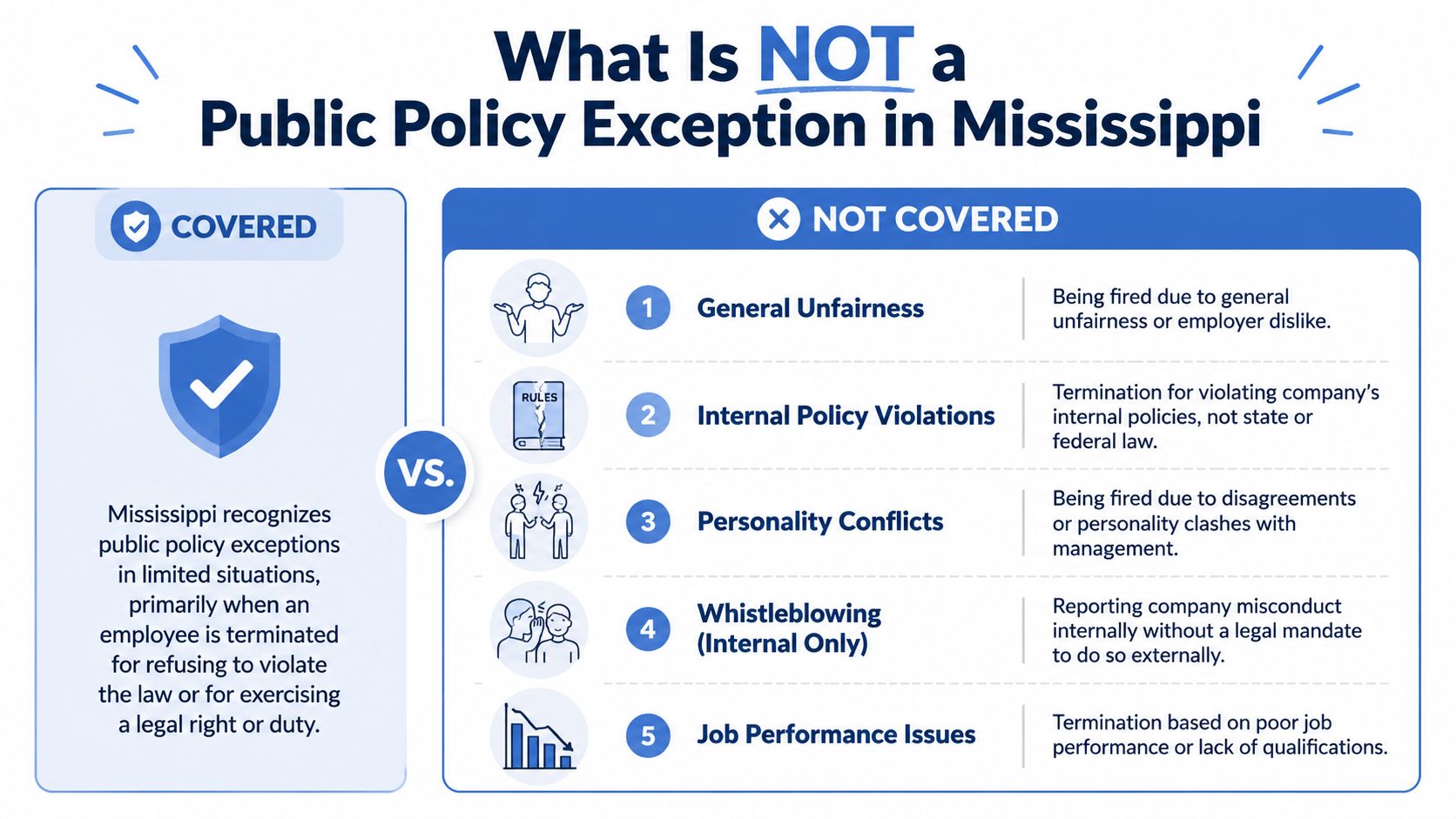
This is the section many readers need. A lot of internet content gives Mississippi workers false confidence. It treats any retaliatory firing as a potential public policy case. That's wrong.
Workers' compensation retaliation is not a standalone public policy claim here
Mississippi does not provide statutory protection against retaliation for filing a workers' compensation claim, and courts have not recognized a standalone retaliation claim based only on filing workers' compensation. That's a hard truth, but you need it upfront.
If you got hurt, filed for workers' compensation, and then got fired, that may feel obviously illegal. In Mississippi, that fact alone does not automatically create a retaliation claim. There is not a retaliation claim for filing workers compensation as a standalone Mississippi public policy case.
Many workers assume they're protected the moment they file a workers' compensation claim. In Mississippi, that assumption can be costly.
Other situations that usually are not covered
These examples may be unfair, but they usually are not McArn claims:
- General unfairness: Your boss didn't like you, played favorites, or treated you badly.
- Internal policy disputes: You objected to a company rule or practice that wasn't illegal.
- Personality clashes: You and management butted heads, and they ended your employment.
- Internal-only complaints without criminal conduct: You reported “misconduct” inside the company, but the issue wasn't a crime.
- Performance-based termination: The employer says you performed poorly, didn't meet expectations, or weren't a fit.
Not every complaint is legally protected
A lot of workers use the word “whistleblowing” too broadly. In normal conversation, that makes sense. In Mississippi employment law, that can be fatal to a case.
If you reported bullying, favoritism, incompetence, poor management, or policy violations that weren't criminal, that usually does not fit McArn. If you complained that your manager lied to you, embarrassed you, or changed your schedule unfairly, that also usually does not fit McArn.
A quick reality test
Use this test before you assume you have a public policy claim:
| Question | If yes | If no |
|---|---|---|
| Did the issue involve criminal conduct? | Keep analyzing | McArn likely fails |
| Did you refuse the act or report it? | Keep analyzing | McArn likely fails |
| Did the firing happen because of that conduct? | Possible claim | McArn likely fails |
This isn't harshness for its own sake. It's clarity. The worst legal advice is the kind that tells workers every ugly firing is actionable. In Mississippi, many aren't.
Examples of Public Policy Wrongful Termination Claims
The easiest way to understand Mississippi's rule is to compare two stories that look similar on the surface but land in very different places.
Example that may qualify
Angela works in accounting for a Mississippi company. Her supervisor tells her to change financial entries so the books look cleaner before outside review. Angela says no and explains that she will not falsify records. A few days later, she sends an email memorializing the instruction and her refusal.
Within a short time, the company strips her duties, writes her up for minor issues that were never raised before, and fires her. The stated reason is “attitude” and “lack of teamwork.”
That case may fit McArn. Why? Because the protected conduct is specific. She refused to participate in an illegal act. The timing supports causation. The employer's shifting explanation may help show pretext. Her email helps tie the firing to the refusal.
The best wrongful termination cases usually have a clean timeline, a clear refusal or report, and a document the employer wishes didn't exist.
Example that likely does not qualify
Marcus works for a Mississippi employer with chaotic management. He repeatedly complains that the office is disorganized, his supervisor plays favorites, and policies are enforced inconsistently. He also believes one manager is dishonest, though he never identifies criminal conduct and never reports a specific illegal act.
Management gets tired of the conflict and fires him. Marcus feels retaliated against, and maybe he was. But this likely does not fit McArn.
The missing piece is the public policy hook. His complaints concern unfairness and dysfunction, not a refusal to commit a crime or a report of criminal conduct. Mississippi law does not convert every retaliation-sounding fact pattern into a valid public policy claim.
Why the distinction matters
Both Angela and Marcus got fired after speaking up. Both stories feel bad. Only one likely falls within Mississippi's narrow rule.
When workers compare themselves to friends in other situations, they often miss that one legal detail. The law doesn't ask whether the employer acted decently. It asks whether the firing fits a recognized legal claim. For public policy exceptions in Mississippi, the answer turns on the illegal-act issue.
Next Steps and Answers to Common Questions
If you think your firing may involve Mississippi public policy exceptions, act like your evidence matters. Because it does.

What to do right away
- Write the timeline: List dates, names, conversations, and the order of events while it's still fresh.
- Preserve documents: Save emails, texts, write-ups, handbooks, reviews, and anything showing what you refused or reported.
- Keep your own copies: Don't alter documents. Don't take anything you have no right to possess. Preserve what you already lawfully have.
- Review severance carefully: Don't sign separation papers or releases before getting legal advice.
- Apply for unemployment: Don't wait around assuming a legal claim will solve your immediate income problem.
Common questions
How can I afford a lawyer
In Mississippi, the typical contingency fee for employment law claims is between 40% and 50% of the recovery. That's the standard range many workers see in these cases. It means the fee is tied to the result rather than paid upfront.
Who do I complain to in Mississippi
Mississippi does not have a state-level human rights commission. For some civil rights complaints involving Mississippi State Department of Health programs, the MSDH Civil Rights Coordinator requires a written complaint within 180 days of the alleged discriminatory action, according to the Mississippi State Department of Health civil rights complaint process. That does not mean every employment claim goes there. It does mean Mississippi workers should stop assuming there is a general state human rights agency handling all employment disputes.
How long do I have to act
Don't sit on your claim. Deadlines vary depending on the legal theory, the facts, and whether any federal law is involved. Waiting is one of the easiest ways to damage a good case. The right move is to get the facts reviewed early, before documents disappear and memories shift.
Bring the timeline, the messages, the termination paperwork, and any severance offer. A lawyer can do more with documents than with guesses.
The bottom line
Public policy exceptions in Mississippi are real, but narrow. If you refused to commit an illegal act or reported criminal conduct and got fired for it, you may have a claim worth serious review. If your situation involves general unfairness, office politics, or a workers' compensation filing by itself, you need a realistic assessment, not wishful thinking.
If you were fired after refusing illegal conduct or reporting criminal activity on the job, talk with Nick Norris, P.A.. The office represents Mississippi workers and can evaluate whether your facts fit Mississippi's narrow wrongful termination protections, what evidence matters most, and what steps make sense next.
This article has been reviewed for legal accuracy by Nick Norris. For employment law matters in Mississippi, consult with an attorney licensed to practice in your state.
Leave a Reply