

A medical diagnosis can turn an ordinary workweek into a financial emergency. You disclose your condition, complete leave paperwork, provide medical documentation, and try to keep your employer informed. Then, shortly after returning, you receive a termination letter citing “performance issues” or “attendance.”
For Mississippi workers, the legal path can be difficult to understand because the state lacks both a human rights commission and a broad private-employer anti-discrimination statute. That means a claim involving wrongful termination due to medical condition usually depends on federal protections, careful evidence, and the U.S. Equal Employment Opportunity Commission, rather than a Mississippi state agency.
A Realistic Situation Many Mississippi Workers Recognize
Consider a hospital billing clerk in Jackson. She's 42 years old and has worked steadily for her employer until she learns she needs treatment for breast cancer. She tells her supervisor that she'll need time away from work, completes the employer's FMLA paperwork, and keeps human resources updated as treatment dates change.
She returns to her position after approved leave. Two weeks later, her supervisor schedules a meeting. The employer says her “performance issues” justify termination. No detailed warning came before the medical disclosure. Her earlier reviews were generally favorable, and the paperwork says nothing about cancer, leave, or accommodation.
The legal question isn't whether the employer's decision was harsh. Mississippi generally follows at-will employment, so an employer can often terminate an employee without advance warning. The important questions are different:
- Was the medical condition a motivating factor?
- Was the employee punished for taking or requesting protected leave?
- Did the employer fail to consider a reasonable accommodation?
- Can the employer's performance explanation be supported by records created before the leave?
The personal consequences arrive immediately. The worker worries about the mortgage payment due soon, health insurance, treatment costs, and how to explain the termination to her family. She may also question whether seeking medical help caused the job loss.
Practical reality: A termination shortly after medical leave isn't automatically illegal, but the timing can become important evidence when it combines with shifting explanations, sudden discipline, or a failure to follow normal procedures.
This pattern reflects the type of timing and documentation the EEOC may investigate. Disability charges remained a significant part of federal workplace enforcement, with 24,324 disability claims filed in 2020 and a ten-year peak of 28,073 claims in 2016, according to reporting that compiles EEOC data (EEOC disability discrimination statistics). Discharge represented about 60% of disability complaints across the cited years, making termination a central issue in these disputes.
The worker receives her separation paperwork, leaves the meeting without clear answers, and decides to seek legal advice. That decision matters because emails, leave records, performance evaluations, and filing deadlines can determine whether a troubling termination develops into a viable federal claim.
What Makes a Termination Wrongful Under Federal Law
Mississippi's at-will rule gives employers broad discretion, but it doesn't give them permission to discriminate or retaliate. An employer may make a poor business decision or misunderstand an employee's performance and still act lawfully. The firing becomes potentially wrongful when a prohibited reason, such as disability discrimination or retaliation for protected medical leave, caused the decision.
A medical condition by itself doesn't automatically create a claim. The employee generally must connect the termination to a protected legal right or protected status. That connection may appear through direct comments, close timing, inconsistent discipline, changed performance evaluations, or evidence that the employer's stated reason isn't the actual reason.
The two federal frameworks most often involved are the Americans with Disabilities Act, or ADA, and the Family and Medical Leave Act, or FMLA. The ADA addresses disability discrimination, accommodation, and retaliation. The FMLA protects qualifying medical leave and the employee's return to the same or an equivalent position.
The protected action doesn't have to be a firing. An adverse employment action can include:
- Termination, including discharge while on leave or soon after returning.
- Demotion, especially when pay, authority, or career progression changes.
- Reduced hours, if the change functions as punishment or materially harms the employee.
- Reassignment, when the new position is less desirable or strips meaningful duties.
- Discipline or negative scoring, when linked to leave, disclosure, or an accommodation request.
Mississippi has no state human rights commission for employment claims. Workers alleging disability discrimination or retaliation generally use the EEOC process, and a federal discrimination claim usually requires administrative exhaustion before a lawsuit can proceed.
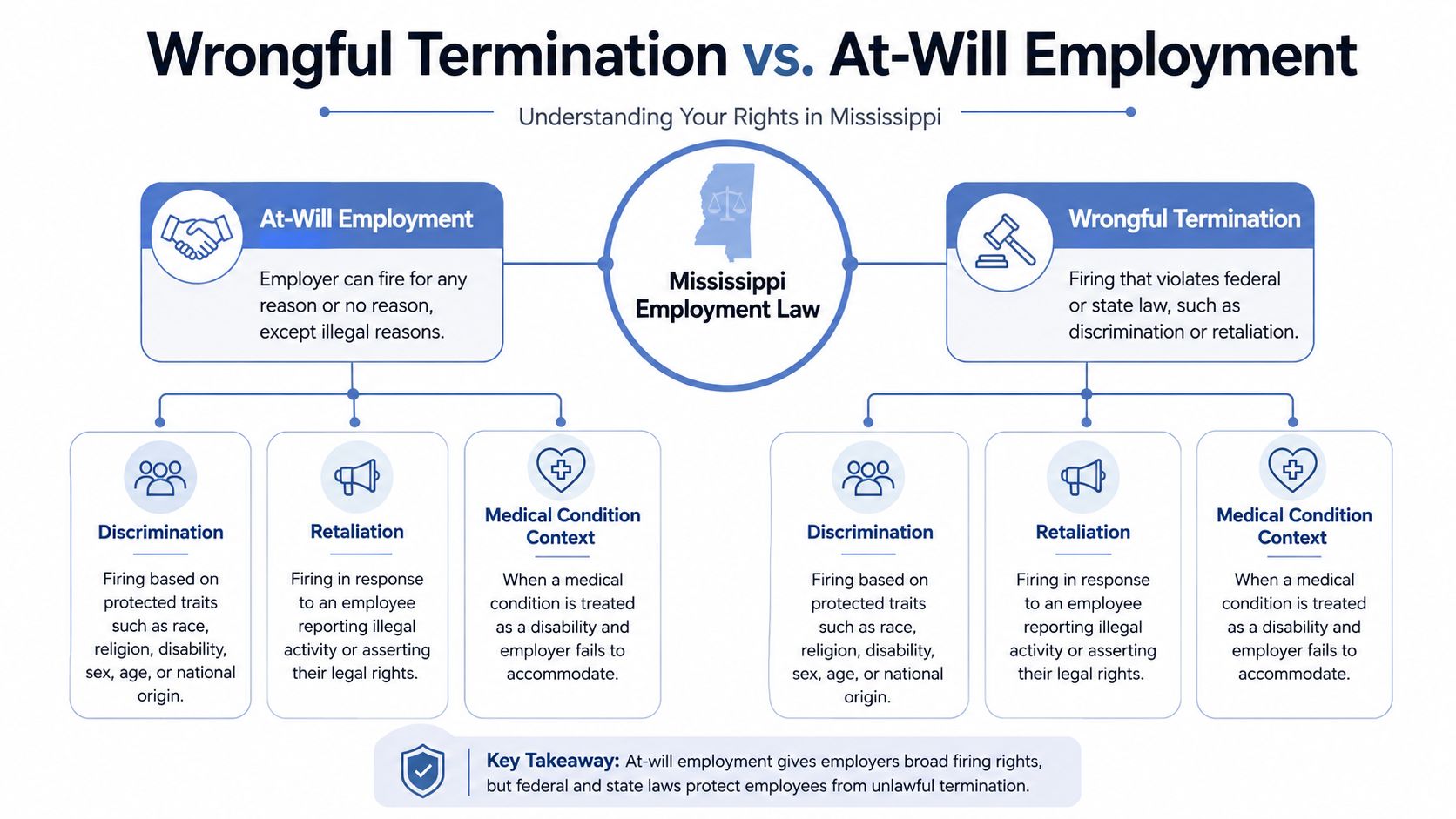
For a broader explanation of the boundary between an unfair firing and an unlawful one, review what qualifies as wrongful termination. The distinction is practical. A worker needs evidence of an illegal motive, not only proof that the employer acted unfairly.
The ADA and FMLA Protections That Apply to Medical Conditions
The ADA and FMLA solve different problems. The FMLA provides qualifying leave, while the ADA may require workplace changes that allow a qualified employee to keep working. One law doesn't replace the other, and an employer's compliance with one statute doesn't necessarily resolve its obligations under the other.
ADA coverage and accommodation
The ADA generally applies to employers with 15 or more employees. It protects a qualified individual with a disability, meaning an employee who can perform the essential functions of the job with or without reasonable accommodation. A disability may involve an actual impairment, a record of impairment, or an employer treating the employee as having an impairment.
The analysis usually asks whether the employee could perform essential duties, what accommodation was requested, and whether the employer engaged in a meaningful interactive process. Possible accommodations can include modified schedules, temporary reassignment of marginal duties, leave, or other changes, depending on the job and the medical limitations.
The employer may argue that the accommodation creates an undue hardship, that the employee can't perform an essential function, or that the termination resulted from a legitimate, nondiscriminatory reason. In Mississippi federal courts, the McDonnell Douglas burden-shifting framework may apply when direct evidence of discrimination is absent. The employee first develops a prima facie case, the employer identifies a legitimate reason, and the employee then attempts to show that reason is pretext.
Temporary impairments can still require careful analysis under the ADA Amendments Act. An employer may also create risk by assuming that a worker is unable to perform without asking what accommodation might work.
FMLA eligibility and protected leave
The FMLA generally covers private employers with 50 employees within a 75-mile radius, along with public agencies and schools. An employee typically must have worked for the employer for 12 months and completed 1,250 hours during the preceding period.
A serious health condition includes inpatient care, incapacity lasting more than three consecutive days with continuing treatment, and chronic conditions requiring medical treatment at least twice yearly, as described in guidance concerning the interaction between the FMLA and ADA (FMLA and ADA leave guidance). Qualifying leave can be taken continuously or intermittently when the medical need supports it.
The FMLA provides up to 12 weeks of unpaid, job-protected leave for eligible employees, a structure established when Congress enacted the law on February 5, 1993 (Congressional Research Service overview of the FMLA). Employers generally can't count protected FMLA absences as ordinary attendance violations, retaliate against the employee for using leave, or deny restoration to the same or an equivalent position.
| Element | ADA, Americans with Disabilities Act | FMLA, Family and Medical Leave Act |
|---|---|---|
| Primary protection | Prevents disability discrimination and may require reasonable accommodation | Provides protected leave for qualifying medical and family reasons |
| Eligibility focus | Covered employer, disability status, and qualified performance with or without accommodation | Covered employer, employee tenure, hours worked, worksite coverage, and serious health condition |
| Workplace obligation | Engage in the interactive process and assess reasonable accommodation | Provide qualifying leave and restore the employee to the same or an equivalent position |
| Common termination issue | Firing because of disability, perceived disability, disclosure, or accommodation request | Firing for taking leave, requesting leave, or treating protected absences as misconduct |
| Overlap | Leave may be a reasonable accommodation in some circumstances | Medical leave may qualify independently when the statutory requirements are met |
Employees seeking a practical explanation of leave rights can also review the Family and Medical Leave Act rights guide. The strongest cases often examine both statutes rather than assuming the dispute belongs exclusively under the ADA or FMLA.
How Mississippi's Legal Structure Shapes Your Claim
A Mississippi worker fired after disclosing a medical condition may expect a state agency to investigate. That option generally is unavailable. Mississippi does not have a human rights commission, and the state lacks a broad anti-discrimination law for private employers, as explained in this Mississippi employment-law guide.
That gap determines where the claim must begin. For disability discrimination, accommodation disputes, and related retaliation, the EEOC is generally the principal administrative gateway. A worker usually cannot choose between a Mississippi civil-rights agency and the EEOC, so preserving the federal theory and following federal filing requirements matters from the start.
Common assumptions and actual protections
| Common Assumption | Mississippi Reality |
|---|---|
| A Mississippi human rights commission will investigate the firing | Mississippi has no state human rights commission for employment claims, so workers generally rely on federal procedures |
| Mississippi has a broad private-employer disability statute | Medical-condition firing claims commonly depend on the ADA, FMLA, or another federal theory |
| Any medical disclosure creates workers' compensation retaliation protection | Mississippi does not provide specific protection from retaliation for filing a workers' compensation claim |
| A diagnosis alone proves unlawful termination | The worker must connect the decision to disability, leave, accommodation, or another protected activity |
| At-will employment eliminates all remedies | At-will status does not permit a termination based on a federally prohibited reason |
Workers' compensation requires separate analysis. Filing a workers' compensation claim is different from disclosing a diagnosis, requesting medical leave, or seeking an accommodation. Mississippi does not provide specific protection against retaliation for filing such a claim, and a disclosed medical condition is not automatically workers' compensation activity, according to this Mississippi workers' compensation retaliation guidance. There is no retaliation claim under a specific Mississippi statute just because an employee filed a workers' compensation claim, although the facts may support another legal theory.
Mississippi's Persons With Disabilities Act has a narrower reach than the ADA. It does not fill the gap left by the absence of a broad private-employer anti-discrimination statute. As a result, the employee must identify the applicable federal protection and develop a record suitable for the EEOC process.
Narrow public-policy theories may also arise in some employment disputes. See this discussion of public-policy exceptions in Mississippi employment law. That possibility does not replace the need to connect the firing to a specific federal protection.
Evidence That Strengthens a Medical-Condition Termination Claim
A persuasive claim usually begins with a clean chronology. Write down when you disclosed the condition, requested leave, submitted certification, received approval, returned to work, received discipline, and learned of the termination. The time gap between protected leave and discipline can be particularly important when the employer's explanation changed after the medical event.
Build the record before memories fade
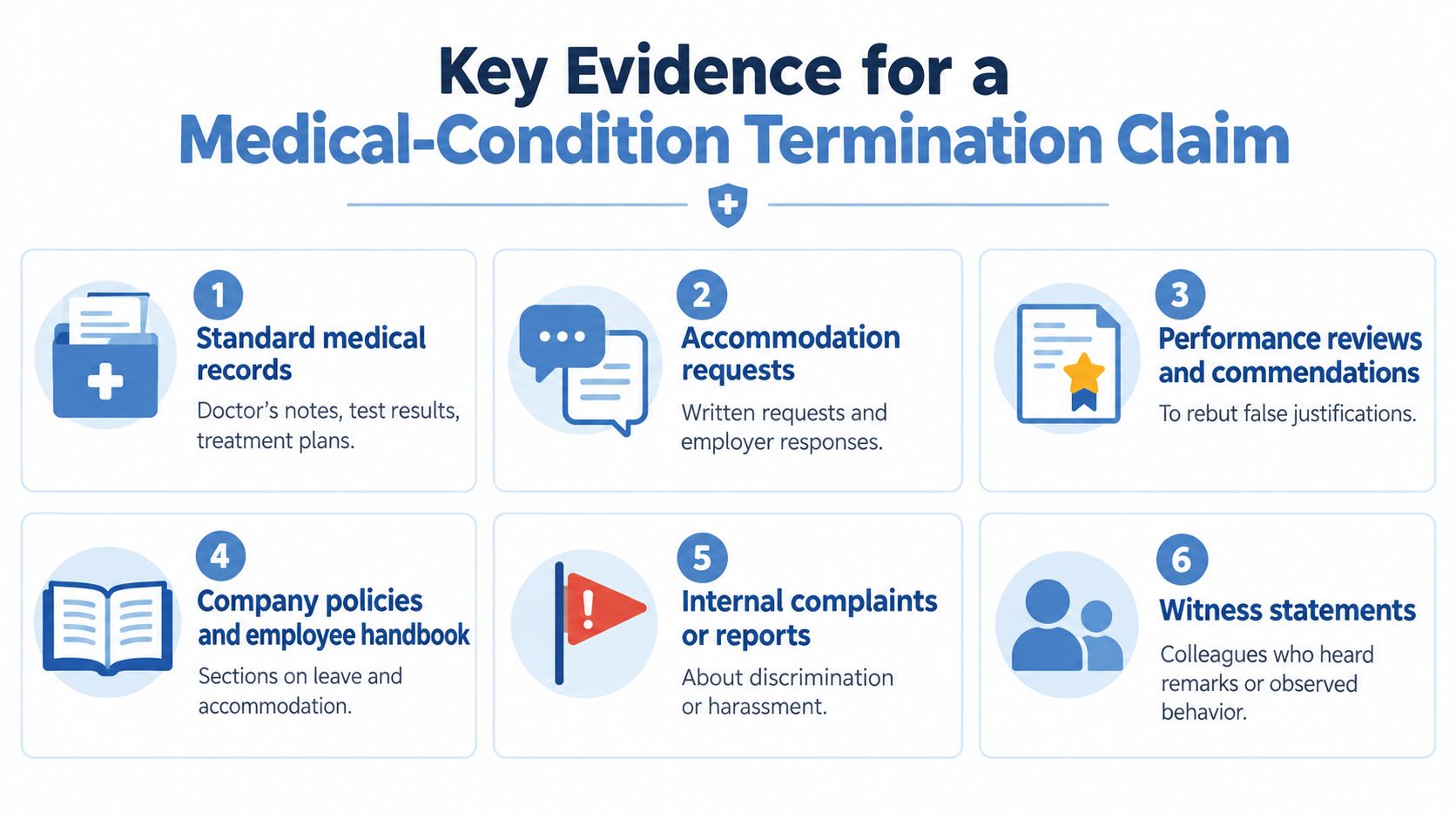
Gather documents that answer four questions: What did the employer know? What did you request? How did the employer respond? Why did the employer say it fired you?
- Medical documentation: Preserve doctor's notes, treatment plans, certifications, restrictions, and return-to-work information that support an ADA or FMLA theory.
- Employer communications: Save emails, text messages, HR tickets, calendar entries, leave approvals, accommodation requests, and termination communications.
- Performance history: Collect evaluations, commendations, production records, and prior discipline to establish whether “performance issues” existed before disclosure.
- Policies and procedures: Keep the employee handbook and leave or accommodation policies, especially if the employer failed to follow its own process.
- Witness information: Identify coworkers who heard comments, observed changed treatment, or know that comparable employees received different treatment.
- Decision records: Note who made the termination decision, who communicated it, and whether the stated reason shifted from meeting to meeting.
Don't delete messages, alter files, or access company systems after termination. Don't post accusations or medical details online. A public post can complicate credibility, privacy, and settlement discussions.
Treat the deadline as evidence management
EEOC deadlines are strict. Disability claims generally must be filed within 180 days, with the period potentially extended to 300 days where a state or local fair employment agency exists. Because Mississippi lacks that agency, private-sector ADA claims generally remain subject to the 180-day filing window. The deadline should be calculated from the discriminatory act, not casually estimated from the last paycheck.
Don't sign a severance agreement or release before having it reviewed. A release can affect valuable federal claims, and waiting to organize documents can make the EEOC process harder.
Filing a Charge and the Path Forward
For a Mississippi employee fired after disclosing a medical condition, requesting leave, or seeking an accommodation, the federal process usually begins with an EEOC intake questionnaire or interview through the Jackson Area Office. The questionnaire organizes the facts. The formal sworn charge identifies the employer, describes the conduct, and states the legal theory.
The EEOC generally gives the employer an opportunity to respond. Investigators may request records, interview witnesses, examine the employer's stated reason, and assess whether the evidence supports discrimination or retaliation. The investigation can end with dismissal, a conciliation settlement, or a right-to-sue letter. The agency's involvement does not guarantee that every fact will be developed.
What the administrative process can and can't do
The EEOC is not the employee's private lawyer. It may not collect every document, develop every comparator, or present the strongest legal theory without a clearly organized charge. The filing should identify the medical disclosure, leave or accommodation request, decision-maker, adverse action, stated reason, and facts connecting those events.
Mississippi has no state human rights commission and no broad state anti-discrimination statute covering these claims. That structural gap leaves many medical-condition termination disputes on the federal EEOC track rather than before a state civil-rights agency.
A mandatory arbitration clause may move the dispute from federal court to private arbitration, depending on the agreement and claims involved. Arbitration does not erase the claim, but it can change discovery, hearing procedures, cost allocation, and appeal rights.
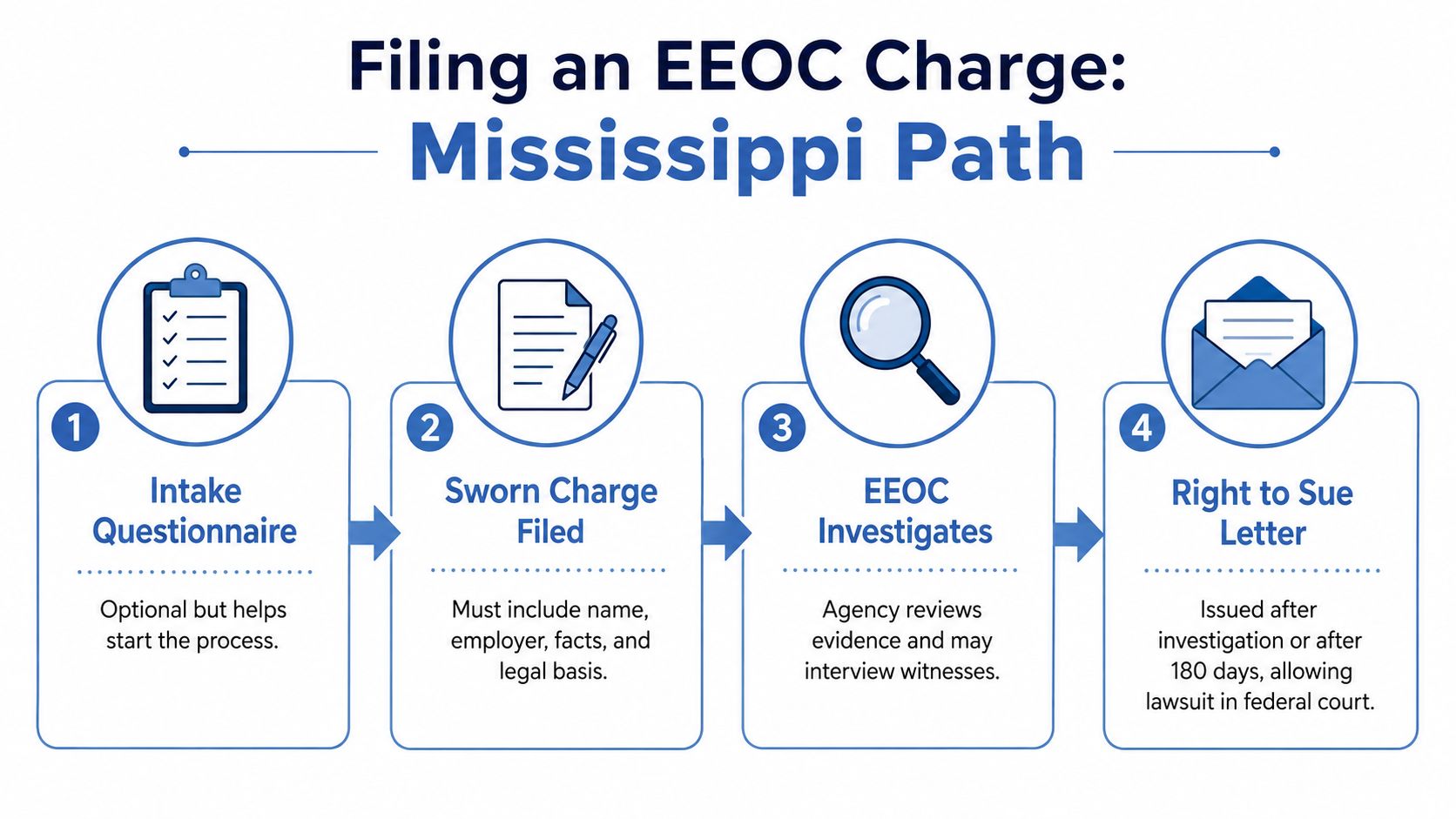
A right-to-sue letter may issue after the investigation or after 180 days. If the claim and timing support it, the employee may then pursue a federal lawsuit. Possible remedies include back pay, front pay, reinstatement in appropriate circumstances, compensatory damages, punitive damages, and attorneys' fees. Compensatory and punitive damages have statutory caps based on employer size, so a strong claim does not promise a particular recovery.
EEOC disability charges remained substantial in reported years, including 22,843 claims in 2021, 25,004 in 2022, 24,605 in 2018, and 24,238 in 2019 (EEOC charge data summary). Separate reporting describes 91,503 total EEOC charges in fiscal year 2025 and a $15 million medical-exemption and disability settlement, but those figures do not establish the value of an individual Mississippi claim. Results depend on proof, employer size, lost wages, mitigation, arbitration terms, and causation evidence.
Practical Next Steps and Choosing the Right Advocate
The first week after termination should be organized, not impulsive. Take these actions promptly:
- Request your personnel file: Ask for performance evaluations, disciplinary records, leave communications, and the documents supporting termination.
- Create a chronology: Record the diagnosis disclosure, leave request, accommodation discussions, return date, discipline, and termination.
- Preserve communications: Save emails, texts, voicemails, HR tickets, calendar entries, and written instructions.
- Identify witnesses: Write down names and what each person personally observed.
- Protect medical proof: Keep certifications and restrictions that explain the requested leave or accommodation.
- Contact the EEOC or counsel: Calculate the filing deadline immediately. Waiting can forfeit a claim even when the facts are troubling.
A consultation should address the federal theory, employer coverage, FMLA eligibility, accommodation options, evidence gaps, arbitration language, and the EEOC deadline. Many employment attorneys use contingency arrangements, commonly described in the 33.33% to 40% range for employment cases (contingency-fee explanation). The requested editorial range of 40% to 50% shouldn't be treated as a universal average, because fee percentages vary by agreement, litigation stage, expenses, and risk.
When screening counsel, ask whether the attorney handles Mississippi employment matters, understands federal court procedure, has experience with ADA and FMLA claims, and will evaluate the case beyond EEOC mediation. You should also ask who pays litigation expenses and whether the agreement changes if the matter resolves before a lawsuit.
Nick Norris, P.A. evaluates Mississippi employment disputes involving disability discrimination, FMLA leave, retaliation, and wrongful termination, including the EEOC-driven process that applies when no Mississippi human rights commission is available. If your separation followed medical disclosure, protected leave, or an accommodation request, gather your records and request a case evaluation through Nick Norris, P.A..
Leave a Reply