

You're salaried, but your workweek looks hourly. You stay late to finish schedules, answer messages after closing, cover weekend shifts, and keep working after everyone else has gone home. Then a manager docks your paycheck because the cash drawer is short or tells you that overtime “doesn't apply” because your title includes the word manager.
That situation is common in Mississippi workplaces, especially where employers treat salary as a shortcut around wage rules. A fixed paycheck doesn't automatically make you exempt from overtime, and a job title doesn't decide whether the law protects you. The details are your actual duties, how you're paid, how deductions are handled, and what your employer knew about the hours you worked.
What Abuse of Salaried Employees Actually Looks Like
Consider a hypothetical Jackson-area assistant manager earning a $42,000 salary while working 55 hours a week. Her employer requires her to open the store, supervise employees, stock merchandise, work the register, and respond to calls after hours. When the store comes up short, the employer docks her paycheck. When she asks about overtime, management says she's “exempt.”
That single scenario illustrates how abuse of salaried employees usually appears in practice. The problem rarely arrives as one isolated decision. Several improper practices often reinforce each other.

Misclassification behind a salary label
An employer may call someone an assistant manager, office administrator, or supervisor and treat that title as proof of exemption. In reality, the employee may spend most of the week performing routine, non-managerial work with little authority over hiring, firing, discipline, or business decisions. Salary alone doesn't answer the legal question.
Unpaid overtime as the routine
A salaried employee may be expected to work beyond 40 hours every week without recording time or receiving additional pay. Employers sometimes describe those hours as part of the “responsibility” of the position. That explanation doesn't eliminate overtime rights when the employee is legally nonexempt.
Deductions that punish the worker
Some employers reduce a salaried paycheck for a partial-day absence, a cash shortage, a customer walkout, damaged equipment, or an alleged mistake. Those deductions can undermine the required salary basis for an exemption, particularly when the employer uses them as a regular management practice.
Hourly control without hourly protection
The worker may have to clock in and out, obtain permission for brief absences, answer calls around the clock, and face discipline for failing to stay late. At the same time, the employer denies overtime and claims the employee has no wage protections. That combination creates the practical contradiction many Mississippi workers experience.
A retail manager can face all four patterns at once. The rest of this guide addresses the exemption tests, overtime calculations, deduction rules, misclassification evidence, and documentation that distinguish a frustrating job from a legally actionable wage problem.
How the FLSA Exemption Rules Apply to Your Salary
A salaried employee must satisfy three separate requirements before a white-collar overtime exemption applies under FLSA Part 541. The employer must satisfy the salary-basis test, the salary-level test, and the duties test. Failing one can defeat the exemption.
A hypothetical office manager at a Hattiesburg accounting firm earns $780 per week. That amount may satisfy a salary threshold in some circumstances, but the paycheck amount is only the starting point.
Salary basis
The employer must pay a predetermined amount that generally isn't reduced because of the quality or quantity of the employee's work. A deduction for a full-day absence may be treated differently from a deduction for part of a day, but repeated improper deductions create a serious problem for the exemption.
The Department of Labor's salary and overtime guidance identifies the federal standard salary level as $684 per week, or $35,568 annually, and explains that the salary basis, salary level, and duties requirements all matter.
Salary level
The thresholds identified in the governing federal guidance include these amounts:
| Effective Date | Minimum Weekly Salary | Minimum Annual Salary |
|---|---|---|
| Federal standard identified in DOL guidance | $684 | $35,568 |
| Scheduled July 1, 2024 level | Not separately stated in the verified guidance used here | $43,888 |
| Scheduled January 1, 2025 level | Not separately stated in the verified guidance used here | $58,656 |
The Department of Labor's 2024 final rule also described further updates every three years beginning in 2027. Because federal overtime rules and litigation can change, Mississippi employees should verify the threshold that applies to the period in dispute rather than rely on an old handbook.
Duties
The employee's duties must fit an executive, administrative, professional, or another recognized exemption. A title such as “manager” or “director” doesn't establish exempt duties. Courts examine what the employee does, what authority the employee exercises, and how much discretion the employee has.
A highly compensated employee exemption may also apply at the required compensation level, but the duties still matter. The practical trap is simple: an employer can meet the salary number and still lose the exemption because the job itself doesn't qualify. Mississippi workers can compare these questions with the discussion of overtime laws for salaried employees before assuming that salary ends the analysis.
Unpaid Overtime and Illegal Pay Deductions
A salary can cover a fixed amount of work without covering every hour the employee performs. For a nonexempt salaried employee, hours over 40 in a workweek generally require overtime at one and one-half times the regular rate. The calculation depends on the compensation arrangement, not on the employee's title alone.
Unpaid overtime
Take a hypothetical Gulf Coast restaurant supervisor earning $700 per week and working 55 hours. If the salary covers the regular straight-time compensation for the workweek, the employer still has to examine the overtime premium for the additional hours. In a fluctuating-workweek arrangement, the overtime premium may be calculated as an additional half-time amount, but that method requires a compliant agreement and consistent payment practices.
The regular rate isn't automatically the weekly salary divided by 40. The employer must account for the hours and the structure of the pay arrangement. Time records can show whether the worker opened the restaurant early, stayed after closing, attended mandatory meetings, or answered work messages from home.
Illegal salary deductions
Under the salary-basis rules, deductions for matters such as partial-day absences, cash shortages, customer walkouts, equipment damage, or unproductive time can jeopardize an exemption. One isolated mistake and a regular policy aren't always treated identically, so the surrounding facts matter.
Practical rule: A payroll record showing a short paycheck is more useful when paired with the written reason for the deduction and the hours worked during that week.
Evidence should be preserved as it exists, not recreated from memory. Useful records include:
- Time-stamped messages: Keep texts and email instructions showing when work began, ended, or continued after a shift.
- Access records: Badge swipes, scheduling applications, point-of-sale logins, and computer records may establish work activity.
- Payroll documents: Save pay stubs, written dock notices, and records showing reduced pay for a short week.
- Personal notes: Record dates, tasks, supervisors, witnesses, and the reason management gave for each deduction.
Improper overtime and unlawful deductions can support back pay, liquidated damages, and attorneys' fees under 29 U.S.C. § 216(b). The Department of Labor's overtime salary-level materials explain why salary amount by itself doesn't resolve exemption status. A separate discussion of unpaid overtime settlements can help workers understand how evidence affects the value and handling of a wage claim.

Misclassification and Hostile Work Conditions
Misclassification occurs when an employer calls a worker exempt even though the person's actual duties do not meet the exemption requirements. It can also occur when the employer treats an employee as an independent contractor and denies protections that apply to employees. The National Employment Law Project cited evidence that between 10% and 30% of employers wrongly label at least one worker as an independent contractor according to this employment misclassification report, affecting several million workers nationwide.
A Mississippi employer may call someone a manager while assigning routine sales, stocking, register, cleaning, or production work for most of the week. A senior-sounding title does not decide the issue. Courts examine the work actually performed. Learn how Mississippi courts distinguish an independent contractor vs employee under the FLSA economic realities test. The March 2024 DOL rule also revised the worker-status analysis under the FLSA, reinforcing the need to evaluate substance rather than labels.
| Factor | Exempt Duties | Non-Exempt Duties |
|---|---|---|
| Authority | Directs meaningful business operations or exercises independent judgment | Follows detailed instructions and has limited authority |
| Work type | Manages or performs recognized administrative or professional functions | Performs routine production, sales, clerical, or manual work |
| Decision-making | Makes significant decisions affecting the business | Escalates ordinary decisions to a supervisor |
| Accountability | Responsible for a department, function, or professional assignment | Measured primarily by output, attendance, or task completion |
Hostility tied to salary status
A demanding supervisor, exclusion from meetings, repeated after-hours demands, or denial of benefits may be unfair. Those facts alone do not establish a hostile-work-environment claim. The conduct must connect to a protected legal basis, such as discrimination, or to protected activity supporting a retaliation claim.
Mississippi has no state human rights commission, so a worker generally must evaluate available federal protections and applicable state-law claims rather than assume a state administrative remedy exists. The legal theory matters. Wage evidence may show hours worked, off-the-clock instructions, or employer knowledge, but it does not automatically prove discrimination under Title VII, the ADA, or another civil rights statute.
The same event can support different claims, but each claim still needs its own legal elements and proof.
Keep those issues separate in your records. Identify the wage violation, any protected complaint, the allegedly discriminatory conduct, the decision-maker, and the timing. That organization helps prevent ordinary workplace unpleasantness from being mislabeled as a hostile-environment claim while preserving facts that may support misclassification, wage, discrimination, or retaliation theories.
Building Your Documentation and Internal Complaint
Start before the dispute becomes a memory contest. Mississippi wage cases turn on specific dates, hours, instructions, deductions, and pay records. A general statement that a supervisor “always made me work late” is less persuasive than a dated entry showing the scheduled end time, the actual end time, the task performed, and the person who required it.
Create a reliable record
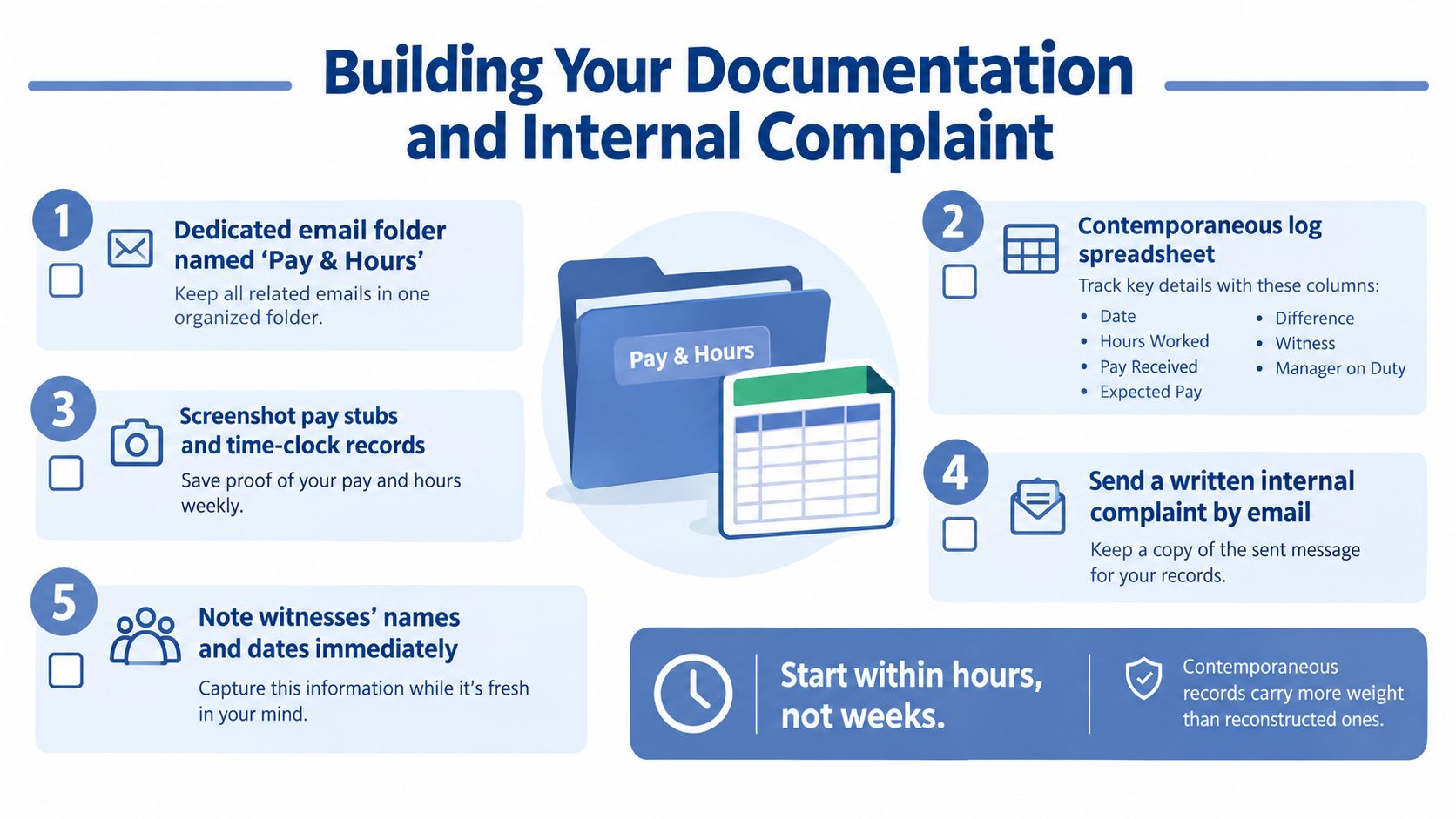
Set up a dedicated email folder named Pay & Hours. Save original messages rather than forwarding only excerpts, and preserve pay stubs, written schedules, time-clock records, and notices about deductions.
A spreadsheet can provide a usable chronology. Include columns for:
- Date: Identify the workday and pay period.
- Hours worked: Record start, end, meal periods, travel between required locations, and after-hours work.
- Tasks performed: Describe the actual work, not the job title.
- Supervisor instructions: Quote or summarize the instruction accurately, without exaggeration.
- Pay received: Record the amount shown on the pay stub.
- Expected pay: Note the calculation or reason you believe additional pay was due.
Keep the language factual. “Manager texted at 9:42 p.m. and required the schedule finished before morning” is stronger than “management constantly exploited me.” If you make a correction, preserve the original entry and explain the correction.
Make the internal complaint usable
Find the company's HR contact, payroll contact, or designated complaint channel. Send a concise written complaint identifying the dates, hours, deductions, job duties, and pay problem. Ask for a meeting, then follow up afterward with a short email confirming what was discussed.
An internal complaint isn't always legally required before a wage claim. It can still help establish that the employer knew about the problem, especially when the complaint identifies specific workweeks and payroll practices. Keep the sent message and any response outside the employer's system if you lawfully can.
Mississippi doesn't have a state labor agency or human rights commission handling these issues as a routine first stop. That makes the internal record especially important when a federal agency or private lawyer later asks what happened and when the employer was told.
Where Mississippi Salaried Workers Can File a Claim
Mississippi workers usually need to choose the forum based on the type of harm. A wage claim and a discrimination claim may involve the same employer, but they don't follow the same administrative process.
Federal wage enforcement
The U.S. Department of Labor's Wage and Hour Division handles federal minimum-wage and overtime complaints. Employees can seek information through the agency's telephone and online channels, and the agency can investigate employer practices. A complaint may produce an investigation, back wages, or another administrative resolution, but the agency controls the process.
Discrimination and harassment claims
The Equal Employment Opportunity Commission handles federal discrimination, harassment, and retaliation charges. Mississippi has no state human rights commission, so employees generally must rely on the federal EEOC for these civil rights complaints rather than starting with a Mississippi human-rights agency.
The EEOC process is free to the employee, as is a DOL complaint. Both routes can take time, and neither agency guarantees a particular recovery. An employee should preserve evidence even after filing because an agency interview or charge form doesn't replace the underlying records.
Private representation
A private employment lawyer can evaluate whether the facts support an FLSA claim, discrimination charge, retaliation theory, or overlapping claims. Contingency agreements commonly use a percentage of any recovery. The American Bar Association explains that these fees are often set at a fixed percentage, commonly around one-third to 40%, while the final percentage depends on risk, case stage, expenses, and the agreement.
The practical trade-off is direct. An agency complaint may cost nothing but gives the worker less control over the pace and strategy. Private representation may provide focused investigation and negotiation, but the fee reduces the amount the worker receives if there is a recovery. Workers comparing counsel and legal-marketing information may also find CitationOS law firm research useful for understanding how employment law firms present practice-area information online.

Retaliation, Workers' Comp, and What Mississippi Allows
Mississippi workers' compensation law has a gap that employees often discover only after a termination. Mississippi-specific guidance states that the Workers' Compensation Act does not create a standalone retaliation claim for filing a workers' compensation claim, and Mississippi does not recognize a separate retaliation cause of action under that Act for this conduct.
The workers' compensation system itself still matters. The Mississippi Workers' Compensation Act applies to employers with five or more employees, according to Mississippi employment-law guidance. Coverage must be determined before analyzing benefits, claim handling, or workplace conduct connected to an injury.
Separate the protected activities
A worker may have a federal retaliation claim if the employer acted because the employee complained about unpaid overtime, discrimination, disability accommodation, family leave, or another activity protected by federal law. Filing a workers' compensation claim alone is different. A termination after the filing may look retaliatory, but appearance doesn't create a standalone Mississippi workers' compensation retaliation claim.
Federal law can provide a remedy when the facts involve another protected activity. For example, a worker who reports wage violations may have an FLSA retaliation issue, while a worker who reports disability discrimination may need to evaluate an ADA or EEOC claim. The protected complaint, decision-maker, timing, and stated reason all matter.
| Legal Basis | What It Prohibits | Filing Forum | Deadline |
|---|---|---|---|
| FLSA retaliation | Retaliation for asserting wage rights or reporting covered wage violations | DOL or federal enforcement process | Confirm the applicable period promptly |
| Title VII, ADA, or ADEA | Discrimination and retaliation involving protected characteristics or activity | EEOC | Confirm the applicable EEOC filing period promptly |
| FMLA | Retaliation or interference involving covered leave rights | DOL or federal court process | Confirm the applicable period promptly |
| Mississippi workers' compensation law | Provides the workers' compensation remedy, but no standalone retaliation claim for filing the claim | Workers' compensation process for covered injuries | Confirm claim requirements promptly |
The safest approach is to identify every protected activity separately. Don't describe a workers' compensation filing as if it automatically creates a Mississippi retaliation lawsuit. It doesn't.
Your Next Steps and Common Questions Answered
A salaried worker who suspects abuse should preserve records before confronting management. Pull pay stubs, offer letters, exemption notices, job descriptions, schedules, and messages showing work outside scheduled hours. Then create a dated log and submit a factual internal complaint that identifies the specific pay periods and deductions.
A practical sequence looks like this:
- Collect the employment records: Save payroll, schedules, job descriptions, and written policies.
- Reconstruct the workweeks: Record actual start and end times, required calls, meetings, and off-site work.
- Describe the duties: Separate managerial or professional work from routine production and clerical tasks.
- Report the problem in writing: Identify the hours, deductions, and statements management made.
- Choose the correct route: Use the DOL for FLSA issues and the EEOC for discrimination or related retaliation claims.
- Get advice before signing: Don't sign a release, severance agreement, or payroll settlement without understanding which claims it covers.
Common questions
Does salaried status guarantee that I won't receive overtime?
No. The employer must satisfy the salary-basis, salary-level, and duties requirements. A salaried worker who fails the duties test may still be nonexempt.
How long does an FLSA claim take?
There isn't one dependable timeline. An agency investigation, private negotiation, and formal litigation move at different speeds. Delaying can reduce the wages available for recovery, so preserve records and obtain advice promptly.
What can a worker recover?
Potential relief may include unpaid overtime, back pay, liquidated damages, and attorneys' fees under the FLSA. The available remedies depend on the claim, the evidence, and the applicable limitations period.
Does a small employer have to carry workers' compensation coverage?
The Mississippi workers' compensation framework applies to employers with five or more employees. Coverage and exceptions should be checked against the employer's actual structure and the injury facts.
Why can't I start with a Mississippi human rights commission?
Mississippi doesn't have a state human rights commission. Discrimination and harassment complaints generally go through the federal EEOC, while wage complaints may go through the federal DOL or a private legal process.
A contingency agreement should be reviewed carefully. Percentage fees in employment matters vary with risk and case stage, and a worker should understand expenses, settlement authority, and the effect of fees on the final recovery before agreeing.
Nick Norris, P.A. evaluates Mississippi salaried-worker claims involving unpaid overtime, misclassification, improper deductions, discrimination, and retaliation. If your paycheck or job duties don't match the “exempt” label, visit Nick Norris, P.A. to request a case evaluation and discuss a practical path forward.
Leave a Reply