

You signed an agreement calling you an independent contractor. But your supervisor sets your schedule, tells you how to do the work, requires a company uniform, and pays you by the hour. You don't receive benefits, overtime, or workers' compensation coverage after an injury. In Mississippi, that arrangement deserves careful scrutiny because the contract label may not match your legal status.
The question is not what the paperwork calls you. It's whether your day-to-day work shows that you're operating an independent business or working as an employee under the company's control. The IRS and U.S. Department of Labor examine the substance of the relationship, including supervision, financial risk, permanence, and how integral your work is to the business.
This guide gives Mississippi workers a practical way to evaluate the difference between an independent contractor vs employee, preserve evidence, and decide what to do next.
Why Worker Classification Matters in Mississippi
A warehouse worker in Mississippi may be told to sign an “independent contractor agreement” before starting work. The company may require the worker to report at a specific time, wear its uniform, follow a supervisor's instructions, and perform tasks inside the company's facility. The worker may receive hourly payments, yet the company treats the worker as if no employment protections apply.
That arrangement creates more than a paperwork problem. If the worker is legally an employee, misclassification may affect overtime pay, payroll tax treatment, unemployment eligibility, workers' compensation coverage, and other workplace rights. The IRS explains that employees generally have income, Social Security, and Medicare taxes withheld, while businesses generally don't withhold those taxes from payments to independent contractors. IRS guidance on independent contractor or employee status describes the practical divide.
Practical rule: A signed contractor agreement is evidence, not a final answer. Actual working conditions carry more weight.
The classification question matters because independent contracting is a significant part of the labor market. The IRS 2024 independent contractor update identifies independent contractors as a major labor category and explains the different tax obligations attached to each status. The U.S. Bureau of Labor Statistics reported that independent contractors on their sole or main job represented 7.4 percent of total employment in its 2024 release. That benchmark shows why classification affects a substantial number of workers and employers.
What can disappear when the label is wrong
A worker classified incorrectly may effectively carry the costs of an employee without receiving the protections that normally accompany employment. The lost value can include:
- Overtime: An hourly worker may be denied overtime rights under the Fair Labor Standards Act.
- Payroll contributions: The worker may bear tax obligations that ordinarily involve employer withholding and payments.
- Unemployment access: The worker may be treated as ineligible because the company reported contractor payments.
- Injury protection: The company may deny workers' compensation coverage by insisting the worker isn't an employee.
- Leave and benefits: The worker may be excluded from programs that apply to employees.
Mississippi doesn't have a state human rights commission for employment claims. Workers often must rely on federal procedures and agencies, which makes it even more important to identify the federal protections that may apply. If you're sorting out tax treatment while reviewing your records, deductions for 1099 workers explained can provide useful background, but tax deductions don't decide whether the company classified you correctly.
Defining Independent Contractor and Employee Status
An employee generally works as part of the employer's business and remains subject to the employer's right to control the work. That control may involve instructions, training, scheduling, supervision, evaluation, payment practices, and the overall relationship between the parties.
An independent contractor generally operates an independent business. The contractor is more likely to control the method of work, invest in equipment, serve multiple clients, negotiate prices, accept the possibility of profit or loss, and perform work under a project-based relationship. Those characteristics matter because contractor status isn't a decision to receive a Form 1099-NEC.
Mississippi workers usually encounter federal standards rather than a separate state classification system that radically changes the analysis. The IRS uses behavioral control, financial control, and the relationship of the parties. The Department of Labor uses an economic-reality analysis under the FLSA. The tests differ in wording and emphasis, but both focus on the actual relationship.
Employee vs. Independent Contractor Key Differences
| Factor | Employee (W-2) | Independent Contractor (1099) |
|---|---|---|
| Control | The business directs how, when, and where work is performed. | The worker generally controls the method and process of performing the service. |
| Tax treatment | The employer generally withholds and reports payroll taxes. | The business generally pays without payroll withholding and typically reports payment on Form 1099-NEC. |
| Payment method | Hourly, weekly, salary, or another recurring wage structure is common. | Payment by project, assignment, or completed service is more consistent with independence. |
| Benefits | The worker may qualify for employer health, retirement, leave, or similar programs, depending on the plan and law. | Employee benefit programs generally don't apply. |
| Financial risk | The worker usually has limited exposure to business expenses and loss. | The worker may invest in tools, carry unreimbursed expenses, and face profit or loss. |
| Business activity | The worker performs an ongoing role within the employer's regular operations. | The worker operates a separate business and may offer services to multiple clients. |
| FLSA protections | An employee may receive minimum wage and overtime protections when covered and nonexempt. | Independent contractors generally aren't covered by the FLSA's employee wage protections. |
| Workplace injury | Employee status may support access to workers' compensation benefits under applicable rules. | The worker may need separate insurance and may not receive employer-provided coverage. |
A worker can be paid through a 1099 and still be an employee under the facts. Likewise, having flexibility or using personal tools doesn't automatically establish contractor status. If your role includes overtime issues, the distinction between classification and exemption also matters. Review what exempt vs. nonexempt employee means before assuming that a salary or job title eliminates overtime rights.
An independent contractor may also use business tools to reduce administrative burdens, such as Recepta.ai for contractors. That kind of business support may be consistent with an independent operation, but it doesn't decide status by itself. The legal category depends on the complete working relationship.
How the IRS and DOL Determine Worker Status
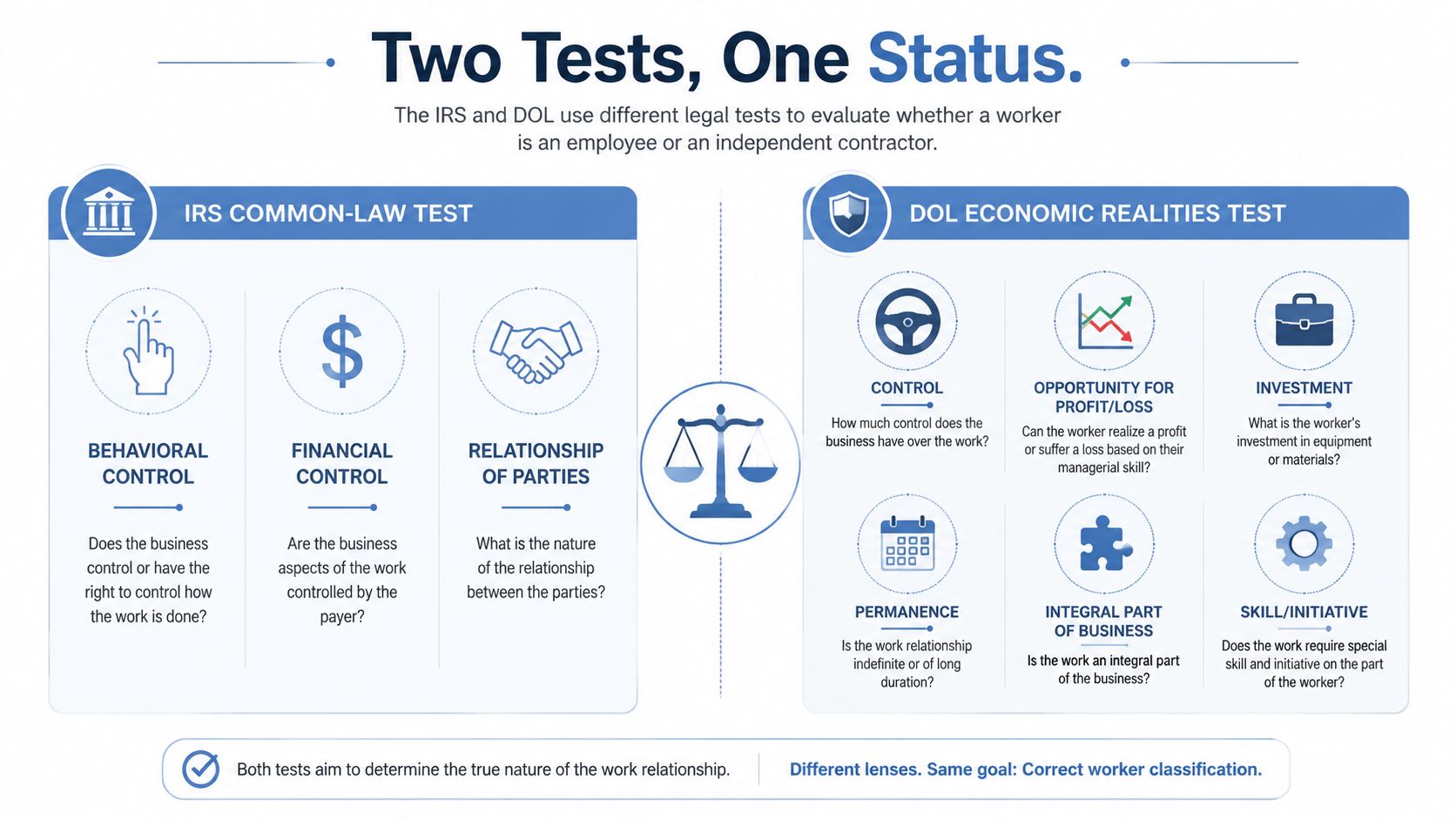
The IRS and Department of Labor ask related but distinct questions. The IRS focuses on the company's right to control the worker for tax purposes. The Department of Labor asks whether the worker is economically dependent on the business under the FLSA.
The IRS common-law categories
The IRS organizes its analysis into three categories:
- Behavioral control: Who decides how the work is done? Detailed instructions, required training, company procedures, performance evaluations, and close supervision point toward employee status.
- Financial control: Who controls the business side of the relationship? The worker's investment, unreimbursed expenses, ability to advertise services, opportunity for profit or loss, and payment structure all matter.
- Relationship of the parties: Do the parties describe the relationship as ongoing employment or a project-based service arrangement? Benefits, permanency, written agreements, and the nature of the work provide evidence, but the agreement doesn't control by itself.
A Mississippi warehouse worker who follows a supervisor's daily instructions, uses company equipment, and receives hourly pay presents a different picture from a contractor who brings specialized equipment, sets prices, serves separate customers, and accepts financial risk on each project.
The DOL economic-reality factors
The Department of Labor's 2024 FLSA worker-classification framework considers six economic-reality factors:
- Opportunity for profit or loss.
- Investments by the worker and the employer.
- Permanence of the working relationship.
- The nature and degree of control.
- Whether the work is integral to the business.
- The worker's skill and initiative.
No single factor decides the issue. The analysis asks whether the worker is economically dependent on the company or is operating a business for themselves.
Consider two truck drivers. One leases and maintains a personal rig, chooses routes, serves different customers, and can increase profit through business decisions. Another drives a company truck, follows assigned routes, reports to a dispatcher, and has little ability to change earnings through independent management. The first arrangement contains stronger indicators of contractor status. The second contains stronger indicators of employment.
For a plain-language overview of the wage law that often applies to these disputes, see the Fair Labor Standards Act explanation.
The legal framework remains subject to federal policy changes. The Department of Labor has issued newer guidance while reviewing the 2024 rule, so workers shouldn't rely on a single checklist or assume that a current contract label settles the matter.
Why a Signed Contract Does Not Decide Your Status
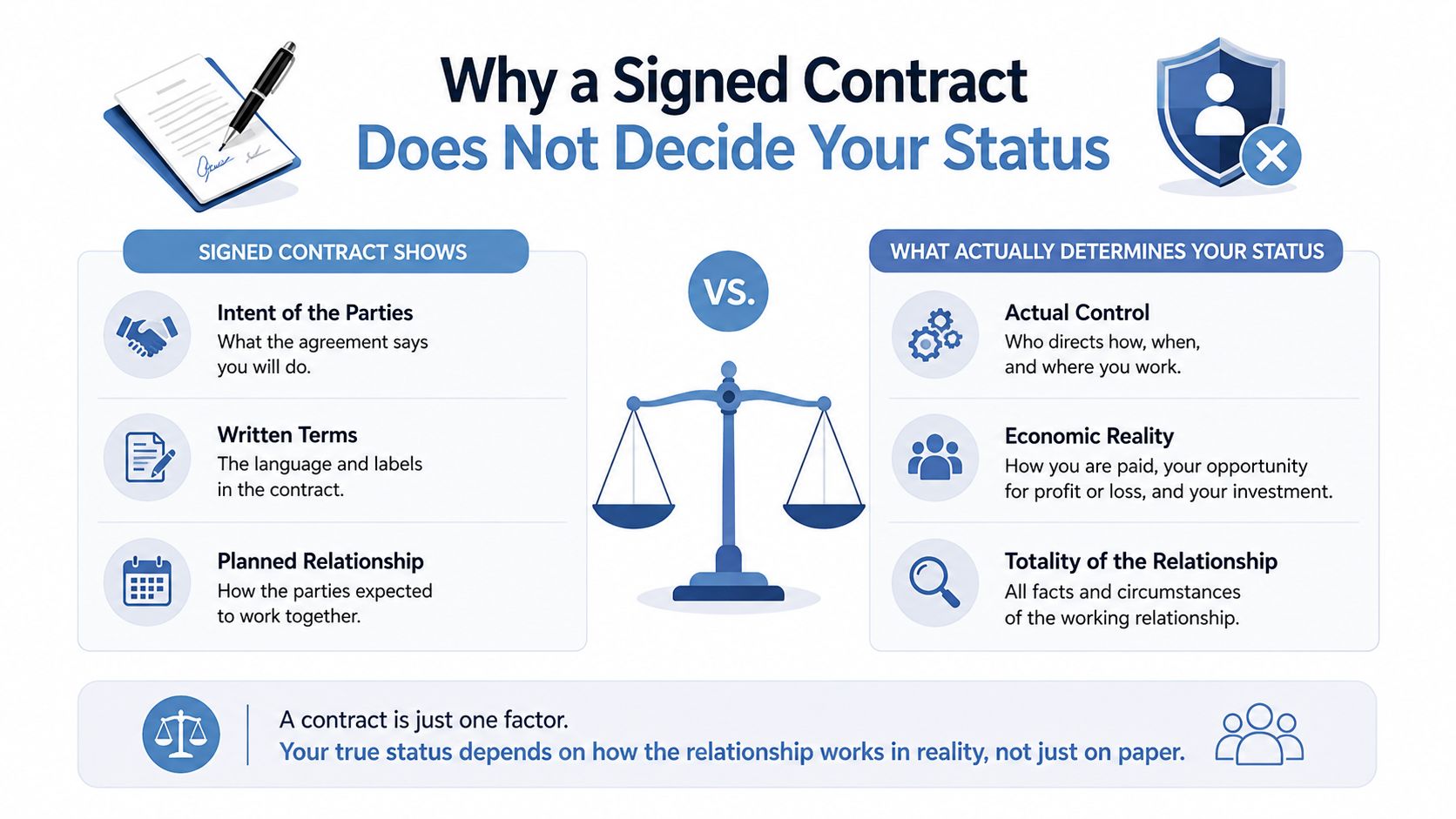
A document titled Independent Contractor Agreement may describe the parties' intentions, but it doesn't erase the facts of the job. The IRS considers the right to control the work, while the Department of Labor examines economic dependence. Both analyses look beyond labels.
A delivery driver may sign a contractor agreement, wear the company's uniform, follow a route assigned by a dispatcher, report at a required time, and receive hourly pay. Those facts suggest the company controls important details of the work. The word “contractor” on the first page doesn't change what happens during each shift.
Evidence that can outweigh the paperwork
A warehouse worker labeled a contractor may have strong evidence of employee status if the company:
- Sets the schedule: Managers decide when the worker must arrive, take breaks, or leave.
- Supervises daily work: A supervisor assigns tasks, monitors performance, and disciplines the worker.
- Controls the method: The worker must follow company procedures instead of choosing the process.
- Provides equipment: The company supplies the facility, tools, technology, uniform, or materials.
- Restricts outside work: The worker can't realistically serve other customers or competitors.
- Maintains permanence: The relationship continues indefinitely instead of ending after a defined project.
- Pays by time: The worker receives hourly or recurring payments rather than negotiated project compensation.
The question isn't whether one fact proves employment. The question is whether the combined facts show a worker dependent on one business.
Paperwork can describe a relationship. It can't transform supervision into independence.
Employers also can't avoid legal obligations by shifting a worker onto a 1099 form. Workers can't waive statutory rights through a label that doesn't reflect reality. The consequences may involve overtime, tax reporting, unemployment, and injury coverage.
A business evaluating contractor arrangements may also review administrative expenses, including Attorney Assistant staffing costs. That type of cost planning is separate from worker classification. The company still must evaluate the actual relationship rather than treating an agreement template as a substitute for compliance.
Legal Consequences of Worker Misclassification
Misclassification shifts costs onto the worker and can deprive the worker of protections that apply to employees. The exact consequences depend on the law involved, the worker's duties, coverage rules, and the evidence available.
An improperly classified worker may lose access to overtime under the FLSA, employer payroll contributions, unemployment insurance, workers' compensation coverage, and employee leave protections. The IRS explains that employees are generally subject to wage withholding and employment taxes, while independent contractors generally aren't paid through that withholding system. That difference can affect both the worker's immediate pay and the worker's later tax responsibilities.
The financial divide
| Benefit or Obligation | Employee | Misclassified Contractor |
|---|---|---|
| Wage reporting | Typically receives a Form W-2. | Typically receives Form 1099-NEC. |
| Payroll withholding | Employer generally withholds applicable income, Social Security, and Medicare taxes. | Business generally doesn't withhold those employment taxes. |
| Overtime | A covered, nonexempt employee may receive overtime for qualifying hours. | The business may improperly deny overtime by treating the worker as outside the FLSA. |
| Unemployment | Employee wages may support eligibility under applicable rules. | Contractor reporting can create a barrier to benefits. |
| Work injury | Employee may qualify for workers' compensation coverage under applicable Mississippi rules. | Contractor may be left without employer coverage. |
| Leave and benefits | The worker may qualify under applicable laws or employer plans. | Contractor status generally excludes employee programs. |
The employer may face responsibility for unpaid wages, payroll tax obligations, and other remedies if the facts establish an employment relationship. The worker, however, shouldn't assume that a later reclassification automatically produces every possible remedy. Each claim has its own coverage requirements, deadlines, and proof.
Deadlines matter
FLSA claims for unpaid minimum wage or overtime generally reach back two years, or three years for willful violations, according to the Department of Labor's misclassification materials. Because the source link for that limitation is already used in the classification discussion, treat the deadline as urgent and verify the current rule during a case evaluation. Waiting can eliminate older wage claims.
Don't estimate the harm from memory. Preserve time records, pay statements, schedules, text messages, work rules, and supervisor communications. A clear record helps determine whether the company controlled the work and what compensation the company paid.
Mississippi-Specific Rules and Limitations Workers Should Know
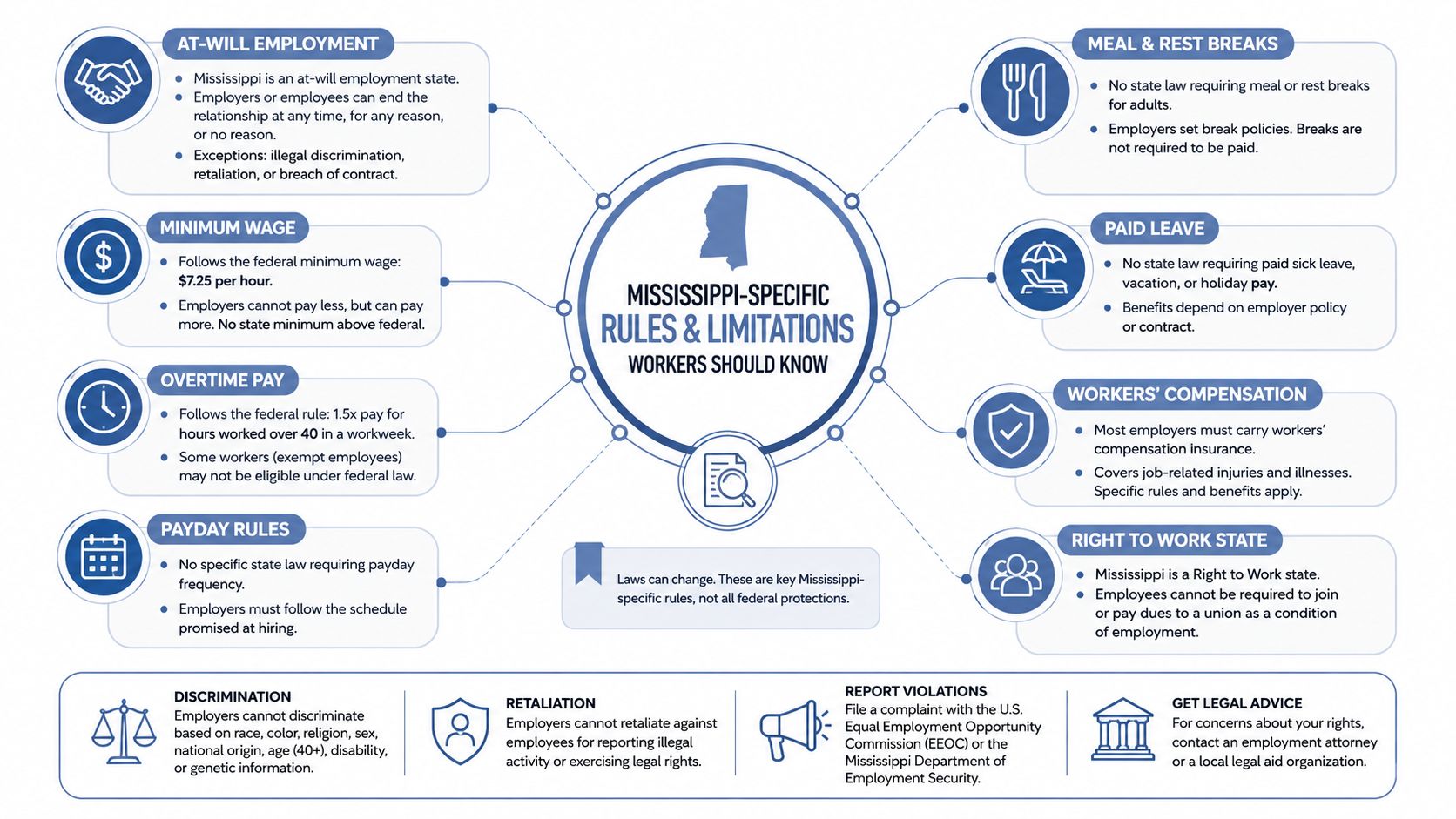
Mississippi workers face a legal environment where federal protections often do much of the practical work. Mississippi doesn't have a state human rights commission for employment claims, so a worker alleging discrimination, harassment, or related retaliation generally must use federal EEOC procedures rather than filing through a Mississippi human rights agency. The cited Mississippi employment materials explain that federal procedures become especially important because the state lacks that agency route.
Mississippi also doesn't provide a retaliation claim for filing a workers' compensation claim. The Mississippi-focused materials state that the Mississippi Workers' Compensation Act contains no anti-retaliation remedy for that protected act. That limitation matters when a worker is injured and the employer disputes both the injury and the worker's status.
State limits do not erase federal rights
Workers' compensation generally applies to employees under the governing system. A company that calls an injured worker a contractor may deny coverage, leaving the worker to prove that the relationship was employment or rely on separate insurance.
Unemployment presents a similar classification problem. A worker reported as receiving contractor payments may encounter an eligibility dispute, even if the daily facts show the worker functioned as part of the employer's workforce. Keep the company's payment records and any evidence showing who directed the work.
Federal statutes can fill important gaps. Depending on the facts, the FLSA may address unpaid minimum wage or overtime, Title VII may address discrimination or harassment, the ADA may address disability discrimination, and the FMLA may provide qualifying leave rights. These laws don't use one universal test for every issue. A worker may need to analyze classification separately for taxes, wages, unemployment, injury coverage, and discrimination protections.
Mississippi warning: Don't assume that one agency's decision controls every employment claim. Different laws can apply different standards.
The answer to “Can I be a contractor for one law and an employee for another?” may be yes, depending on the statute and relationship. That is why gig work, trucking, construction, staffing, home services, and warehouse arrangements require a fact-specific review rather than a generic online checklist.
What to Do If You Suspect Misclassification
Start gathering evidence before confronting the company. Your strongest proof usually comes from ordinary work records, not from your memory of what the company called you.
Build a classification file
Create a private timeline and save copies outside the employer's systems:
- Record supervision: Write down who assigned tasks, reviewed work, trained you, corrected mistakes, and could end the relationship.
- Preserve schedules: Save posted schedules, timekeeping records, route assignments, shift messages, and instructions about arrival or break times.
- Track equipment: Identify who supplied vehicles, tools, uniforms, software, materials, and workspace.
- Collect payment records: Keep invoices, pay statements, deposits, tax forms, and messages describing hourly, weekly, or project-based pay.
- Document independence: Note whether you advertised services, worked for other customers, hired help, negotiated rates, or could make a profit or loss through business decisions.
- Identify witnesses: List coworkers who experienced the same supervision, scheduling, and payment practices.
Don't alter records or take information you aren't entitled to access. Preserve what you lawfully possess and keep the original context when possible.
Use the available federal process
You can ask the IRS for a formal worker-status determination through Form SS-8. The IRS's classification guidance and Publication 1779 emphasize that actual working conditions matter more than the contract label. The determination process may take time, so it shouldn't replace prompt legal advice about wage deadlines.
You may also contact the Department of Labor's Wage and Hour Division regarding possible FLSA violations. A complaint can be appropriate when the employer denied minimum wage or overtime by treating an employee as a contractor. The FLSA generally provides a two-year limitations period, extended to three years for willful violations, so don't delay while collecting documents.
Retaliation for asserting federal wage rights can itself violate federal law. Keep written proof of schedule changes, discipline, threats, termination, or other adverse treatment after you raised classification or pay concerns.
Read the Mississippi-focused guidance on what to do if you are misclassified as an independent contractor for a focused review of the evidence and options. Nick Norris, P.A. evaluates misclassification matters on a contingency basis, so qualifying workers generally don't pay upfront attorney fees. Mississippi employment-law fee guidance commonly places contingency fees at 40% to 50% of the recovery, as described in the firm's Mississippi fee materials, and the agreement should state the fee and case expenses clearly before representation begins.
Bring your agreement, tax forms, pay records, schedules, messages, job description, injury records, and termination communications to an initial review. Call 601-641-4897 to discuss whether the facts support an employee-classification, unpaid-wage, retaliation, or related employment claim.
Nick Norris, P.A. provides Mississippi workers with case evaluations focused on the facts behind contractor labels, including supervision, schedules, pay records, and workplace consequences. Visit Nick Norris, P.A. to request a review and learn what evidence to preserve before you act.
By Nick Norris, Attorney
Last updated: August 25, 2026
Reviewed by Nick Norris
Leave a Reply