

Religious employment discrimination is covered by federal Title VII, which applies to employers with 15 or more employees. Mississippi has no state human-rights commission, so workers generally pursue these claims through the EEOC, with charge-filing deadlines typically 180 or 300 days, depending on the applicable rules.
If your supervisor denied a schedule change for worship, questioned your religious clothing, or treated you differently after you raised a faith-related concern, the key issue is what motivated the employer's decision and how it responded to your request. A difficult workplace conversation doesn't automatically prove discrimination, but careful documentation can help show whether the employer considered a workable accommodation or dismissed the request.
What Counts as Religious Employment Discrimination at Work
Religious employment discrimination occurs when an employer makes a decision about work because of a person's religion, religious beliefs, or need for a religious accommodation. It can affect applicants and current employees, and it may involve hiring, firing, pay, scheduling, promotion, job assignments, or other working conditions.
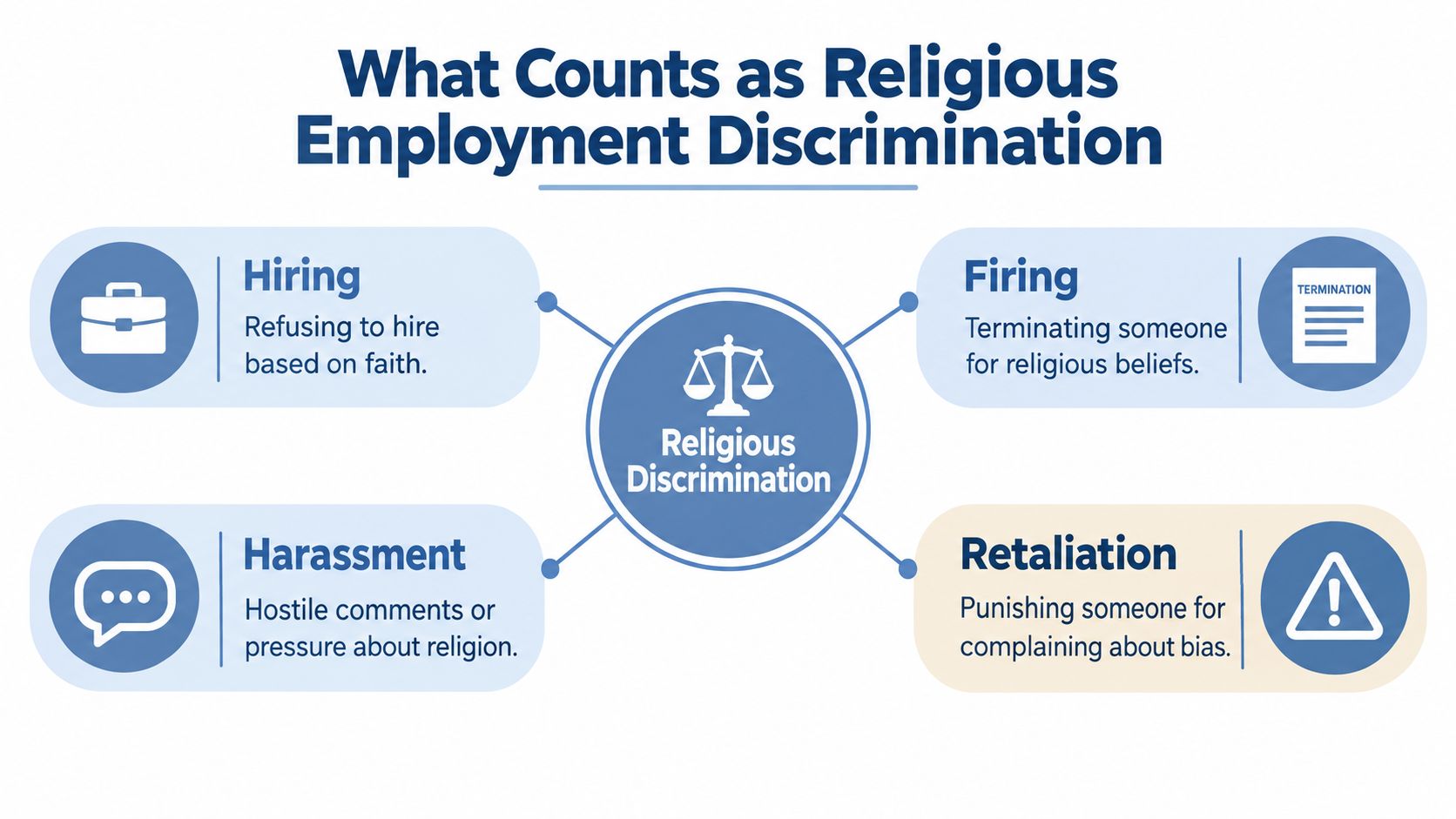
Title VII of the Civil Rights Act of 1964 prohibits employers with 15 or more employees from discriminating because of religion. It also requires reasonable accommodation for a worker's sincere religious observance or practice unless accommodation would impose an undue hardship on the employer's business. The protection isn't limited to people who belong to a traditional or formally organized faith. The Congressional Research Service's overview of Title VII and religious accommodation describes this federal framework.
There are two related but distinct ways a workplace can violate that framework:
- Disparate treatment: An employer refuses to hire, fires, demotes, or otherwise treats someone worse because of religion.
- Failure to accommodate: An employer doesn't reasonably address a conflict between work and a sincere religious practice, such as a Sabbath observance or required religious dress.
You don't need to hear an openly hostile comment to raise a concern. A manager might give a secular scheduling request more favorable treatment, then deny a similar religious request without a sound business explanation. Or an employer might enforce a dress rule selectively. The facts, not whether someone used an openly discriminatory phrase, are what matter.
Harassment and retaliation may also be relevant if an employee faces religious hostility or is punished for complaining. For support in handling difficult workplace situations, overcoming unjust challenges at work can offer a practical perspective alongside legal guidance.
Federal Protections Every Mississippi Worker Should Know
A denied schedule adjustment does not automatically violate federal law. The key question is whether the employer considered the request and can show that granting an accommodation would cause substantial hardship in the overall context of its business. Title VII applies to employers with 15 or more employees and bars religious discrimination in hiring, discharge, compensation, and other terms and conditions of employment. It also requires employers to accommodate sincere religious observances or practices unless they meet the undue-hardship standard.

Different legal theories require different evidence. A worker may challenge discriminatory treatment without having submitted a formal accommodation request. An accommodation claim, by contrast, focuses on whether the employer addressed a conflict between work and a sincere religious practice. Keep written records of the request, the employer's response, proposed alternatives, and any stated reason for refusal. Those details can matter if you later file an EEOC charge.
What changed after Hardison and Groff
For decades, employers relied on the Supreme Court's 1977 decision in Trans World Airlines, Inc. v. Hardison, which described undue hardship as involving more than a “de minimis” cost. In 2023, the Supreme Court unanimously revisited that standard in Groff v. DeJoy. It held that an employer must show a substantial burden in the overall context of its business to deny an accommodation. A minimal cost alone is not enough. The Supreme Court's Groff opinion also requires employers to consider other workable accommodations rather than reject a request at the first obstacle.
In practice, ordinary coworker inconvenience does not automatically establish undue hardship. A coworker's objection to covering a shift is not enough by itself. The employer should assess whether the effect on coworkers would create a real operational burden, then consider options such as a voluntary shift swap or another schedule. Document the alternatives you suggest and the employer's response. That record helps distinguish a genuine business constraint from a refusal to consider accommodation.
Mississippi has no statewide human-rights commission that processes employment-discrimination complaints. The EEOC handles these federal claims, and the filing period is generally 180 or 300 days, depending on the applicable jurisdictional rules. Mississippi's filing route and deadlines are covered in detail below.
Real-World Examples of Religious Discrimination on the Job
A worker in a Mississippi distribution center asks not to work a recurring Sabbath shift. The manager says no without considering a voluntary swap or another schedule, while approving comparable secular scheduling requests. That could support a failure-to-accommodate claim, and the different treatment may also be relevant to a disparate-treatment theory.

A uniformed employee requests an exception to a grooming rule for a religious practice. The employer doesn't have to grant every request exactly as proposed, but it should assess workable alternatives and the business impact. A blanket refusal, without meaningful consideration, may raise an accommodation issue.
Other situations can look less direct. A supervisor may repeatedly pressure an employee to skip prayer, schedule work in conflict with religious observance, or remove religious headwear when the same policy is not enforced consistently. An employer may also move an employee away from customer-facing work because it assumes customers will object to the employee's religious clothing. Depending on the evidence, those facts may point to accommodation, disparate treatment, or both.
The response after a request matters, too. A worker who suddenly receives closer scrutiny, worse assignments, or discipline after raising a religious concern should keep records. The timing alone doesn't prove retaliation, but it can help show whether the employer's stated explanation is credible.
The EEOC's litigation report offers a limited enforcement snapshot, not a measure of how common discrimination is nationwide. In fiscal year 2024, the agency's Office of General Counsel filed three religious-discrimination lawsuits; hiring and accommodation allegations each appeared in about 66.7%, and discharge allegations in about 33.3%. Some cases involved more than one theory, so those categories overlap. The EEOC's fiscal-year 2024 performance report shows how claims can arise at different points in employment.
This overview may help you recognize the issue and identify questions to ask about your own circumstances.
How Mississippi Employees Request a Religious Accommodation
You don't need to cite Title VII or use a special form to request accommodation. Notice is enough when your employer understands that the adjustment you need is connected to a religious practice. A clear request can start a conversation and create a record of what the employer knew. The EEOC's workplace religious-accommodation guidance explains the notice rule and examples of possible adjustments.

Make the request specific. Say what work requirement conflicts with your practice, what adjustment you need, and when the conflict occurs. You might explain that you can't work a particular Sabbath shift, need time for prayer, or need an exception to a dress or grooming rule.
Make a practical request and preserve the response
Possible accommodations include a schedule change, a voluntary shift swap, reassignment, a modification to workplace practices, or leave. A worker can suggest options, but the employer should consider reasonable alternatives rather than treating the first proposed solution as the only possibility.
Practical rule: Don't leave the religious reason unstated. A supervisor may not understand that a scheduling or dress request is tied to a sincere religious practice unless you explain the connection.
After speaking with your supervisor or human-resources contact, follow up in writing. Keep the date, the recipient, the words you used, the employer's response, and any alternatives discussed. Save relevant schedules, attendance records, discipline notices, and communications. If the employer rejects one option, ask whether another adjustment could work.
Avoid skipping the request if it's safe and practical to make one. Also avoid describing the conflict only in secular terms if religion is the reason you need the change. That distinction can matter later when the employer argues it didn't know the request was religiously motivated. For a closer look at the accommodation process, review religious accommodations in the workplace.
Filing a Religious Discrimination Claim in Mississippi
If your employer denies a religious accommodation or disciplines you after a request, record what happened and when. Mississippi has no state human-rights commission that handles employment-discrimination complaints, so workers generally bring religious-discrimination claims through the federal EEOC. The charge-filing window is 180 or 300 days, depending on the applicable jurisdictional rules. Check the date of the action promptly. The EEOC's charge-filing deadline rules set the filing windows, and a charge filed after the applicable deadline may be barred.
Identify the employment action and its date. Collect the employer's name and location, the people involved, a concise account of what occurred, and records supporting your account. Preserve accommodation requests, schedules, emails, texts, performance reviews, attendance records, and discipline documents. Include evidence showing how the employer treated comparable employees. For a religious-accommodation dispute, keep the request and the employer's response together with any records showing whether proposed alternatives were considered and whether the employer relied on coworker inconvenience.
What happens after a charge
The EEOC may review your charge, request information from the employer, investigate, and attempt conciliation. Expect possible follow-up questions and an employer response. The agency may decide not to litigate the case itself. Filing a charge is a separate step from bringing a lawsuit, and a charge is generally required before most federal employment-discrimination lawsuits can proceed. If the EEOC issues a Notice of Right to Sue, you may pursue a federal court case, subject to the applicable requirements and deadlines.
An EEOC decision not to litigate does not decide that discrimination did not occur. The agency's litigation program handles only some claims. Keep your evidence and get advice about what the agency's notice means for your options.
Review the EEOC investigation process to understand what may happen after filing. If you are also considering a separate workplace complaint, keep its facts and legal theories distinct. Pursuing one complaint does not necessarily preserve the deadline for another claim.
What Hiring a Mississippi Employment Lawyer Actually Costs
Employment lawyers may use different fee arrangements. In Mississippi employment cases, a commonly discussed contingency-fee range is 40% to 50% of the recovery, but the written agreement and circumstances of the case determine the actual fee. A contingency arrangement doesn't guarantee that you'll recover money or that the lawyer will take the case. This overview of Mississippi employment-lawyer costs discusses the range and the need to review the agreement.
Here's how the percentage works if a case results in a $100,000 recovery:
| Fee Percentage | Attorney Fee | Client Share (Before Expenses) |
|---|---|---|
| 40% | $40,000 | $60,000 |
| 50% | $50,000 | $50,000 |
The client share shown is before litigation expenses. The fee agreement should explain how costs such as filing fees, records, experts, and other expenses are handled, including whether they're deducted before or after the attorney's percentage is calculated. Ask for a clear written answer before signing.
A lawyer can also explain what information is useful for evaluating a religious-discrimination claim: the accommodation request, employer response, timing of any adverse treatment, and records showing how policies were applied. Keep the conversation confidential and ask how the office handles sensitive employment documents. For background on the cone of legal silence, remember that confidentiality and legal privilege have specific rules; asking a question online isn't a substitute for discussing your situation directly with counsel.
Common Questions Mississippi Workers Ask About Religious Claims
Why do some EEOC charges never become lawsuits?
A charge and a court case aren't the same thing. A worker may face administrative requirements, evidence challenges, a missed deadline, an employer-size issue, or an arbitration agreement. A claim may also depend on showing that a belief is sincere, that the employer acted because of religion or failed to accommodate, and that the employer's explanation doesn't resolve the dispute. Some conduct goes unreported because workers fear retaliation or aren't sure that subtle schedule pressure or selective policy enforcement is unlawful.
What should I save if I'm worried about retaliation?
Keep the original messages and make a dated log of events. Record who was present, what was said, when your treatment changed, and whether the employer gave a reason. Save schedules, evaluations, discipline notices, and examples of how comparable workers were treated. Don't alter records or take confidential material you aren't allowed to access.
Does filing a workers' compensation claim create a retaliation claim?
No. Mississippi workers' compensation law doesn't create a general retaliation claim solely because an employee filed a workers' compensation claim. A termination or other adverse action after filing may need analysis under another Mississippi or federal employment-law theory, but the filing itself doesn't supply the retaliation claim. The relevant Mississippi workers' compensation provision addresses the limits of that system.
Can coworker inconvenience defeat a religious accommodation request?
Not automatically. Under the Groff standard discussed above, the employer must assess whether denying accommodation would impose a substantial burden in the overall context of its business. Coworker effects matter when they affect operations, and the employer should consider alternatives such as a voluntary swap or adjusted schedule rather than relying on coworker resentment alone.
Nick Norris, P.A. represents Mississippi employees in workplace discrimination matters, including religious-discrimination and accommodation claims. If you need help assessing your EEOC options, preserving evidence, or understanding a proposed fee agreement, visit Nick Norris, P.A. to learn about speaking with the firm.
Leave a Reply