

You're salaried, you're working nights and weekends, and your paycheck never changes. When you asked about it, you got a short answer. You're on salary, so that's just how it works.
That answer is sometimes right. Often, it's incomplete. For many cases involving unpaid overtime, salaried workers in Mississippi are told salary status ends the conversation when federal law starts there.
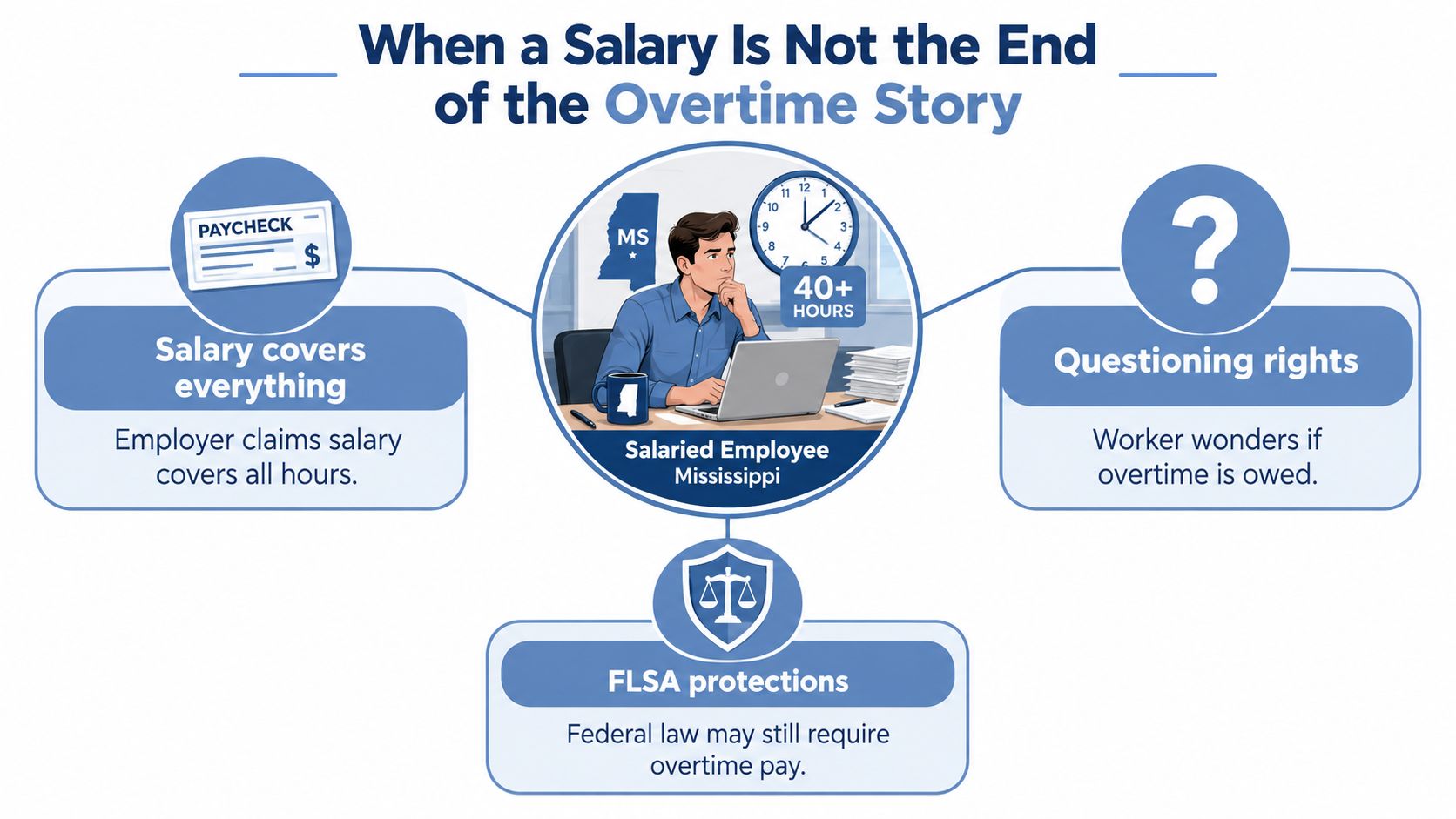
When a Salary Is Not the End of the Overtime Story
Consider a salaried assistant manager in Mississippi who opens the store early, covers registers during lunch, stocks shelves in the afternoon, and answers work messages after getting home. The schedule says one thing. The actual week regularly runs well past forty hours, but the paycheck stays flat because management says the salary covers everything.
That worker may be exempt and owed nothing extra. Or the worker may be nonexempt despite the salary and owed overtime for every hour over forty in a workweek. You can't tell from the offer letter, the title, or the fact that pay arrives as a salary.
Why This Confusion Became So Common
The coverage gap isn't new. The share of full-time salaried workers covered by the federal overtime salary threshold fell from approximately 65% in 1975 to less than 7% by 2016 as the threshold failed to keep pace with wage growth. As that floor lost ground, more lower paid salaried employees could be treated as exempt even when they had little real authority at work.
That history matters because it explains the habit you may be seeing now. Employers sometimes put a worker on salary, add a management sounding title, and stop the analysis. Federal law requires more.
Practical rule: Your pay method is a fact to examine, not a verdict. Ask what you're paid, how that pay is treated, and what work fills your week.
Three questions usually do the heavy lifting. Are you paid on a true salary basis? Do you clear the applicable salary level? Do your actual duties fit a recognized exemption? If the answer to any required part is no, overtime may still be owed.
What follows walks through the two gates that decide most claims, the current threshold after the 2024 rule fight, the duties that titles often hide, and the records that help a Mississippi worker prove hours an employer discouraged them from tracking.
The Two-Part FLSA Framework Every Salaried Worker Should Know
Under the Fair Labor Standards Act, the default rule is straightforward. Workers generally must receive overtime at 1.5 times their regular rate for hours beyond 40 in a workweek unless they satisfy both a salary level requirement and duties requirements for an executive, administrative, or professional exemption.
Think of exemption as a door with two locks. The employer needs both keys. Failing one gate leaves the worker nonexempt.
The first gate is about pay. The worker must be paid on a salary basis and at or above the required level. The second is about work. The worker's primary duties must fit the executive, administrative, or professional category the employer is claiming.

The Pay Gate Comes First, But It Is Not Enough
Salary basis generally means a predetermined amount that isn't reduced because of variations in the quality or quantity of work in a week, subject to specific rules. If that structure isn't really in place, the exemption can fail before duties are even reached. A closer look at how the salary basis test works under the FLSA helps separate a true salary arrangement from hourly pay dressed up with a different label.
Pay level is separate. Clearing the minimum doesn't make weak duties exempt, and strong sounding duties don't cure pay below the required floor. Each part has its own job.
The Duties Gate Looks at the Real Job
- Executive work: This centers on managing the business or a recognized department, regularly directing other employees, and having meaningful input on hiring, firing, or similar status decisions.
- Administrative work: This involves office or nonmanual work tied to general business operations, plus discretion and independent judgment on matters of significance.
- Professional work: This generally requires advanced knowledge in a recognized field, typically gained through prolonged specialized education, applied as the primary duty.
This short video reinforces how those pieces fit together for salaried employees who aren't sure where they fall.
Here's a worked contrast. A department head who sets staffing, directs a team, and influences personnel decisions may fit the executive side if the pay tests are met. A salaried lead who mostly performs the same frontline tasks as hourly staff, follows a checklist, and needs approval for routine calls looks very different, even if both people are called managers.
Titles are evidence of what the employer calls the job. They aren't a substitute for what you actually do all day.
Ask yourself three blunt questions. Who, if anyone, do you supervise? What decisions can you make without approval? If you listed your tasks hour by hour this week, how many were routine production, clerical, sales, or customer service tasks? Those answers point you toward the next two inquiries, the dollar threshold and the duties test in detail.
Salary Thresholds After the 2024 Rule Was Vacated
Salary level is the easier gate to apply because it starts with a number. It's also where outdated charts cause real damage. Workers search online, find a threshold from a rule that never fully took effect, and either give up a claim or assume they have one on pay alone.
The Department of Labor's 2024 rulemaking described a higher standard threshold taking effect in stages, with a further planned increase for January 2025. That path didn't hold.

The Operative Federal Floor
After a Texas federal court vacated the 2024 rule nationwide, the minimum federal salary threshold reverted to $684 per week, or $35,568 annually, and the planned January 2025 threshold of $58,656 did not take effect. Don't rely on a chart that treats the planned figure as current law for a Mississippi worker's federal claim.
That $684 per week line has a clean consequence. If you're a salaried employee paid below the applicable threshold for the executive, administrative, or professional exemption, the salary level test fails. Your title doesn't repair that failure.
If you're paid at or above it, you've only cleared a gate, not won or lost the case. The duties test still decides whether the exemption applies.
Why Workers Near the Line Need Extra Care
Pay near the threshold creates the messiest conversations. An employer may have raised a salary in anticipation of the 2024 rule, changed a classification, then changed course after the rule was vacated. Pay stubs from different periods may not tell the same story, and a later raise doesn't answer what was owed in earlier weeks.
- Check each workweek: Overtime is generally assessed week by week, so one annualized number can hide weeks that fell short.
- Save dated pay records: Keep stubs, offer letters, raise notices, and any writing that says what the salary was intended to cover.
- Don't stop at the number: A higher paid worker can still be nonexempt if the duties don't qualify.
There's a gray zone you should expect. The legally operative threshold can change through litigation, regulation, or later agency action. Verify the threshold that applies to the weeks at issue when you evaluate a claim, not just the number an employer put in a handbook months ago.
Dated records beat memory: A pay stub showing the amount, pay period, and date is worth more than a confident recollection that you were probably paid about the same all year.
The Duties Test and Why Job Titles Do Not Decide Overtime
Close cases turn on the workweek, not the business card. What did you do between 9 a.m. and 5 p.m., who told you how to do it, and which decisions were yours to make?

The Manager Who Mostly Does Frontline Work
A retail assistant manager can carry keys, open the store, and still spend 32 of 40 hours stocking, cashiering, cleaning, and covering breaks. A time log with that split is the kind of record that undercuts an executive exemption claim, because it shows where the week went instead of accepting the title on the schedule.
Occasional supervisory moments do not automatically turn frontline labor into management of a recognized department. Hiring recommendations, discipline authority, and control over staffing carry more weight than being the senior person left on shift. If the store runs the same way when you are off, that matters too.
The Administrator Who Follows the Script
Office work is not exempt administrative work by default. A coordinator who enters data, processes forms exactly as a manual directs, routes problems upward, and cannot depart from set procedures may be doing necessary work while still lacking discretion on significant matters.
The dividing line is judgment with consequence. An employee who evaluates options for general business operations, commits resources within defined authority, and is expected to decide consequential questions looks different on paper and in practice. Desk location settles nothing.
The Professional Title Without Professional Duties
Skill alone does not finish the analysis. A capable technician, support specialist, or junior employee may be closely supervised, complete standardized tasks, and rely on experience or on the job training rather than advanced knowledge from prolonged specialized education. Calling that role professional does not make the duties fit.
- Supervision given: Do you regularly direct at least two full-time employees or their equivalent, or do you mainly help coworkers when it gets busy?
- Supervision received: Can you decide significant matters, or does a supervisor approve the calls that count?
- Time split: How much of your week goes to routine, manual, clerical, production, or customer facing tasks?
- Authority on paper versus practice: Does the description promise discretion that daily instructions take away?
Do a one week self audit before you talk to anyone. Write tasks in blocks, note who assigned them, and mark each decision you made without approval. If your employer discourages timekeeping, keep your own calendar, emails, badge swipes, tickets, and closing reports; in Mississippi, that private record often becomes the starting point for unpaid overtime for salaried workers before any agency complaint or federal claim. Do not clean it up to sound more senior. Accuracy is what separates a demanding exempt job from a misclassified one.
Calculating Unpaid Overtime and Reconstructing Off-the-Clock Hours
Once a salaried worker is nonexempt, the math starts with the regular rate and the hours worked in the workweek. The exact calculation can depend on what the salary was intended to cover, so don't treat any quick estimate as a final legal number. It is still useful for deciding whether the shortfall is worth pursuing.
For illustration only, assume a $684 weekly salary was intended to compensate a forty hour week. The regular rate would be $684 divided by 40, and overtime hours would be priced at 1.5 times that rate.
Overtime Owed Under Three Common Salaried Pay Scenarios
| Weekly Hours | Weekly Pay | Regular Rate | Overtime Hours | Overtime Premium Owed |
|---|---|---|---|---|
| 45 | $684 | $17.10 | 5 | $128.25 |
| 50 | $684 | $17.10 | 10 | $256.50 |
| 55 | $684 | $17.10 | 15 | $384.75 |
Those are arithmetic illustrations under that stated assumption, not a promise about your case. Different pay structures, bonuses, deductions, and agreements about what the salary covers can change the method. What doesn't change is the need for reliable hours.
The stakes nationally are substantial. Federal enforcement data reports annual back wage recoveries for overtime violations ranging from roughly $127 million to more than $194 million in the years shown. Numbers that large usually reflect ordinary workplaces where hours were never recorded properly, not rare schemes.
Rebuilding Hours You Were Told Not To Record
Start with records created at the time, not estimates built months later. Useful proof often sits in plain sight.
- Calendars and schedules: Save posted schedules, shift swaps, meeting invites, and deadline calendars that show expected presence.
- Message timestamps: Preserve emails, texts, and chat messages sent before or after your stated workday, especially instructions from supervisors.
- System records: Computer logins, badge access, point of sale activity, ticket systems, and call logs can confirm start, stop, and weekend work.
- Travel and task records: Mileage, delivery records, client notes, and travel between sites help capture work away from a desk.
- Personal contemporaneous notes: A dated notebook or phone note made the same day is stronger than a reconstructed spreadsheet with identical hours every week.
If you also dealt with instructions to shave time, work through breaks, or handle tasks after clocking out, compare those facts with the patterns described in the firm's overview of working off the clock. For the administrative side, this plain English walkthrough of how to file an overtime complaint is a useful companion before you contact an agency or send anything in writing.
An express order to work late isn't the only scenario that matters. If management saw the after hours messages, accepted weekend work product, set deadlines that couldn't be met within the scheduled week, or knew extra work was occurring and let it continue, that knowledge can become part of the proof. Don't exaggerate to fill gaps. A smaller, well supported reconstruction usually holds up better than a round number you can't explain.
Put a source next to every block of time you claim. If a week rests on memory alone, say so and keep it separate from weeks documents can prove.
Mississippi Considerations Every Agency Is Built Around
Federal overtime law supplies the framework, but Mississippi's agency structure shapes where you go and how quickly you need to move. Workers often lose time looking for a state office that doesn't exist for their type of claim.
No Mississippi Human Rights Commission
Mississippi does not have a state human rights commission or a general state fair employment agency that processes private sector employment discrimination complaints. For covered discrimination or harassment claims, Mississippi employees generally rely on federal law and the Equal Employment Opportunity Commission.
That absence changes the deadline. Because Mississippi lacks a qualifying state or local fair employment agency, the EEOC charge filing period for covered discrimination claims is generally 180 days rather than 300 days. That 180 day period is not the overtime test itself, but wage disputes sometimes surface alongside discrimination, harassment, or retaliation concerns after a termination. Document the date of each act separately so one deadline isn't confused with another.
For unpaid overtime itself, the U.S. Department of Labor's Wage and Hour Division is the primary federal enforcement channel workers commonly consider. Don't wait for a Mississippi fair employment agency to forward a discrimination charge that agency doesn't process.
Workers Compensation Benefits Are a Separate Question
Mississippi's workers compensation system is administered by the Mississippi Workers' Compensation Commission, and benefits for a qualifying workplace injury are analytically separate from a claim that an employer retaliated for seeking them. Mississippi authority does not recognize a retaliation claim based solely on filing or pursuing a workers compensation claim.
That distinction is blunt, and workers need to hear it early. Mississippi does not provide protection from retaliation for filing a workers compensation claim on that basis alone, and there is no retaliation claim for filing workers compensation merely because benefits were sought. A discharge after an injury may still raise other federal or factual issues, but don't assume the compensation filing itself creates that separate claim.
Keep the lanes separate in your records. Wage hours and classification proof support an overtime inquiry. Dates of discriminatory acts support an EEOC timeline. Injury and benefit documents belong to the compensation system. Mixing them into one narrative makes each issue harder to evaluate.
A Practical Next-Steps Path for Mississippi Salaried Workers
Start by preserving, not arguing. Save pay stubs, schedules, job descriptions, handbooks, classification notices, and messages about hours or time recording. Keep copies lawfully available to you and don't alter originals.
Build the Packet Before You Escalate
- Map your actual duties: Use the one week task audit and, where possible, note patterns across representative weeks rather than cherry picking the worst one.
- Map your hours: Pair personal notes with calendars, timestamps, access records, and payroll dates for each workweek.
- Identify the pay gate facts: Record the salary amount, pay frequency, deductions, and any writing stating what hours the salary was meant to cover.
- Write down instructions: Note who told you not to record time, when, and whether coworkers heard the same direction.
A careful written demand can follow once the facts are organized. Keep it factual and specific, identify the weeks and classification question, and avoid threats you aren't prepared to support. The practical overview of how to report unpaid wages can help you think through reporting channels before you choose one.
From there, options may include contact with the Department of Labor's Wage and Hour Division, an EEOC filing for a covered discrimination issue within its deadline, private negotiation, or attorney led resolution. The right sequence depends on whether you're still employed, how clear the records are, and whether other workers face the same classification.
Cost is a fair question. Contingency fee arrangements in employment matters typically range from 40% to 50% of the recovery, depending on the stage at which the case resolves and the complexity of the matter. Ask what costs are included, how the percentage changes if the matter resolves early, and what happens if there's no recovery. Get the arrangement in writing before you rely on it.
Set expectations clearly. A clean below threshold case with strong time records may move differently than a duties dispute built from competing job descriptions. Documentation doesn't guarantee a result, but it gives an agency or attorney something testable instead of a title and a hunch.
Your Short Checklist Before You Reach Out
Run this test before you make the call.
- Pay basis and level: What salary were you paid for each week, and did it clear the operative threshold?
- Actual duties: What filled your hours, who did you direct, and what significant decisions were yours?
- Hours proof: Can calendars, messages, logs, travel records, or dated notes support the time over forty?
- Mississippi timing: Have you marked the 180 day EEOC period for any separate covered discrimination claim?
- Instructions: Did anyone discourage timekeeping, alter records, or knowingly accept off the clock work?
Keep the packet together and chronological. If salary was the only reason you were given for no overtime, you haven't received the full legal answer yet.
If you're a salaried Mississippi worker who suspects your title or paycheck structure has been used to deny overtime, Nick Norris, P.A. can review your pay records, actual duties, and reconstructed hours and explain your practical options under the FLSA. Bring the checklist above, your recent pay stubs, and any schedules or messages showing work beyond forty hours. Visit Nick Norris, P.A. to request a personalized strategy session about your unpaid overtime concerns.
Leave a Reply