

Userra Reemployment Rights: Know Your Protections Today
Coming home from military service has enough hurdles—worrying about your job shouldn't be one of them. That's where the Uniformed Services Employment and Reemployment Rights Act (USERRA) comes in. It’s a powerful federal law that ensures your civilian career is waiting for you when you return. Think of it as your shield against employment discrimination just because you wear a uniform.
Your Job Is Protected While You Serve

For service members here in Mississippi, getting a handle on your USERRA reemployment rights is key to a smooth transition. The entire point of this law is to make sure your career isn't penalized because of your service. It clearly states that an employer can't deny you a job, refuse to rehire you, fire you, pass you over for a promotion, or withhold any benefit of employment due to your military commitment.
This guide will break down what those rights actually mean for you and how to stand up for them. We'll walk through who qualifies, what your employer is required to do, and the critical timelines you need to know to protect your job.
What USERRA Guarantees
At its heart, USERRA operates on a straightforward principle: you shouldn't have to sacrifice your civilian career to serve your country. To make that a reality, the law provides several ironclad protections.
Here’s what USERRA promises:
- Prompt Reemployment: You have a right to get your job back after your service ends, as long as you meet a few basic eligibility rules.
- Protection from Discrimination: Employers can't discriminate against you—whether you're an employee or just applying—because of your past, present, or future military obligations.
- Continuation of Benefits: The law also ensures you have a way to continue your health insurance and that your pension plan benefits are protected while you're away.
This means your employer can't legally take negative action against you just for being in the service. Sometimes those actions aren't obvious, so it's important to recognize what counts as an adverse employment action under the law.
Navigating Your Rights in Mississippi
It’s crucial to understand that in Mississippi, these protections come directly from federal law. Mississippi does not have a human rights commission or a state agency to field these kinds of complaints. This means if you have an issue, you have to go through a federal channel—either by filing a complaint with the Department of Labor or by filing a private lawsuit in federal court.
You are not alone in this process. If you face resistance from an employer, you can seek legal counsel. Many employment attorneys in Mississippi handle these cases on a contingency fee basis, which is often between 40-50%, meaning you pay nothing unless your case is successful.
We'll get into the nitty-gritty of your USERRA reemployment rights, from the famous "escalator principle" that determines the position you return to, all the way to the practical steps for holding a stubborn employer accountable. Consider this your first briefing on securing the career you've earned.
Who Is Covered by USERRA?
Think of USERRA as a broad shield, designed to protect just about every service member working for nearly any employer in the United States. Congress wrote this law to be intentionally far-reaching, making sure your USERRA reemployment rights are safe whether you work for a mom-and-pop shop in Mississippi or a massive corporation.
The law doesn’t discriminate based on the branch you serve in. It covers members of the Armed Forces, the Reserves, and the National Guard, and even extends to those in the Commissioned Corps of the Public Health Service.
This wide net is what gives the Uniformed Services Employment and Reemployment Rights Act its power. Signed into law on October 13, 1994, USERRA created a federal standard that applies to all U.S. employers, regardless of size. This consistency is a huge deal, ensuring service members get the same core protections no matter where they live and work. For a deeper dive, the Department of Labor offers a detailed overview of USERRA's history and impact.
The Five-Year Service Limit Explained
One of the most common questions we get is about the five-year cumulative service limit. This is the general rule: you can be absent from your job for military service for a total of up to five years and still keep your right to get that job back.
But it’s not as rigid as it sounds. This five-year clock is cumulative, meaning it only counts the time you're away from a specific employer for military duty.
Even more important, a lot of common military service doesn't count toward that five-year total at all. This is a critical detail, especially for members of the Guard and Reserve who might be called up multiple times over their careers. Knowing what’s exempt is the key to understanding your long-term rights.
What Service Does Not Count Against the Limit
The law is smart about this. It recognizes that certain types of service are part of the deal when you join, and they shouldn't penalize your civilian career. USERRA specifically carves out several types of military duty from the five-year calculation.
Here are the key exceptions:
- Annual Training: Your standard two-weeks-a-year training and regular weekend drills for the Guard or Reserves? They don't count.
- Involuntary Service: If you’re involuntarily called to active duty or your orders are extended during a war or national emergency, that time is exempt.
- Required Training: Any specialized or required training you have to complete for your military job (outside of regular annual training) is also excluded.
- Voluntary Service During Emergencies: If you volunteer for service during a time of war or a national emergency, that time won't be held against your five-year limit either.
This structure ensures that those who step up to serve, especially during a national crisis, don't accidentally run out the clock on their reemployment rights.
The core idea is simple: your career should not be a casualty of your commitment to serve. USERRA’s broad applicability and its flexible five-year rule are designed to make sure your job is waiting for you when you return.
Eligibility Requirements for Employees
So, to be protected by USERRA, what do you need to do? The requirements are pretty straightforward—they aren't high hurdles, but you do have to clear them to lock in your rights.
You must:
- Hold a Civilian Job: You had to leave a civilian job specifically to perform military service.
- Provide Notice: You need to give your employer advance notice of your service. The law is reasonable here; notice isn't required if it's impossible or military necessity prevents it.
- Serve Honorably: You must be released from service under honorable conditions.
- Report Back Timely: After your service ends, you have to return to work or apply for reemployment within a specific timeframe (which we'll cover later).
As long as you meet these four basic conditions, the law is on your side. Your employer has a legal duty to reemploy you according to USERRA's protective rules.
The Escalator Principle: Returning to a Better Position
One of the most powerful ideas baked into USERRA is what’s known as the “escalator principle.” This isn't just about getting your old job back; it’s about making sure your career didn’t just hit the pause button while you were serving. It's the core of your USERRA reemployment rights.
Think of it this way: your career is an escalator moving steadily upward. When you leave for military duty, you have to step off. But while you're gone, that escalator keeps climbing. When you come back, the law says your employer can't just put you back on the step you left. They have to place you where you would have been if you’d been riding it the whole time.
This principle is the foundation of USERRA’s reemployment protections. It essentially treats your time in uniform as time on the job for the purposes of your position, pay, and seniority.
What Does the "Escalator Position" Actually Include?
This isn't just a feel-good theory; it has very real, tangible components. The "escalator position" is the job you would have reasonably and certainly attained if you had never left for service.
This means you’re entitled to:
- Pay: Any across-the-board raises, cost-of-living adjustments, or performance bonuses you almost certainly would have received must be factored into your new salary. If the whole company got a 3% raise, your pay should reflect that upon your return.
- Position: If your coworkers were promoted based on seniority or a predictable career track, you should be returned to that elevated position. Your employer can't hold you back just because you were gone.
- Seniority: All the perks that come with time-in-service—things like vacation accrual, pension plan vesting, and even shift preferences—must be calculated as if you never took a break.
The Department of Labor puts it plainly: "The escalator principle requires that the service member be reemployed in a position that reflects with reasonable certainty the pay, benefits, seniority, and other job perquisites that he or she would have attained if not for the period of military service."
Putting It All Together in the Real World
Let's make this concrete. Imagine a service member, Sarah, is a "Technician I" when she leaves for a two-year deployment. While she's gone, her company has a standing policy of promoting any Technician I to a "Technician II" after three years on the job.
When Sarah gets back, she now has four years of total seniority—two years working and two years serving. Thanks to the escalator principle, her employer can’t just slot her back into her old Technician I role. They have to put her in the Technician II position, complete with the higher pay, because it's reasonably certain that’s where she would have landed.
This is a non-negotiable part of your USERRA reemployment rights. Your employer has an obligation to evaluate your career path, not just your last job title.
What if You're Not Qualified for the New Role?
It's a fair question. What happens if that "Technician II" job requires a new software certification you missed out on during deployment?
USERRA thought of that, too. If you aren't immediately qualified for the escalator position, the burden shifts to your employer. They have a legal duty to help you get up to speed.
This includes:
- Making Reasonable Efforts: The company must provide the necessary training to help you catch up on new skills or processes.
- Providing Accommodation: This training must be offered at no cost to you. It's their responsibility to refresh or upgrade your skills to meet the new job's demands.
Only if you're still unable to become qualified after they've made these good-faith efforts can the employer place you in a different position. And even then, they must put you in a job that is the closest possible equivalent. The responsibility is on them to prove they did their part, ensuring you get a fair shot at the role you've earned.
Understanding USERRA's Critical Timelines and Notice Rules
When it comes to your USERRA reemployment rights, think of it as a partnership. The law gives you a powerful safety net, but you have to hold up your end of the bargain. This means giving your employer proper notice and sticking to some very specific deadlines when you return. If you miss these windows, you could unfortunately put your rights at risk, so it’s crucial to know exactly what the law expects.
It all starts before you even leave for duty. You need to give your employer advance notice that you'll be gone for military service. Don't overthink this—it doesn't have to be a formal letter. A simple verbal heads-up works just fine, and it can even come from your commanding officer. The point is to make sure they know you're leaving for service. The only exception is if a military necessity makes it impossible or unreasonable to give notice.
Deadlines for Applying to Get Your Job Back
Once your service is complete, the clock starts ticking to apply for your old job. This is where the deadlines get really serious. The amount of time you have to get in touch with your employer and ask for your job back is based directly on how long you were away. These timelines aren't just suggestions; they're hard-and-fast rules.
The whole point of USERRA is to ensure your military service is just a pause in your career, not a full stop. You should be able to step right back onto the career "escalator" at the place you would have been if you’d never left.
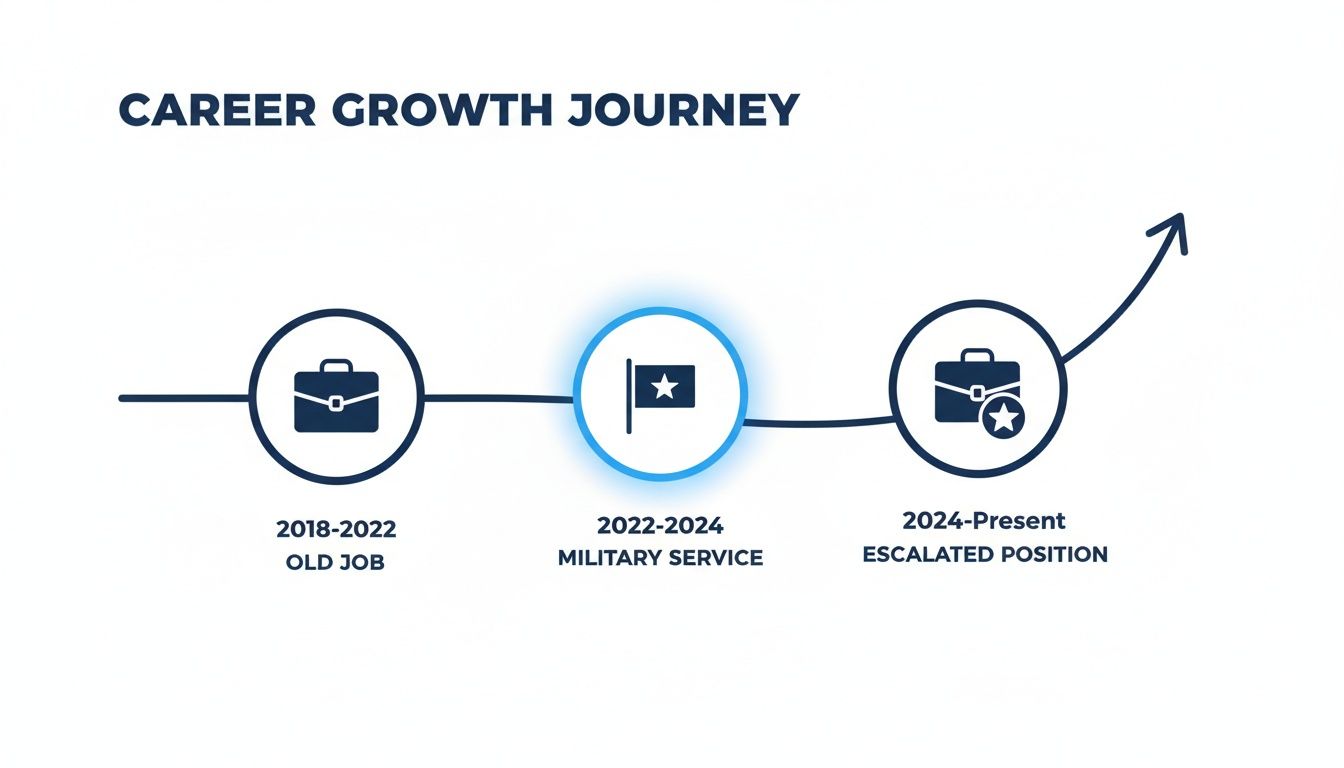
As this shows, your service is a protected part of your career journey, not a detour. You come back to a position that reflects the seniority and progress you've earned.
Getting these reporting deadlines right is everything. For example, if you're gone for a quick weekend drill, the law expects you back at work almost right away. But if you’ve been deployed overseas for a year, you get a much longer window to get your life in order before you have to formally apply to return. The system is designed to be fair, but it is firm.
Under USERRA, your reemployment application window is directly tied to your service duration. For service of more than 30 but less than 181 days, you must apply within 14 days. For service longer than 180 days, this window expands to 90 days.
This tiered system gives service members returning from long deployments the time they need to transition back to civilian life before worrying about their job. You can dig deeper into these rules by exploring the federal framework for reemployment.
USERRA Application for Reemployment Deadlines
Let’s lay out the exact timelines you need to follow. It’s a good idea to find the one that applies to your situation and commit it to memory—it's the key to unlocking your reemployment rights.
| Length of Military Service | Deadline to Apply for Reemployment |
|---|---|
| Less than 31 days | You must report to your employer by the beginning of the first full, regularly scheduled work period on the first full calendar day after completing service, plus time for safe travel home and an eight-hour rest period. |
| 31 to 180 days | You must submit an application for reemployment to your employer no later than 14 days after the completion of your service. |
| 181 days or more | You must submit an application for reemployment to your employer no later than 90 days after the completion of your service. |
| Service-Connected Injury/Illness | The deadlines above are extended for up to two years if you are hospitalized for or convalescing from an injury or illness incurred or aggravated during your service. |
As you can see, the law accounts for different circumstances, giving you more time for longer periods of service or if you're recovering from an injury.
Job Protection After You're Back at Work
USERRA’s shield doesn’t just disappear the moment you walk back in the door. The law recognizes that returning service members can be in a vulnerable position, so it provides special protection against being fired without a good reason. This is what we call "for cause" termination protection.
Essentially, it means your boss can't let you go just because they hired someone else while you were gone or because they're unhappy you left in the first place. They need a legitimate reason tied to your job performance or conduct.
How long this protection lasts also depends on how long you were on duty:
- If your service was between 31 and 180 days: You are protected from being fired without cause for 180 days after you return to work.
- If your service was 181 days or more: You are protected from being fired without cause for one full year after returning.
This is a critical part of the law. It gives you a stable period to get back into the swing of things at work, cementing your USERRA reemployment rights long after you’ve come home.
What to Do When Your Employer Violates Your Rights

It’s a gut-wrenching moment. You’ve served your country, and you come home only to find your employer has illegally denied your USERRA reemployment rights. The frustration is real, but you aren't without options. The law provides a clear and powerful path forward.
For service members here in Mississippi, it's crucial to know that this fight happens at the federal level. Mississippi does not have a human rights commission or a similar state agency to handle these specific claims. This means you’ll be turning to the federal system to make things right.
You're not alone in this. The Department of Labor resolved 976 USERRA complaints in fiscal year 2022, which was a 10% jump from the year before. This trend shows two things: more service members are learning about their rights, and unfortunately, too many employers are still getting it wrong. You can dive deeper into these enforcement statistics and trends to see the bigger picture.
Filing a Complaint with the Department of Labor
Your first stop, and the most common starting point, is filing a complaint with the U.S. Department of Labor’s Veterans' Employment and Training Service, or VETS. The best part? It costs you nothing. The federal government essentially steps in to act on your behalf.
Think of VETS as your government-backed investigator. Once you file a claim, they take over the legwork. They will investigate the facts, contact your employer, and try to bring them into compliance with the law.
Here’s a simple breakdown of how it works:
- You File: You submit a claim form that outlines your military service, your job, and exactly how your employer violated your rights.
- VETS Investigates: They assign an investigator to dig into the details, gathering information from both you and your employer.
- They Seek a Resolution: If VETS finds your claim has merit, they'll push for a solution. This could mean getting your job back, securing back pay, or other remedies to make you whole.
What if your employer still refuses to cooperate? VETS can refer your case to the Department of Justice, which has the power to file a lawsuit in federal court for you.
Pursuing a Private Lawsuit in Federal Court
You also have the right to bypass the VETS process entirely. You can hire a private attorney and take your employer directly to federal court. This route gives you much more direct control over your case from start to finish.
Filing a private lawsuit is a serious step, and this is where an experienced employment lawyer becomes your greatest asset. They can evaluate the strength of your case, navigate the complex court procedures, and fight for you at every turn. An employer’s refusal to rehire you is a classic example of wrongful termination, and you can learn more about how to file a wrongful termination lawsuit to get a sense of the general process.
For many service members, the thought of legal fees is a major barrier. That’s why most Mississippi employment lawyers handle USERRA cases on a contingency fee basis. The average fee is 40-50%, which means you don’t pay a dime in attorney's fees unless you win your case.
This structure levels the playing field. It allows you to pursue justice without worrying about upfront costs, ensuring you can enforce your USERRA reemployment rights no matter your financial situation. Whether you begin with a VETS complaint or go straight to a private suit, you have a clear path to hold your employer accountable.
How a Mississippi Employment Lawyer Can Help
While you absolutely have the right to file a USERRA complaint on your own, let's be realistic: going it alone against your employer's legal team is an uphill battle. Hiring an experienced Mississippi employment lawyer doesn't just level the playing field; it gives you a powerful advocate who knows the system inside and out.
A good lawyer does far more than just fill out forms. They know exactly what kind of evidence makes a case solid, how to handle a VETS investigation, and, crucially, when to shift gears and file a private lawsuit in federal court to get real results.
Navigating a Complex Legal System
Here's something important to know about Mississippi: we don't have a state-level human rights commission to handle these claims. That means your only path to justice is through the federal system. This is where having an attorney who is comfortable in federal court becomes a game-changer, especially when an employer tries to argue their way out of their legal duties.
With an expert on your side, you can be confident your case is being built for the best possible outcome. Your attorney will:
- Accurately Calculate Damages: They'll figure out the full value of your claim, including all lost wages, benefits, and any potential liquidated damages you're owed.
- Manage All Communications: They will handle every phone call and email with your employer and their legal team, shielding you from any intimidation or pressure tactics.
- Gather Critical Evidence: They have the power to subpoena documents and track down witnesses to create a powerful, undeniable record of what happened.
One of the first questions I always get is, "How can I afford a lawyer?" Most Mississippi employment lawyers take USERRA cases on a contingency fee basis, usually between 40-50%. This means you pay nothing upfront—the attorney only gets paid if they win your case. It makes getting justice possible for everyone.
Preparing for Your Legal Journey
Your lawyer’s job is to fight for the rights you earned through your service so you can focus on getting back to your civilian life. They will push for a fair settlement or, if it comes to it, take the fight to a courtroom.
To make that first meeting as productive as possible, it pays to be prepared. We've put together a guide on how to prepare for your first talk with an employment lawyer that can help you get organized. Remember, hiring an attorney sends a powerful message: your rights are not up for negotiation.
Common Questions About Your USERRA Rights
When you're trying to get back to your civilian job after military service, a lot of specific questions can pop up. Let's tackle some of the most common issues Mississippi service members run into.
Am I Protected if I Mention My Military Service in a Job Interview?
Yes, you absolutely are. USERRA’s anti-discrimination shield covers you from the very beginning of the employment process, including hiring. An employer legally cannot pass you over for a job simply because you're in the Guard or Reserve, have served in the past, or might be called to duty in the future.
If you have a strong reason to believe a Mississippi employer turned you down because of your military commitment, that's a direct violation of your rights. This protection is crucial; it ensures the uniform you wear doesn't become a roadblock in your career path.
What Happens to My Health Insurance While I'm Away on Duty?
USERRA provides a critical safety net for your health coverage, but the rules change based on how long you're gone.
- For service of 30 days or less: Your employer typically has to keep your health plan going just as if you were still at work, with no change in your contribution.
- For service longer than 30 days: You have the right to keep your employer's health plan for up to 24 months. The catch is you might have to pay the full premium yourself—up to 102% of the cost—to maintain that coverage.
This ensures a deployment or training doesn't force your family to go without health insurance.
My Job Was Cut During a Layoff While I Was Deployed. What Now?
This is where things get tricky, but you still have rights. An employer can't just use a layoff as an easy excuse to avoid reemploying you. The law puts the burden squarely on them to prove it's impossible or unreasonable to bring you back, and that's a very tough standard to meet.
Even if your exact job was legitimately eliminated, their duty doesn't end there. They still have to try to put you in your "escalator" position or, if that's also gone, a truly comparable one. If they claim it would be an "undue hardship," they have to prove it. This is a situation where getting advice from a USERRA attorney is a very smart move.
Under USERRA, an employer has to do more than just say "your job is gone." The law demands they demonstrate why they can't reemploy a returning service member, and that's a high bar to clear.
What if a Service-Related Injury Keeps Me From Doing My Old Job?
This is one of the most powerful protections USERRA offers. If you come back with a disability that prevents you from performing the duties of your old "escalator" position, your employer's responsibility is far from over.
First, they must make reasonable efforts to accommodate your disability. If that allows you to do the job, great. If not, they have to find another position for you that provides the same seniority, status, and pay. And if even that isn't possible, they must place you in a role that is the closest possible match.
If you're facing an employer who is ignoring your rights or refusing to bring you back after your service, don't just take their word for it. At Nick Norris, P.A., we're committed to fighting for Mississippi's service members and making sure their USERRA rights are honored. Contact us for a clear evaluation of your case.
This article has been reviewed for legal accuracy by Nick Norris. For employment law matters in Mississippi, consult with an attorney licensed to practice in your state.
Leave a Reply