

A Mississippi Employee’s Guide to the Workplace Investigation Process
Getting that notification about a workplace investigation can be a real gut-punch. The whole workplace investigation process can feel like a black box, leaving you feeling anxious and in the dark.
Essentially, it’s a formal process your employer kicks off after receiving a complaint—think harassment, discrimination, safety violations, or even theft. Their goal is to gather the facts, figure out what actually happened, and then decide what to do about it. Knowing how this usually plays out is the best way to get your footing and handle the situation with confidence.
What Happens When a Workplace Investigation Begins
The moment a formal complaint lands on HR’s desk, the clock starts ticking. This isn't just about company policy; it’s a legal and ethical obligation to ensure the workplace is safe, fair, and compliant. The trigger could be anything from a direct accusation of sexual harassment to an anonymous tip about a manager fudging expense reports.
For example, if a team member files a complaint alleging they're being passed over for promotions because of their race, the company has to investigate. It’s not an option. The same goes for reports of safety violations or accusations of corporate wrongdoing. For more serious issues involving illegal activity, you may want to understand how to file a whistleblower complaint in Mississippi to protect yourself from potential retaliation.
Key Players and Their Roles
You’re going to be talking to a few different people during this process, and it helps to know who’s who. Here’s a quick breakdown of the key players you might encounter and what their primary function is.
Who's Who in a Workplace Investigation
| Role | Who They Are | Primary Responsibility |
|---|---|---|
| Complainant | The employee who filed the complaint or reported the issue. | To provide a truthful account of the events that led to the complaint. |
| Respondent | The employee who is the subject of the complaint. | To respond to the allegations and provide their side of the story. |
| Investigator | Often someone from HR, but could be an external attorney. | To be a neutral fact-finder, conduct interviews, and gather evidence. |
| Witness | Anyone who may have seen, heard, or knows about the incident. | To provide objective information about what they know. |
| Decision-Maker | Usually a senior manager or executive. | To review the investigator's findings and decide on the final outcome. |
Knowing who sits on what side of the table—or, more accurately, who is meant to be neutral—can make a huge difference in how you approach your conversations.
It's easy to think the investigator is on someone's "side," but that's a common misconception. Their only job is to be an objective fact-finder and report back to the company leaders who will make the final call. They aren't your advocate or your adversary.
The Typical Stages of an Investigation
While the details can vary, most workplace investigations follow a pretty standard roadmap. It kicks off with a complaint, moves into an evidence-gathering phase with interviews, and wraps up with a conclusion and, if necessary, corrective action.
This flowchart gives you a simple, high-level view of how things typically progress.
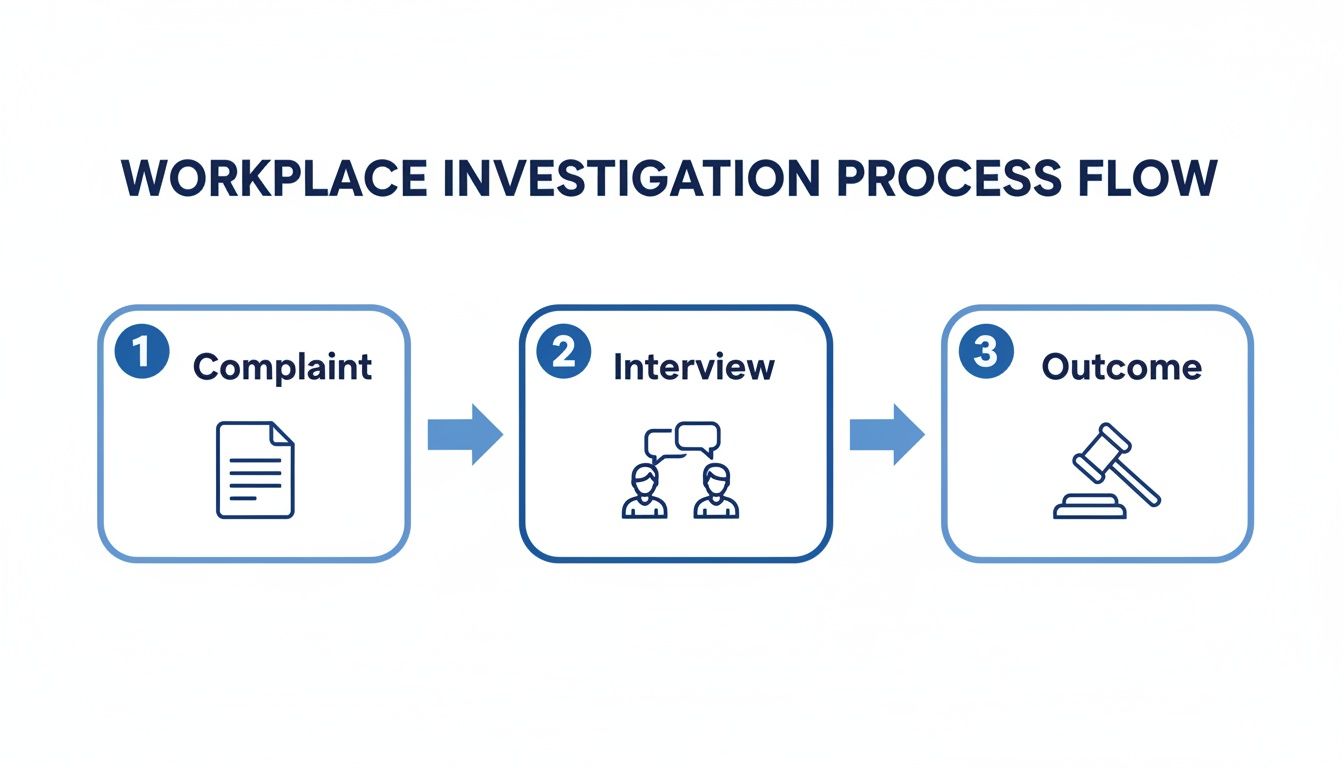
It all starts the second an employee raises an issue or the company gets wind of misconduct. The investigator then puts together a game plan: who needs to be interviewed, and what documents, emails, or other evidence needs to be collected?
Next comes the core of the investigation: confidential interviews. The investigator will speak separately with the person who made the complaint, the person it’s about, and anyone else who might have relevant information.
Once all the information is on the table, the investigator pieces everything together, analyzes the facts, and writes up a report for management. It's this report that the decision-makers will use to decide the final outcome. This structured approach helps ensure the final decision is based on solid evidence, not just hearsay or gut feelings.
What Are My Rights and Responsibilities as a Mississippi Employee?

Finding yourself involved in a workplace investigation can feel overwhelming and even a bit scary. Whether you're the one who filed the complaint, the person it's about, or a witness, it’s crucial to understand that you have both rights and responsibilities. Getting this balance right is the key to navigating the process.
Let's start with your most important protection: the right to be free from retaliation. Your employer cannot legally punish you, demote you, or fire you for participating in good faith in the workplace investigation process. This protection is the bedrock of a fair system—without it, no one would feel safe coming forward.
Still, the fear of backlash is very real. A staggering 42% of employees who witness or experience misconduct never report it, mostly because they're afraid of retaliation. These workplace harassment and misconduct insights show just how big the trust gap is between employees and employers.
Your Duty to Cooperate
While the law protects you, you also have a serious obligation to cooperate truthfully with the investigation. This isn't a suggestion; it's a requirement. Your employer is legally required to look into certain complaints, and your honest participation is essential.
Refusing to cooperate can be treated as insubordination, which could lead to disciplinary action—completely separate from the original complaint. This includes refusing to answer questions, giving misleading information, or deleting emails or messages that could be evidence.
The golden rule here is simple: be honest. If you don't know the answer to a question, just say, "I don't know" or "I don't recall." Guessing or speculating can wreck your credibility and make things much worse.
Why Confidentiality Is Non-Negotiable
From the very beginning, you will be told to keep the investigation confidential. Take this seriously. Discussing the situation with your coworkers is a surefire way to compromise the entire process and can have major consequences.
Here’s why keeping quiet is so critical:
- Protects the Investigation's Integrity: Gossip can contaminate witness memories and make it nearly impossible for the investigator to find out what really happened.
- Prevents Retaliation: It shields the person who complained and any witnesses from potential backlash while the company is still gathering facts.
- Safeguards Reputations: Allegations can be career-altering. Confidentiality ensures that reputations aren't destroyed before the investigation is complete.
Breaching confidentiality can get you disciplined or even fired. It's a serious misstep that can derail the investigation and put your own job on the line.
Knowing What You're Accused Of
If you're the subject of the complaint, you have a right to know what the allegations are. An investigator should give you enough detail to allow you to give your side of the story. You can't mount a defense against vague, undefined accusations.
For instance, if the complaint is about harassment, the investigator should outline the nature of the alleged behavior and when it supposedly happened. They may not reveal who made the complaint, especially if there's a risk of retaliation, but they must give you enough information to respond meaningfully.
It's also important for Mississippi employees to know that our state doesn't have its own human rights agency. This means your first stop for federal discrimination or harassment claims is your company's internal process and the federal Equal Employment Opportunity Commission (EEOC).
Finally, don't let cost stop you from seeking legal advice. Many employment attorneys in Mississippi work on a contingency fee basis. This means you owe nothing upfront; the lawyer's fee is a percentage of what you recover, usually between 40-50%, and is only paid if you win your case or get a settlement.
How to Prepare for the Investigation Interview
The interview is often the most nerve-wracking part of a workplace investigation. This is where the investigator digs into the details, and for many people, it feels like the whole case hinges on this one conversation. It’s where your side of the story gets told, so walking in prepared can make a world of difference.

Whether you’re the person who filed the complaint, the one responding to it, or a witness, your objective is the same: give a clear, honest, and factual account. This isn't just about showing up—it's about doing your homework first.
Gather Your Facts and Create a Timeline
Stress can make memories fuzzy. Before you sit down with an investigator, take some time to get your thoughts and any evidence in order. You’re trying to build a solid narrative based on facts, not just feelings.
I always tell clients to start with a simple chronological timeline. What happened, and when? Be as specific as you can with dates, times, and even where you were. This simple act of organizing events can bring incredible clarity to what might feel like a jumble of incidents.
Then, pull together any documentation you have:
- Emails or Messages: Print out any relevant text messages, internal chats (like Slack or Teams), or emails.
- Documents: Do you have performance reviews, project files, or other papers that back up what you’re saying? Get them.
- Personal Notes: If you kept a journal or notes for yourself about what was happening, have those handy to jog your memory.
Having this information organized does two things: it helps you recall details accurately, and it shows the investigator you’re taking this seriously.
Understand the Types of Questions to Expect
Investigators are trained to ask open-ended questions to get you talking. They'll likely start broad and then zero in on the specifics. The questions will, of course, change depending on your role.
- For the Complainant: You’ll be asked to describe what happened in your own words. Expect questions like, "Can you walk me through what happened on that day?" or "Who else saw or heard this?" For more context, it’s worth reviewing our guide on how to report workplace harassment, which has tips on documenting your experience.
- For the Respondent: The investigator will tell you about the allegations and give you a chance to respond. Questions will be aimed at getting your side of the story, such as, "How do you respond to the claim that…?" or "Can you tell me about your interaction with [Name] on Tuesday?"
- For a Witness: The questions will be strictly about what you personally saw or heard—not what you think happened or what others told you. The investigator might ask, "Were you in the breakroom on the afternoon of the 15th?" or "Did you ever overhear conversations between these two employees?"
No matter your role, the investigator is trying to get to the who, what, where, when, and why of the situation.
Key Takeaway: Stick to the facts. The single most important rule is to be truthful and avoid guessing. If you don't know the answer to a question, it is perfectly acceptable—and highly recommended—to say, "I don't know" or "I don't recall." Speculation can damage your credibility.
Navigating the Interview Itself
The interview should feel professional and neutral. Remember, the investigator isn't your friend or your enemy; they are simply a fact-finder. Listen carefully to every question before answering. If you’re not sure what they’re asking, don’t hesitate to say, "Can you rephrase that?"
It’s also crucial to know that retaliation is illegal. If you participate in an investigation—whether as a complainant or a witness—your employer cannot legally punish you for it. This protection is more critical than ever, as retaliation claims have risen sharply in recent years. This trend is a major headache for employers, as even the perception of retaliation can spark a whole new legal battle.
If you start to feel pressured, confused, or overwhelmed, it is completely fine to ask for a short break. Staying composed is the key to giving a clear, accurate account. The prep work you do beforehand will give you the confidence to get through the conversation calmly and make sure your side of the story is heard loud and clear.
Understanding the Investigation's Outcome
Once the final interview wraps up and all the evidence is on the table, the investigation moves into its most critical phase. The investigator now has the tough job of piecing everything together to figure out what happened.
It's important to remember this isn't a courtroom drama. The standard isn't "beyond a reasonable doubt." Instead, the investigator is looking at the evidence to determine if it’s more likely than not that a company policy was violated. They weigh the credibility of witnesses, review documents, and connect the dots.
After this careful analysis, the investigator will prepare a final report for management. This report is the roadmap—it outlines the initial complaint, summarizes the evidence, and presents the investigator's conclusion. This document is the foundation for whatever action the company decides to take next.
Deciphering the Findings
The conclusion of an investigation usually lands in one of three buckets. Knowing what these mean can help you manage your expectations.
- Substantiated: This is the formal way of saying the investigator found enough credible evidence to conclude that the misconduct probably happened.
- Unsubstantiated: This means there wasn't enough evidence to prove the complaint. It's a crucial distinction: it doesn't mean the incident didn't happen, just that it couldn't be proven with the information available.
- Inconclusive: Sometimes, you're left with a "he said, she said" situation with no other evidence to tip the scales. An inconclusive finding means the investigator simply couldn't determine what occurred.
These findings are a big deal, especially with workplace complaints hitting record highs. A 2024 study found that investigations into issues like discrimination and harassment surged to an all-time high of 14.7 issues per 1,000 employees. What's more concerning is that while 88% of companies believe their investigators are doing things by the book, only 57% actually have a mandatory investigation process. That gap can lead to serious mistakes. You can read the full research on these employee relations benchmarks to see the data for yourself.
When a Complaint Is Substantiated
If a complaint is substantiated, the company is legally obligated to take prompt and effective action. The goal here is simple: stop the behavior and make sure it doesn’t happen again.
The consequences will vary depending on how serious the misconduct was. The response could be anything from:
- Required training or coaching for the employee.
- A formal written warning in their personnel file.
- Suspension without pay.
- A transfer to another department.
- Termination of employment for the most severe violations.
Whatever action is taken, it needs to be consistent with how the company has handled similar situations before. This is key to avoiding claims of favoritism or discrimination.
Don't be surprised if you aren't told exactly what disciplinary action was taken against a coworker. That's typically considered confidential. However, your employer should confirm that they have taken appropriate steps to address the situation.
When a Complaint Is Unsubstantiated or Inconclusive
It can be incredibly frustrating to hear that your complaint was unsubstantiated or inconclusive. It might feel like nothing was accomplished, but that's not necessarily true. Even without a definitive outcome, the company still has work to do.
The first and most important step is to double down on the company’s strict anti-retaliation policy. Everyone involved should be clearly reminded that any form of payback against someone for participating in an investigation is prohibited and will lead to its own disciplinary action.
An investigation can also shine a light on other problems. Maybe it revealed a breakdown in communication or simmering tensions on a team. In that case, the company might decide to implement conflict resolution training, team-building activities, or a policy refresher for the whole department. The goal is to repair the work environment and make sure everyone feels safe moving forward, no matter what the investigation concluded.
When You Should Talk to a Mississippi Employment Lawyer
Ideally, a workplace investigation should be a straightforward process to get to the truth and resolve a problem. But let's be honest, that’s not always how it plays out. Sometimes, the process itself feels skewed, and you might start to wonder if the outcome is already decided.
Not every bump in the road requires calling a lawyer. But knowing when to pick up the phone can make all the difference in protecting your rights and your career.

A good rule of thumb? Trust your gut. If you get the sense that the investigation is more about protecting the company than finding the facts, it’s probably time to get some professional advice.
Clear Signs It's Time to Call an Attorney
Some actions during an investigation are more than just frustrating—they're giant red flags signaling a biased or fundamentally flawed process. If any of these things happen to you, consider it a serious signal to seek legal counsel.
-
You're Facing Obvious Retaliation: Suddenly, your hours are cut, you're hit with a demotion, or you're mysteriously left out of key meetings right after speaking up. Retaliation isn’t just unfair; it's illegal. You can learn more about the common signs of retaliation at work in Mississippi to see if your experience fits the pattern.
-
The Investigator Is Clearly Biased: Does the person asking the questions have a close personal relationship with the subject of the complaint? Are their questions leading you toward a certain answer or dismissive of your side of the story? A fair outcome is impossible without an impartial investigator.
-
You're Not Given a Fair Chance to Speak: The investigator refuses to talk to your key witnesses or won't even look at the proof you've gathered, like crucial emails or text messages. A one-sided inquiry isn't a real investigation.
These aren't just minor procedural hiccups. They point to a system that may be rigged against you, making it incredibly difficult to get a just result on your own.
How a Mississippi Employment Lawyer Can Help
Reaching out to an attorney doesn't always mean you're about to pursue legal action in federal court. In many cases, a lawyer's most critical role is to guide you from behind the scenes, helping you navigate the process with confidence.
An experienced lawyer can step in to:
-
Review Your Case: They will listen to your story, go over your evidence, and give you a frank, realistic assessment of where you stand and what your legal options are.
-
Coach You for Interviews: An attorney can help you prepare for your meeting with the investigator. They'll help you organize your thoughts and present the facts clearly so you can avoid common traps.
-
Communicate on Your Behalf: If things start to get heated, your lawyer can communicate directly with your employer’s HR department or legal team to make sure your rights are being taken seriously.
-
File an EEOC Charge: It's important to know that Mississippi does not have a human rights commission. This means your main path for federal discrimination or harassment claims is through the Equal Employment Opportunity Commission (EEOC). An attorney can guide you through this complex process, from drafting the charge to representing you in mediation.
A lawyer helps level the playing field. Your employer has a team of HR and legal pros protecting its interests; you deserve to have an expert protecting yours.
Understanding the Cost of Legal Help
Many people hesitate to call a lawyer because they're worried about the bill. The good news is that most employment attorneys in Mississippi work on a contingency fee basis.
What does that mean for you? You pay absolutely nothing upfront. The lawyer's fee is simply a percentage of the money they help you recover, whether through a settlement or a verdict. In these types of cases, the average contingency fee is usually between 40-50%.
If you don't recover anything, you owe no attorney fees. This structure gives every employee access to justice, regardless of their financial situation. Getting advice early on can be crucial, so don't let fear of cost stop you from making that first call.
Got Questions About Mississippi Workplace Investigations? We Have Answers.
When you get pulled into a workplace investigation, your mind starts racing. It’s a stressful, uncertain time, and suddenly you have a million questions. Let's walk through some of the most common concerns we hear from Mississippi employees who find themselves in this exact situation.
How Long Is This Going to Take?
Honestly, there’s no magic number. The timeline really depends on what’s being investigated. If it's a straightforward issue between two people with clear-cut evidence, the whole thing might be resolved in a week or two.
But for more complex situations—maybe there are multiple witnesses to interview, tons of emails to dig through, or the allegations are particularly serious—it can easily stretch into several weeks or even a few months. While there isn't a strict legal deadline, your employer is expected to get things moving without unnecessary delays. A company that drags its feet can compromise the entire investigation and even open itself up to legal trouble. The goal should always be a thorough investigation, not just a fast one.
Can I Actually Get Fired Over This?
The short answer is yes. Mississippi is an "at-will" employment state, which gives employers a lot of leeway. They can fire an employee for just about any reason—or even no reason at all—as long as it isn't an illegal one, like discrimination or retaliation.
If the investigation finds that you violated a major company policy, engaged in serious misconduct, or were part of creating a hostile work environment, termination is a very real possibility. It's important to understand that the standard of proof here isn't the same as in a criminal court. They don't need to prove something "beyond a reasonable doubt." They just need to believe it's "more likely than not" that the misconduct happened.
Here's the critical takeaway: You cannot be legally fired for an unlawful reason. If you suspect the investigation is just a cover story—a pretext—to fire you for discriminatory reasons or for retaliating against you for speaking up, the game changes completely. That’s when you need legal advice.
I'm Being Investigated. What Do I Do?
How you react when you learn you're part of an investigation can make a huge difference. Staying calm and strategic is your best bet. Your behavior will be scrutinized just as much as the facts of the case.
To make it simple, here’s a quick rundown of the do's and don'ts that can help you navigate the process professionally.
Quick Guide to Employee Actions During an Investigation
| Action | What to Do | What to Avoid |
|---|---|---|
| Participation | Cooperate honestly and stick to the facts you know. | Lying, hiding information, or outright refusing to participate. |
| Communication | Keep conversations about the investigation strictly confidential. | Gossiping with colleagues or posting anything about it on social media. |
| Evidence | Gather any relevant documents, emails, or notes to support your side. | Deleting emails, texts, or anything that could be considered evidence. |
| Conduct | Maintain your professionalism and stay calm, even when it's tough. | Getting defensive, angry, or confrontational with anyone involved. |
Following these guidelines helps protect you and ensures you don't inadvertently make the situation worse. Your goal is to be seen as a credible and cooperative participant, regardless of your role in the complaint.
The Investigation Felt Unfair. What's My Next Move?
What happens if the internal process is a sham, or you believe the real issue is discrimination or harassment? This is a crucial moment. One thing many people don't realize is that Mississippi does not have a state-level agency for employment discrimination claims.
This means your main path for recourse is the federal Equal Employment Opportunity Commission (EEOC). The EEOC is the agency that enforces federal laws against discrimination based on race, color, religion, sex, national origin, age, disability, or genetic information.
Filing a charge with the EEOC is a formal process with very strict deadlines, so you can't afford to wait. This is where talking to an employment lawyer can be a lifesaver. They can make sure your claim is filed correctly and on time. Many Mississippi attorneys who handle these cases work on a contingency fee basis, which is typically around 40-50%. That means you don’t pay them unless you recover money on your claim.
If you're a Mississippi employee caught in an unfair workplace investigation or facing retaliation, you don't have to go through it alone. At Nick Norris, P.A., we are dedicated to protecting workers' rights and making sure your story is heard. We can offer the clear, experienced guidance you need to fight for a just outcome. Contact us for a confidential evaluation of your case.
This article has been reviewed for legal accuracy by Nick Norris. For employment law matters in Mississippi, consult with an attorney licensed to practice in your state.
Leave a Reply