

How to Prove Wrongful Termination in Mississippi
Being fired can feel like a punch to the gut. One minute you're doing your job, the next you're walking out the door. But how you prove your termination was wrongful in Mississippi starts with what you do in those first few hours and days. The secret is to secure every piece of communication, meticulously document what happened, and understand that even in an "at-will" state, powerful federal laws can protect you from an illegal firing. Your first moves lay the groundwork for everything that follows.
Your First Moves After a Mississippi Termination
Losing your job is overwhelming. It's easy to feel powerless, but the time immediately following a termination is absolutely the most critical for protecting your legal rights. Yes, Mississippi is an "at-will" employment state, meaning an employer can fire you for a good reason, a bad reason, or no reason at all. But what they can't do is fire you for an illegal reason.
That's where federal laws come in. They carve out crucial exceptions to the at-will rule, making it illegal to fire you based on:
- Discrimination: Firing you because of your race, color, religion, sex (including pregnancy), national origin, age (40 or older), or disability.
- Retaliation: Firing you for engaging in a legally protected activity. This could be anything from reporting sexual harassment or requesting FMLA leave to blowing the whistle on illegal activity.
The real challenge is proving the company's official reason for firing you was just a smoke screen—a pretext—for their real, illegal motive. This is precisely why what you do right away matters so much.
Preserve Every Piece of Communication
Your top priority is to save everything. I mean everything. Don't count on your memory or assume you'll have access to company servers later, because you won't.
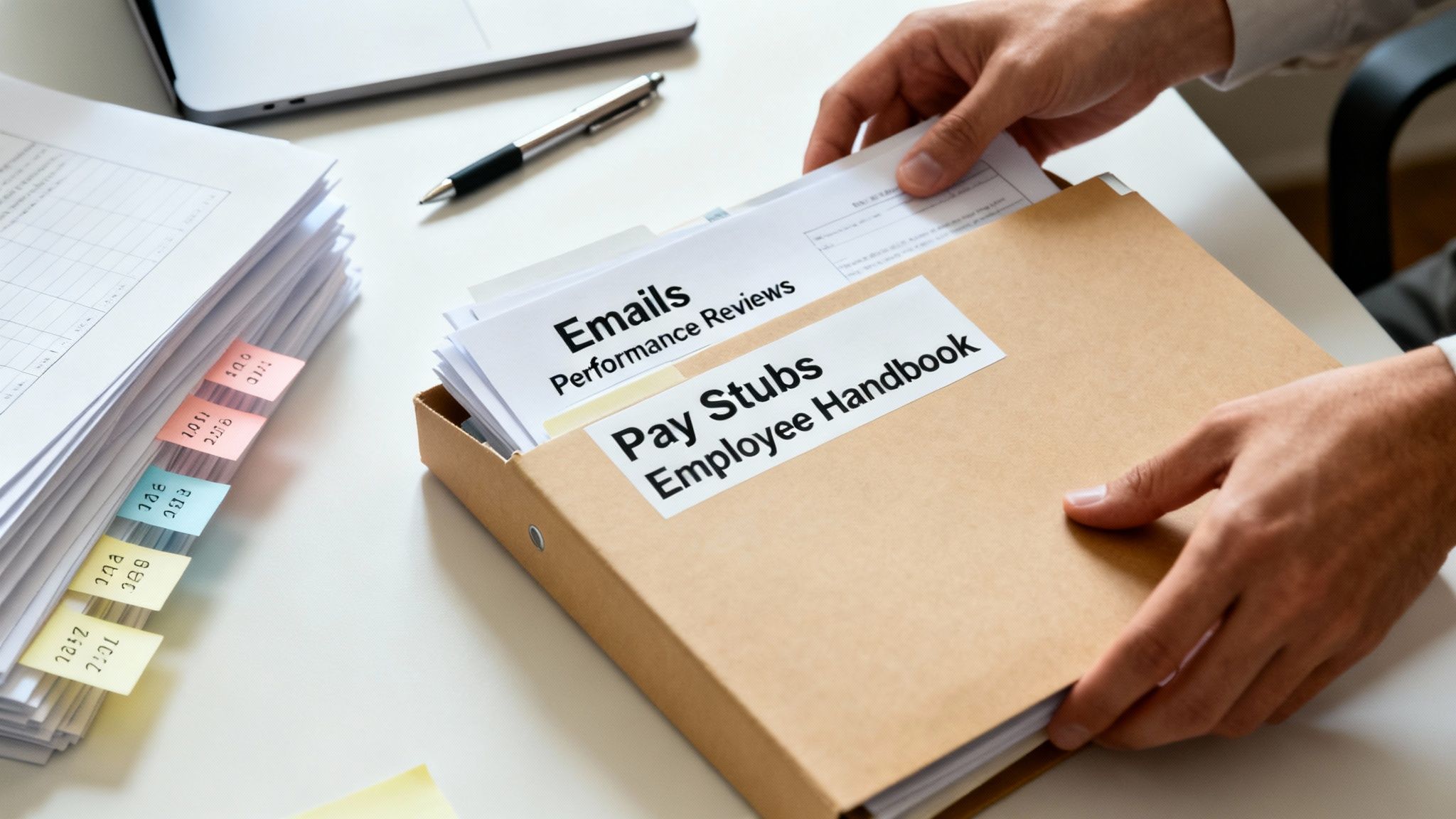
Immediately forward any important work emails to your personal account. Take screenshots of text messages or internal Slack/Teams chats. Grab any physical documents you have access to. Think performance reviews (especially the glowing ones), your employee handbook, recent pay stubs, and any "write-ups" or disciplinary notices. A long track record of great reviews can be dynamite when you're suddenly fired for "poor performance."
Our comprehensive employee termination checklist walks you through exactly which documents are the most valuable to have in your possession.
Document the Termination Itself
Your mind will be racing the moment you're fired. It’s a shock. But as soon as you get to a quiet place, write down every single detail you can remember about that termination meeting.
Take a few minutes to create a detailed timeline. Who was in the meeting? What was the exact reason they gave for your termination? What was their tone? These specific details can reveal inconsistencies in your employer's story later on.
This isn't just an exercise; this written record becomes a powerful piece of evidence. It's a contemporary account of what happened, which carries far more weight than trying to recall fuzzy details months down the road. If the reason they gave you feels vague or just doesn't add up with your work history, that's a huge red flag.
This quick decision tree can help you map out whether your firing has the signs of a wrongful termination claim.
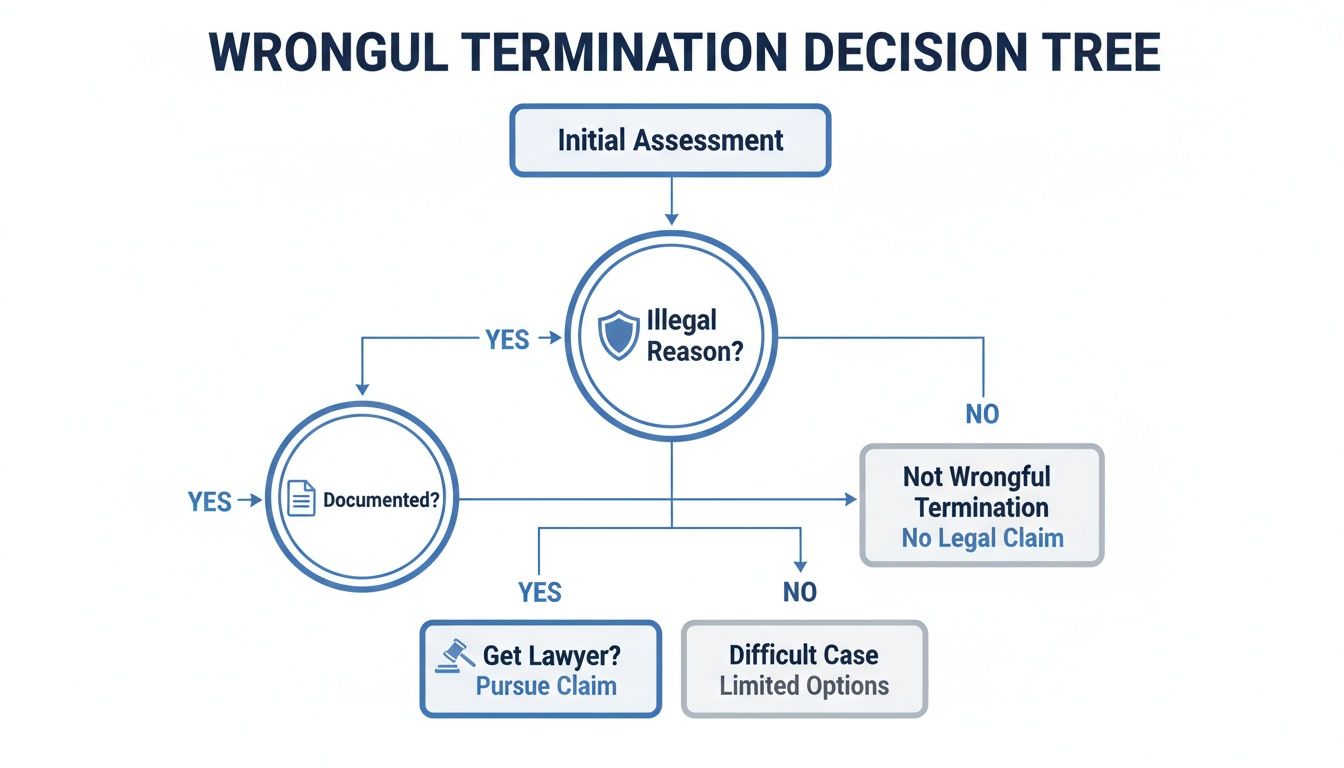
As you can see, connecting the firing to an illegal reason and having the documents to back it up are the fundamental first steps before you even think about calling a lawyer.
Sometimes, it's tough to know if what happened to you crosses the line from unfair to unlawful. This table can help you quickly spot the signs.
Could Your Firing Be Unlawful in Mississippi?
| Reason for Firing | What Makes It Potentially Illegal | Your Immediate Next Step |
|---|---|---|
| "Performance Issues" | You have a history of positive reviews, but the criticism only started after you reported harassment or requested medical leave. | Gather all past performance reviews, emails praising your work, and document the timeline of events. |
| "Restructuring" or "Layoffs" | You were the only one let go, or only employees over 50, women, or minorities were included in the "layoff." | Note the demographics of who was let go and who was kept. Were younger or less-qualified employees retained? |
| Fired after an injury or medical leave request | The termination happens shortly after you filed a workers' comp claim or requested FMLA leave. | Save all medical documentation, leave requests, and any communication with HR or your manager about your health. |
| Vague reasons like "not a good fit" | This happens after you complained about illegal activity (whistleblowing) or refused to do something unethical. | Write down a detailed account of your complaint, including who you spoke to and when. Preserve any related emails. |
This isn't an exhaustive list, of course, but it covers some of the most common scenarios we see. If your situation sounds like anything in this table, you need to be extra vigilant.
Be Cautious with Separation Agreements
Finally, be on high alert if your employer offers you a separation or severance agreement. These documents almost always include a small payment in exchange for you signing away your right to sue the company for any reason, including wrongful termination.
Never sign one on the spot. Never sign one without having an employment attorney review it first.
Once you sign that paper, you could permanently lose your ability to fight back. An experienced attorney can tell you exactly what rights you're giving up, whether the offer is even remotely fair, and if you have a strong potential case that's worth far more than the severance check. Taking these first steps carefully and deliberately can make or break your ability to prove your firing wasn't just unfair, but illegal.
Gathering the Evidence to Build Your Case

Proving you were wrongfully terminated in Mississippi isn't about having a gut feeling that something was unfair. It's about building a case with hard evidence that tells a story—your story—and directly challenges the company's official reason for letting you go.
The tough part is that the burden of proof is on you. It's up to you to show that your firing was motivated by an illegal reason, not the one they put on paper. This is where your personal records become your most powerful weapon. The evidence you gather will be the foundation for any claim you file with the U.S. Equal Employment Opportunity Commission (EEOC), which handles these cases in Mississippi. Without solid proof, even a completely valid claim can unravel quickly.
The Paper Trail That Tells the Real Story
Your mission is to collect every document that can either prove you were a good employee or poke holes in the company's excuse for firing you. Think of yourself as an investigator building a case file. You need to systematically gather your documents, and if you still have access, save digital copies to a personal email or cloud drive immediately. If you only have paper copies, get them organized in a safe place.
Here’s what you absolutely need to find:
- Performance Reviews and Evaluations: A history of positive reviews is your single best defense against a sudden claim of "poor performance." If your reviews were great right up until you reported harassment or requested leave, that timeline becomes incredibly powerful.
- Emails, Texts, and Internal Messages: Any written communication is gold. Look for messages from your boss praising your work, emails where you discussed your pregnancy or a medical condition, or chat logs related to a complaint you made. An email from a manager saying "great job on the project" a week before you were fired for "not meeting expectations" can completely dismantle their argument.
- Your Employee Handbook and Company Policies: This is the company's own rulebook. If they didn't follow their own progressive discipline policy—like giving you a verbal warning, then a written one—it shows they treated you differently. That’s a red flag.
The goal here is to create a stark contrast. You want to paint a clear picture of a valued employee whose job was suddenly in jeopardy right after a specific event, like requesting FMLA leave or reporting discrimination.
Documenting Your Personal Experience
Official company records are one thing, but your own notes are just as crucial. A personal journal or a detailed timeline of events can fill in the gaps and capture the details that never make it into a formal HR file.
As soon as you can after being fired, sit down and write out everything you remember about the termination and the events leading up to it. Be specific. Who was there? What was said? What was the date and time? These details matter. The more detailed your notes are, the more credible they become.
This is especially critical if you were fired after bringing up a safety issue. Having a clear record of when and how you reported the problem is key to a retaliation claim. You can learn more here about how to formally document and report unsafe working conditions.
The Financial and Contractual Evidence
Finally, you need the documents that lay out the terms of your job and the financial hit you took from being fired. This paperwork is essential for calculating damages if you win your case.
Make sure you have these:
- Your Offer Letter or Employment Contract: This establishes your role, salary, and the conditions of your employment.
- Pay Stubs: These are non-negotiable. They prove your rate of pay and hours worked, which is how we calculate your lost wages.
- Termination Notice: The official letter or email firing you. The reason they gave is the exact claim you'll be working to disprove.
Let’s put it all together. Imagine you were fired for "absenteeism" just two days after you emailed HR to request medical leave for a documented disability. By combining your history of positive performance reviews, that email to HR, and the termination letter, a story starts to form—one that suggests the real reason you were fired was your disability. Each document is a piece of the puzzle, and when assembled, they can reveal what really happened.
Linking Your Firing to a Protected Status or Action
Simply having a stack of documents isn't enough to win a case. The real challenge—and the heart of any wrongful termination claim—is connecting the dots. You have to prove that your firing wasn't just unfair or a bad business decision, but that it was a direct result of who you are (your protected status) or something specific you did (a protected activity).
This connection is the bridge between having a pile of paperwork and having a powerful legal case.
Your employer will almost never come out and admit they fired you for an illegal reason. They'll offer up a neutral, business-sounding excuse like "restructuring," "poor performance," or "not a good culture fit." Your job, with our help, is to peel back that official story and show it’s a pretext—a cover-up for the real, unlawful motive.
What Is a Protected Status?
Federal law makes it illegal for an employer to fire you because of certain personal traits. These are known as protected statuses or protected classes.
You cannot be legally terminated based on your:
- Race or Color
- Religion
- Sex (which includes pregnancy, sexual orientation, and gender identity)
- National Origin
- Age (specifically, if you are 40 or older)
- Disability (both physical and mental)
- Genetic Information
Proving discrimination based on your status often means looking for telling patterns. For example, if a company lays off ten people and eight of them happen to be over the age of 50, that’s a major red flag for age discrimination. Or, let’s say a manager repeatedly makes negative comments about your religion and then fires you for a minor mistake that other employees make all the time. That pattern is what helps build a strong case for a discriminatory motive.
What Is a Protected Activity?
Beyond who you are, the law also protects you for exercising your legal rights. When you engage in a protected activity, you're doing something the law gives you the right to do, and your employer can't punish you for it. Firing you for it is called retaliation, and it’s illegal.
Some of the most common protected activities include:
- Reporting sexual harassment or discrimination to HR.
- Acting as a witness in a coworker's discrimination case.
- Requesting a reasonable accommodation for a disability.
- Requesting or taking approved FMLA leave.
- Reporting illegal conduct by your employer (whistleblowing).
Retaliation is a massive issue. In fact, it's now the single most common charge filed with the Equal Employment Opportunity Commission (EEOC). In 2021, the EEOC received 61,331 discrimination charges, and an astonishing 60% of them included a claim for retaliation. This trend is alive and well in Mississippi. Between 2009 and 2018, our state had one of the highest rates of EEOC complaints in the country, averaging 60.8 claims per 100,000 residents. This tells you just how often Mississippi workers have to fight back against illegal punishment.
The Power of Timing
In my experience, one of the most compelling pieces of evidence in a retaliation case is timing. The closer your firing is to a protected activity, the more suspicious it becomes. We call this temporal proximity.
Picture this: You’ve worked at your company for five years with nothing but positive performance reviews. On Monday, you send an email to HR to complain that your supervisor has been making sexually suggestive comments. On Friday of that same week, that supervisor fires you for "not being a team player."
The extremely short time between your complaint and your termination is powerful circumstantial evidence. It strongly suggests the firing wasn't about your performance but was a direct punishment for you speaking up.
This kind of timing creates an inference of retaliation that is hard for an employer to explain away. If you think you were fired as punishment for reporting wrongdoing, our guide on whistleblower retaliation examples has more detailed scenarios.
Using Patterns and Comparisons to Build Your Case
Beyond just timing, you can expose an employer's pretext by showing a pattern of behavior or demonstrating how you were treated differently than your colleagues. This involves comparing your situation to coworkers who aren't in your protected class or didn't engage in a protected activity.
Start by asking yourself these crucial questions:
- Were company rules applied selectively? For instance, were you written up for being five minutes late when other employees of a different race or gender are frequently late with no consequences?
- Who did they hire to replace you? If you were fired for "performance issues" but your replacement is younger, less qualified, and not a member of your protected class, it seriously undermines the company's excuse.
- Was there a pattern to a layoff? In a supposed "reduction in force," did the company seem to only eliminate older workers, pregnant women, or employees who recently took medical leave?
By methodically connecting your firing to your status or a specific action—using timing, patterns, and direct comparisons—you elevate your claim from a feeling of being wronged to a logical, evidence-based argument that can withstand legal scrutiny. This is how a personal injustice becomes a provable case of wrongful termination.
How to Expose an Employer's False Justification
Let's be blunt: employers rarely come out and admit they fired you for an illegal reason. They’re smarter than that. Instead, they’ll construct what looks like a perfectly legitimate, business-related excuse for letting you go.
In the legal world, we call this fabricated reason pretext. It’s a cover story, plain and simple, designed to hide the real, unlawful motive.
Your biggest job in a wrongful termination case is to systematically tear that cover story apart. Think of yourself as a detective, using the evidence you’ve gathered to poke holes in their narrative until it completely falls apart, revealing the discrimination or retaliation underneath.
Spotting Inconsistencies in Their Story
The first place to look for cracks is in the employer's own story. When someone has to invent a reason for firing you, the details often get fuzzy, change over time, or just don't line up with the facts.
For instance, did your manager tell you in the termination meeting that you were being let go because of "company restructuring"? But then, on the paperwork they sent to the unemployment office, they claimed it was for "poor performance"? These kinds of conflicting reasons are a huge red flag. If the reason was legitimate, why would the story need to change?
A shifting explanation for a termination is one of the clearest signs of pretext. It tells a judge or jury that the employer is scrambling to find a justification that will stick, precisely because the real reason is one they can't legally admit.
Another classic inconsistency is when their reason for firing you is a complete departure from your documented work history. It’s hard to believe a sudden claim of "poor performance" when an employee has years of glowing reviews, raises, and bonuses in their file. This is exactly why those performance evaluations you saved are pure gold.
Proving They Didn't Play by Their Own Rules
One of the most compelling ways to prove pretext is to show you were treated differently than your colleagues. If you were fired for something that other employees do all the time without any consequences, it’s a strong signal that the "rule" wasn't the real issue.
Think about situations like these:
- Selective Enforcement: You get fired for being late twice in one month. Meanwhile, you know for a fact (and hopefully have some proof) that other employees in your department are frequently late and never even get a write-up.
- Disproportionate Punishment: You make a minor clerical error and are immediately shown the door. But just last month, a coworker of a different race or gender made a similar mistake and got nothing more than a verbal warning.
When you can point to this kind of disparate treatment, you build a powerful argument that your protected characteristic (like your age, race, or religion) or your protected activity (like reporting harassment) was the real reason you were singled out. The company’s failure to apply its own rules consistently completely undermines its credibility.
Using Timing to Your Advantage
Sometimes, the "when" is just as important as the "what." The timing of your termination can be a dead giveaway, exposing an employer’s flimsy justification. If you get fired suspiciously close to engaging in a legally protected activity, their official reason suddenly looks a lot less believable.
Imagine this: you've been a stellar employee for years. Then, you submit a request for FMLA leave to care for your sick mother. A week after your leave is approved, you're abruptly fired for "not being a team player." The closeness of those two events creates a very strong inference that the firing was retaliation for exercising your legal right to take FMLA leave.
Proving that an employer’s stated reason is just a cover story is the heart of winning a wrongful termination case. It's no surprise that federal data shows termination is the most common issue in discrimination lawsuits, appearing in a huge majority of cases filed by the EEOC.
Courts look at the evidence—performance reviews, write-ups, emails—to find these very inconsistencies. If your evaluations were great until right after you reported harassment or requested a disability accommodation, a sudden nosedive to "poor performance" looks incredibly suspicious. As explained in various legal analyses of employment law statistics and trends, this pattern is often compelling evidence of pretext.
By systematically pointing out the shifting stories, the unequal treatment, and the suspicious timing, you can effectively dismantle your employer's defense and show a judge or jury what really happened.
When It's Time to Call a Mississippi Employment Lawyer
You’ve gathered your documents, created a timeline, and you feel in your gut that something isn’t right. You might have a solid foundation, but knowing you were wronged and proving it in a legal setting are two very different challenges.
Going up against a company, with its HR department and legal team, is a daunting task. Honestly, it’s an uphill battle that’s nearly impossible to win on your own. This is the point where bringing in a skilled Mississippi employment attorney isn’t just a good idea—it’s essential.
A good lawyer is more than just a legal advisor. They become your advocate, taking the legal burden off your shoulders so you can focus on finding a new job and getting your life back on track. We handle the complex paperwork, deal directly with the company’s lawyers, and build a strategic case designed to get you the justice you deserve.
Why the EEOC Is So Important in Mississippi
Here’s something many Mississippi workers don't realize: our state does not have its own human rights commission to handle discrimination claims. This means the federal U.S. Equal Employment Opportunity Commission (EEOC) is usually the only place to file a formal complaint.
The EEOC has its own specific rules, procedures, and unforgiving deadlines. An attorney who deals with these claims every day knows exactly what the EEOC investigators are looking for, how to frame your complaint to make it as strong as possible, and how to shut down the company’s counterarguments. One small procedural mistake can get your entire case thrown out before it ever really begins.
What Happens in the First Consultation?
The first step is almost always a free, confidential consultation. This is your chance to tell your story and show us the evidence you’ve collected. I'll listen to what happened, ask specific questions about the timeline and the reasons you were given for being fired, and then give you a straightforward, honest assessment of your legal options.
To make the most of this meeting, be ready to talk about:
- The exact reason your employer gave for your termination.
- The timeline of events leading up to that day.
- Any proof you have of discrimination, retaliation, or a false reason for your firing (pretext).
- Your work history, including past performance reviews and salary information.
Think of this initial meeting as a two-way interview. It allows the lawyer to determine if you have a viable case, and it lets you decide if they’re the right person to fight for you.
A consultation isn't just about figuring out if you have a case. It's about understanding what it will actually take to prove it. A good lawyer will be upfront about the challenges and potential outcomes, setting realistic expectations from day one.
How Can You Afford a Lawyer if You've Lost Your Job?
This is the biggest worry for most people, and it's completely understandable. That’s why we use the contingency fee model. It’s simple: you pay absolutely no upfront legal fees.
Our fee is a percentage of the money we recover for you, whether that comes from a negotiated settlement or a court verdict. If we don’t win your case, you don’t owe us a dime. This system ensures our goals are perfectly aligned with yours—we are both fully motivated to get the best possible result.
In Mississippi, contingency fees for these cases typically range from 40-50% of the total recovery. This structure gives you access to top-tier legal help without the stress of hourly bills. It levels the playing field, ensuring your story gets the powerful voice it needs to be heard.
Common Questions on Proving Wrongful Termination
Losing a job is disorienting, and the questions that follow can be overwhelming. What are my rights? Do I even have a case? Getting straight answers is the first step toward figuring out your next move. Below, I’ve answered some of the most common questions Mississippi workers have when they suspect they've been wrongfully terminated.
What Is the Deadline to File a Claim in Mississippi?
You need to act fast. In Mississippi, you typically have just 180 days from the day you were fired to file a charge of discrimination or retaliation with the U.S. Equal Employment Opportunity Commission (EEOC).
This is one of the shortest deadlines in the entire country, and it is brutally strict. If you miss this 180-day window, you almost always lose your right to sue in federal court. It’s absolutely essential to talk to an employment lawyer right away to make sure you don't accidentally forfeit your claim.
My Boss Fired Me for Poor Performance but My Reviews Are Great
This is a huge red flag. In legal terms, we call this a potential "pretext"—a fake reason used to cover up the real, illegal one.
If you have a paper trail of good performance reviews, company awards, or even simple emails from your boss praising your work, that evidence is gold. We can use it to show that the "poor performance" excuse doesn't hold water. A sudden claim of incompetence after years of positive feedback is a powerful inconsistency that can expose an employer's true motive, like retaliation or age discrimination.
A strong history of positive performance is one of the best tools to dismantle an employer's flimsy excuse for a firing. That contradiction often becomes the cornerstone of a successful wrongful termination case.
Can I Still Have a Case if I Was an At-Will Employee?
Yes. This is probably the most common and damaging misconception out there. It’s true that Mississippi is an “at-will” state, which means you can be fired for a good reason, a bad reason, or no reason at all.
But you can never be fired for an illegal reason.
Federal laws carve out critical exceptions to the at-will doctrine. It is against the law for your employer to fire you because of your race, religion, gender, age, disability, or for reporting illegal activity. Your at-will status is not a license for your employer to discriminate or retaliate.
What Compensation Can I Recover?
If we prove you were wrongfully terminated, the goal is to recover damages that make you whole again. Every case is different, but the compensation we fight for often includes several key components:
- Back Pay: The wages, bonuses, and benefits you lost from the date of your firing.
- Front Pay: An amount to cover future lost earnings if getting your old job back isn't a realistic option.
- Compensatory Damages: Money awarded for the emotional distress and mental anguish the firing caused.
- Punitive Damages: In especially outrageous cases, these are awarded to punish the employer for their malicious or reckless conduct.
The value of any claim depends entirely on the unique facts of your situation and the evidence we can gather.
If you’ve been fired and something just doesn't feel right, you don't have to navigate this alone. The team at Nick Norris, P.A. is here to listen to your story, explain your rights, and help you fight for the justice you deserve. Contact us today for a confidential consultation at https://www.nicknorris.law.
This article has been reviewed for legal accuracy by Nick Norris. For employment law matters in Mississippi, consult with an attorney licensed to practice in your state.
Leave a Reply