

Wrongful Termination Lawyer: Get Justice Now
You get fired on a Tuesday, and by Wednesday morning you’re searching for answers with whatever words come to mind. Sometimes that search is “la wrongful termination lawyer,” even if you live nowhere near Los Angeles. What usually matters in that moment isn’t geography. It’s urgency. You want to know whether what happened was legal, what to save, who to call, and how not to make a bad situation worse.
If you work in Mississippi, the rules that matter most will come from Mississippi employment law and federal law, not California law. Still, the core lessons are universal. Act fast. Preserve evidence. Don’t sign away rights without review. Get advice from a lawyer who handles employment cases for employees, not general business disputes.
Your Guide to Finding a Wrongful Termination Lawyer
A search for a la wrongful termination lawyer often means one of two things. Either you’re looking for a lawyer in Los Angeles, or you’re using a common search phrase while trying to solve a problem where you live. If you’re in Mississippi, translate that search into a more practical question: Who handles employee-side employment cases here, and what do they need from me right now?
Start with focus, not branding. A lawyer who occasionally handles contract disputes is different from a lawyer who regularly deals with discrimination, retaliation, FMLA, WARN, USERRA, and wage claims. Wrongful termination cases turn on timing, documents, deadlines, and legal theories that overlap. You want someone who works in that lane.
Start with a short screening checklist
Use this before you book a consultation:
Practice focus: Ask whether the lawyer represents employees in employment law matters on a regular basis.
Claim type: Ask whether they handle claims involving termination tied to discrimination, retaliation, leave rights, or whistleblowing.
Process clarity: Notice whether the office can tell you what to gather before the first meeting.
Responsiveness: If communication is chaotic at intake, it usually won’t improve later. Firms that care about intake operations often rely on systems like a legal answering service playbook so workers can reach someone when a workplace crisis hits.
Jurisdiction: Make sure the lawyer is licensed where your claims will be evaluated.
Practical rule: Don’t hire the first person who sounds confident. Hire the person who asks the best questions about your facts.
A strong first step is reviewing a practical guide on how to find an employment lawyer in Mississippi. It helps you sort real employment counsel from lawyers who only touch these cases occasionally.
What good representation looks like early
In the first conversation, a solid employment lawyer should want dates, names, documents, and a clear sequence of events. They should ask what happened before the firing, not just what happened on the day you were let go. They should also ask whether you complained internally, requested leave, reported misconduct, or were suddenly criticized after a protected activity.
That early fact pattern matters more than a dramatic termination meeting. In many cases, the paper trail before termination tells the true story.
Recognizing a Wrongful Termination Claim in Mississippi
Mississippi is generally an at-will employment state. That means an employer can often fire an employee for a bad reason, an unfair reason, or no stated reason at all. But “at will” does not mean “anything goes.”
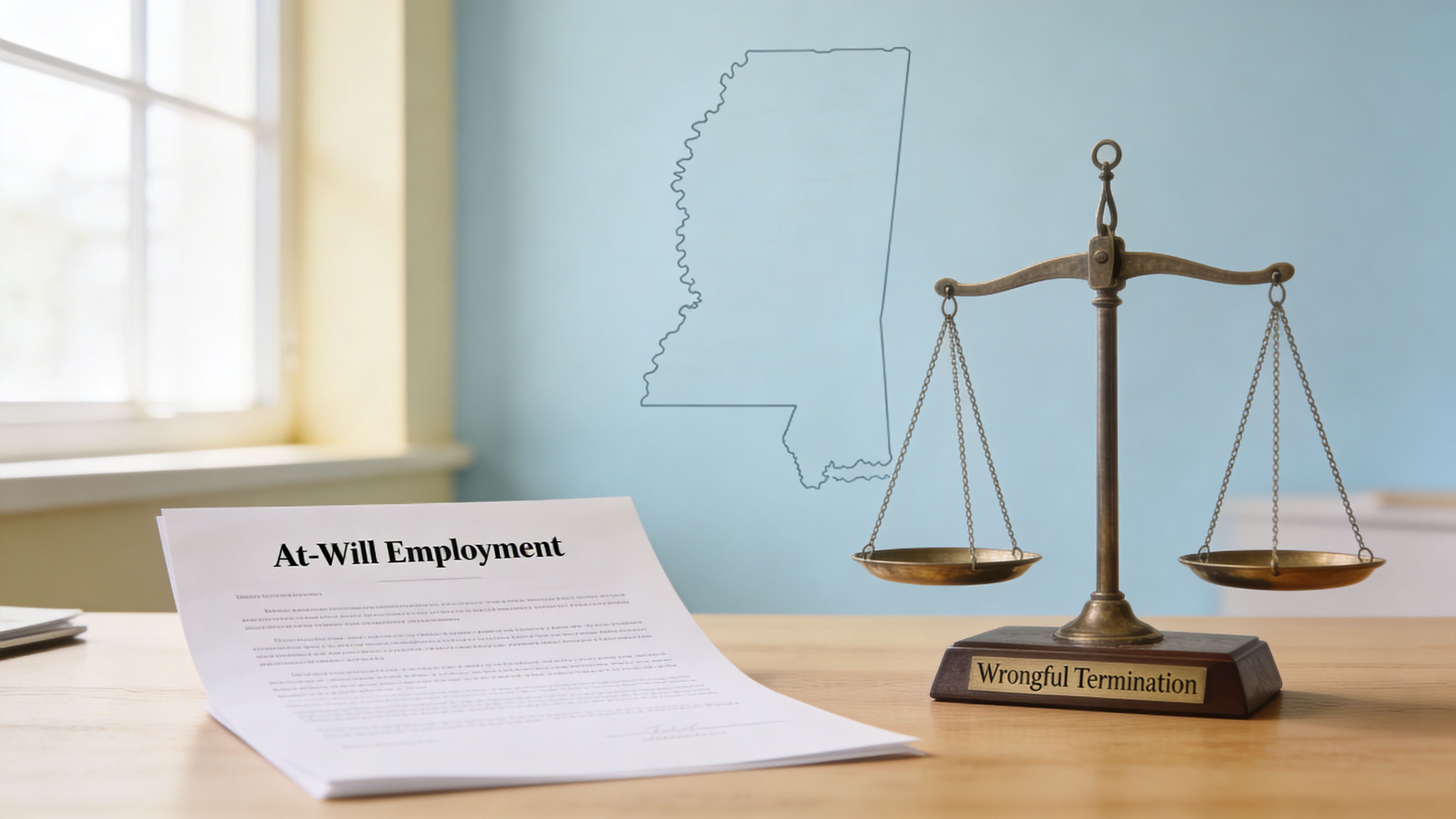
The question isn’t whether the firing felt wrong. The question is whether the firing was illegal. Federal law creates several important limits on what an employer can do, and those limits are where many Mississippi claims begin.
Claims that may support a case
Termination may be unlawful if it happened because of a protected characteristic or because you engaged in protected conduct. Common examples include being fired because of your race, sex, religion, national origin, disability, or age if you’re 40 or older. It can also include retaliation for asserting rights under laws like the Family and Medical Leave Act or protections tied to military service under USERRA.
One fact matters here. EEOC data shows that issues related to termination are the most prevalent in federal employment litigation, making it a core battleground for workplace rights violations across the country, including in Mississippi (employment litigation trends noted here).
That doesn’t mean every firing is actionable. It does mean termination is where many workplace disputes finally become impossible to ignore.
What workers often misunderstand
Many employees assume that if a firing was unfair, a lawsuit automatically follows. That’s not how this works. Employers can still defend a case by pointing to performance issues, restructuring, attendance, policy violations, or business judgment. Your job is not just to say, “I was treated badly.” Your job is to connect the firing to a legally protected reason.
Here’s a useful way to look at it:
Suspicious timing matters: If discipline started right after a complaint, leave request, or report of misconduct, that can matter.
Shifting explanations matter: If the employer gives different reasons at different times, that can matter.
Comparators matter: If others did the same thing and weren’t fired, that can matter.
Documents matter most: Emails, write-ups, reviews, and messages usually carry more weight than memory alone.
This short overview may help as you sort out the basics:
One important Mississippi limitation
Not every workplace complaint creates a retaliation claim under Mississippi law. A point many workers don’t learn until too late is this: Mississippi does not provide protection from retaliation for filing workers compensation claims. That doesn’t mean no other claim may exist on your facts, but it does mean you shouldn’t assume every retaliatory firing fits neatly into a recognized cause of action.
If you think your employer targeted you after leave, a discrimination complaint, wage complaints, or military-service issues, say that clearly when you speak with counsel. The legal label matters.
How to Prepare Your Case and Find the Right Lawyer
The first days after termination are often where good cases get stronger, or where strong cases get damaged. People sign severance papers without review. They vent on social media. They return company devices without preserving personal evidence they were allowed to keep. They delete texts because they’re upset. Those mistakes can shrink your options fast.
A useful benchmark comes from Los Angeles wrongful termination reporting. An estimated 80% of wrongful termination claims fail within the first 30 days, primarily due to inadequate documentation and missed procedural deadlines (reported in this wrongful termination analysis). That figure comes from a California-focused source, but the practical lesson applies anywhere. Delay hurts.
What to gather immediately
Build a file. Don’t curate it. Save the good facts and the bad facts. A lawyer can only evaluate what they can see.
| Document Type | Why It's Important |
|---|---|
| Termination letter or separation paperwork | Shows the stated reason, final date, and any conditions tied to separation |
| Offer letter and handbook | Helps identify policies, disclaimers, discipline rules, and leave procedures |
| Pay records and schedules | Helps calculate lost wages and identify pay-related issues |
| Performance reviews | May show a mismatch between your history and the reason suddenly given for termination |
| Write-ups and warnings | Reveals whether the employer documented concerns consistently or only after protected activity |
| Emails and text messages | Often show timing, complaints, instructions, and changes in tone from management |
| Leave requests and medical paperwork | Important in FMLA-related disputes |
| Internal complaints to HR or supervisors | Helps establish protected activity and notice to the employer |
| Witness names and job titles | Lets your lawyer assess who saw what and who may confirm your account |
| Severance agreement or release | May affect deadlines, rights, and negotiation strategy |
Build a timeline before memory fades
Write out the story in date order. Don’t worry about sounding polished. Start with when things were normal, then mark the shift. Include complaints, leave requests, disciplinary meetings, changes in supervisors, sudden negative reviews, and the termination itself.
If you’re unsure whether a texted agreement, electronically signed acknowledgment, or scanned document will matter, a plain-language guide on digital agreement legality explained can help you understand why those records may still carry legal weight.
Save first, sort later. Preservation is more important than perfect organization on day one.
How to choose counsel after the evidence is secured
Once your records are together, look for a lawyer who can tell you two things clearly. First, what claim or claims may fit your facts. Second, what evidence is missing.
A focused employee-side firm should be able to assess whether your facts point toward discrimination, retaliation, leave interference, military-service protections, mass layoff issues, or unpaid wage problems connected to the termination. If you want a practical overview before that call, review how to prove wrongful termination.
For Mississippi workers, Nick Norris, P.A. is one option that represents employees in employment disputes involving wrongful termination and related workplace claims. Whether you speak with that office or another employment lawyer, ask for a candid view of risk, proof problems, and deadlines. Avoid anyone who promises a quick payout before reading your documents.
Your Initial Consultation What to Ask and Expect
The first consultation isn’t just for the lawyer to evaluate you. It’s for you to evaluate the lawyer. You need to know whether this person understands employee-side employment law, whether they can explain your options in plain English, and whether the office will communicate with you.

Bring your timeline, your key documents, and your questions. Don’t worry about impressing anyone. Accuracy matters more than presentation.
Questions worth asking on the first call
Use questions that reveal judgment, not salesmanship.
Case fit: Have you handled cases involving this kind of termination issue before?
Claim theory: What legal claim do you think may apply to my facts?
Proof problems: What’s the weakest part of my case right now?
Next step: Should I file an agency charge, negotiate first, or gather more evidence before anything else?
Communication: Who will be my main contact if I hire the firm?
Documents: What should I preserve that people commonly overlook?
Employer contact: Should I keep communicating with HR, or stop?
Severance review: If I’ve been offered severance, what should I avoid signing before review?
A practical prep guide on how to prepare for your first talk with an employment lawyer can help you make that conversation more productive.
What to expect about fees
Many employment cases are handled on a contingency fee. In plain terms, the lawyer is paid from a recovery if money is obtained for you. If there’s no recovery, the fee structure often means you don’t pay an attorney’s fee out of pocket for the case result itself, though you should always ask about costs, expenses, and how they’re handled.
The author’s brief here matters. A typical contingency fee is 40 to 50 percent. That range should be discussed plainly, not buried in paperwork. Ask the lawyer to explain:
what percentage applies,
whether the percentage changes at different stages,
how litigation expenses are handled,
and whether expenses come out before or after the fee is calculated.
What a realistic lawyer sounds like
A reliable lawyer won’t promise that the employer will settle quickly. They also won’t tell you every ugly fact destroys the case. Most real evaluations sound balanced.
What to listen for: “Here’s what helps you, here’s what hurts you, here’s what I need to confirm, and here’s the likely path.”
That’s a much better sign than bravado.
You should also expect the lawyer to discuss process in stages. That may involve reviewing records, evaluating agency filing requirements, sending a demand, discussing settlement, and preparing for a longer dispute if the employer digs in. If someone acts like the entire matter will turn on one angry email from your boss, keep looking.
Understanding Potential Outcomes and Case Value
People often ask one question too early: “What’s my case worth?” A better first question is, “What outcome is realistically available on these facts?” Value follows proof.

In wrongful termination matters, “winning” usually doesn’t mean a dramatic courtroom verdict. It often means reaching a resolution that compensates you for what the firing cost and ends the dispute on terms you can live with.
What compensation may include
Depending on the claim and facts, compensation may involve:
Back pay: Wages and benefits lost after termination
Front pay: Future lost earnings in some cases
Emotional distress damages: Available in some claims when the facts support them
Other case-specific relief: This depends on the legal theory, the evidence, and the forum
Not every category applies in every case. Mitigation also matters. If you can work, your job search efforts may become relevant later.
Why representation changes the picture
One data point is worth knowing. A Nolo survey found that 64% of employees who hired a lawyer for wrongful termination received compensation, averaging $48,800, compared with 30% of unrepresented employees who received compensation, averaging $19,200 (survey summary discussed here).
That doesn’t mean hiring a lawyer guarantees a result. It does show two practical truths. First, legal representation can improve the odds of obtaining compensation. Second, representation can affect the size of the outcome, not just whether money is paid at all.
Strong cases usually become stronger through disciplined presentation, not louder accusations.
What actually drives value
Case value usually turns on a handful of things:
The paper trail. Clean, contemporaneous documents carry weight.
The legal fit. A bad workplace story is not the same as a legally viable claim.
Your wage loss. Lost pay and benefits matter.
Credibility. Consistent facts help. Public rants, contradictory messages, and missing records hurt.
Employer risk. Employers pay more attention when the facts are well documented and the theory is clear.
A lawyer can’t manufacture value that the facts won’t support. Good counsel can, however, identify what’s recoverable, frame the evidence properly, and keep you from undervaluing or accidentally damaging your own claim.
Next Steps for Mississippi Workers and Beyond
If you live in Mississippi and think your firing crossed a legal line, your next move should be simple. Preserve every document you can lawfully keep, write out a timeline, and get legal advice before signing anything important. Waiting usually helps the employer more than it helps you.
A lot of workers get stuck because they want certainty before making the call. They want to know they’ll win. They want to know the exact dollar value. They want a guarantee that the termination was illegal. Employment lawyers usually can’t give that on day one, and anyone who does should make you cautious. What you can get early is a grounded assessment of whether the facts point toward a real claim and what to do next without hurting it.
If you’re in Mississippi, talk to a lawyer licensed here who handles employee-side employment law. If you really did mean Los Angeles when you searched for la wrongful termination lawyer, find counsel licensed in California or use the National Employment Lawyers Association to locate someone in your state.
The common thread is the same wherever you are. Wrongful termination cases are rarely won by outrage alone. They’re built with facts, timing, and disciplined action in the first days after the firing.
If you need practical guidance after a firing in Mississippi, Nick Norris, P.A. represents employees in wrongful termination and related employment matters. A focused review of your timeline, documents, and employer’s stated reasons can help you understand whether you may have a claim and what steps make sense next.
This article has been reviewed for legal accuracy by Nick Norris. For employment law matters in Mississippi, consult with an attorney licensed to practice in your state.
Leave a Reply