

Decoding Time Clock Rounding Rules in Mississippi
You clock in a few minutes early. You stay a few minutes late. Yet, when you look at your paycheck, the numbers don't seem to add up. Sound familiar?
Under the federal Fair Labor Standards Act (FLSA), your employer is allowed to round your punch times to the nearest increment. However, there's a huge catch: this practice is only legal if it's fair and doesn't consistently favor the company over you.
Are You Missing Pay for Time You Actually Worked?
It’s a story we hear all too often from hourly workers across Mississippi. You glance at your timecard, compare it to your pay stub, and get that nagging feeling that something is off.
Those few minutes shaved off your shift each day might not seem like a big deal, but they add up. Over weeks, months, and a full year, that lost time can amount to a significant chunk of unpaid wages. This isn't just a minor bookkeeping quirk—it could be a sign that your employer's pay practices are breaking federal law.
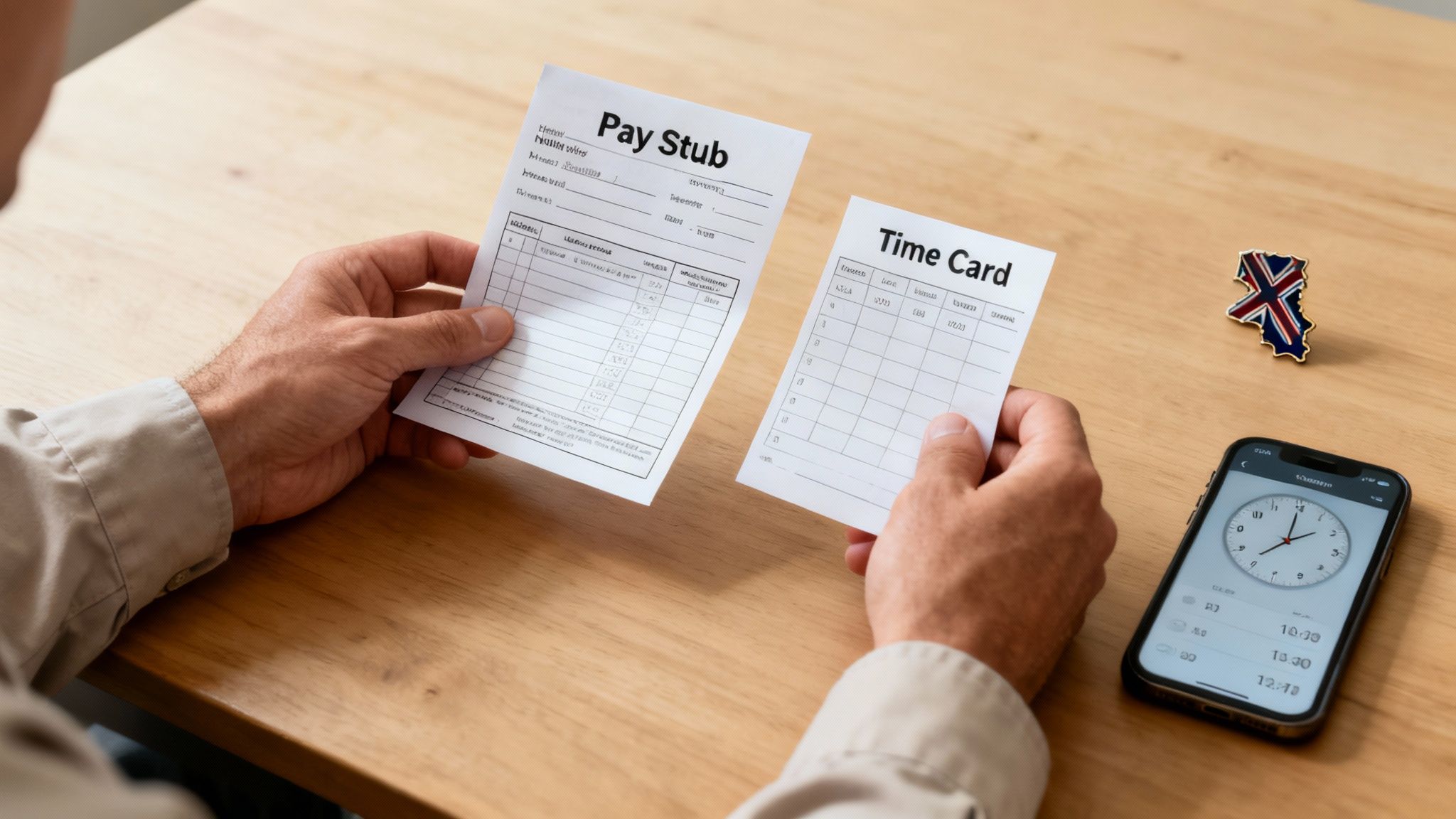
This guide is here to pull back the curtain on time clock rounding. We'll walk you through how these small, daily adjustments can lead to real financial losses and what your rights are as a Mississippi employee.
What You Will Learn From This Guide
Our main goal is to arm you with the knowledge to protect your hard-earned wages. After reading this, you'll be able to spot the difference between a legal rounding policy and illegal wage theft.
Here’s what we’ll cover:
- The core principle that rounding must be neutral and can't systematically shortchange you.
- The red flags that indicate an employer’s rounding policy might be illegal.
- How to identify and document potential time theft from your own pay stubs.
- What steps to take if you believe you're being underpaid.
Since Mississippi doesn't have a state-level agency to handle these claims, knowing your rights under federal law is absolutely critical. If you do need to take legal action, remember that most attorneys work on a contingency fee basis. This is typically 40-50% of whatever amount is recovered, meaning you don't pay anything out of pocket.
The single most important test of a lawful rounding policy is whether it's neutral. If the practice always works in the employer’s favor—like rounding your start time forward but never rounding your end time up—it's likely violating the FLSA. Over time, the rounding must average out so that you are fully paid for all the time you've actually worked.
This guide gives you the tools you need to scrutinize your paychecks, recognize unfair practices, and take the right steps to get the pay you're owed. Let's dive in.
Understanding Federal Time Clock Rounding Rules
While rounding time seems straightforward, the federal government has very specific rules to make sure it’s done fairly. Here in Mississippi, every employer, whether in Jackson or on the Gulf Coast, has to follow the guidelines of the Fair Labor Standards Act (FLSA). These rules are in place for all non-exempt employees—the folks who are legally entitled to overtime pay.
You can get a deeper understanding of these employee categories by reading our detailed guide on exempt vs non-exempt employees.
The FLSA does allow employers to round time, but this isn't a blank check to shortchange workers. Think of it like a coin flip; over a pay period, the rounding should even out. It can't be a system where the employer always wins the toss. A policy that only rounds in a way that benefits the company is illegal, plain and simple.

This idea of neutrality is the absolute foundation of legal time clock rounding. If your employer's rounding policy consistently shaves a few minutes off your workday, it’s almost certainly breaking federal law, no matter how it’s worded.
The Core Principles of Legal Rounding
The U.S. Department of Labor (DOL) has laid out some very clear ground rules for any company that chooses to round employee time. A rounding policy is only legal if it pays you for all the time you've actually worked over the long run.
These rules exist to stop a subtle but serious form of wage theft. The DOL is very firm on this: rounding must be impartial, use 15-minute maximum increments, and follow what's known as the 7-minute split. These protections are vital for preventing payroll practices that can add up to thousands of dollars in lost wages.
For a rounding system to be compliant, it must meet these key requirements:
- It Must Be Impartial. The policy can't be set up to always favor the employer. Over time, the rounding has to average out so it doesn't systematically underpay you.
- It Must Round Both Up and Down. An employer can't have a system that only rounds down when you clock out or only rounds up when you clock in. That’s illegal.
- It Must Be Applied Consistently. The same rules have to apply to everyone in a similar role, covering all clock-ins, clock-outs, and meal breaks without exception.
Demystifying the 7-Minute Rule
By far, the most common legal method employers use is rounding to the nearest quarter-hour (15 minutes). To do this correctly, they have to follow what’s known as the "7-minute rule." This rule creates a clear, simple cutoff for when time is rounded back or pushed forward.
It’s pretty simple. Any punch recorded from 1 to 7 minutes past the quarter-hour mark gets rounded down to that quarter-hour. On the flip side, any punch from 8 to 14 minutes past the mark gets rounded up to the next quarter-hour.
The Neutrality Test: A lawful rounding policy has to work both ways. If your employer rounds your 8:07 AM clock-in down to 8:00 AM, they are also legally required to round your 8:08 AM clock-in up to 8:15 AM.
To see how this works in the real world, let's break down the 7-minute rule with a standard 15-minute rounding increment.
How the 7-Minute Rounding Rule Works
| Minutes Clocked Past the Quarter Hour | How Your Time Is Rounded | Example Clock-In Time (Scheduled 8:00 AM) |
|---|---|---|
| 1 to 7 minutes | Rounded Down | Clock in at 8:06 AM, pay starts at 8:00 AM |
| 8 to 14 minutes | Rounded Up | Clock in at 8:08 AM, pay starts at 8:15 AM |
As you can see, sometimes you gain a few minutes of paid time, and other times you lose a few.
Over an entire pay period, these small gains and losses are supposed to balance out. This is the core concept you need to understand to check your own time entries and spot the difference between a fair system and one that’s quietly taking money out of your pocket.
How to Spot When Time Clock Rounding Crosses the Line
Knowing the federal rules on time clock rounding is one thing. Being able to look at your own pay stub and see if you’re getting shorted is what really counts. An employer’s rounding policy can look completely legal on paper but, in reality, be a sneaky way to skim off your wages over time.
The key isn't just to look at the policy itself—you have to look at the results.
The single most important test is whether the system is neutral. Does the rounding even out in the long run, or does it always seem to work out in your employer's favor? If you notice that minutes are constantly being shaved off your workday but you rarely get any added, that’s a massive red flag. This kind of imbalance is the classic sign of an illegal rounding practice.
The One-Sided Rounding Trap
One of the most common ways employers break the law is with one-sided rounding. This is where the system is programmed to only round in a way that cuts your paid hours. It’s a subtle but powerful tool for underpayment.
Keep an eye out for these specific warning signs on your timecards:
- It Only Rounds Down: Your clock-out times are always rounded down to your employer’s benefit. For example, if you clock out at 5:07 PM, you're paid until 5:00 PM. But if you clock in at 7:54 AM, you're paid from 8:00 AM—the system never rounds in a way that adds time for you.
- It’s Applied Selectively: The rounding rule might be used when you clock in but not when you clock out. Maybe your 8:06 AM start time gets rounded down to 8:00 AM (a loss of 6 minutes of pay for you), but when you work until 5:06 PM, that time is also rounded down to 5:00 PM. It never rounds up to 5:15 PM.
- "Grace Periods" That Only Go One Way: Your boss might have a “grace period” policy where you won’t get disciplined for clocking in a few minutes late. But they’ll still dock your pay to the nearest quarter-hour. The problem is, this grace period rarely works the other way—staying a few minutes late to finish up a task almost never results in extra pay.
If you’re seeing these patterns, your employer’s rounding system isn’t neutral. It’s a tilted scale, and it’s costing you money.
When a "Fair" Policy Becomes Illegal in Practice
Here’s where it gets tricky. Even a rounding policy that seems fair on its face can be illegal if its real-world application consistently underpays employees. Modern timekeeping software can track every second you work, yet some employers still apply rounding rules that create unfair gaps.
The crucial question isn't what the policy says—it's what the data shows.
A landmark court case, Houston v. St. Luke’s Health System, perfectly illustrates this. The hospital had a rounding policy that looked neutral, but the numbers told a different story.
An in-depth analysis of the company's payroll records revealed a devastating pattern. The rounding policy cut time from roughly 50% of all employee shifts. In contrast, it only added time to just over one-third of the shifts.
This imbalance meant that over several years, a staggering two-thirds of the employees lost more paid time than they ever gained. This case drives home a critical point for Mississippi workers: the actual outcome of a rounding policy is what determines if it’s legal. You can read more about how courts are viewing these situations in these insights on employer timekeeping policies.
How to Keep Tabs on Your Own Wages
To protect yourself, you have to be your own best advocate. Don't just assume your employer's payroll system is accurate or fair. The best way to catch problems is to keep your own records and compare them against what the company gives you.
Here are a few practical steps you can take:
- Keep a Personal Log: Get a small notebook or use a notes app on your phone. Every single day, write down your exact clock-in and clock-out times.
- Save Your Pay Stubs: Never throw away your pay stubs. They are the official record of what you were paid for and are crucial pieces of evidence.
- Do Regular Audits: At the end of each pay period, sit down with your personal log and your pay stub. Do the hours match up? If not, figure out where the discrepancy is.
- Look for Patterns: Search for the red flags we just discussed. Is the rounding consistently favoring your employer? Tally up the total minutes lost versus any minutes gained over several weeks.
By taking these simple steps, you empower yourself to spot problems and ask the right questions. In Mississippi, where there isn't a state agency to handle wage claims, being your own first line of defense is absolutely essential. If you uncover a pattern of underpayment, your next step should be to talk to a legal professional who understands federal labor laws.
Comparing Legal vs. Illegal Rounding Scenarios
Sometimes, the best way to understand the difference between a fair and an illegal time clock policy is to see it in action. Let's walk through a real-world comparison to make these abstract rules crystal clear.
We’ll follow a fictional Mississippi worker, Maria, through a typical week. We'll look at her actual punch times and see how they're calculated under two very different company policies. This side-by-side breakdown will show you exactly how a small, seemingly insignificant rule can cost you real money.
Scenario 1: A Fair and Lawful Rounding Policy
First, let's look at Maria's week under a perfectly legal system that follows the FLSA's 7-minute rule. Her employer rounds to the nearest 15-minute increment, and the policy is neutral—sometimes it benefits Maria, sometimes it benefits the company.
Maria's schedule is 8:00 AM to 4:30 PM, with a 30-minute unpaid lunch break.
Here are her actual punch times:
- Monday: Punches in at 7:54 AM, out at 4:36 PM.
- Tuesday: Punches in at 8:06 AM, out at 4:28 PM.
- Wednesday: Punches in at 7:58 AM, out at 4:39 PM.
- Thursday: Punches in at 8:09 AM, out at 4:32 PM.
- Friday: Punches in at 7:55 AM, out at 4:25 PM.
Now, let's see how the legal 7-minute rule calculates her paid time:
- Monday: 7:54 AM is within 7 minutes of 8:00, so it rounds to 8:00 AM. 4:36 PM is within 7 minutes of 4:30, so it rounds down to 4:30 PM.
- Tuesday: 8:06 AM is within 7 minutes of 8:00, so it rounds back to 8:00 AM. 4:28 PM is within 7 minutes of 4:30, so it rounds up to 4:30 PM.
- Wednesday: 7:58 AM rounds to 8:00 AM. 4:39 PM is past the 7-minute mark, so it rounds forward to 4:45 PM.
- Thursday: 8:09 AM is past the 7-minute mark, so it rounds forward to 8:15 AM. 4:32 PM rounds down to 4:30 PM.
- Friday: 7:55 AM rounds to 8:00 AM. 4:25 PM rounds up to 4:30 PM.
Notice how the rounding works both ways. On Tuesday, Maria punched in 6 minutes late but was paid from 8:00 AM. On Thursday, she punched in 9 minutes late and the clock rounded forward. This is the hallmark of a fair system—it evens out over time.
Scenario 2: An Illegal, One-Sided Rounding Policy
Now, let's take Maria’s exact same punches and run them through an illegal policy designed to only benefit the company. This system is programmed to always round in its own favor, which is a clear violation of federal law.
The shady policy is simple: always round the clock-in time forward to the nearest quarter-hour and the clock-out time backward. This guarantees the company never pays for a minute more than the scheduled shift.
Here’s how that plays out for Maria:
- Monday: 7:54 AM rounds forward to 8:00 AM. 4:36 PM rounds back to 4:30 PM.
- Tuesday: 8:06 AM rounds forward to 8:15 AM. 4:28 PM rounds back to 4:15 PM.
- Wednesday: 7:58 AM rounds forward to 8:00 AM. 4:39 PM rounds back to 4:30 PM.
- Thursday: 8:09 AM rounds forward to 8:15 AM. 4:32 PM rounds back to 4:30 PM.
- Friday: 7:55 AM rounds forward to 8:00 AM. 4:25 PM rounds back to 4:15 PM.
The difference is staggering. Maria never gains a single minute. The system is designed to only take, never give. On Tuesday, she lost 6 minutes when she clocked in and another 13 minutes when she clocked out—that's 19 minutes of unpaid work in one shift.
The Financial Impact of Unlawful Rounding
You can see how these small, daily discrepancies start to add up, turning into significant lost wages over weeks and months. This is especially true when it pushes your hours below the overtime threshold.
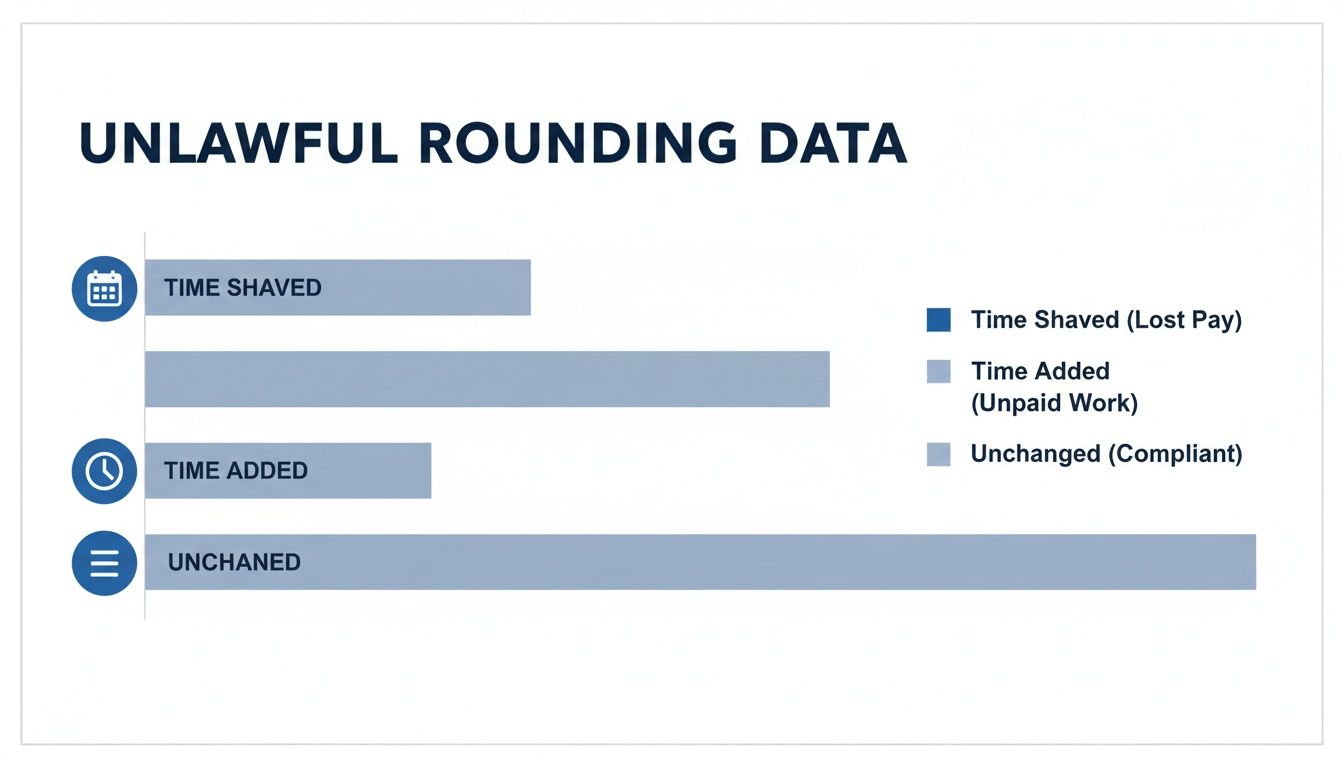
The data speaks for itself. Rounding systems that aren't truly neutral will almost always result in employees being underpaid.
Let's put some hard numbers to Maria's week. Assume she earns $15 per hour. Any time worked over 40 hours a week should be paid at time-and-a-half. To understand that math, it's important to know what the overtime pay rate is and how it's calculated.
Here's a table that breaks down the final numbers, so you can see the real cost of an illegal policy.
Weekly Pay Comparison: Legal vs. Illegal Rounding
| Day | Actual Punch In and Out Times | Paid Hours Under Legal Rounding | Paid Hours Under Illegal Rounding |
|---|---|---|---|
| Monday | In: 7:54 AM, Out: 4:36 PM | 8.0 hours | 8.0 hours |
| Tuesday | In: 8:06 AM, Out: 4:28 PM | 8.0 hours | 7.5 hours |
| Wednesday | In: 7:58 AM, Out: 4:39 PM | 8.25 hours | 8.0 hours |
| Thursday | In: 8:09 AM, Out: 4:32 PM | 7.75 hours | 7.75 hours |
| Friday | In: 7:55 AM, Out: 4:25 PM | 8.0 hours | 7.75 hours |
| Total | 40.0 hours | 39.0 hours |
The final tally shows the true cost of a rigged system. Under the legal, neutral policy, Maria was paid for 40 hours of work. But under the illegal, one-sided policy, her paycheck was for just 39 hours.
She worked the exact same schedule but lost a full hour of pay.
This kind of comparison is your best tool. Use this method—track your actual punch times and compare them to your paid hours—to see if your employer's policy is truly neutral or if it's systematically shorting your paycheck.
Your Action Plan for Recovering Unpaid Wages
It’s incredibly frustrating to realize your employer’s time clock rounding rules might be shorting your paycheck. But that feeling of being powerless doesn't have to be the end of the story. If you suspect you're a victim of unlawful rounding in Mississippi, there are clear, proactive steps you can take to reclaim the wages you've rightfully earned.
The whole process starts with one critical action: documentation. A vague feeling that you're being underpaid isn't enough; you need hard evidence to back it up. This is the foundation you'll build your entire case on.
First things first, start keeping your own detailed time log. Don't just trust your employer's system. Grab a notebook or use a notes app on your phone to record the exact time you clock in and out every single day, including for lunch breaks. Be precise down to the minute.
At the same time, make sure you save every single pay stub. These documents are your employer's official record of what they paid you. When you compare them to your personal time log, they can reveal a clear pattern of underpayment.
Calculating Your Potential Unpaid Wages
Once you’ve gathered a few weeks or months of records—your personal log and your pay stubs—it’s time to do some math. This is the step that turns your suspicions into real numbers, showing the actual financial hit you've taken from the rounding policy.
Start by comparing your logged hours to your paid hours for each pay period. Go through it day by day. For every shift, write down the difference between the time you actually worked and the time you were paid for after rounding.
Next, add up all those lost minutes over a full pay period. Convert those total minutes into a dollar amount using your hourly wage. If you spot a consistent pattern where you're always losing time and money, you're building a powerful argument that the rounding policy isn't neutral—and is therefore illegal under federal law.
Remember, the key question is whether the rounding truly averages out over time. If your math shows you consistently lose paid time and almost never gain any, the policy is likely failing the FLSA's neutrality test.
This calculation isn't just for your own peace of mind. It’s the core data you'll need to present when you seek help, and having it organized will make the next steps much smoother.
Why You Need to Consult a Professional
After you've documented everything and calculated your potential losses, the next crucial step is getting professional legal advice. This is especially important here in Mississippi, since the state doesn’t have its own Department of Labor or a human rights commission to handle these kinds of wage claims.
This means your main path to recovering lost wages is through federal channels—either by filing a complaint with the U.S. Department of Labor or by partnering with a private attorney who focuses on employment law. An experienced lawyer can look at your evidence, explain your rights under the FLSA, and map out the best strategy for your specific situation. There are many factors that go into a potential case, and understanding the process of filing an unpaid wages lawsuit can help clarify your options.
Understanding the Contingency Fee Model
A lot of workers get nervous about calling a lawyer because they're worried about the cost. The good news is, most employment lawyers in Mississippi handle wage and hour cases on a contingency fee basis, making legal help accessible to everyone.
Here’s how it works:
- No Upfront Costs: You don’t pay a dime out of your own pocket to get the case started.
- Payment From Recovery: The attorney’s fee is just a percentage of the money recovered for you in a settlement or court award.
- No Recovery, No Fee: Plain and simple—if you don't win your case, you owe the attorney nothing.
The average contingency fee is usually between 40-50% of the total recovery. This system ensures your lawyer is highly motivated to win the best possible outcome for you, since their payment is tied directly to your success. It completely removes the financial risk, empowering you to pursue justice and get back the money you're owed.
Your Top Questions About Time Rounding Answered
It's one thing to understand the rules on paper, but it’s another to see how they apply to your specific situation. Time clock rounding can feel confusing, and it’s normal to have questions. Here are clear, straightforward answers to the most common questions we hear from workers across Mississippi.
Is It Legal for My Boss to Round My Time?
Yes, but there are major strings attached. The federal Fair Labor Standards Act (FLSA) does allow employers to round employee time. However, this isn't a license to skim from your paycheck. The practice is only legal if the rounding system is fair and doesn't consistently shortchange you over time.
The most common—and legally accepted—method is rounding to the nearest quarter-hour (15 minutes). For any other system, especially one that always seems to benefit the company, you should be skeptical. If your employer's rounding policy is systematically shaving minutes off your paycheck, that’s not just unfair—it could be wage theft.
What’s This “7-Minute Rule” I Keep Hearing About?
The 7-minute rule is the Department of Labor's standard for rounding to the nearest 15-minute mark. Think of it as a simple cutoff that decides whether your time gets rounded back or pushed forward.
It works like this:
- 1 to 7 minutes past the quarter-hour? Your time rounds down. So, if you clock in at 8:06 AM, your paid time starts at 8:00 AM.
- 8 to 14 minutes past the quarter-hour? Your time rounds up. If you clock in at 8:08 AM, your paid time starts at 8:15 AM.
The key to this rule being legal is its fairness. It has to work both ways, applying to clock-ins and clock-outs. Over a pay period, the minutes you gain and the minutes you lose should more or less cancel each other out.
This rule exists to make payroll a bit easier, not to create a system where employees are constantly working for free.
What Should I Do if I Think the Rounding Is Unfair?
If you have a gut feeling that your employer's rounding is costing you money, the first step is to move from suspicion to proof. You need cold, hard data.
Start keeping your own, independent log of your hours. Every single day, write down your exact clock-in and clock-out times. Then, when you get your paycheck, sit down and compare your personal records to your official pay stub. Are you noticing a pattern where the rounding always seems to go in the company’s favor?
Once you’ve documented the differences and have a good idea of how much you might be owed, it’s time to talk to a professional. An experienced employment law attorney can look at your evidence, explain your rights, and help you figure out the best way to move forward.
Is It Really Worth It to Fight Over a Few Minutes a Day?
Absolutely. Those "few minutes" add up much faster than you think. Losing just ten minutes of paid time every workday at $12 an hour costs you over $500 in a single year. Now imagine that happening to every employee, year after year. It becomes a massive amount of money that rightfully belongs to the workers.
Beyond your own lost wages, holding an employer accountable for unfair pay practices helps protect your coworkers from the same treatment. Remember, wage theft is wage theft—even if it happens just a few minutes at a time.
I Can’t Afford a Lawyer. What Are My Options?
This is the number one reason people hesitate to seek help, but there’s a solution built right into the legal system for wage claims. Most employment lawyers handle these cases on a contingency fee basis.
In plain English, that means you don't pay the lawyer a dime upfront. Their payment is a percentage of the money they successfully recover for you, whether it’s through a settlement or a court award. This fee is typically around 40-50%.
The contingency model levels the playing field. If you don't win your case, you owe nothing in legal fees. It ensures that your ability to fight for your hard-earned wages isn't limited by the money in your bank account.
If you believe your employer’s time clock rounding practices are unfair and costing you money, you don't have to face the situation alone. The legal team at Nick Norris, P.A. is dedicated to protecting the rights of Mississippi workers. We can help you understand your options and fight for the wages you have earned. Contact us today for a confidential consultation to discuss your case. Learn more at https://www.nicknorris.law.
This article has been reviewed for legal accuracy by Nick Norris. For employment law matters in Mississippi, consult with an attorney licensed to practice in your state.
Leave a Reply