

What to Do If You Are misclassified as independent contractor
When an employer calls you an “independent contractor,” but you’re treated just like a regular employee, you’ve likely been misclassified. This isn't just a simple mix-up with paperwork; it's an incorrect and often illegal label that can rob you of fundamental rights like overtime pay, unemployment benefits, and workers' compensation.
What matters isn't the title they give you—it's the actual reality of your job and how much control the company has over your work.
Employee vs. Independent Contractor: What's the Real Difference?

It’s confusing to be called a "contractor" when your day-to-day work feels no different from a standard job. You come in at a set time, use company equipment, and get direct orders on how to do your tasks. These are all classic signs of an employee. So, what truly separates the two in the eyes of the law?
The entire distinction comes down to one crucial factor: control. Government bodies like the IRS and the Department of Labor (DOL) don’t care about your job title. They look at the "economic reality" of the relationship to figure out who is really in charge.
The Construction Worker Analogy
Think about a construction worker in Jackson hired as an independent contractor to frame a house. If the company sets a rigid 8-to-5 schedule, demands he attend daily progress meetings, provides all the nail guns and saws, and tells him exactly how to frame each wall, he's being treated like an employee. The company is controlling the how, when, and where of his work.
A true independent contractor, on the other hand, would have a much different arrangement. He'd likely bid on the entire framing project, bring his own tools and crew, and decide his own work hours to hit the final deadline. He controls the process; the company just cares about the finished product.
This distinction is everything because it determines your legal rights. Often, the first step in creating a clear relationship is drafting essential employee contracts that properly outline the nature of the work.
Why Your Classification Matters So Much
Being correctly classified as an employee gives you a safety net of legal and financial protections that contractors simply don't get. This isn’t a minor detail—it directly affects your financial stability and well-being.
When an employer misclassifies a worker, they are unlawfully shifting their own legal and financial responsibilities onto the employee. This can leave the worker vulnerable to unpaid wages, unexpected tax burdens, and a lack of coverage for on-the-job injuries.
Grasping this fundamental difference is the first step to figuring out if you've been misclassified. Key protections you lose out on include:
- Overtime Pay: Under the Fair Labor Standards Act (FLSA), employees are entitled to time-and-a-half pay for any hours worked over 40 in a week.
- Unemployment Insurance: If you lose your job through no fault of your own, you can access these benefits to stay afloat.
- Workers’ Compensation: This covers your medical bills and a portion of lost wages if you get hurt on the job.
- Employer-Paid Taxes: As an employee, your employer must pay half of your Social Security and Medicare taxes. Contractors are stuck with the whole bill.
If your job feels more like the first construction worker example, that "independent contractor" label might just be a way for your employer to cut costs—at your expense.
The Hidden Costs of Worker Misclassification
Being slapped with the "independent contractor" label when you're really an employee isn't just a mix-up with paperwork. It's a financial gut punch. This misclassification is a way for companies to quietly shift their legal and financial responsibilities onto your shoulders, leaving you unprotected and out of pocket.
What you lose is far more than a job title. It hits your wallet, your future, and your family's security.
This isn't some rare occurrence, either. It’s a massive, nationwide issue. Some studies estimate that 10% to 30% of employers misclassify at least one worker. Millions of people in industries like trucking, construction, and gig-based delivery services are affected, and it siphons billions from the systems designed to protect all of us.
Lost Wages and Missing Overtime Pay
The first and most obvious hit is to your paycheck, specifically through the loss of overtime. The Fair Labor Standards Act (FLSA) is crystal clear: most employees must be paid time-and-a-half for any hours they work over 40 in a single week. As an independent contractor, that right vanishes.
Think about a delivery driver right here in Mississippi. They might get a flat daily rate but are pushing 50 or 60 hours a week just to finish their routes. If they were correctly classified as an employee, those extra 10-20 hours would mean a much bigger check. But because they’re misclassified, it’s just free labor for the company. The employer pockets the cash that rightfully belongs to the worker.
The Vanishing Safety Net
Beyond overtime, employee status comes with a crucial safety net that independent contractors are forced to go without. These are the protections that catch you when life throws a curveball. Misclassification strips them away entirely.
Here’s what you’re being denied:
- Unemployment Insurance: If the company lays you off, you have zero access to unemployment benefits. That means no income to support your family while you scramble to find another job.
- Workers' Compensation: Get hurt on the job? A fall at a work site or a car wreck while making a delivery could be devastating. Without workers' comp, you’re on your own to cover medical bills and make up for lost wages. The financial fallout can be catastrophic.
One of the biggest hidden costs is that you are immediately on the hook for your own benefits. A misclassified worker suddenly has to figure out their own insurance. For a complete look at what that entails, this Insurance for Independent Contractors Guide is an excellent resource.
The Crushing Burden of Self-Employment Taxes
The final blow often comes at tax time. When you're an employee, you and your employer split the cost of Social Security and Medicare taxes—you each pay 7.65%.
But when you're misclassified as an independent contractor, the entire 15.3% self-employment tax lands squarely on you.
This tax shift means you are effectively paying your employer's share of taxes out of your own pocket, significantly reducing your take-home pay. On top of that, you are required to manage complicated quarterly estimated tax payments to the IRS, a burden most employees never have to worry about.
This isn't just an accounting detail; it’s a direct hit to your bottom line. Over the course of a year, that extra tax burden can easily add up to thousands of dollars in lost income, making it that much harder to pay the bills, let alone save for the future.
How Federal Agencies Determine Your Worker Status
Think you’ve been misclassified as an independent contractor? It’s not just your word against your employer’s. Federal agencies like the Internal Revenue Service (IRS) and the U.S. Department of Labor (DOL) have their own rulebooks for figuring out your true worker status.
At the end of the day, they care far more about the reality of your job than the title on your contract. These agencies dig into the details of your work relationship to see who really holds the power. Their main goal is to figure out one thing: are you economically dependent on the employer, or are you genuinely in business for yourself?
The IRS Three-Category Test
The IRS takes a big-picture approach, grouping evidence into three main categories to get a feel for the degree of control and independence in your working relationship. No single detail decides the case; it’s about how all the pieces fit together.
Behavioral Control: This is all about who calls the shots on how you do your work. Does the company dictate when and where you work? Do they train you on a specific process you have to follow? If your boss sets your hours for a construction job in Biloxi and makes you attend mandatory daily safety meetings, that’s a strong sign you're an employee. A true contractor would have the freedom to set their own schedule to meet the project deadline.
Financial Control: Here, the IRS looks at the business side of things. Does the company control how you get paid and handle your expenses? A huge question is whether you have a real opportunity to make a profit or take a loss. An employee just gets a paycheck. A contractor, on the other hand, can make more money by working efficiently or even lose money if things go wrong.
Relationship of the Parties: This category weighs how you and the company see the relationship. Is there a contract? Does it call you an employee or a contractor? More importantly, does the company provide benefits like insurance, a 401(k), or paid vacation? A long-term, indefinite relationship also points toward employment, while a contractor is usually brought on for a specific project with a clear end date.
This decision tree shows exactly how being misclassified hits you where it hurts—your wallet. It directly leads to financial losses from lost wages, missing benefits, and an unfairly high tax burden.
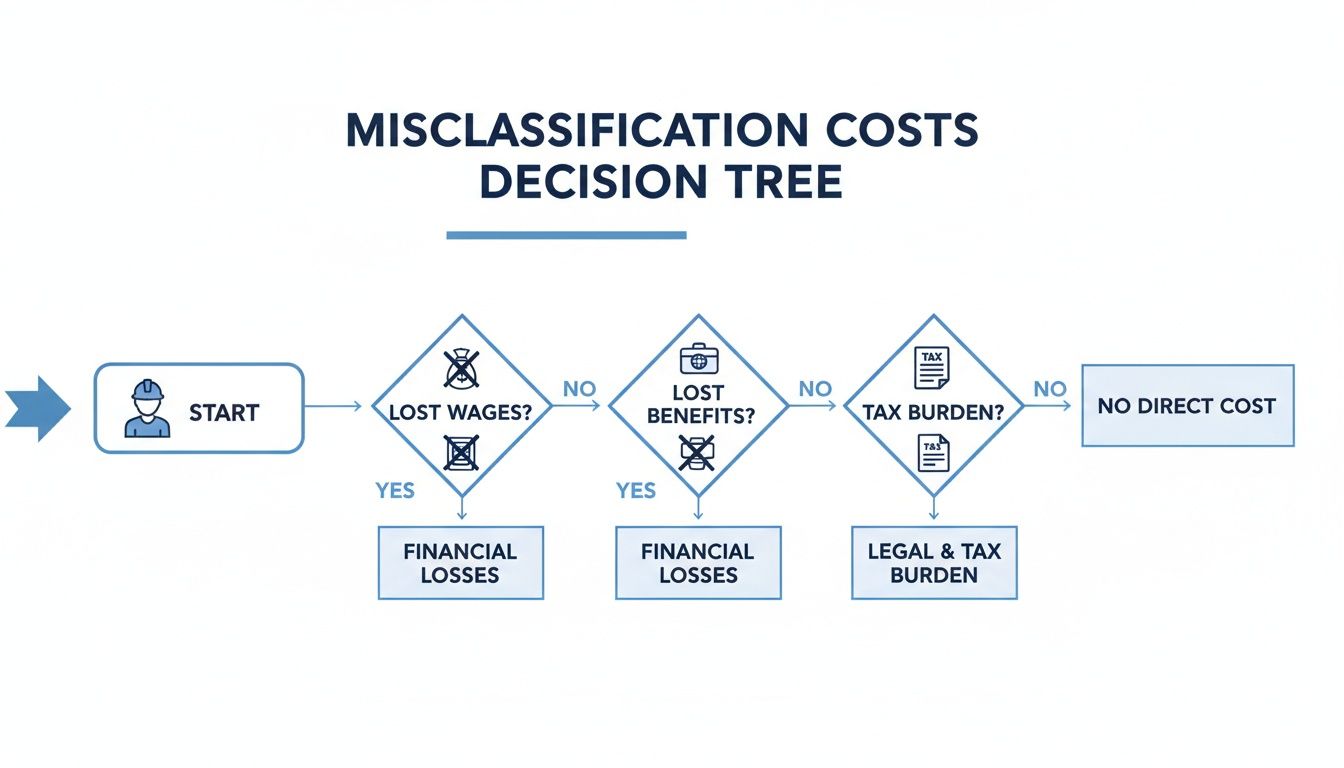
As you can see, every consequence of misclassification—from unpaid overtime to being forced to pay self-employment taxes—takes money out of your pocket and puts it back in your employer’s.
The DOL Economic Reality Test
The Department of Labor enforces laws like the Fair Labor Standards Act (FLSA), so they have their own lens for viewing this issue. They use what’s called the "Economic Reality" test. The core question is simple: are you economically dependent on the employer for your livelihood, or are you truly running your own show?
The DOL's test isn't a simple checklist. It's a holistic review of the work relationship to determine the true nature of the arrangement, ensuring that workers who are employees in practice receive the protections they are legally owed.
The DOL usually looks at six key factors to paint a full picture:
- Is the work you do an integral part of the employer’s business?
- Do your management skills affect your chance to make a profit or loss?
- How does your investment in tools and equipment compare to the employer’s?
- Does the job require special skills and independent initiative?
- Is your relationship with the company permanent or for a fixed term?
- What is the nature and degree of the employer’s control over your work?
Getting these factors right is also essential for determining if you are an exempt or non-exempt worker—another classification that has a huge impact on your pay. You can learn more about what is exempt vs. nonexempt employee status in our detailed guide.
Comparing the Two Worker Types
To help you see where you might stand, we’ve put together a table that breaks down the common signs federal agencies look for. It’s a great way to quickly compare the two roles side-by-side.
Employee vs Independent Contractor Key Differences
| Factor | Signs You Are an Employee | Signs You Are an Independent Contractor |
|---|---|---|
| Control Over Work | The company provides detailed instructions on how, when, and where to work. You are often trained to perform the job a certain way. | You control the method and means of completing the project. You use your own approach to get the job done. |
| Tools & Equipment | The employer provides the necessary tools, equipment, and supplies needed to perform your job. | You provide your own tools, equipment, and materials for the work. This represents a significant personal investment. |
| Payment Method | You are paid a regular wage or salary at set intervals (e.g., weekly or bi-weekly). | You are typically paid by the project or a flat fee. You submit invoices for your work. |
| Opportunity for Profit | Your income is fixed and does not depend on your efficiency. You cannot suffer a financial loss from the work. | You can increase your profit by working efficiently or lose money if your costs exceed your payment. |
| Permanence | The working relationship is ongoing and indefinite, without a specified end date. | The relationship is for a specific project or a defined period. Once the project is done, the relationship ends. |
| Benefits | You are eligible for benefits like health insurance, retirement plans, and paid time off. | You are not provided with benefits and must secure your own insurance and retirement savings. |
Looking at this table, ask yourself honestly: does your day-to-day reality line up more with the "Employee" column or the "Independent Contractor" column? The answer can tell you a lot about whether you've been misclassified.
Your Action Plan if You've Been Misclassified in Mississippi

Realizing you might be misclassified as an independent contractor can be a frustrating and confusing experience. But it's important to know you aren't powerless. The key to protecting your rights and getting what you're owed is to take organized, decisive action. It all starts with building a solid case and then knowing exactly where to turn for help.
This is especially true for workers here in Mississippi. Since we don't have a state-level agency to field these kinds of claims, you'll need to work with federal agencies and find the right legal support to fight back. Think of this as your step-by-step game plan for doing just that.
Step 1: Gather Your Evidence
Before you make a single phone call or file any paperwork, your first job is to become your own best detective. You need to collect every piece of paper, every email, and every text that tells the real story of your relationship with the company. This evidence is the foundation of your entire case.
Your main goal is to paint a clear picture of how much control the company had over your work. The more control you can show, the stronger your argument is that you were an employee, not a contractor.
Start by pulling together these items:
- Contracts and Agreements: Find any document you signed, especially your independent contractor agreement. Often, the language in these contracts can actually help prove you were treated like an employee.
- Pay Stubs and Invoices: Keep a complete record of every payment. A consistent payment history looks a lot more like an employee's regular paycheck than a contractor's invoicing.
- Communications: This is huge. Save every email, text message, or app notification with instructions, schedules, or corrections from a manager. These are direct proof of the company's control over how you did your job.
- Company Policies: Were you told to follow an employee handbook, a code of conduct, or other specific company rules? Get copies if you can.
- Work Schedules: Keep records of any schedules, shift assignments, or mandatory meetings the company required you to attend.
- Expense Records: Did you pay for your own fuel, tools, or supplies without getting paid back? Make a list of these business-related expenses.
Step 2: File with Federal Agencies
With your evidence organized, it’s time to get an official ruling. Since Mississippi does not have a human rights commission or state labor department to handle wage claims, you'll need to go through federal agencies. These two filings are your most powerful first moves.
File Form SS-8 with the IRS
The IRS uses Form SS-8, "Determination of Worker Status for Purposes of Federal Employment Taxes and Income Tax Withholding," to make an official call on whether a worker is an employee or an independent contractor. It can be a slow process, but an official determination from the IRS saying you're an employee is an incredibly powerful piece of evidence.
File a Wage Claim with the U.S. Department of Labor (DOL)
If you believe you're owed unpaid overtime or minimum wages as a result of being misclassified, you can file a complaint with the DOL's Wage and Hour Division. The DOL can investigate your claim, and if they find the company broke the law, they can force your employer to pay you the wages you're owed. Our guide on how to handle an unpaid wages lawsuit provides more detail on what this process looks like.
Filing these federal claims creates an official record of your dispute and forces the employer to answer to a government authority. This step shifts the power dynamic and is a critical part of holding the company accountable.
Step 3: Talk to a Mississippi Employment Lawyer
While filing with federal agencies is a great start, trying to navigate the legal maze of a misclassification claim by yourself is a tough road. This is where you bring in a professional who fights for workers' rights for a living. An experienced employment lawyer is the best ally you can have.
An attorney can look at the unique details of your situation, calculate exactly how much you're owed—including unpaid overtime and other damages—and take over all the communication with your employer. They know the games companies play and can build a strong strategy to shut them down.
A lot of workers worry about how they'll afford a lawyer, but most employment law firms work on a contingency fee basis. What does that mean? You pay nothing upfront. The attorney only gets paid if they win money for you, usually taking a percentage of the final settlement or award. While it can vary, the average contingency fee is around 40-50% of what's recovered. This system makes sure every worker in Mississippi can get expert legal help, no matter their financial situation.
Why You Need a Mississippi Employment Lawyer
Trying to handle a worker misclassification dispute by yourself is a tough, uphill battle. You’re not just going up against your employer; you’re going up against their legal team, whose entire job is to protect the company's interests. The laws are confusing, the deadlines are rigid, and it's easy to make a misstep that could cost you everything.
Hiring an experienced Mississippi employment lawyer changes the entire dynamic. It puts a dedicated professional in your corner, someone who knows the system inside and out and is committed to fighting for you.
Building Your Case From the Ground Up
The first thing a good lawyer does is dig deep into the details of your job. They’ll pour over every piece of evidence you have—your emails, contracts, text messages, pay stubs, and work assignments—to piece together the full story of your employment relationship.
This isn't just about checking boxes on a form. Your attorney is looking for the specific facts that prove your employer exercised control over your work, which is the heart of any misclassification claim. They know exactly what the Department of Labor and the IRS look for and will frame your evidence to build the strongest argument possible.
Then comes the math. A lawyer will calculate the true financial damage you've suffered, which is often far more than just a few missed paychecks. This detailed accounting can include:
- All unpaid overtime wages, potentially going back two or even three years.
- "Liquidated damages," which can double the amount of back pay you're awarded.
- Reimbursement for the employer-side payroll taxes you were wrongfully forced to pay.
Negotiating from a Position of Strength
Once your case is solid, your lawyer takes over as your voice and your shield. They handle all the stressful phone calls and emails with your employer and their attorneys, so you don't have to. Companies immediately take a claim more seriously when it comes from a respected law firm.
An employment lawyer isn't just asking for what's fair—they're negotiating with the full weight of the law behind them. They present a detailed, evidence-backed demand that shows the company the serious financial risk they face by proceeding with a federal lawsuit.
This leverage is critical. It turns your complaint into a significant problem for the employer, pushing them toward a fair settlement instead of a long, public, and expensive legal fight they'll likely lose.
Protecting You From Retaliation
Many people are terrified of what might happen if they speak up. "Will I get fired? Will they make my life miserable?" These are valid fears, but federal law is on your side. It is illegal for an employer to fire, demote, or punish you in any way for filing a legitimate wage claim.
If your employer does retaliate, your attorney can immediately file a separate lawsuit against them for that illegal action. This makes them answer not just for misclassifying you, but for trying to intimidate you into silence.
Making Justice Affordable
The biggest worry for most misclassified workers is the cost. How can you afford a lawyer when you're already struggling with lost wages? The good news is that nearly all employment attorneys work on a contingency fee basis.
This arrangement means you pay zero upfront costs. There are no hourly bills or out-of-pocket expenses. Your lawyer only gets paid if they win your case and recover money for you. Their fee is a percentage of the final settlement or verdict, usually between 40-50%.
Their success is directly tied to your success. They win when you win.
Common Questions About Misclassification Claims
Walking through a worker misclassification claim can feel like trying to solve a legal puzzle. To help clear things up, I’ve put together answers to some of the most common questions we hear from Mississippi workers who think they might have been misclassified as independent contractors. My goal here is to give you straightforward information so you can understand your rights and figure out your next steps.
What Is the Deadline for Filing an Unpaid Overtime Claim?
Time is not on your side when it comes to wage claims. The clock is always ticking. Under the federal Fair Labor Standards Act (FLSA), you generally have two years to file a claim for unpaid overtime. This deadline is called the statute of limitations, and it’s a hard stop.
There's one important exception: that window can stretch to three years if you can show your employer’s misclassification was a "willful" violation of the law. Because these deadlines are ironclad, it's critical to act as soon as you suspect something is wrong. To get a deeper understanding of how these time limits could affect your case, you can learn more about the employment law statute of limitations in our guide.
Can My Employer Fire Me for Reporting Misclassification?
This is probably the biggest fear holding people back, but let me be clear: the law is on your side here. Federal laws like the FLSA include powerful anti-retaliation rules. It is illegal for an employer to fire, demote, harass, or punish you in any way for standing up for your rights.
This protection kicks in when you file a complaint with the Department of Labor, cooperate with an investigation, or even just talk to an attorney about your situation. If your employer does retaliate, they’ve just opened themselves up to a second, separate legal claim for their illegal actions.
Simply put, you are protected when you ask for what you've rightfully earned. A good attorney will make sure your rights are defended at every turn.
What if I Signed a Contract Calling Me an Independent Contractor?
A lot of workers get tripped up by this one. They assume that signing an "independent contractor agreement" settles the matter for good. That’s just not how it works. Federal agencies and courts don't just take the contract at face value; they dig deeper into the "economic reality" of your actual working relationship.
The label on the paperwork doesn't mean much if the day-to-day reality tells a different story. If your employer controls the key parts of your job—setting your hours, telling you how to do the work, and supplying the equipment—then you are almost certainly an employee in the eyes of the law. An experienced lawyer can look at how things really operate and figure out your true classification, no matter what a piece of paper says.
How Much Does It Cost to Hire an Employment Lawyer?
Don't let worries about legal fees stop you from getting the help you need. Most good employment law firms in Mississippi will review your case in a free, completely confidential consultation.
If they determine you have a solid claim, they'll almost always take the case on a contingency fee basis. This is a game-changer. It means you pay zero money upfront. The law firm only gets paid if they win money for you. Their fee is simply a percentage of the settlement or award they recover, usually between 40-50%. This approach levels the playing field, ensuring every worker has access to top-notch legal help.
If you believe you've been misclassified and cheated out of the wages and protections you deserve, you don't have to fight this battle alone. At Nick Norris, P.A., we are committed to defending the rights of Mississippi workers. Contact us today for a confidential consultation to explore your options and take the first step toward getting the compensation you've earned. Visit us at https://www.nicknorris.law to learn more.
This article has been reviewed for legal accuracy by Nick Norris. For employment law matters in Mississippi, consult with an attorney licensed to practice in your state.
Leave a Reply