
What Is Whistleblower Retaliation and How Can You Fight It
When you speak up about something wrong at work—like fraud, safety violations, or illegal activity—you're supposed to be protected. But what happens when your employer punishes you for it instead? That's whistleblower retaliation.
It’s any negative action your employer takes against you specifically because you reported something you had a good reason to believe was illegal or unsafe. It’s punishment for doing the right thing, and it's against the law. This can be as blatant as getting fired, but it often takes subtler, more insidious forms.
Defining Whistleblower Retaliation in Mississippi

Think of it like this: you tell the company that a machine on the factory floor is dangerously broken, and instead of fixing it, your boss demotes you. The focus shifts from the real problem—the safety hazard—to punishing the messenger. That's the essence of retaliation.
This isn't a rare occurrence. Far from it. Studies show that retaliation is a widespread problem, with nearly 50% of employees who report misconduct saying they experienced some form of payback. It’s a staggering number that shows just how difficult it can be to speak out.
The Three Core Elements of a Retaliation Claim
For a Mississippi worker, proving retaliation isn’t just about having a gut feeling that you were wronged. The law requires you to connect the dots in a specific way. To build a solid case, you need to establish three key elements that link your brave act to your employer's punishment.
Understanding these pillars is the first step toward figuring out if you have a legitimate claim. Let's break down what you need to show.
The Three Elements of a Whistleblower Retaliation Claim
| Legal Element | What It Means for You | Simple Example |
|---|---|---|
| Protected Activity | You reported something illegal or unsafe, cooperated with an investigation, or refused to do something illegal. | You sent an email to HR detailing how your manager is falsifying financial reports. |
| Adverse Employment Action | Your employer took a negative action against you that would discourage a reasonable person from speaking up. | You were fired, demoted, had your pay cut, or were suddenly transferred to a less desirable shift. |
| Causal Connection | You need to show a link between your report (the protected activity) and the punishment (the adverse action). | You were fired just one week after sending that email to HR, despite having a perfect performance record. |
These three elements form the foundation of your case. Without all three, it’s incredibly difficult to prove that what happened was illegal retaliation and not just an unfortunate, unrelated decision.
At its heart, whistleblower retaliation undermines workplace integrity. When employees fear punishment for speaking out against wrongdoing, illegal and unsafe practices are allowed to continue, harming not just the individual but the public as well.
This is why it's so important for companies to build a speak up culture, where reporting problems is encouraged, not punished.
When that culture doesn't exist, you're left vulnerable. Remember, retaliation isn't always a pink slip. It can be the slow, quiet campaign to push you out: excluding you from key meetings, giving you a suddenly terrible performance review, or piling on impossible tasks designed to make you fail. Learning to spot these signs is the first step in protecting yourself.
Recognizing the Common Signs of Retaliation
Whistleblower retaliation rarely looks like a scene from a movie. It’s not usually one big, dramatic firing. More often, it's a slow burn—a campaign of smaller, hostile actions that systematically dismantle your career, financial stability, and peace of mind. Learning to spot these actions for what they are is the first, most critical step toward protecting yourself.
A lot of employees second-guess themselves, writing off bad treatment as just "office politics" or chalking it up to a demanding manager. But when a clear pattern of negative behavior kicks in right after you’ve reported wrongdoing, that’s no coincidence. It’s a massive red flag. Knowing the difference between a tough boss and an illegally retaliating one is everything.
Overt vs. Subtle Forms of Retaliation
Retaliation can be shockingly blunt or cleverly disguised. The obvious stuff is meant to send a clear, intimidating message. The subtle tactics, on the other hand, are designed to be deniable, making you question your own sanity.
It’s absolutely crucial to identify both. Why? Because subtle retaliation is just as destructive. It creates a toxic, hostile environment specifically designed to make you so miserable that you quit on your own.
Here's a look at how these two forms of retaliation often play out in the real world.
Comparing Overt vs. Subtle Forms of Retaliation
This table helps break down the difference between the blatant retaliatory actions that are easy to spot and the more insidious, hidden moves employers might make after you've reported misconduct.
| Type of Action | Overt Retaliation (Easy to Spot) | Subtle Retaliation (Harder to Prove) |
|---|---|---|
| Job Status | Termination, demotion, or suspension. | Being passed over for a promotion you clearly deserved. |
| Compensation | A direct pay cut or bonus denial. | Receiving a smaller raise than your peers for no justifiable reason. |
| Work Duties | Reassignment to a dead-end project or menial tasks. | Your key responsibilities are slowly stripped away and given to others. |
| Work Environment | Openly berating or yelling at you in front of colleagues. | Being consistently excluded from important emails, meetings, and team social events. |
These quiet shifts in your work life are often the first warning shots. An employer might be hoping that by making your day-to-day miserable, you’ll just give up and resign. That way, they get you out the door without having to fire you—and without creating a paper trail.
Career Roadblocks and Financial Penalties
The most common retaliatory tactics hit you where it hurts most: your professional standing and your wallet. All of a sudden, your years of great work and stellar reviews seem to have vanished into thin air.
You might get your first-ever negative performance review, full of vague, subjective criticisms that were never mentioned until you spoke up. Or maybe your manager starts micromanaging every tiny detail of your work, scrutinizing your emails and questioning your every move. This isn't just new management style; it’s a strategy.
These actions often include:
- Unwarranted Discipline: Getting slapped with formal warnings or write-ups for minor things that everyone else gets a pass on.
- Reduced Hours or Pay: Finding your hours slashed for no clear business reason, which directly cuts into your income.
- Blocking Advancement: Being suddenly denied training opportunities or promotions that you are obviously qualified for.
The numbers back this up. A study from Bradley University is pretty revealing: 69% of whistleblowers end up losing their jobs or being forced into retirement. The same research found that 64% receive poor performance evaluations and 68% face much closer scrutiny from supervisors after blowing the whistle.
Social and Professional Isolation
It’s not always about your job duties or your paycheck. Sometimes, the punishment is social. Employers often use isolation to make a whistleblower feel completely alone and unsupported, effectively icing them out from the team.
Retaliation often works by making the workplace so uncomfortable and hostile that the employee feels they have no choice but to leave. It's a way for an employer to achieve a wrongful termination without officially firing anyone.
This can take many forms. Colleagues who used to be friendly might suddenly keep their distance, maybe even at the direction of management. You could be moved to an isolated office, far from your team, or find yourself mysteriously left off the invite list for team lunches and important meetings.
These aren't just hurt feelings. They are calculated moves intended to punish you. If this sounds familiar, it's time to get familiar with the common signs of retaliation at work. Being able to put a name to these behaviors is the first step toward fighting back.
How Federal Laws Protect Mississippi Whistleblowers
When you decide to blow the whistle in Mississippi, it's easy to feel like you're standing alone. That's a real concern, especially since Mississippi does not have a state-level human rights commission to field retaliation complaints. This means your primary shield isn't local—it’s forged at the federal level.
Thankfully, a solid framework of federal laws provides powerful protections for workers across the state. Think of these laws as a national safety net, making sure employers can't punish you for reporting illegal activity, no matter where you punch the clock. The key is figuring out which law fits your specific situation.
These federal statutes aren't a one-size-fits-all solution. Each one is tailored to protect different kinds of whistleblowing, from reporting government fraud to calling out corporate financial misconduct.
The False Claims Act (FCA)
The False Claims Act is one of the oldest and most potent whistleblower laws on the books. It was originally signed into law by President Abraham Lincoln to fight fraud by military contractors during the Civil War. Its mission today is the same: protecting taxpayers from companies that cheat the federal government.
So, if your employer is overbilling Medicare, using shoddy parts for a military contract, or finding other ways to defraud a federal program, the FCA protects you from retaliation for speaking up. And that protection is incredibly broad.
The FCA’s anti-retaliation provision shields employees, contractors, and agents who take steps to stop fraud against the government. This includes investigating the misconduct, reporting it internally or externally, or testifying about it. If you get fired, demoted, or harassed for any of these actions, the FCA gives you a clear path to seek justice.
Sarbanes-Oxley Act (SOX) and Dodd-Frank Act
After the massive corporate accounting scandals of the early 2000s, Congress passed the Sarbanes-Oxley Act (SOX) to protect investors and demand more accountability from corporate executives. A critical piece of SOX is its whistleblower protection, which shields employees of publicly traded companies who report financial wrongdoing.
SOX protects you if you report something you reasonably believe to be:
- Mail, wire, bank, or securities fraud
- Violations of any SEC rule or regulation
- Any federal law related to defrauding shareholders
Later on, the Dodd-Frank Act expanded these protections even further. It created a program that specifically protects whistleblowers who report securities violations directly to the Securities and Exchange Commission (SEC). Both laws are designed to empower corporate insiders to expose fraud without the fear of career suicide. As the diagram below shows, the impact of retaliation is rarely limited to just your job.
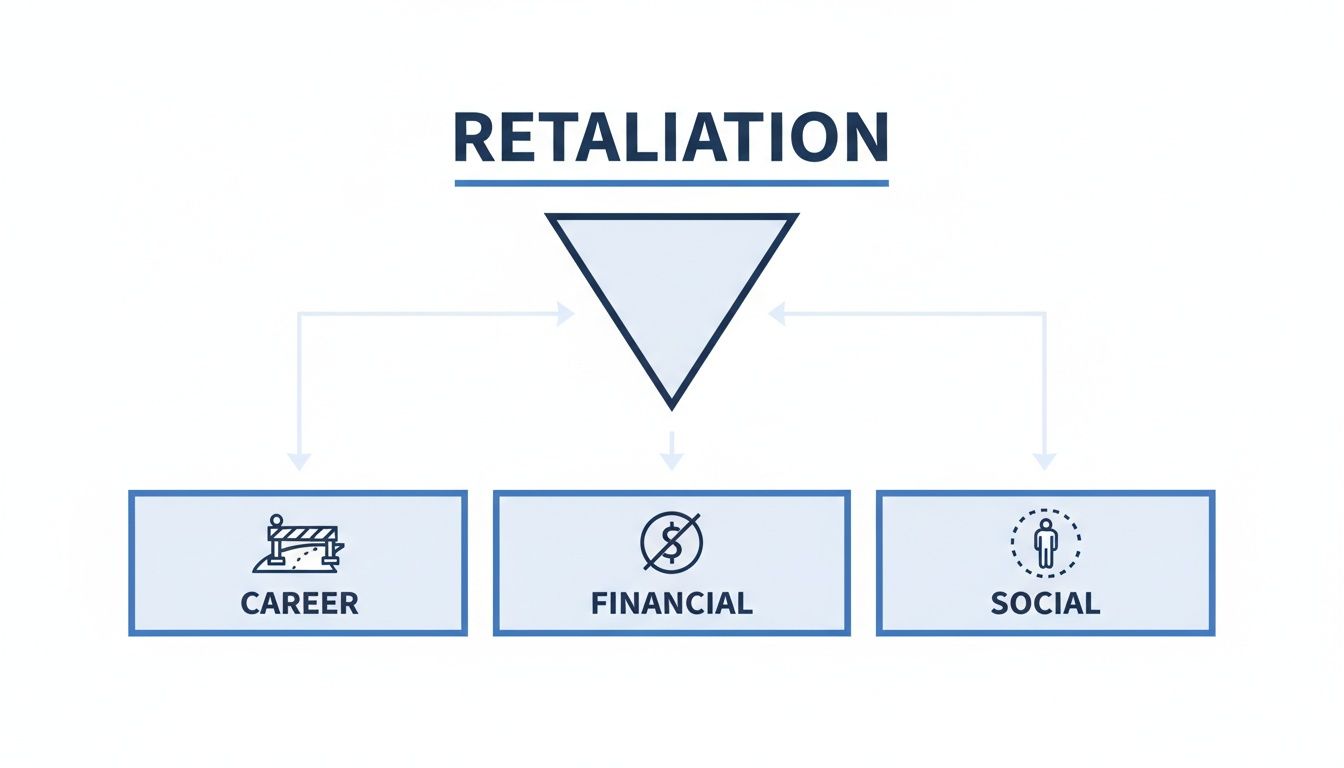
This just goes to show how an employer's illegal actions can quickly spread, affecting nearly every part of an employee's professional and personal life.
Title VII and Other Anti-Discrimination Laws
Sometimes, whistleblower retaliation and illegal discrimination are two sides of the same coin. Federal laws like Title VII of the Civil Rights Act of 1964, the Americans with Disabilities Act (ADA), and the Age Discrimination in Employment Act (ADEA) do more than just outlaw discrimination—they also have powerful anti-retaliation rules baked in.
Under these laws, it's illegal for your employer to punish you for:
- Filing a charge of discrimination with the Equal Employment Opportunity Commission (EEOC)
- Participating in an EEOC investigation, like by being a witness for a coworker
- Complaining internally about harassment or discrimination you experienced or witnessed
This protection is absolutely crucial. It means that even if an investigation doesn't find enough evidence of discrimination, your employer is still legally forbidden from retaliating against you for making the complaint in good faith. The act of speaking up is what’s protected.
Together, these federal laws create a strong, multi-layered defense for Mississippi workers. You are not on an island, and your courage is backed by the full force of the law.
Of course, navigating these complex federal statutes and their strict filing deadlines is a challenge. That's why working with a lawyer who knows this territory is so important. An experienced attorney typically handles these cases on a contingency fee basis, meaning you pay nothing upfront. The average contingency fee is 40-50% of the final settlement or award, a structure that ensures everyone has access to justice, not just those who can afford to pay a lawyer out of their own pocket.
What to Do If You Suspect Retaliation

Realizing you might be the target of retaliation is a deeply unsettling experience. It can feel isolating, and it's easy to second-guess yourself. But this is the moment where clarity and decisive action matter most. You can shift from a position of vulnerability to one of strength by methodically documenting what's happening and understanding your rights. The first, most crucial step is this: document everything.
Think of yourself as the lead investigator on your own case. Every little detail, every offhand comment that seems odd, could become a critical piece of the puzzle down the road. Memories fade, but a written record stands firm.
Create a Detailed Retaliation Log
Start a private journal or a secure document on your personal computer—never, ever use a work device for this. For every single incident that feels retaliatory, create a detailed entry. This log will become your most powerful tool for demonstrating a pattern of illegal behavior.
Each entry needs to capture the essentials:
- Date and Time: Pinpoint exactly when the incident occurred.
- Location: Where did it happen? Your manager’s office? The breakroom? A virtual meeting?
- People Involved: List everyone present, including their full names and job titles.
- What Happened: Describe the event with objective, factual language. If you can remember exact quotes, write them down verbatim.
- Your Reaction: Briefly note how the incident made you feel or what you said or did in response.
For instance, an entry might read: "March 15, 2024, 2:30 PM. In John Smith’s office. John told me, 'Ever since you made that report, you’ve become a real problem for this team.' He then removed me from the Miller account." That kind of specific detail is absolutely invaluable.
Gather and Preserve Key Evidence
Beyond your personal log, you’ll need to legally and discreetly gather tangible evidence to back up your claim. This isn't about sneaking into company systems; it's about preserving documents you already have legitimate access to. Just be careful not to violate any company policies on data privacy or confidentiality in the process.
The goal is to build a clear timeline that connects your protected activity (the whistleblowing) to the adverse actions you experienced. This evidence is what establishes the "causal link" needed to prove your case.
Gather and save personal copies of these types of documents:
- Emails and Messages: Forward any relevant work emails to your personal email account. Take clear screenshots of incriminating text messages or internal chats.
- Performance Reviews: Collect all of your past performance evaluations, especially if they show a history of strong work before you blew the whistle.
- Pay Stubs: Keep your pay records to document any sudden cuts in your hours or salary.
- Company Policies: Find and save a copy of the employee handbook, paying close attention to sections on internal reporting procedures and anti-retaliation policies.
This collection provides a baseline of your performance and how you were treated before you spoke up, making any sudden, negative changes glaringly obvious. If you're wondering what to do next, take a look at our guide on how to file a whistleblower complaint.
Respect Critical Filing Deadlines
One of the harshest realities of retaliation law is the statute of limitations—a strict, non-negotiable deadline for filing a claim. If you miss this window, you could lose your right to seek justice forever, no matter how strong your case might be.
These deadlines vary dramatically depending on the specific law that protects you. For example, some claims filed with an agency like the Occupational Safety and Health Administration (OSHA) must be submitted in as little as 30 days. Others, like certain claims with the Equal Employment Opportunity Commission (EEOC), might allow for 180 or 300 days.
Because these deadlines are so complex and unforgiving, time is of the essence. Simply waiting to see if things "get better" is a huge gamble that could permanently close the door on your legal options. The moment you suspect retaliation, the clock starts ticking.
How to Build a Strong Retaliation Case
It takes more than just a gut feeling to prove you were the victim of whistleblower retaliation. To build a solid case, you need to collect evidence that draws a clear, undeniable line connecting your report to the negative action your employer took against you.
Think of it like building a bridge: each piece of evidence is a crucial support beam. Without enough of them, your claim won’t hold up under pressure.
At the heart of any retaliation case is the legal concept of causation. This simply means you have to prove your employer took action against you because you blew the whistle, not for some other made-up reason. This is almost always the biggest hurdle to clear.
The Smoking Gun vs. Connecting the Dots
Evidence in these cases generally falls into two buckets. The first, direct evidence, is the most powerful but also the hardest to find. It’s the proverbial smoking gun.
Direct evidence is an outright admission that links the retaliation directly to your report. There’s no ambiguity.
- Example: Imagine your supervisor sending an email saying, "Since you reported those safety issues to the main office, we've been told to eliminate your role."
Of course, most employers are smart enough not to leave such an obvious trail. That’s why the vast majority of retaliation cases rely on the second type of evidence.
Circumstantial evidence is more subtle. One piece on its own might not look like much, but when you put several pieces together, they paint a very clear picture for a judge or investigator. The most powerful form of circumstantial evidence is suspicious timing.
If you had a flawless performance record for five years but were suddenly fired for "poor performance" one week after reporting illegal activity, the timing alone raises a huge red flag.
That close timing is critical. While it's not a confession, it makes it incredibly difficult for an employer to convincingly argue the two events are unrelated. The shorter the time between your report and the negative action, the stronger the suggestion of retaliation.
Your Essential Evidence Checklist
A powerful retaliation claim is built on a foundation of solid documentation. An experienced attorney will need to see these records to properly assess your case. You should start gathering personal copies of these items right away—and never use a work computer or company network to do it.
Here’s a checklist of the documents that can make or break your case:
- Proof of Your Strong Work History: Pull together all of your positive performance reviews, awards, and any emails from managers or clients that praise your work.
- Records of the Adverse Action: Keep your termination letter, the email announcing a demotion, or pay stubs that show a sudden and unexplained cut in your hours.
- The Protected Activity: Make sure you have a copy of the email you sent to HR, detailed notes from your call to a compliance hotline, or any other proof of your report.
- Company Policies: Find and save a copy of the employee handbook, paying close attention to the company's anti-retaliation policies and official reporting procedures.
- Witness Information: On a personal device, create a list of colleagues who witnessed what happened or who can speak to your excellent work record before the incident.
Gathering this information helps tell your story. It establishes you as a valued employee who was unfairly targeted only after you had the courage to speak up. Understanding how to prove retaliation at work is all about putting these puzzle pieces together to create a compelling picture. Doing this prep work puts you in the strongest position to protect your rights.
Why You Need an Experienced Mississippi Employment Lawyer

Trying to handle a whistleblower retaliation claim by yourself is a tough road to walk. For Mississippi workers, it’s even tougher because you’re dealing with a complicated maze of federal agencies. When you’re up against your employer and their team of lawyers, the situation can feel downright intimidating.
This is exactly where a seasoned employment attorney steps in to become your most important ally.
A lawyer who lives and breathes these cases acts as your shield, handling all the stressful back-and-forth with your employer. This keeps you from being cornered into saying something that could hurt your case. They also know precisely which federal agency—be it the EEOC or the Department of Labor—needs to receive your complaint and how to file it correctly.
This kind of expert guidance has never been more vital. Whistleblower programs are seeing a flood of new tips, even as fears of retaliation grow. In fiscal year 2024, the SEC got a record-breaking 24,980 tips. The CFTC wasn't far behind, receiving 1,744 tips from people in 64 different countries, a 14% jump from the previous year. You can get more details on these growing trends in whistleblower reports.
Maximizing Your Chances of Success
A good lawyer does so much more than just fill out forms. Their real skill lies in weaving together the facts to tell a compelling story—one that clearly connects your decision to speak up with the negative consequences you faced. A strong case hinges on well-organized evidence; understanding the principles behind document management for law firms shows just how critical this organization is.
Here’s what your attorney will handle:
- Meeting All Deadlines: Federal whistleblower laws have strict, unforgiving deadlines. An attorney makes sure every single one is met, protecting your right to pursue your claim.
- Negotiating on Your Behalf: They bring years of experience to the negotiating table, fighting for a fair settlement that can cover lost pay, emotional distress, and other damages.
- Building a Strategic Case: They dig for evidence, talk to witnesses, and strategize around the defenses your employer is likely to use, all to build the strongest case possible for you.
An employment lawyer levels the playing field. They ensure your voice is heard and your rights are fiercely protected against a company that has far more resources at its disposal. Their expertise turns a frightening legal battle into a clear path toward justice.
No Upfront Costs for Legal Help
One of the first things people worry about is how they’ll afford a lawyer. The good news is that most employment attorneys representing workers in Mississippi work on a contingency fee basis.
What does that mean? You pay absolutely nothing upfront.
The lawyer's fee is simply a percentage of the settlement or award they win for you, usually between 40-50%. If you don’t win, you don’t owe any attorney fees. This approach makes it possible for anyone, regardless of their financial situation, to get top-notch legal help and stand up to illegal retaliation.
Your Whistleblower Questions, Answered
When you stick your neck out to report wrongdoing, a million questions can race through your mind, especially if you start facing backlash. Let's tackle some of the most common concerns we hear from employees in Mississippi who find themselves in this tough spot.
How Long Do I Have to File a Whistleblower Claim?
This is where things get tricky, and time is absolutely not on your side. The deadlines, legally known as statutes of limitations, are incredibly strict and can be surprisingly short.
Depending on the specific federal law that covers your situation, you might have as few as 30 days to file your claim with a federal agency. Other laws might give you a bit more breathing room, like 180 or 300 days. Miss that window, and your right to seek justice is likely gone for good. This is why you can't afford to wait and see if things get better; a conversation with an employment lawyer right away is critical.
What if I Was Mistaken About the Illegal Activity?
Good news here. The law generally protects you as long as you had a "reasonable belief" that what you were reporting was a violation. You don't have to be right in the end.
Think of it this way: the law wants to encourage people to speak up, not punish them for honest mistakes. The focus is on your good-faith belief when you made the report, not on whether an investigation later proves your suspicions were 100% accurate. An attorney can help determine if your belief meets the "reasonable" standard under the law.
Can My Boss Fire Me for Reporting Something Anonymously?
Even though many companies have anonymous hotlines, true anonymity is a myth more often than not. If your employer figures out it was you and takes action against you, you are still protected by whistleblower laws.
The challenge, however, is connecting the dots. It's much harder to prove they retaliated against you for an "anonymous" report. If you go this route, you must start documenting every single change in your work environment, no matter how small, right after you submit your complaint.
The core principle is this: the law protects your act of reporting. The system is designed to shield employees who speak up about potential wrongdoing, and your genuine belief at that moment is what counts.
What Kind of Compensation Could I Get?
Since your case will move through the federal system, the exact remedies available will hinge on which federal law applies and the specific facts of your case.
Generally, a successful whistleblower claim can help you recover:
- Back Pay: All the wages, bonuses, and benefits you lost because of the retaliation.
- Reinstatement: An order forcing the company to give you your job back.
- Compensatory Damages: Money to compensate for the emotional distress or damage to your professional reputation.
- Attorney's Fees: The employer is often required to pay your legal bills.
In particularly egregious cases where the employer's actions were malicious, you might also be awarded punitive damages, which are designed to punish the company. An experienced lawyer can give you a realistic assessment of what you might be able to recover.
If you’ve been punished for doing the right thing, you don't have to navigate this alone. The legal system protecting whistleblowers is a maze, but the right guide can make all the difference. Contact Nick Norris, P.A. for a confidential review of your situation to understand your rights and how to protect them. Visit us online to get started.
This article has been reviewed for legal accuracy by Nick Norris. For employment law matters in Mississippi, consult with an attorney licensed to practice in your state.
Leave a Reply