

How to Prove Retaliation at Work in Mississippi
When you stand up for your rights at work, the law is supposed to have your back. But what happens when your employer punishes you for it? That's the core of a retaliation claim: proving that a negative action you suffered was a direct result of you engaging in a legally protected activity.
Your whole case rests on drawing a clear, undeniable line between your action (like reporting harassment) and their reaction (like a sudden demotion or getting fired).
What Is Workplace Retaliation in Mississippi?

Simply put, workplace retaliation is when an employer punishes an employee for asserting their legal rights. The law encourages people to report illegal behavior, like discrimination or dangerous safety violations, without the fear of losing their job. When a company penalizes you for doing just that, they've crossed the line into retaliation.
And it's not always as obvious as being fired. The punishment can be much more subtle. Maybe you're suddenly left out of important meetings you used to run. Or perhaps you receive a mysteriously bad performance review after years of glowing feedback. It could even be a sudden shift change to the least desirable schedule.
The legal test is whether the employer's action would be enough to discourage a reasonable person from speaking up in the future. If so, it likely counts as retaliation.
The Three Pillars of a Retaliation Claim
From a legal standpoint, every successful retaliation case is built on three core elements. Think of these as the legs of a stool—without all three, your claim can't stand. We have to prove each one to win your case.
| Legal Element | What It Means | Common Examples |
|---|---|---|
| Protected Activity | You took an action shielded by law, like reporting illegal conduct. | Filing an internal complaint about discrimination, participating in a workplace investigation, or requesting a reasonable accommodation. |
| Adverse Action | Your employer took a negative action against you that hurt your employment. | Termination, demotion, a negative performance review, a pay cut, or being moved to a less desirable role or shift. |
| Causal Connection | You must show a direct link between the protected activity and the adverse action. | The punishment happened very soon after your complaint, your boss made comments about your complaint, or you were treated differently than colleagues who didn't complain. |
So, imagine you send an email to HR about a coworker making racist jokes (that’s the protected activity). Just a week later, you’re pulled off a major project you were set to lead (the adverse action). The incredibly close timing between your email and this sudden demotion is powerful evidence that helps establish the causal connection.
Retaliation isn't some minor workplace spat; it's the single most common form of discrimination claim filed in the country. This trend shows a troubling pattern: when employees find the courage to speak out, employers often hit back illegally.
You Are Not Alone in This Fight
If you feel like you're being punished for doing the right thing, please know you are far from alone. This is a massive, widespread problem. In fact, retaliation has become the most dominant form of workplace discrimination in the United States.
A startling statistic from the 2023 ECI Global Business Ethics Survey found that 46% of employees who reported misconduct at work also said they experienced some form of retribution.
The numbers from the federal Equal Employment Opportunity Commission (EEOC) tell the same story. In 2023, retaliation charges made up 46,047 cases, making it the #1 type of discrimination charge filed. For employees here in Mississippi facing this kind of treatment, these national statistics confirm a tough reality: this happens all the time. You can read more about these findings in the Global Business Ethics Survey report on JD Supra.
What Counts as a "Legally Protected Activity"?
Before you can build a retaliation case, you have to prove you did something the law shields you for doing. This is what we call a legally protected activity, and it's the absolute bedrock of your claim. Think of it as the event that started it all—the action you took that the law says your employer can't punish you for.
A lot of people think this has to be some huge, formal action, like filing a federal lawsuit. But that’s not the case. The law is designed to protect people who speak up in good faith about conduct they reasonably believe is illegal.
This protection is surprisingly broad. It covers everything from formal, written complaints to casual conversations. The core idea is that you're either opposing discrimination, taking part in an investigation, or asking for a right you're legally entitled to.
Real-World Examples of Protected Activities
It's critical to know what qualifies. If the action you took isn't legally protected, then what happened afterward—no matter how unfair—might not be illegal retaliation. Let's look at some of the most common things federal laws protect you for doing.
-
Reporting Discrimination or Harassment: This is probably the most common trigger we see. It could be a verbal or written complaint to HR, a manager, or anyone in a supervisory role about conduct you believe is discriminatory based on race, sex, age, disability, religion, or another protected class.
-
Participating in an Investigation: Maybe you didn't file the complaint, but you were a witness in a coworker's harassment investigation. Or maybe you gave information to the Equal Employment Opportunity Commission (EEOC). Your participation is protected. An employer can't punish you for telling the truth.
-
Requesting a Reasonable Accommodation: Simply asking for a change at work because of a disability (like an ergonomic keyboard) or a religious practice (like a schedule adjustment for prayer) is a protected right.
-
Calling Out Unpaid Wages: Did you complain internally that you weren't getting the overtime pay you earned? Or report that your employer was shaving hours off your timecard? Those are protected activities.
-
Taking or Asking for FMLA Leave: The Family and Medical Leave Act (FMLA) provides job-protected leave for serious health and family situations. You can't be penalized for requesting or using it.
And here’s something crucial to remember: you don’t have to be 100% right that your employer’s conduct was illegal. You just need a reasonable, good-faith belief that it was when you reported it.
Don't Underestimate Informal Complaints
One of the biggest misconceptions I see is that an informal complaint doesn't "count." That's flat-out wrong. You don’t need to use fancy legal terms or write a five-page memo to HR for your action to be legally protected.
The law is there to protect employees who have the courage to speak up, not just the ones who know how to file a perfect complaint. A simple, informal "heads up" to your boss can have the exact same legal weight as a formal letter to the CEO.
For instance, telling your manager, "I'm worried that the men on our team are being paid more than Sarah for the same job," is a protected activity. So is sending an email to your supervisor that says, "The jokes John told in yesterday's meeting crossed the line into sexual harassment."
The method doesn't matter nearly as much as the message—you are raising a concern about something that could be illegal. Understanding this is a critical first step when figuring out how to prove retaliation at work, because the clock often starts ticking from the moment of that very first, informal conversation. Establishing this protected activity is the first domino you need to line up for a successful case.
What Counts as an Adverse Action?
When you’re trying to build a retaliation case, it’s easy to think the punishment has to be as dramatic as getting fired. While termination is the clearest example, the law actually casts a much wider net. This is the second piece of the puzzle: proving you suffered what's legally known as an "adverse employment action."
The real question isn't just "Was it bad?" but "Was it bad enough to scare a reasonable person from speaking up in the future?" If the answer is yes, you're likely looking at an adverse action. These actions can be obvious and financially devastating, or they can be subtle, chipping away at your career and well-being.
The Blatant Stuff: Obvious Forms of Retaliation
These are the clear, in-your-face punishments that leave little room for doubt. They hit you directly in the wallet or your job title, making them powerful evidence.
-
Termination: Getting fired is, of course, the ultimate adverse action.
-
Demotion: Suddenly finding yourself in a lower-level role with fewer responsibilities.
-
Pay Cuts or Denied Raises: Your salary is reduced, or a promised (or deserved) raise mysteriously vanishes.
-
Suspension: Being benched, whether you're paid for the time off or not.
Imagine you report a serious safety hazard on a Monday. By Wednesday, you’re suspended for a tiny rule everyone else breaks all the time. That’s not a coincidence; it's a textbook adverse action.
The Sneakier Tactics: Subtle But Still Illegal
This is where employers often get clever. Retaliation can be disguised as a routine management decision, but the intent is the same: to punish you for speaking out. These actions are just as illegal, and spotting them is crucial.
Your boss doesn't have to fire you to be guilty of retaliation. Any action that messes with your career, makes your job miserable, or creates a hostile environment can be illegal. The law cares about the negative impact on you, not the label the company uses.
Think back. Did things at work change right after you raised a concern? Look for patterns like these:
-
Sudden, Awful Performance Reviews: You have a history of stellar reviews, but just weeks after you filed an HR complaint, you get a performance review that seems to come from another planet.
-
Being Sidelined: You're yanked from important projects, meetings you used to run are now happening without you, or you’re mysteriously dropped from key email threads.
-
A "Promotion" to Nowhere: You're "reassigned" to a dead-end role, a terrible shift you can't work, or duties nobody wants.
-
Passed Over for Promotions: That promotion or training opportunity you were a shoo-in for? It just went to a less-qualified coworker, and no one can give you a straight answer why.
These aren't just minor annoyances; they're calculated moves designed to harm your career and make you regret ever speaking up. A good lawyer knows how to connect these seemingly small dots to your original complaint, revealing the full picture of retaliation. To get a more complete understanding, you can learn more about what is an adverse employment action in our detailed guide.
How To Gather and Document Evidence
Winning a retaliation case rarely hinges on a single "smoking gun" email where your boss admits everything. The reality is that these cases are built methodically, piece by piece. You assemble a collection of documents, conversations, and observations that, when put together, tell a clear and undeniable story of cause and effect.
This is where your own diligence becomes your most powerful asset. You have to become the chief archivist of your own career. Every email, text message, performance review, and off-the-cuff comment can become a crucial piece of the puzzle, helping to forge the link between your protected activity and the negative treatment that followed.
This simple visual breaks down the core of an effective documentation strategy.
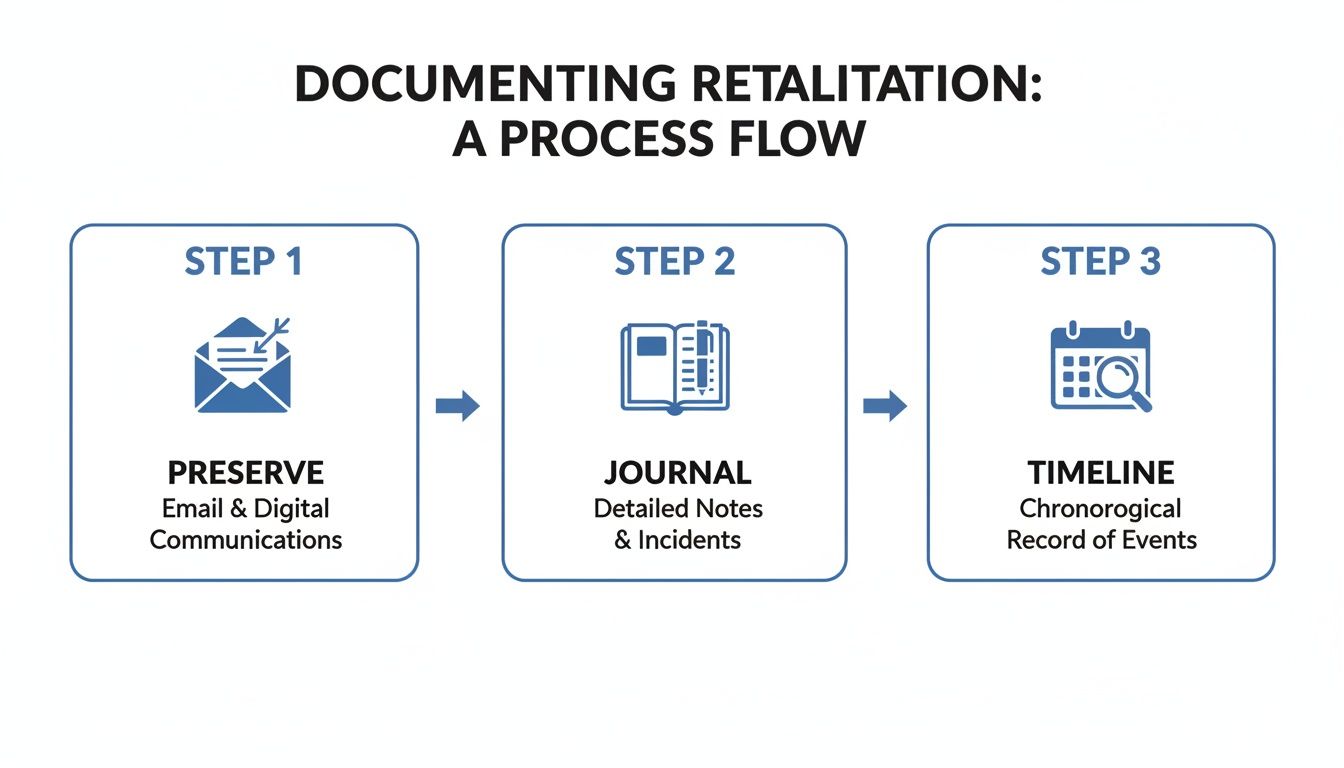
As you can see, a solid case starts with preserving your records, keeping a detailed personal journal of incidents, and then organizing everything into a timeline that connects the dots.
Preserve Your Digital and Paper Trails
First things first: secure any evidence you already have. In today's workplace, emails, text messages, and internal chat logs (like Slack or Teams) are often the most compelling proof. They provide time-stamped, written records that are incredibly difficult for an employer to explain away.
Here’s a critical tip I give every client: discreetly forward important work emails to your personal email account. This creates a backup copy that you control. If you’re suddenly fired and locked out of the company’s systems, you won't lose your proof. Just be mindful of company policy, but securing evidence of your complaint and the interactions that followed is paramount.
Don't forget about physical documents, either. Gather things like:
-
Past Performance Reviews: Get copies of all your reviews, especially the positive ones. A sudden nosedive in your ratings right after you made a complaint is a classic red flag for retaliation.
-
Company Handbooks: The official employee handbook can show that the company violated its own rules in how they treated you.
-
Pay Stubs: These are essential for proving a pay cut, a denied raise, or a sudden reduction in your hours.
Keep a Detailed Personal Journal
Your memory can fail you under stress, but a written record is forever. Start a journal immediately and—this is important—keep it at home, not on your work computer or at your desk. For every incident that feels wrong or out of place, document it with as much precision as possible.
Don't just jot down what happened. Write down everything about what happened. The more specific details you include—dates, times, locations, exact quotes, and the names of anyone present—the more credible and powerful your account becomes.
Your journal entries should capture:
-
The date and time of the interaction.
-
Who was involved and who witnessed it.
-
The exact words that were said, using direct quotes whenever you can.
-
How the event made you feel and how it impacted your ability to do your job.
This journal is what fills the gaps between the official documents. It paints a vivid, day-to-day picture of the hostility or subtle punishment you’re enduring.
The Power of Timing and Witness Statements
The closer the adverse action happens to your protected activity, the stronger the connection looks. A big part of your job is to create a clear, easy-to-follow timeline that connects these dots for an investigator, a judge, or an attorney.
For example, let's say you read up on how to report unsafe working conditions and filed a formal complaint on a Tuesday. If you were then written up on Thursday for being two minutes late for the very first time, that timing is extremely suspicious. Your timeline should highlight these kinds of connections.
Think about coworkers who might have seen the retaliatory behavior or overheard comments from a manager. It’s a tough spot for them, and many are understandably afraid to get involved. However, some colleagues might be willing to provide a statement about what they observed. You can gently and discreetly ask if they would be comfortable sharing what they saw or heard.
Collecting different types of evidence strengthens your claim by providing a more complete picture of what happened.
Types of Evidence to Prove Retaliation
| Type of Evidence | What It Looks Like | How to Collect It |
|---|---|---|
| Direct Evidence | An email or recorded comment like, "You're being demoted because you complained to HR." | Extremely rare. Preserve any written communication (emails, texts) and document verbal statements in your journal immediately. |
| Circumstantial Evidence | Sudden negative performance reviews after a history of positive ones; being excluded from meetings you previously attended. | Gather all past and present performance reviews. Note changes in duties and meeting invites in your journal. |
| Temporal Proximity | Being fired or disciplined very shortly after you engaged in a protected activity (e.g., within days or weeks). | Create a detailed timeline. Note the date of your protected activity and the date of every adverse action that followed. |
| Inconsistent Explanations | Management gives you one reason for a decision (e.g., "budget cuts") but tells others a different story. | Document every conversation and reason given to you. Note if other, non-complaining employees were treated differently. |
| Witness Testimony | A coworker who saw your manager berate you after your complaint or heard them say they were "getting even." | Identify potential witnesses and note what they saw/heard in your journal. An attorney can later help formalize statements. |
This table illustrates that while direct evidence is the strongest, a solid case is most often built on a compelling combination of circumstantial evidence, timing, and witness accounts.
The fear of being punished for speaking up is real and pervasive. A 2023 study by HR Acuity found that while 52% of employees have witnessed misconduct, 46% fear retaliation if they report it. This very paradox is why retaliation laws exist—to protect those who find the courage to speak up. The fact that you overcame that fear is legally significant and can strengthen your claim.
Filing Your Claim with the EEOC in Mississippi

So, you've carefully saved every email, kept a detailed log of events, and laid out a clear timeline. What’s the next move? For workers in Mississippi, the path forward is singular and leads straight to one place: the federal Equal Employment Opportunity Commission (EEOC).
You might be surprised to learn that Mississippi does not have its own state-level agency to handle these types of complaints, like a state human rights commission. This isn't a bad thing; it just simplifies the process by making the EEOC your one and only stop for filing a formal retaliation charge.
The EEOC is the federal agency tasked with enforcing the laws that make workplace discrimination and retaliation illegal. Filing a charge with them is the official first step to getting the government to look into what happened to you.
The Critical 180-Day Filing Deadline
I can't stress this enough: timing is everything. In Mississippi, you have a very strict 180-calendar-day deadline from the date the retaliation happened to file your charge with the EEOC. This isn't a guideline—it's a hard and fast rule. Miss that window, and you unfortunately lose your right to pursue your claim.
This is exactly why documenting the retaliatory act from day one is so crucial. That clock starts ticking the moment the adverse action occurs, whether it’s the day you were fired, demoted, or handed that sudden, bogus performance review. You absolutely must act quickly to protect your rights.
Starting the EEOC Charge Process
Filing a charge is a legally protected activity in itself, meaning your employer can't punish you for doing it. You’ve got a few options for getting the ball rolling:
-
Online: The EEOC's Public Portal is often the easiest way to submit an initial inquiry and get an interview scheduled.
-
By Phone: You can call the EEOC to discuss your situation and start the process.
-
By Mail: Sending a detailed letter to the nearest EEOC office is also an option.
No matter which method you choose, you'll need to provide a clear, written summary of the events. This is where all that organized evidence you gathered becomes your best friend. Your statement should plainly lay out the protected activity, the adverse action you faced, and the dates to connect the two.
Pro Tip: Your initial EEOC charge isn't the place to write a novel. The goal is to provide a clear, factual, and chronological summary that lets an investigator immediately grasp the heart of your retaliation claim.
Once you’ve officially filed, the EEOC will notify your employer, usually within 10 days. From there, the investigation begins. The agency will likely ask your employer for a written response, request documents, and maybe even interview you, your boss, or your coworkers.
Mediation: A Voluntary Alternative
Pretty early on, the EEOC might offer both you and your employer the option of mediation. This is a completely voluntary and confidential meeting where a neutral mediator helps both sides try to find some common ground and reach a settlement.
Mediation can be a much faster and less adversarial way to resolve things than a full-blown investigation. But you're under no obligation to agree to it. If either you or your employer declines, or if you just can't reach an agreement, your case simply moves forward to the formal investigation stage. Deciding whether to mediate is a strategic call, and it’s a decision best made after talking with an employment lawyer who can give you a realistic assessment of your case's strengths and potential value.
Why You Should Speak with an Employment Attorney
Sure, you can file an EEOC charge on your own. But understanding how to prove retaliation at work isn't just about telling your story—it's about building a legal case. This is where an experienced employment attorney becomes your most critical asset.
Think of an attorney as a strategist. They aren't just filling out paperwork; they're analyzing every angle of your situation. They can spot weaknesses you might have missed and identify the key pieces of evidence that will make your case compelling to an investigator. They also handle all the back-and-forth, using precise legal language to frame your arguments and protecting you from the tactics employers often use to get claims dismissed.
How Can You Afford a Lawyer?
This is usually the first question people ask, and it’s a fair one. The fear of legal bills stops too many people from seeking justice. But here’s the reality: you don’t need a penny upfront to hire a top-notch employment lawyer.
Most firms that specialize in this area, including Nick Norris, P.A., work on a contingency fee basis.
It’s a straightforward arrangement: the attorney only gets paid if they successfully recover money for you. Their fee is a percentage of the settlement or court award. If you don't win, you don't owe them anything for their time.
A contingency fee arrangement means your lawyer's success is tied directly to yours. They are fully invested in securing the best possible outcome because their payment depends on it.
In Mississippi, this fee typically falls between 40-50% of the total recovery. This model opens the door for anyone to get expert legal help, removing the financial risk and leveling the playing field.
Don't Underestimate What Your Claim Is Worth
A seasoned attorney brings another crucial skill to the table: negotiation. They know how to calculate the true value of your claim, which goes far beyond just lost paychecks. It includes things like emotional distress, damage to your career, and sometimes even punitive damages.
The financial impact of these cases is significant. Retaliation isn't just a personal injustice; it often results in substantial awards for victims. In the 2023 fiscal year alone, the EEOC recovered over $665 million for more than 22,000 people who faced discrimination and retaliation. You can see more of the numbers in these workplace harassment claims data on Embroker.
An attorney’s job is to ensure any settlement offer truly reflects the harm you’ve endured.
If you believe you have a case, the next move is yours. Get a clear picture of your options by learning how to prepare for your first talk with an employment lawyer. Speaking with a professional is the single most powerful step you can take to protect your rights.
Answering Your Top Questions About Proving Retaliation
When you're facing retaliation, a million questions can run through your mind. Let's tackle some of the most common ones we hear from Mississippi employees who are trying to make sense of their situation.
"My Boss Never Said They Fired Me Because I Complained. How Can I Prove It?"
This is the reality for almost every retaliation case. You absolutely do not need a "smoking gun" confession from your boss. The truth is, that almost never happens.
Instead, we build a powerful case using circumstantial evidence. The most critical piece is often the timing. For instance, if you get slapped with your first-ever disciplinary action just days after reporting harassment, that timing speaks volumes. It creates a strong connection that any judge or jury can understand. An experienced attorney knows exactly how to weave these seemingly small details together to tell the full story.
"The Situation Got So Bad I Had to Quit. Do I Still Have a Case?"
Yes, you very well might. This is a situation we call "constructive discharge," and it’s a powerful legal tool.
It applies when the retaliation makes your work environment so hostile and unbearable that no reasonable person would feel they had no other choice but to resign. Essentially, the law treats your resignation as a firing because your employer's actions forced you out. While it's a high bar to meet—you have to show the conditions were truly intolerable—it's a valid foundation for a retaliation claim.
"What's It Going to Cost Me to Hire an Employment Lawyer?"
This is a huge concern for most people, and the answer is usually a relief: The vast majority of employment lawyers, including our firm, handle these cases on a contingency fee basis.
This means our fee is simply a percentage of the money we recover for you.
In Mississippi, that percentage is typically between 40-50%. If we don't win your case and secure a financial recovery, you don't owe us a dime in attorney's fees. This system levels the playing field, allowing you to get top-tier legal help without worrying about how you'll pay for it.
If you’ve been punished for doing the right thing, you shouldn't have to face the fallout by yourself. The team at Nick Norris, P.A. is here to help Mississippi workers understand their rights and fight for the justice they deserve. Contact us for a confidential evaluation of your case.
This article has been reviewed for legal accuracy by Nick Norris. For employment law matters in Mississippi, consult with an attorney licensed to practice in your state.
Leave a Reply