

How Many Hours Is FMLA Leave in Mississippi
When you're dealing with a serious health issue or a family medical crisis, the last thing you should be worrying about is your job. One of the first questions we hear from Mississippi employees is, "How many hours do I get for FMLA?"
For most people, the answer is 12 workweeks of unpaid, job-protected leave. If you work a standard 40-hour week, that translates to a bank of 480 hours you can use.
Your Quick Answer to FMLA Hours in Mississippi
The Family and Medical Leave Act (FMLA) is a federal law designed to give you a safety net. It lets you take time off for specific family and medical reasons without the fear of being fired.
But before you can tap into that safety net, you have to qualify. The big hurdle for most people is the hours requirement: you must have worked at least 1,250 hours for your employer in the 12 months before your leave begins.
Think of it like this: working those 1,250 hours is what earns you the right to the FMLA benefit. Once you've met that condition, you have 480 hours (for a typical full-time employee) to use when you need it.
FMLA at a Glance Key Hour Requirements
To make this crystal clear, let's break down the two most important numbers you need to know.
| Requirement Type | Required Hours | What It Means for You |
|---|---|---|
| Eligibility Threshold | 1,250 hours | This is the magic number you must have worked in the 12 months leading up to your leave. |
| Leave Entitlement | 480 hours | This is your bank of leave time for a standard 40-hour workweek, giving you 12 weeks of coverage. |
The FMLA has been protecting workers since 1993. That 480-hour figure is a simple calculation based on a standard work schedule: 40 hours per week multiplied by the 12 weeks of leave the law provides. This is the baseline for most full-time employees, as confirmed by guidance from the U.S. Department of Labor.
Getting these two numbers straight—the 1,250 hours to qualify and the 480 hours you get—is the first step. Knowing the rules empowers you, and understanding your employee rights under FMLA is the best way to make sure you get the time you need when it matters most.
The 1,250-Hour Rule: Your First Step to FMLA Qualification
Before you can even think about taking FMLA leave, you have to qualify for it. Think of it as unlocking a benefit—you have to meet a few key conditions first. For many folks here in Mississippi, the biggest hurdle is what’s known as the 1,250-hour rule.
So, what is it? Put simply, you must have worked at least 1,250 hours for your employer during the 12-month period right before you need to take leave. This breaks down to roughly 24 hours per week, but it’s the annual total that really matters.
What Actually Counts Toward Those 1,250 Hours?
This is where people often get tripped up. The law is very specific: only hours you actually worked count. That means any paid time off you took—vacation days, sick leave, paid holidays—doesn't get added to your total. It’s all about the time you were truly on the clock and working.
This quick guide lays out the basic path to eligibility.
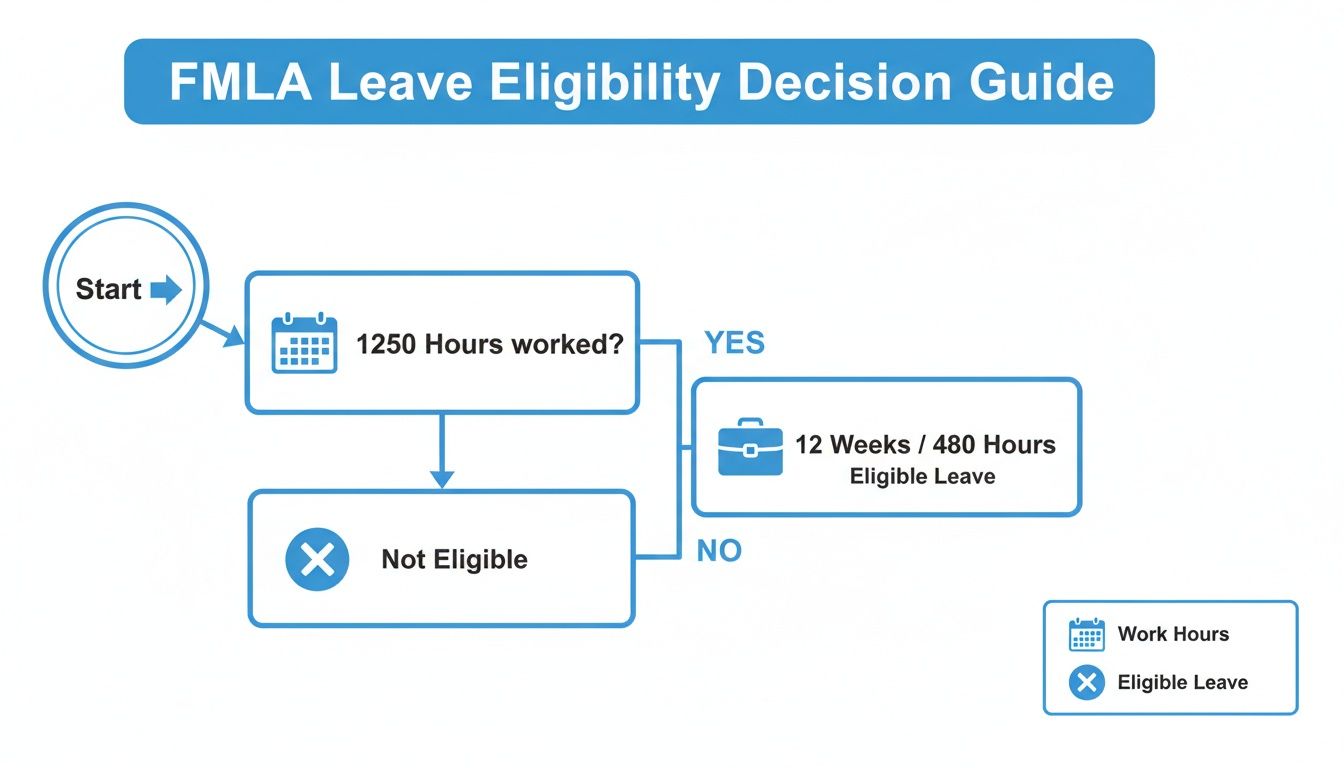
As you can see, hitting that 1,250-hour benchmark is the non-negotiable first step to unlocking your FMLA benefits.
More Than Just Hours: The Other Key Eligibility Rules
Clearing the hours-worked requirement is a big deal, but it’s not the only piece of the puzzle. There are two other rules you have to satisfy, and they are just as important.
- The 12-Month Service Rule: You need to have been with your company for at least 12 months. The good news? Those months don't have to be consecutive. If you worked there for ten months, left for a bit, and then came back for another two, you’ve met the requirement.
- The 50/75 Rule: This one is all about your employer. They must have at least 50 employees working within a 75-mile radius of your specific job site. This can be a real sticking point for employees in the more rural parts of Mississippi, as it often disqualifies people who work at smaller, isolated branch offices.
The eligibility rules for FMLA are surprisingly strict. In fact, Department of Labor data reveals that only about 56% of all U.S. workers are even eligible. In states like Mississippi, that number is likely even lower—estimated around 45-50%—simply because we have more small businesses. If you want to dive deeper, this detailed FMLA leave guide from the DOL is a great resource.
Key Takeaway: Getting FMLA isn't a given. You have to check three specific boxes: your time on the clock (1,250 hours), your time with the company (12 months), and your employer’s size (50 employees within 75 miles). Miss just one, and you won't qualify for this job-protected leave.
Calculating Your True FMLA Hour Bank
When people hear “12 weeks of FMLA,” most immediately jump to the number 480 hours. That’s a simple calculation: 40 hours a week times 12 weeks. But that number is just a starting point, and for many workers, it's just plain wrong.
The truth is, your FMLA leave isn't a fixed block of 480 hours. It's 12 workweeks of leave, and what constitutes your workweek is the key. If you regularly pull overtime, your FMLA hour bank is bigger than you think. This is a critical detail, especially for folks in Mississippi's manufacturing plants or healthcare facilities where 50-hour weeks can be the norm.

How Overtime Boosts Your FMLA Leave
The math here is refreshingly simple. Just figure out the average number of hours you work each week and multiply that by 12. That's it. That’s your personal FMLA hour bank.
So, if you consistently work a 45-hour week, you aren't entitled to 480 hours of leave; you’re entitled to 540 hours. If you work 50 hours a week, that number jumps to 600 hours.
This isn't some loophole; it's baked right into the federal regulations. The Department of Labor is clear that FMLA leave must reflect an employee's actual schedule. This ensures that someone working significant overtime gets the same proportional time off as a standard 40-hour employee. You can read more about how the DOL handles these calculations to see the official guidance for yourself.
This is also why accurate timekeeping is so important. Every minute of your logged time contributes to both your eligibility and the total leave you can take. If you want to get into the weeds, you can learn more about how time clock rounding rules can affect your pay and leave.
Comparing Different Work Schedules
Let’s put some real numbers to this to see how it plays out. The following table shows how an employee's average weekly hours directly impact their total FMLA leave entitlement over a 12-week period.
How Your Workweek Affects Your Total FMLA Hours
| Average Weekly Hours Worked | Total FMLA Hours (Weekly Hours x 12) |
|---|---|
| 25 Hours (Part-Time) | 300 Hours |
| 40 Hours (Standard Full-Time) | 480 Hours |
| 45 Hours (Regular Overtime) | 540 Hours |
| 50 Hours (Significant Overtime) | 600 Hours |
As you can see, your work schedule makes a huge difference.
Your Bottom Line: Don't sell yourself short by defaulting to the 480-hour assumption. Take a hard look at your average weekly hours—including all mandatory overtime—and multiply that number by 12. That final figure is your actual, legally protected FMLA hour bank. Knowing this number gives you the confidence to ask for, and receive, the full amount of job-protected leave you’ve earned.
How to Use Your FMLA Hours Flexibly
One of the best things about the FMLA is its flexibility. You’re not forced to take all your leave in one solid block. The law gives you two powerful ways to handle health or family care needs without giving up your job: intermittent leave and a reduced leave schedule.
This isn't just legal jargon; it’s designed for real life. Maybe you need to leave work every Tuesday afternoon for a family member's ongoing physical therapy. Or perhaps you're recovering from a procedure and can only manage six-hour days instead of your usual eight for a few weeks. Both of these situations are exactly what flexible FMLA is for.
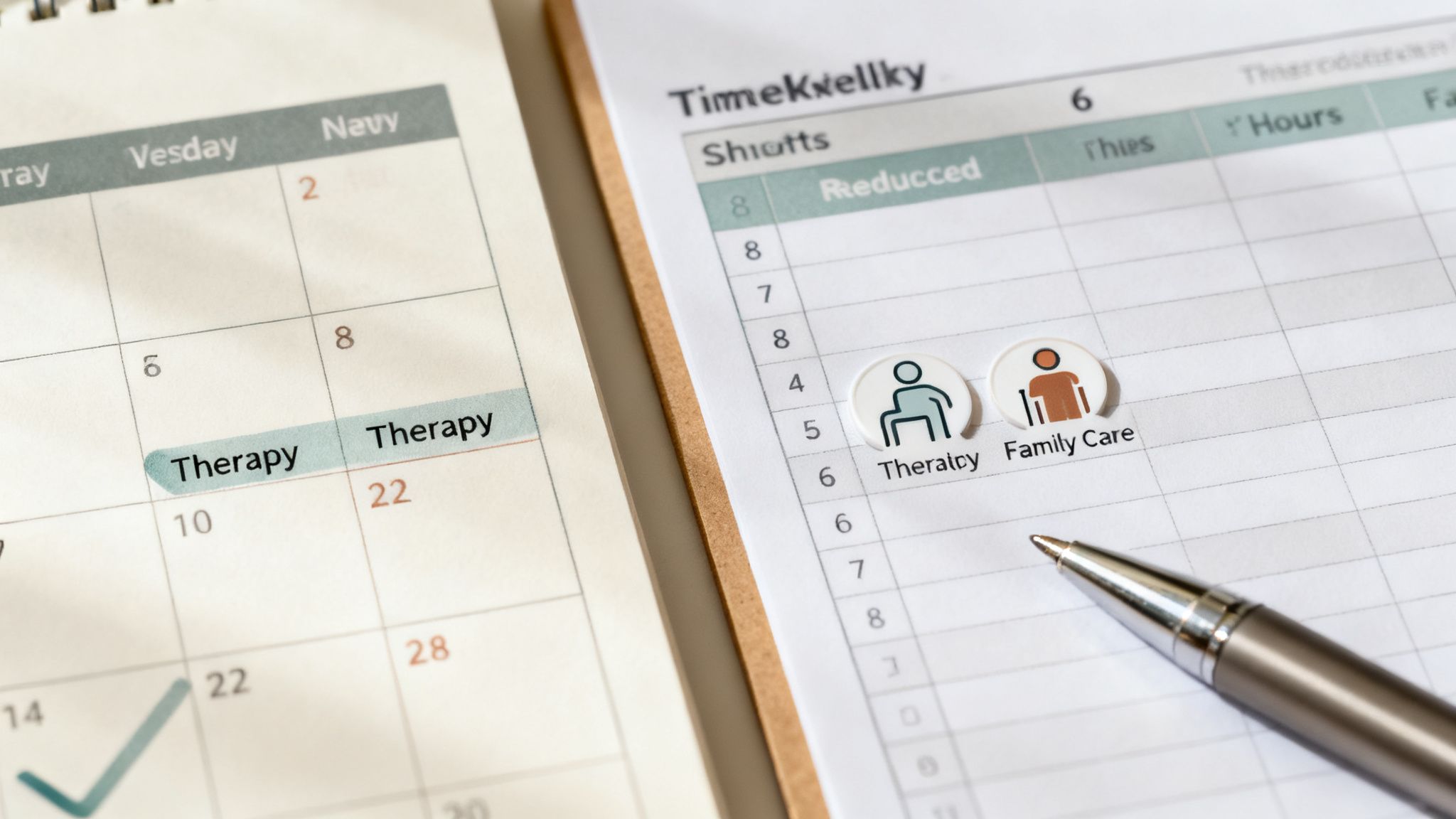
How Employers Must Track Flexible FMLA Time
When you start using FMLA in smaller pieces, your employer can't just round up and charge you for a full or half day. They are legally required to track your time using the smallest increment their payroll system allows for any other type of leave. For many companies, that could be as specific as 15-minute chunks, or even down to the minute.
So, if you duck out 45 minutes early for a doctor's visit, your employer can only subtract those 45 minutes from your total FMLA hours. They can't legally dock you for two hours of leave when you were only gone for one.
It goes without saying that accurate absence tracking is crucial for compliance for both you and your employer. This detailed tracking protects your valuable leave time, making sure every minute is counted correctly.
Securing Your Need for a Flexible Schedule
To get approval for intermittent leave or a reduced schedule, you have to show it’s medically necessary. The key is providing a solid medical certification from a healthcare provider.
This document needs to explain why this type of schedule is required. For instance, it might explain that your condition has unpredictable flare-ups that prevent you from working, or that your mother needs someone to drive her to medical treatments twice a week.
Important Note: You need to give your employer enough information to understand the timing and frequency of your leave. A vague request without a doctor's explanation will almost certainly lead to questions, delays, or even a dispute with HR.
Clear communication and proper paperwork are your best friends here. By being proactive and providing the right documentation upfront, you create a clear record, prevent misunderstandings, and ensure you can use your FMLA hours exactly when and how you need them.
What to Do If Your FMLA Request Is Denied
It’s a gut-punch, no doubt. You’re already dealing with a serious health issue—your own or a family member’s—and then the letter arrives: FMLA request denied. It’s easy to feel overwhelmed and confused, but a denial isn't always the end of the road.
The first thing to do is take a breath and figure out exactly why it was turned down. Your employer can't just say "no"; they are legally required to give you a specific reason in writing.
Often, the problem is a simple clerical error or a piece of missing information. Did you forget to sign a form? Did your doctor's office leave a field blank on the medical certification? Or maybe they're claiming you haven't worked the required 1,250 hours. The denial letter is your starting point.
Taking Action After a Denial
Once you pinpoint the reason, your next step is to talk to HR. It’s crucial to approach this conversation professionally and collaboratively—think of it as solving a puzzle together, not starting a fight.
Here’s a game plan that usually works best:
Gather Your Documents: Before you do anything else, get your evidence in order. Pull together your pay stubs (to prove your hours), a copy of the medical certification you sent in, and the denial letter itself. Having everything organized shows you’re serious and prepared.
Request a Meeting: Ask for a sit-down with someone in HR to go over the denial. Frame your request as simply wanting to understand the problem so you can fix it. Something like, "I'd like to make sure I provide any missing information to get this corrected."
Create a Written Record: After you talk, send a brief follow-up email. Just summarize what you discussed and what the next steps are. This creates a simple paper trail, proving you've made a good-faith effort to resolve the situation.
It can also be helpful to understand what a standard leave request looks like from the employer's side. Taking a look at a typical employee time off request form can give you a better sense of the details they need, helping you make sure your resubmission is rock-solid.
Recognizing Unlawful Interference
Unfortunately, sometimes a denial isn't just an administrative hiccup. It can be a sign of something more serious, like illegal FMLA interference or retaliation. This happens when a manager or company actively tries to stop you from taking the leave you're entitled to.
Key Insight: FMLA interference isn't just about a flat-out denial. It can be more subtle, like your manager "losing" your paperwork, constantly delaying the approval process, or making comments that discourage you from applying in the first place.
If you’re in Mississippi and suspect your rights have been violated, the process is a bit different than in other states. Mississippi does not have a state-level human rights commission, so you can't file a complaint there. Instead, you must file your complaint directly with the federal Equal Employment Opportunity Commission (EEOC), which is the agency that enforces FMLA protections nationwide.
When You Should Call a Mississippi Employment Lawyer
Most of the time, FMLA issues can be cleared up with a straightforward conversation with HR. But sometimes, what seems like a simple "mistake" from your employer feels more like a calculated move to deny your rights.
When that happens, knowing when to bring in a legal professional is the key to protecting your job.
Red Flags That Justify Legal Action
There’s a big difference between an honest misunderstanding and a deliberate FMLA violation. If you find yourself in any of the situations below, it’s a strong signal that you need to speak with an employment lawyer to understand your options.
Keep an eye out for these serious red flags:
- Refusal to Provide Forms: You ask for FMLA paperwork, but your employer ignores you, stalls, or flat-out tells you not to bother applying.
- Demotion or Pay Cut: You come back from your leave only to find you've been shifted to a lesser role, your responsibilities have been stripped, or your paycheck is smaller.
- Termination After Leave: You're fired shortly after requesting or returning from FMLA leave, and the reason your employer gives feels weak, vague, or completely fabricated.
- Discouragement or Interference: Your boss or manager makes comments designed to scare you out of taking leave, hinting at negative consequences for your career if you do.
What an Employment Lawyer Does for You
Think of an employment lawyer as someone who levels the playing field. Their first step is to sit down with you and review the facts of your case to determine if you have a legitimate claim. If you do, they can take over all the communications with your employer, making sure your rights are asserted firmly and professionally.
If your employer refuses to cooperate, your attorney can escalate the matter by filing a formal complaint. In Mississippi, this means going to the Equal Employment Opportunity Commission (EEOC), since Mississippi does not have a human rights commission of its own to handle these types of claims.
A huge worry for many people is the cost. The good news is that most employment lawyers take FMLA cases on a contingency fee basis. This means you don’t pay any attorney fees upfront. They only get paid if they win your case and recover money for you, typically a percentage of the final amount. The average contingency fee is around 40-50% of the recovery.
This arrangement removes the financial risk, so you can pursue justice without the stress of upfront legal bills. To get the most out of that initial consultation, it's a great idea to read up on how to prepare for your first talk with an employment lawyer.
Your FMLA Questions Answered: A Mississippi Guide
Once you understand the basics of FMLA, the real-world questions start to pop up. How do holidays affect your leave? What about that vacation time you've saved up? Let's walk through some of the most common scenarios Mississippi employees face.
Can My Boss Force Me to Use My Vacation Time During FMLA?
Yes, they absolutely can. It's a very common policy for employers to require you to use your accrued paid time off—like vacation days or sick leave—concurrently with your FMLA leave.
Think of it this way: FMLA guarantees your job is safe, but it doesn't guarantee a paycheck. By making you use your PTO, your employer ensures you're still getting paid for at least part of your time off. While it stings to see your vacation balance go down, the upside is that it helps keep income flowing. The main rule here is that your employer has to apply this policy consistently to everyone.
How Do Holidays Affect My FMLA Time?
This one trips a lot of people up, and the answer depends on how you're taking your leave.
If you take a full week off for FMLA and a company holiday like the Fourth of July falls within that week, the entire week still counts as one week of FMLA.
But what if you're using intermittent FMLA? Let's say you're working a reduced schedule of Monday, Wednesday, and Friday. If a holiday falls on a Tuesday—a day you weren't scheduled to work anyway—your employer can't count that day against your FMLA time. It only counts if you were actually scheduled to work.
The Bottom Line: Your FMLA clock is tied to your current employer. If you switch jobs, you have to start over and meet the 12-month and 1,250-hour requirements all over again with the new company.
What if I Get a New Job or Work for Two Different Companies?
FMLA eligibility isn't something you can carry with you from one job to the next. When you start with a new employer, the clock resets completely. You'll need to work for that new company for at least 12 months and rack up another 1,250 hours before you can qualify for FMLA with them.
Now, if you work two part-time jobs and happen to qualify for FMLA at both, you get two separate leave entitlements. Taking your 12 weeks of leave from Job A has zero effect on your available 12 weeks at Job B. Each bucket of leave is completely independent.
If you feel like your employer isn't following these rules or your FMLA rights have been violated, you don't have to figure it out alone. At Nick Norris, P.A., we specialize in helping Mississippi workers navigate these complex situations. Visit us online at https://www.nicknorris.law to see how we can help protect your job and stand up for your rights.
This article has been reviewed for legal accuracy by Nick Norris. For employment law matters in Mississippi, consult with an attorney licensed to practice in your state.
Leave a Reply