

How to Calculate Back Pay for Unpaid Wages
If you've put in the hours but your paycheck doesn't reflect it, you're likely owed back pay. Simply put, it's the money an employer owes you for work you've already done. Figuring out how to calculate back pay is a matter of adding up all the wages, overtime, and other compensation that you were shorted.
Understanding Your Right to Back Pay in Mississippi

It’s a gut-wrenching feeling to see your paycheck and realize it’s wrong. The financial stress can be immediate and overwhelming. Whether it's a simple accounting mistake or a serious legal violation, you have a right to every single dollar you earned.
Here in Mississippi, most wage disputes fall under federal law—specifically, the Fair Labor Standards Act (FLSA). This guide will walk you through the most common situations we see and cut through the legal jargon. My goal is to give you the clarity and confidence to go after the wages you are rightfully owed.
Common Scenarios Leading to Back Pay
A back pay claim isn't always about a completely missing paycheck. It can pop up in a number of ways where an employer just doesn't compensate you correctly. Recognizing these situations is the first real step in knowing if you have a case.
From my experience, here are some of the most frequent reasons for back pay claims:
- Unpaid Overtime: This is a big one. It happens when your employer pays your regular rate for hours over 40 in a week instead of the legally required time-and-a-half.
- Minimum Wage Violations: Your hourly pay dips below the federal minimum wage, which currently stands at $7.25 per hour.
- Missed Commissions or Bonuses: You hit your numbers and earned a commission or bonus, but the company fails to pay it out, which often happens right after an employee leaves.
- Wrongful Termination: If you were fired illegally, you could be entitled to the wages you would have earned from the day you were terminated until your case is settled.
Back Pay vs. Retroactive Pay: What’s the Difference?
People often mix up "back pay" and "retroactive pay," but they solve two very different problems.
Think of it this way: back pay fixes a situation where you weren't paid at all for work you did. Retroactive pay, on the other hand, fixes a situation where you were paid, but at the wrong rate.
For example, let's say your promotion and raise were effective on May 1st, but HR didn't process the paperwork until your June paycheck. The extra money you get to "catch up" for May's lower pay rate is retroactive pay. It's making you whole after the fact.
Back pay is for wages that were flat-out withheld, often in violation of a contract or law. This is a critical distinction because back pay claims can sometimes include extra "liquidated damages" as a penalty against the employer.
Because Mississippi has no state-level labor department to handle these issues, most employees need to pursue their claims in federal court. You can find more details on this process by reading about unpaid wages lawsuits in our related article. We'll get into the nitty-gritty of the calculations next.
Calculating Unpaid Overtime for Hourly Workers

Unpaid overtime is, without a doubt, one of the most common ways hourly workers in Mississippi get shorted on their paychecks. The rule under the Fair Labor Standards Act (FLSA) is crystal clear: for every hour you work over 40 in a single workweek, you must be paid at a rate of 1.5 times your regular hourly wage.
It's a simple rule, but employers sometimes fail to follow it, whether by an honest mistake or by design. When that happens, it leaves you with the tough job of figuring out exactly how much money you're owed.
The Basic Formula for Overtime Back Pay
Calculating the overtime pay you're missing isn't as intimidating as it might sound. At its core, the math is pretty straightforward and breaks down into three key parts.
This is the basic formula I walk my clients through:
- Find Your Overtime Rate: Your Regular Hourly Rate x 1.5
- Figure Out the Shortage Per Hour: The Overtime Rate – Your Regular Hourly Rate
- Calculate Total Back Pay: The Shortage Per Hour x Total Unpaid Overtime Hours
This method pinpoints the extra half-time premium you were denied for every single hour of overtime you worked. Let's run through a quick example to see it in action.
A Real-World Example in Jackson
Let's say you're a construction worker in Jackson, Mississippi, making $20 an hour. For three months straight (we'll call it 13 weeks), you worked 50 hours every single week. The problem? Your employer paid you the flat $20 rate for all 50 hours, completely ignoring the time-and-a-half requirement.
You know you’re owed something, but how much? Let's break it down.
First, find your correct overtime rate:
Your regular rate is $20. Your time-and-a-half rate should have been:
$20 x 1.5 = $30 per hourNext, calculate the hourly shortage:
You were paid $20, but you should have gotten $30. The difference is simple:
$30 – $20 = $10 per hour
That $10 is the unpaid premium for each overtime hour.Then, add up your total unpaid overtime hours:
You worked 10 overtime hours each week (50 total hours – 40 regular hours). Over 13 weeks, that comes to:
10 hours/week x 13 weeks = 130 overtime hoursFinally, calculate your total back pay:
Now, just multiply the shortage by the hours:
$10 shortage per hour x 130 hours = $1,300
In this scenario, your employer owes you $1,300 in unpaid overtime. When you're dealing with months or years of records, keeping track of these figures is critical. For complex cases, leveraging advanced spreadsheet capabilities, including Excel AI tools, can really help organize the data and ensure accuracy.
Common Employer Tactics to Watch For
Sometimes, unpaid overtime isn't just a payroll error. I've seen employers use specific tactics to intentionally avoid paying workers what the law requires.
Key Takeaway: The single most crucial part of any back pay claim is solid documentation. Pay stubs, personal time logs, emails, and even text messages can all serve as powerful evidence to prove the hours you actually worked.
Be on the lookout for these common red flags:
- Misclassification: An employer labels you an "independent contractor" to dodge overtime rules, even though they control your schedule and how you do your work.
- "Off-the-Clock" Work: You're told to prep your workspace before clocking in or clean up after clocking out. This is illegal—all time spent working must be paid.
- Ignoring All Work Time: Failing to pay for short breaks (under 20 minutes), required travel time between job sites, or mandatory training.
If any of these situations sound familiar, you may have a stronger case for back pay than you think. Our guide on how to calculate overtime pay dives deeper into this topic with more examples and information.
Figuring Out Back Pay for Salaried Employees
It's a common misconception that back pay issues only affect hourly workers. In reality, salaried employees across Mississippi find themselves shortchanged for a number of reasons, from retroactive pay raises that never materialize to illegal deductions nipping away at their paychecks.
Unlike tallying up missed overtime hours, calculating what you're owed as a salaried employee is a bit different. It’s all about breaking down your annual salary to a per-pay-period figure and comparing what you should have earned with what you actually took home. This is the only way to get a clear picture of the shortfall.
From Annual Salary to Paycheck Earnings
The first thing you have to do is figure out your gross pay for a single pay period. This just means knowing your annual salary and how often you get paid.
The math is straightforward. If you're paid semi-monthly, you get 24 paychecks a year. If you're paid bi-weekly, it's 26. You simply divide your total annual salary by the number of pay periods.
For instance, an employee earning $80,000 a year on a semi-monthly schedule should see $3,333.33 ($80,000 ÷ 24) on each paycheck before taxes. If you want a deeper dive into how businesses handle these kinds of payroll details, there's some great information on back pay calculations at FreshBooks.com.
A Real-World Example in Gulfport
Let's put this into a practical scenario. Imagine you’re a manager for a logistics company in Gulfport, and your salary is $60,000 a year. You get paid semi-monthly, so that’s 24 paychecks.
On March 1st, you get a promotion, and your boss promises a raise to $66,000 annually, effective immediately. Great news! But then March and April go by, and your paychecks are still based on your old salary. That’s a payroll mistake that’s left you underpaid for two full months, or four pay periods.
Here's how you’d break down what you're owed:
Old Paycheck Amount:
$60,000 / 24 pay periods = $2,500 per checkNew Paycheck Amount:
$66,000 / 24 pay periods = $2,750 per checkThe Shortfall:
$2,750 (new rate) – $2,500 (old rate) = $250 per checkTotal Back Pay Due:
$250 shortage x 4 pay periods = $1,000
In this situation, your employer owes you $1,000 in back wages to correct the error and make you whole.
Other Problems That Affect Salaried Pay
Retroactive raises aren't the only reason you might be owed money. There are a few other common, and sometimes less obvious, issues that salaried employees run into.
Pay very close attention to any deductions from your salary. In most cases, an employer can't legally dock a salaried employee's pay for things like cash shortages, broken equipment, or even missing a few hours of a workday. These deductions are often illegal and can add up fast.
Keep an eye out for these red flags, too:
- Misclassification as Exempt: This is a big one. An employer might call you "salaried exempt" to dodge paying overtime, even if your job duties don't actually qualify for that status. We cover this in detail in our guide to overtime laws for salaried employees.
- Withheld Final Paycheck: When you leave a job, your employer is legally required to give you your final paycheck. Sometimes, they wrongfully hold it back.
- Breach of Contract: If your employment contract outlines a specific salary or bonus that your employer isn't paying, you have a claim for the unpaid amount.
Calculating Lost Wages in Wrongful Termination Cases
When an employer fires you for an illegal reason—like retaliation for whistleblowing or discrimination based on your race or gender—the term "back pay" takes on a whole new weight. This isn't about fixing a simple payroll mistake anymore. It’s about making you whole for the wages you lost because you were unlawfully terminated.
The clock on back pay starts ticking the day you were fired and doesn't stop until your case is settled or a judge makes a final decision. The goal is to account for every single dollar you would have brought home if you had never been let go. And it goes far beyond just your basic salary.
What to Include in Your Calculation
To get a truly accurate picture of your losses, you have to think bigger than your hourly wage or bi-weekly paycheck. The real question is: what would your complete financial situation look like if the termination never happened?
That means you need to factor in all the compensation you've lost, including:
- Lost Wages: The salary or hourly pay you would have earned.
- Lost Bonuses and Commissions: Any performance-based income you were on track to receive.
- Lost Benefits: The value of things like health insurance premiums your employer paid, 401(k) matching funds, or accrued vacation time.
- Raises and Promotions: If you had a clear track record and were on the path to a raise or promotion, that expected increase in pay can be part of the calculation.
This isn't just simple arithmetic; these cases often demand a sophisticated financial analysis. Experts look at factors like work-life expectancy and interest rates to determine the present-day value of everything you lost, from wages to pension contributions. You can get a sense of the economic methodology involved by reviewing this detailed analysis on SSRN.
The infographic below shows a simplified version of this process, focusing on a common component: figuring out back pay after a missed raise.
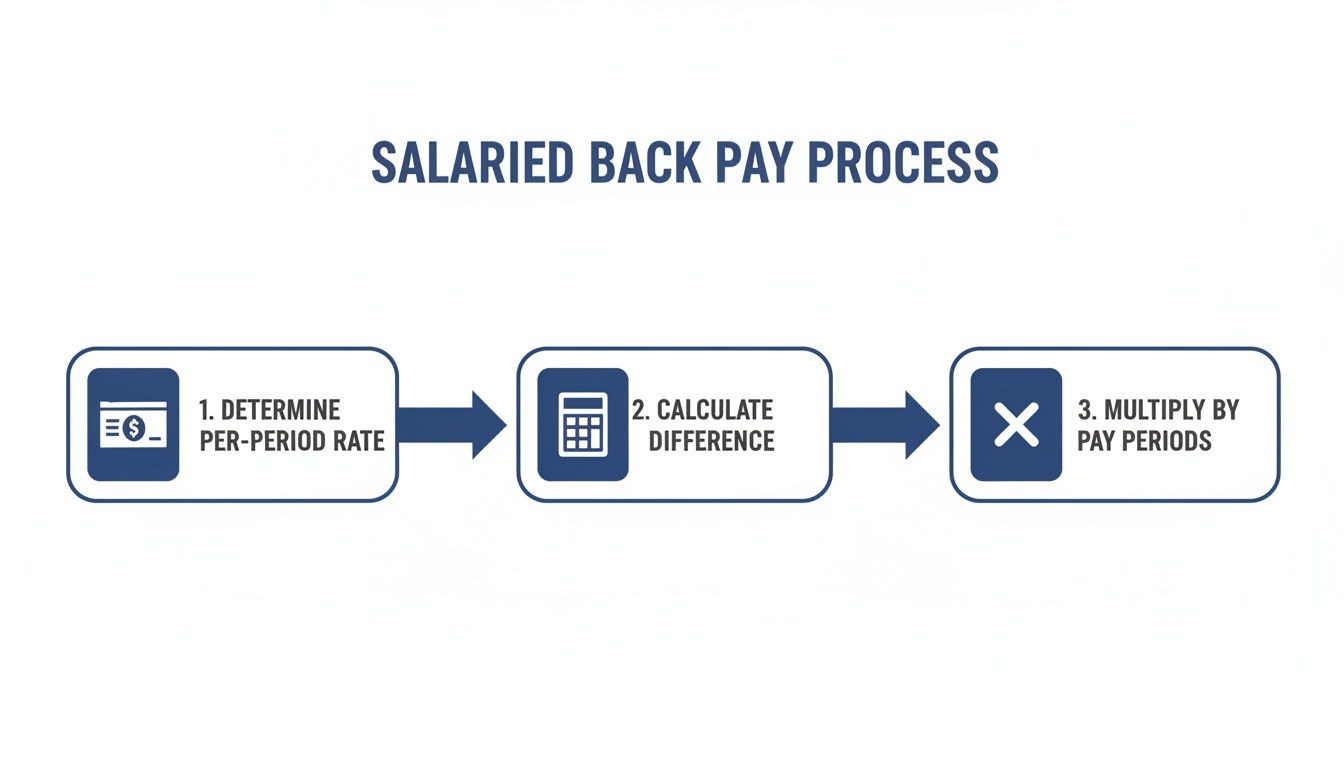
As you can see, the basic idea is to find your earnings per pay period, figure out the difference between your old pay rate and what it should have been, and then multiply that difference by the number of pay periods you were underpaid.
The Duty to Mitigate Your Damages
Now, here’s a crucial concept you absolutely must understand: the mitigation of damages. Legally, you have a responsibility to try and lessen your financial losses. You can’t just sit at home and let the lost wages pile up while you wait for a settlement check.
You are expected to make a reasonable and good-faith effort to find a comparable new job. This is one of the most important things to do after a wrongful termination, not just for your finances but for your legal case as well.
This legal duty directly affects how much back pay you can recover. Any money you earn from a new job during the back pay period is subtracted from the total your former employer owes.
Let's say you would have earned $50,000 at your old job during the back pay period. If you went out, found a new job, and earned $30,000 in that same timeframe, your back pay claim for lost wages drops to $20,000.
Navigating the Legal Complexities
Wrongful termination claims are tough, and calculating your damages is just one piece of a very complicated puzzle. The situation is even more challenging here because Mississippi does not have a human rights commission or a similar agency to handle these claims. That means your only real option is to file a lawsuit in federal court.
Navigating federal litigation comes with strict procedures and unforgiving deadlines. An experienced employment lawyer can be your guide, helping you accurately value your total losses, manage the demands of a federal case, and build the strongest argument on your behalf.
Most attorneys in this field work on a contingency fee basis, which means you don't pay anything unless you win your case. This fee typically averages around 40-50% of whatever amount you recover.
Looking Beyond Back Pay: Other Damages and Financial Losses

When you're fighting for unpaid wages, it's easy to focus only on the missing hours or unpaid overtime. But that's just the starting point. The law, particularly the Fair Labor Standards Act (FLSA), recognizes that being shorted on your paycheck causes a ripple effect of financial harm.
That's why a proper back pay calculation has to include all the other financial damages you've suffered. These additional amounts aren't just a bonus—they are a critical part of making you whole again.
The Power of "Liquidated Damages"
One of the most important concepts in federal wage claims is liquidated damages. It sounds complex, but the idea is simple: it’s a penalty against the employer for failing to pay you correctly and on time.
Under the FLSA, liquidated damages are typically equal to the total amount of back pay you’re owed.
This means you could be entitled to double your unpaid wages. For instance, if you prove you're owed $5,000 in unpaid overtime, the court can award you an additional $5,000 in liquidated damages, for a total award of $10,000.
Why does the law do this? Because it presumes that when you aren't paid on time, you suffer other financial hardships—like late fees on bills or the inability to invest—that are tough to pin an exact dollar amount on. Liquidated damages are there to compensate you for that harm without forcing you to prove every single penny of related loss.
An employer can only get out of paying these damages if they can convince a court they acted in "good faith" and had a solid, reasonable reason to believe they weren't breaking the law. That's a very high bar to clear. Simply not knowing the law isn't a valid excuse.
What About Interest and Other Penalties?
You might also be entitled to interest on your unpaid wages, often called prejudgment interest. This is meant to compensate you for the time you didn't have access to your own money. After all, your employer had use of it, and you didn't.
It's important to know that under the FLSA, you generally can’t get both liquidated damages and prejudgment interest. An experienced employment attorney can advise you on which route makes the most sense for your situation and could lead to the best recovery.
Don't Forget Lost Benefits and Perks
Your paycheck is only one piece of your total compensation. Many jobs offer valuable benefits that have a real monetary value, and if you were wrongfully terminated or denied hours, you lost out on those, too.
When calculating your total losses, you have to factor in the value of everything you were denied, including:
- Health Insurance Contributions: If your employer paid for part of your health insurance premiums, you should claim the value of those missed payments.
- 401(k) or Retirement Matching: Did you miss out on your employer's 401(k) match? Those funds are part of your damages.
- Unpaid Commissions or Bonuses: Any performance-based pay you earned but never received must be included.
- Lost Vacation or PTO: If you would have accrued paid time off, the value of those lost days should be part of your calculation.
These "fringe benefits" can add up to a significant amount of money. Overlooking them is like leaving part of your rightful earnings on the table.
Your Essential Documentation Checklist
Building a strong, accurate claim all comes down to the evidence. Your job is to create a paper trail that clearly shows what you're owed. The sooner you start gathering these documents, the better.
Having a solid set of records is the foundation of a successful claim. This table breaks down what you'll need to pull together.
Documentation Checklist for a Complete Back Pay Claim
| Document Type | Why It's Important |
|---|---|
| Pay Stubs | Shows your official pay rate, hours, and deductions. This is the starting point for proving what you were actually paid. |
| Personal Time Logs | Your own notes on start/end times and breaks can be crucial, especially if employer records are inaccurate or missing. |
| Employment Contract/Offer Letter | Outlines your agreed-upon salary, commission plan, bonuses, and other compensation terms. |
| Employee Handbook | Details company policies on pay, overtime, benefits accrual, and paid time off. |
| Emails, Texts, or Memos | Any written communication about your hours, pay rates, or job duties can serve as powerful evidence of what was promised or required. |
| Benefits Statements | Provides proof of employer contributions to things like your health insurance or 401(k) plan. |
Keeping these documents organized from the start will make the entire process of calculating your full back pay and damages much more accurate and straightforward.
Why You Might Need a Mississippi Employment Lawyer
Trying to calculate back pay on your own can feel overwhelming. While the formulas are a great starting point, the real challenge comes when you apply them to your specific situation. That's where an experienced employment lawyer becomes invaluable—they don't just run the numbers, they build a solid legal strategy around them.
A good attorney will dig into the details to identify every penny you're owed, from missed overtime to the potential for liquidated damages. More importantly, they make sure you don't miss critical deadlines, like the statute of limitations. If you miss that window to file a claim, you could lose your right to recover any money at all.
The Unique Challenge in Mississippi
This is especially true for workers here in Mississippi. A lot of people are surprised to learn that Mississippi does not have a state-level human rights commission or its own department of labor to handle wage claims.
So, what does that mean for you? It means there's no state agency to file a complaint with and have them investigate on your behalf. For most unpaid wage issues, your only real option is to file a lawsuit in federal court. That's a formal process with strict rules that are incredibly difficult to navigate without legal training.
Without a state agency to act as a go-between, your case immediately lands in a formal legal arena where your employer will have lawyers on their side. Having your own legal advocate isn't a luxury in this situation—it’s the only way to level the playing field.
An attorney who knows their way around federal court understands the judges, the procedures, and the common tactics the other side will use. They can manage the entire process, from filing the initial lawsuit to negotiating a settlement or, if it comes to it, arguing your case at trial.
Making Legal Help Affordable
I get it—the number one concern for most people in this situation is the cost. When you're already struggling with missing wages, the last thing you want is another bill. The good news is, most employment lawyers in Mississippi take these cases on a contingency fee basis.
This setup is designed to give everyone access to justice, regardless of their financial situation. Here’s a quick breakdown of how it works:
- No Upfront Fees: You pay nothing out of pocket to get your case started.
- Payment Is "Contingent" on Success: The lawyer only gets paid if they win your case and recover money for you.
- Fees Come From the Settlement: The attorney’s fee is simply a percentage of the total amount they recover on your behalf.
In Mississippi, a typical contingency fee is around 40-50% of the total recovery. This structure means your lawyer is just as invested in getting you the best possible result as you are. Their success is tied directly to yours.
The best first step is always a consultation. It lets you have an expert review the facts of your case, understand what you're truly owed, and decide on the best way forward. Don't let the fear of cost stop you from getting the wages you earned.
At Nick Norris, P.A., we are dedicated to protecting the rights of Mississippi workers. If you believe you are owed back pay or have been treated unfairly at work, contact us for dedicated, knowledgeable representation. Learn more at https://www.nicknorris.law.
This article has been reviewed for legal accuracy by Nick Norris. For employment law matters in Mississippi, consult with an attorney licensed to practice in your state.
Leave a Reply