

Your Guide to False Claims Act Whistleblower Retaliation
Deciding to report fraud against the government is one of the toughest calls an employee can make. You know it’s the right thing to do, but you’re also worried about your job, your reputation, and your future. The federal False Claims Act (FCA) was built for this exact situation, giving you a powerful legal shield if your employer tries to punish you for speaking up. This guide will walk you through your rights and the steps you can take if you find yourself facing false claims act whistleblower retaliation in Mississippi.
The Courage to Report Fraud and The Risk of Retaliation
Let's say you work for a healthcare company in Mississippi and discover it's been systematically overbilling Medicare for years. You're sitting on evidence of a massive fraud against U.S. taxpayers. But what happens when you report it? Will you be fired? Demoted? Blacklisted?
This is the classic whistleblower’s dilemma. The False Claims Act tackles this head-on with a two-pronged approach: it provides a way to recover stolen government funds, and just as importantly, it fiercely protects the whistleblowers who make those recoveries possible.

And make no mistake, whistleblowers get results. Since 1986, courageous individuals have helped the U.S. government recover over $60 billion in fraudulent payments. Even with a steady stream of new cases and record-breaking recoveries, retaliation is still a very real and common problem. This is why understanding the FCA's anti-retaliation rules is so critical. If you want to dig deeper, you can explore detailed whistleblower statistics and their impact on the False Claims Act to see the full picture.
Your Federal Shield in Mississippi
For employees in Mississippi, the federal False Claims Act is your strongest, and often only, line of defense. Unlike some other states, Mississippi doesn't have its own dedicated state-level commission for these types of claims. This means your protection flows directly from federal law.
If you are reporting fraud that involves federal money—think Medicare, defense contracts, or federally funded construction projects—your rights are secured by a specific provision of the law: 31 U.S.C. § 3730(h).
Because this is a federal claim, you really need someone in your corner who knows the ins and outs of federal employment law and the FCA.
A seasoned whistleblower attorney can map out a clear strategy to protect your career and your financial future. They typically work on a contingency fee basis, meaning you pay nothing upfront, and the attorney receives a percentage of the recovery (often 40-50%) only if you win. It's a way to get top-tier legal help without the financial risk.
To give you a clearer picture of what a retaliation claim involves, here's a quick breakdown of the key elements.
False Claims Act Retaliation Quick Facts
This table summarizes the core components of a successful FCA retaliation claim. Each of these elements must be present for you to have a case.
| Element | Description |
|---|---|
| Protected Activity | Any lawful act you take to stop or report a potential FCA violation. This can include internal complaints, asking questions about billing, or cooperating with an investigation. |
| Employer's Knowledge | You must show that your employer knew about your protected activity. It's hard to retaliate against something you don't know about. |
| Adverse Action | Your employer took a negative action against you. This is most obviously firing, but also includes demotions, harassment, threats, or any other action that would dissuade a reasonable employee from reporting fraud. |
| Causation | This is the crucial link. You must prove that the adverse action was taken because of your protected activity. The timing between your report and the negative action is often key evidence here. |
Understanding these components is the first step toward protecting yourself. If you believe your employer has taken action against you for trying to do the right thing, it's time to start gathering your evidence and think about your next steps.
What Are Your Rights Under The False Claims Act
To really get a handle on your rights, you first need to understand the law that grants them: the False Claims Act (FCA). At its core, the FCA does two things: it helps the government claw back taxpayer money lost to fraud, and it protects the courageous employees who bring that fraud to light.
When you step forward under the FCA’s qui tam provisions, you’re essentially acting as a private citizen on behalf of the U.S. government. The law empowers you because you have a front-row seat to wrongdoing that government auditors, miles away in an office, would likely never discover. But what does a "false claim" actually look like?

What Is a False Claim
Simply put, a false claim is any fraudulent attempt to get paid by the government or to avoid paying money owed to the government. It’s a much broader concept than just faking an invoice; the schemes can get surprisingly creative.
The critical legal ingredient is that the person or company acted knowingly. This doesn't mean you have to prove they were twirling their mustache in a secret meeting. Under the FCA, "knowingly" can mean one of three things:
- Actual knowledge that the information was false.
- Deliberate ignorance of whether the information was true or false.
- Reckless disregard for the truth.
Imagine a project manager on a federal construction job who hears rumors that his company is using cheap, substandard steel. If he purposefully avoids looking into it because he doesn't want to know the answer, that's a classic case of reckless disregard.
Your Legal Bodyguard: The Anti-Retaliation Provision
This is where the law’s most powerful shield for employees comes into play. The instant you take "lawful acts" to stop a potential fraud against the government, you are protected by the FCA's anti-retaliation provision, codified at 31 U.S.C. § 3730(h).
Think of this provision as your personal legal bodyguard. It makes it illegal for your employer to fire, demote, harass, or punish you in any way for investigating or reporting what you believe to be fraud. This protection against false claims act whistleblower retaliation is critical—it kicks in long before you ever file a lawsuit, starting from the moment you engage in "protected activity."
The whole system is designed to encourage people on the inside to speak up. The law recognizes a simple reality: without robust job protection, very few would risk their livelihood to do the right thing. That's why these anti-retaliation rules are the backbone of the entire False Claims Act.
Of course, the FCA isn't the only law protecting whistleblowers. For instance, employees at publicly traded companies have additional shields. You can read more about Sarbanes-Oxley whistleblower protections in our separate guide.
Real-World Examples of False Claims
Let's ground this in reality. Here are a few common schemes that could easily become a False Claims Act case right here in Mississippi:
- Healthcare Fraud: A clinic in Jackson systematically bills Medicare for complex diagnostic tests that were never actually performed. This is a straightforward case of billing for services not rendered.
- Defense Contractor Fraud: A Gulf Coast manufacturer knowingly uses substandard metal in parts for a Navy ship, then falsely certifies that the parts meet all military-grade contract specifications.
- Customs Fraud: An importer based in Mississippi works with an overseas supplier to create fake invoices with artificially low prices. They show these to customs officials to deliberately underpay import duties, illegally keeping money that belongs to the government.
In every one of these situations, an employee who uncovers the scheme and begins asking questions, collecting documents, or reporting it to a supervisor is engaging in protected activity. The FCA's anti-retaliation shield is immediately activated, guarding their job while they try to stop the fraud.
Recognizing Illegal Whistleblower Retaliation
When people hear "retaliation," they usually picture a dramatic scene—being fired on the spot. And while getting terminated is certainly the clearest form of punishment, false claims act whistleblower retaliation is often much more subtle. The law is smart about this; it recognizes that an employer can make your life miserable in countless ways, often to pressure you into quitting on your own.
To bring a successful retaliation claim under the False Claims Act, your case needs to stand on two essential pillars. If either one is weak, the whole claim can come tumbling down.
The Two Pillars of a Retaliation Claim
The legal framework here is intentionally broad to cover a wide range of retaliatory actions. To build your case, you must show that:
- You were engaged in “protected activity.” This is any lawful action you took in an effort to stop a violation of the False Claims Act.
- You suffered an “adverse employment action” as a result. This is any negative step your employer took that would make a reasonable person think twice about blowing the whistle.
Let's unpack what these legal terms actually mean in the real world. Getting a firm grip on these concepts is the first step to figuring out if you have a solid case.
What Is Protected Activity?
A dangerous and widespread myth is that you’re only protected from retaliation after you’ve hired an attorney and formally filed a lawsuit. That’s completely wrong. The FCA’s anti-retaliation shield kicks in the very moment you take a legitimate step to investigate or report what you believe to be fraud.
This “protected activity” covers a whole host of actions you might take long before a court ever gets involved.
- Internal Investigations: Simply gathering documents, saving emails, or collecting other evidence of a fraudulent scheme.
- Questioning Practices: Asking your supervisor or someone in the billing department why procedures are being handled a certain way.
- Voicing Concerns: Telling a manager you’re worried the company isn't complying with the terms of a government contract.
- Internal Reporting: Using official channels to report suspected fraud to your compliance officer or HR department.
- Refusing to Participate: Informing your boss that you won’t sign off on an invoice or report that you know is false.
The key takeaway is that your efforts to stop fraud inside the company are legally protected. The law actually encourages employees to try and resolve things internally first, and it shields you for doing just that.
It’s critical to remember this: you don’t have to prove that fraud actually happened to be protected. You only need to show that you had a reasonable, good-faith belief that your employer might be violating the False Claims Act when you took action.
What Is an Adverse Employment Action?
Once you’ve engaged in a protected activity, the second pillar is showing you suffered an “adverse employment action” because of it. This is where the definition of retaliation gets incredibly broad, covering much more than just getting fired.
An adverse action is any conduct by an employer that is harmful enough that it might discourage a reasonable worker from reporting fraud in the future. This includes everything from obvious punishment to more subtle, insidious tactics. For a deep dive into the different ways employers retaliate, take a look at our guide on common whistleblower retaliation examples.
Here are some real-world examples of actions that often qualify as illegal retaliation:
Overt Retaliation:
- Termination or Firing: The most blatant form.
- Demotion: Being moved to a lower-paying or less respected position.
- Pay Cut: Having your salary, hourly wage, or bonus potential reduced.
- Suspension: Being put on leave without a legitimate business reason.
Subtle Retaliation:
- Undesirable Reassignment: Getting transferred to a remote office, the dreaded night shift, or a dead-end project.
- Constructive Discharge: Making the work environment so hostile and unbearable that you feel you have no choice but to resign.
- Exclusion: Being deliberately left out of key meetings, training sessions, or career opportunities you were previously included in.
- Sudden Negative Reviews: Suddenly receiving poor performance evaluations after a consistent history of positive feedback.
- Harassment: Enduring threats, intimidation, or being ostracized by managers or even coworkers.
- Blacklisting: Your employer taking steps to damage your professional reputation and prevent you from finding another job in your industry.
If you took steps to report fraud and then found yourself on the receiving end of any of these actions, you may have the foundation for a strong false claims act whistleblower retaliation claim.
How to Prove Retaliation and What You Can Win
When you’ve been punished for doing the right thing, it can feel like you’re fighting a losing battle alone. But the False Claims Act gives you a powerful way to fight back. Proving a false claims act whistleblower retaliation case doesn't require a secretly recorded confession from your boss. It's about connecting the dots with solid evidence.
The legal standard you have to meet is that your whistleblowing was a "contributing factor" to your employer's decision to punish you. Think of it like this: your actions don't have to be the only reason they took action against you, just one of the key ingredients that led to the outcome.
The process boils down to showing a clear link between your protected activity (like reporting fraud) and the negative action your employer took.
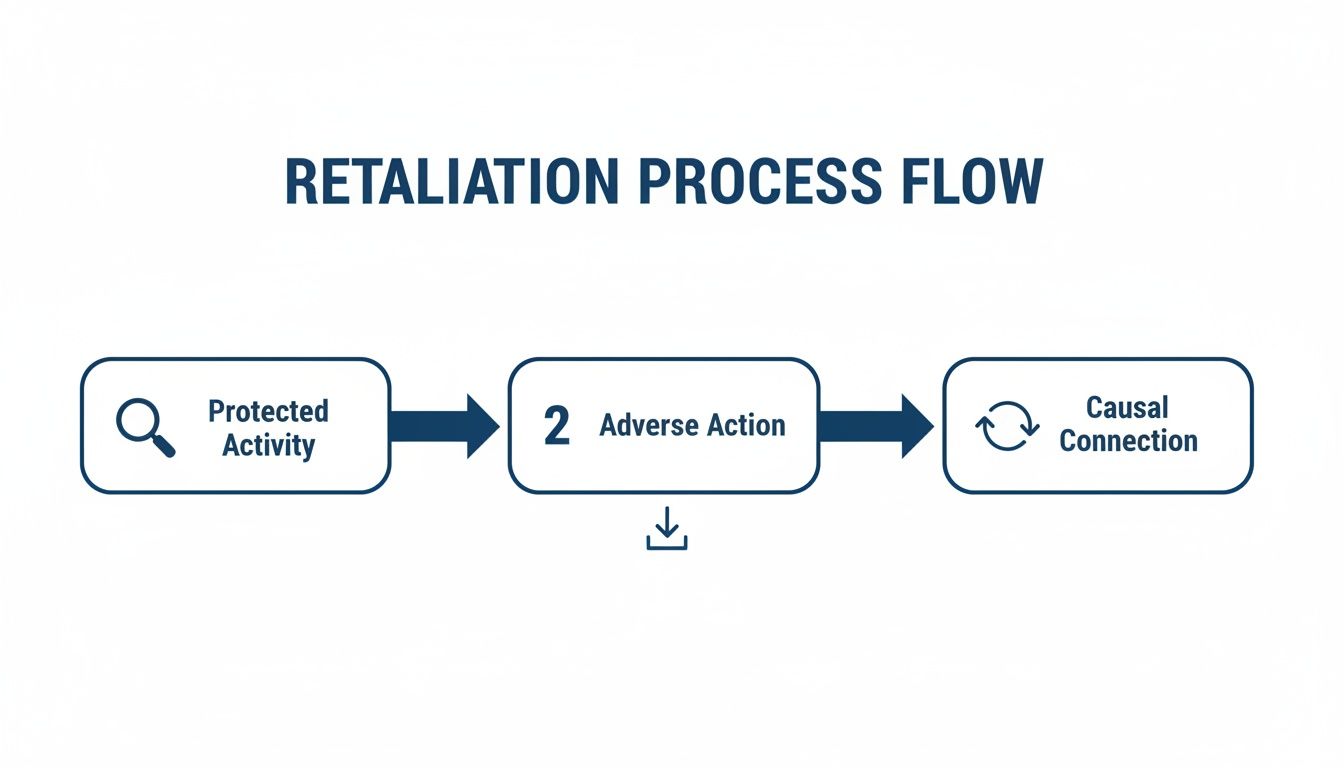
The trick is proving that connection. That's where your evidence comes in, and you need to become a meticulous archivist of your own experience.
Building Your Evidence Locker
Your strongest weapon is documentation. When an employer retaliates, they often—and unknowingly—create a paper trail. Your job is to collect and preserve every piece of it. To make sure your evidence holds up, it helps to know what makes a document legally binding and how to present it effectively.
Start building your case file with these key items:
- Performance Reviews: A history of glowing reviews that suddenly turns sour right after you voiced concerns is a classic sign of retaliation.
- Emails and Messages: Save every single email, text, and internal chat message that feels relevant. You’re looking for a change in tone from your manager, sudden criticism, or being excluded from meetings and email chains you were once a part of.
- A Personal Log: Keep a detailed, private journal of events. For each incident, write down the date, time, who was there, what was said, and who might have witnessed it. Stick to the facts.
- Company Policies: Get your hands on copies of the employee handbook, the company's code of conduct, and any official internal reporting procedures. These can prove that the company didn't even follow its own rules when dealing with you.
This collection of documents helps tell a story: before you spoke up, you were a valued employee. After you did, everything changed.
The Remedies You Can Recover
The False Claims Act doesn’t just aim to punish the employer; it’s designed to make you whole again, as if the retaliation never occurred. If your case is successful, the law provides for significant damages to get you back on your feet.
The goal of the FCA’s anti-retaliation provision is to put you back in the same position—financially and professionally—you would have been in had your employer not broken the law. This includes recovery for both economic and emotional harm.
Here’s what you can recover in a successful FCA retaliation claim:
- Reinstatement: A court can order your employer to give you your job back, complete with the seniority and status you had before they retaliated.
- Double Back Pay: This is the heart of the financial remedy. You are entitled to two times the amount of all wages, salary, and benefits you lost from the day you were fired or demoted until the day you win your case, plus interest.
- Special Damages: This is compensation for the personal toll the retaliation took on you. It can include damages for emotional distress, anxiety, and harm to your professional reputation.
- Attorney's Fees and Costs: The law mandates that the employer pays your reasonable attorney's fees and court costs. This means your legal expenses won't be deducted from your award. You can learn more in our detailed guide on how to prove retaliation at work.
How You Can Afford a Lawyer
This all might sound expensive, but the law is structured to make justice accessible. Most experienced whistleblower attorneys take these cases on a contingency fee basis. This means you pay absolutely nothing out of pocket.
Your lawyer's fee is a percentage of the financial award they recover for you, typically between 40-50%. If you don't win your case, you owe them nothing. This arrangement removes the financial risk and ensures that anyone, regardless of their financial situation, can stand up to an employer who broke the law.
Filing Your Claim in Mississippi
After you've been punished for doing the right thing, the last thing you need is to get tangled in legal deadlines. But when it comes to false claims act whistleblower retaliation, the clock starts ticking immediately. Getting the timing right is critical to protecting your rights and holding your former employer accountable.
The most important deadline you need to know is the statute of limitations. For a federal FCA retaliation claim, you have three years from the date the company took action against you to file your lawsuit. So, if you were fired on June 1, 2024, for reporting fraud, your deadline to file is June 1, 2027. While three years might sound like a long time, building a rock-solid case takes work, so you can't afford to wait.
Mississippi's Unique Legal Landscape
Here’s a crucial fact that surprises many Mississippi employees: our state does not have its own version of the False Claims Act. This means if you're reporting fraud against the government—whether it involves federal funds or a mix of state and federal money—your strongest, and often only, legal tool is the federal False Claims Act.
This has a huge impact on how your case will proceed. Because Mississippi also lacks a state-level human rights commission that handles these types of whistleblower complaints, your entire case will be guided by federal law and fought in federal court.
Your case for false claims act whistleblower retaliation won't be filed in a county or state court. Whether the fraud involved Medicare kickbacks in Jackson, defense contractor overbilling on the Gulf Coast, or faked reports on federally funded projects in DeSoto County, your claim belongs in federal court.
This federal focus makes it non-negotiable: you need an attorney who has spent years litigating employment cases specifically within the federal court system. The rules, procedures, and even the judges are completely different from what you'd find in a typical local court. You absolutely need a guide who knows this territory inside and out.
What to Expect in Federal Court
Because your case will be filed in a U.S. District Court, it follows a distinct and demanding federal path. An attorney who is truly experienced in this arena will know how to manage every turn, from filing the initial complaint all the way through arguing motions before a federal judge.
Your lawyer will handle the technical and strategic details that are unique to federal lawsuits, which often involve:
- Drafting the Complaint: Writing a powerful legal narrative that not only tells your story but also meets the very strict pleading standards required by federal courts.
- Running Discovery: Using federal rules to force your employer to turn over the evidence you need, like incriminating emails, internal memos, and payroll data that proves their motives.
- Going Toe-to-Toe with Opposing Counsel: Standing up to the large, corporate law firms that companies hire to bury these kinds of high-stakes cases.
Having a seasoned expert in your corner levels the playing field. It sends a clear message that you won't be intimidated by a well-funded opponent and gives you a real shot at the justice you deserve.
The Cost of Seeking Justice
It's natural to worry about how you could possibly afford a top-tier lawyer to take on a major company. The good news is, the system is built to give you access to excellent legal help without paying out of pocket. The vast majority of reputable employment attorneys who handle FCA retaliation cases work on a contingency fee basis.
This arrangement is simple: you pay nothing upfront. The lawyer’s fee is taken as a percentage of the money they win for you, usually somewhere between 40-50%. If you don't win, you owe them nothing for their work. Even better, the FCA includes a provision that allows a judge to order your employer to pay your attorney’s fees on top of your award. This powerful feature means your ability to fight back isn't limited by what's in your bank account.
Navigating Your Next Moves to Protect Your Rights
If you're reading this, you likely believe your employer is retaliating against you for blowing the whistle on fraud. The next few choices you make are incredibly important, and acting on impulse can unfortunately do permanent damage to your case. Let's walk through how to handle this correctly.
It’s completely understandable that your first instinct might be to just quit and escape a hostile work environment. But if you can, hold off on resigning. When you leave voluntarily, you hand your employer a ready-made defense, making it much harder for your attorney to prove you were "constructively discharged"—in other words, forced out. The law has powerful tools to help you, but you have to be deliberate.
Legally Preserve Your Evidence
Right now, the single most important thing you can do is gather and secure every piece of potential evidence. Think of this documentation as the foundation of your entire retaliation claim.
- Your Performance History: Pull together copies of your performance reviews (especially older ones that show a pattern of success), your official job description, and your pay stubs.
- Fraud-Related Documents: Collect copies of any key documents that relate to the underlying fraud you reported.
- Written Communications: Save every relevant email, text message, or internal message. A word of caution: never forward work emails to a personal account. If company policy allows, a safer route is to print them out or take clear photos on your personal phone.
- What Not to Take: Be extremely careful not to take physical documents or digital files that could be considered company property. This is a minefield, and a lawyer can give you precise guidance on what you are legally entitled to have.
Document Meticulously and Stay Quiet
While you gather existing documents, you also need to create your own record of what's happening. Start a private journal—on a personal device or notebook you keep at home—and log every instance of retaliation. For each entry, be specific: note the date, time, who was involved, what was said or done, and who else might have seen or heard it.
Just as important is what you don't do. It may be tempting to vent to trusted coworkers, but you have to resist the urge. These conversations have a way of getting back to management and can be twisted to be used against you. For now, discretion is your best friend.
The most critical step you can take is to speak with an experienced employment attorney before making any big moves. They can offer a confidential case evaluation, help you steer clear of common mistakes, and map out a strategy built for your unique circumstances.
Finding the Right Attorney
Choosing the right legal partner will be the most significant decision you make in this process. You're not looking for just any lawyer; you need someone who lives and breathes federal employment law and has a track record of winning False Claims Act retaliation cases specifically in Mississippi.
The good news is that you don't need a lot of money to hire the best. Nearly all reputable attorneys in this practice area work on a contingency fee basis. This means you pay absolutely nothing upfront. The attorney's fee, which typically averages between 40-50%, is taken from the money they recover for you. If you don't win your case, you owe them nothing. This model levels the playing field, giving everyone access to top-tier legal representation.
Frequently Asked Questions About FCA Retaliation
Let's walk through some of the most common questions we hear from Mississippi employees who are facing retaliation after reporting fraud.
What Happens If The Government Declines My Case?
This is a common source of anxiety, but the answer is reassuring. Your retaliation claim is completely separate from the government's fraud case. Think of them as two different legal actions running on parallel tracks.
Even if the government decides not to "intervene" or join your qui tam lawsuit, that has absolutely no legal bearing on your personal right to sue your employer for retaliating against you. The government's decision is often a strategic one based on its own resources and priorities; it is not a judgment on whether you were wrongfully punished.
You can—and should—still move forward with your individual claim under § 3730(h) to get justice for the harm you suffered.
How Much Does It Cost To Hire An Attorney?
The last thing you should worry about when standing up for what's right is how you'll afford a lawyer. That's why most experienced whistleblower attorneys handle these cases on a contingency fee basis.
This structure means you pay nothing upfront. Your legal team advances all the costs of the litigation.
The attorney’s fee is simply a percentage of the financial award they obtain for you, which typically ranges from 40-50%. If your case isn't successful, you owe nothing.
On top of that, the False Claims Act has a powerful fee-shifting provision. If you win, the court can order your employer to pay for your legal fees, ensuring the compensation you receive isn't eaten up by costs.
Am I Protected If I Only Reported Fraud Internally?
Absolutely. The FCA’s anti-retaliation shield is broad and protects you long before a lawsuit is ever filed. Protection kicks in the moment you take any reasonable step to try and stop potential fraud.
This is what the law calls "protected activity," and it includes actions like:
- Telling a supervisor you're concerned about billing irregularities.
- Asking questions in a meeting about why the company is taking a certain action.
- Gathering documents that could serve as evidence of fraud.
- Refusing to participate in a practice you believe is illegal.
You don't have to use the words "fraud" or "illegal" to be protected. As long as you are acting in furtherance of stopping a potential violation, the law is on your side.
If you believe you have been punished for doing the right thing, you don't have to let your employer have the final say. At Nick Norris, P.A., we focus on protecting the rights of workers across Mississippi. To get a confidential review of your situation, please contact our firm through our website.
This article has been reviewed for legal accuracy by Nick Norris. For employment law matters in Mississippi, consult with an attorney licensed to practice in your state.
Leave a Reply