
Whistleblower Protection Act for Private Sector: 2026 Guide
You notice something is off at work. Maybe invoices are being manipulated. Maybe a supervisor tells people to ignore a safety problem. Maybe someone wants you to sign paperwork that doesn't match what happened. You know reporting it could put a target on your back. You also know staying quiet may pull you deeper into the problem.
That tension is where many Mississippi employees start. They aren't looking for a legal theory. They're trying to keep a paycheck, protect their reputation, and avoid becoming the next person pushed out of the building.
Mississippi workers face a hard reality here. State law offers limited help for private-sector whistleblowers, so most real protection comes from federal law. That means your path usually runs through a federal statute, a federal agency, and strict filing deadlines. It also means the answer depends on what you reported, who your employer is, and whether your report falls inside a law that protects it.
The pressure is real. Between 2015 and 2020, retaliation against employees who reported misconduct rose from 40% to 61%, while the share of employees willing to report rose from 58% to 81%, according to an ILO analysis discussed by The Signals Network. More people are speaking up. More employers are pushing back.

If you're searching for the whistleblower protection act for private sector employees, you're probably already in the danger zone. The practical questions matter most right now. Is your report protected? What counts as retaliation? What should you save? Where do you file? How fast do you need to move?
Introduction
The first mistake employees make is assuming any complaint at work counts as whistleblowing. It doesn't. The law protects certain disclosures about specific kinds of wrongdoing. It usually doesn't protect a general complaint that your boss is unfair, rude, disorganized, or impossible to work with.
Think of it this way. Reporting a leaky faucet is a workplace complaint. Reporting that the water supply is contaminated is different. One is about inconvenience. The other points to a legal or regulatory violation.
What usually qualifies
A report is more likely to be protected whistleblowing if it involves conduct such as:
- Fraud or false statements tied to investors, shareholders, accounting, or securities rules
- Safety violations that put workers or the public at risk
- Environmental violations involving pollution, asbestos, or unsafe drinking water
- Fraud against the government in contracting or billing
- Refusal to participate in conduct you reasonably believe breaks the law
That last point matters. Sometimes the protected act isn't only reporting misconduct. It can also involve refusing to carry out an unlawful instruction.
What usually does not qualify by itself
These issues may still matter in employment law, but standing alone they often aren't whistleblower claims:
- A personality conflict with a manager
- Ordinary favoritism
- A disagreement over scheduling
- A complaint that feels unfair but isn't tied to a legal violation
- General workplace gossip
Practical rule: Before you report, ask yourself one question. "What law, rule, regulation, fraud, or safety requirement is being violated?" If you can't answer that clearly, the claim may need more analysis before you act.
Specificity helps. "My supervisor is unethical" is weak. "My supervisor directed me to alter records submitted to a publicly traded client" is much stronger. The same goes for safety complaints. "This place is dangerous" is vague. "Management told us to ignore asbestos handling rules" is far more useful.
If your concern involves fraud against the government, this guide on False Claims Act whistleblower retaliation may help you sort out whether your report fits a federal framework.
Federal Laws That Protect Mississippi Employees
A Mississippi employee often learns this the hard way. You report fraud, a safety problem, or misconduct that could hurt the public, then start looking for a state whistleblower law that covers private-sector workers. In most cases, there is no broad Mississippi statute waiting for you. The case usually rises or falls on federal law.
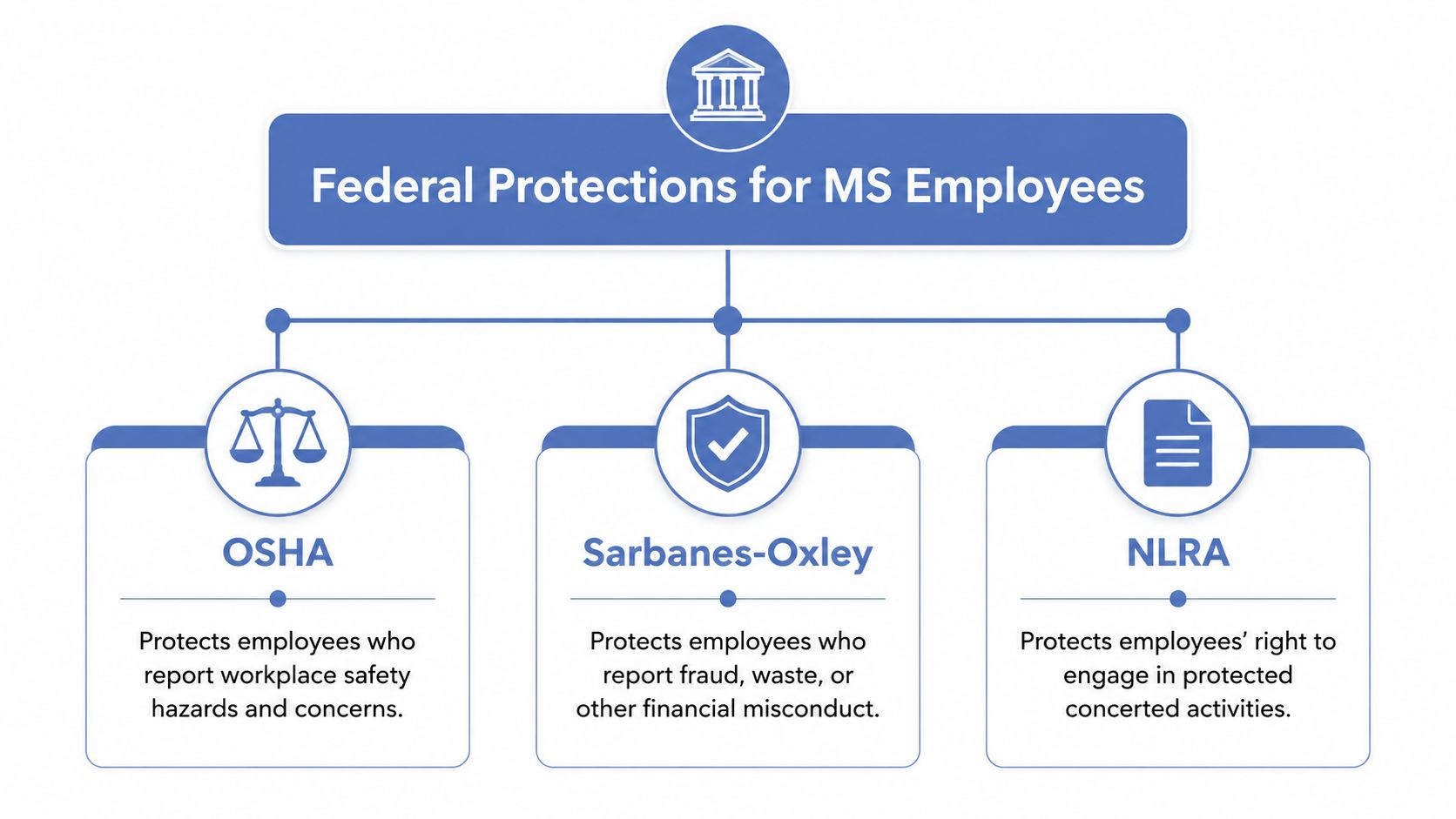
That federal system is not one law. It is a group of separate statutes tied to specific subjects, employers, and reporting channels. The House private sector whistleblower fact sheet summarizes the range of federal protections enforced through OSHA and other agencies. For Mississippi workers, the practical question is narrower. Which federal statute fits what you reported, and did you act soon enough to use it?
Sarbanes-Oxley
Sarbanes-Oxley Act Section 806, usually called SOX, protects certain employees who report fraud connected to publicly traded companies. It commonly applies to concerns involving:
- Securities fraud
- Shareholder fraud
- Bank fraud
- Mail fraud
- Wire fraud
- SEC rule violations
Many Mississippi workers assume SOX only covers people on the payroll of a public company. That is too narrow. Employees of private contractors, accounting firms, consultants, and vendors may also be covered when their work is tied closely enough to a public company. This explanation of Sarbanes-Oxley whistleblower protections covers that issue in more detail.
In practice, SOX cases often turn on records. Preserve the email, spreadsheet, audit note, or instruction that shows what you reported and when you reported it. If access to systems may be cut off, timing becomes a real problem very quickly.
Dodd-Frank
Dodd-Frank can affect whistleblower cases involving securities violations, especially where reporting reaches the SEC. It also created a reward structure for some qualifying whistleblowers through SEC and CFTC programs.
Employees often get tripped up here. Internal complaints alone do not always trigger the same protections or incentives people expect. The reporting path, the type of violation, and whether the information went to the right federal agency can all change the analysis. A worker who says, "I told my manager, so I'm protected," may be right under one statute and wrong under another.
OSHA administered statutes
A large share of Mississippi private-sector workers are outside the securities world. They work in plants, warehouses, transportation, healthcare, environmental compliance, and industrial operations. Their protections often come from one of the many whistleblower laws OSHA administers.
Those statutes can apply to reports involving:
- Workplace safety
- Environmental disclosures
- Asbestos exposure
- Pollution
- Unsafe drinking water
- Energy sector violations
One complication is that the retaliation claim and the underlying misconduct may move through different channels. OSHA may investigate whether the employer punished the worker for reporting. Another agency may examine the actual environmental, safety, or financial violation. Employees are often dealing with both tracks while still trying to keep a job, protect their mental health, and avoid saying something in panic that later gets used against them.
False Claims Act and related claims
If an employer is cheating in a federal contract, falsifying billing to the government, or misusing grant funds, the False Claims Act may be part of the case. These claims require careful handling from the start.
That is not just a legal point. It is a practical one. Employees sometimes confront management too early, forward confidential documents the wrong way, or wait until they have been locked out of email and payroll systems. Good cases get weaker when proof disappears, deadlines pass, or the employee acts on anger instead of a plan.
Why this matters in Mississippi
For many private-sector employees in Mississippi, federal law is the whole path. If there is no federal hook, there may be no whistleblower claim even when the conduct feels plainly wrong.
That is why early case framing matters so much. Identify the statute, preserve the proof, and match the complaint to the right agency or process before the employer controls the timeline.
Recognizing Illegal Workplace Retaliation
Retaliation doesn't always arrive as a firing letter. Employers often know direct termination looks suspicious. So they use pressure, isolation, paperwork, and sudden "performance concerns" to make the employee easier to remove.

A common pattern looks like this. An employee reports a safety issue, accounting problem, or fraudulent practice. For months or years, that employee had solid reviews. Then the tone changes. Meetings stop appearing on the calendar. A supervisor starts documenting minor mistakes. Training opportunities disappear. A once-routine job becomes impossible because the employee is cut out of information and support.
Retaliation can be subtle
Illegal retaliation may include:
- Termination after a protected report
- Demotion or title loss, even if pay doesn't immediately change
- Negative evaluations that appear only after the disclosure
- Exclusion from meetings, projects, or training
- Reassignment to undesirable duties or a dead-end role
- Pay reduction or discipline
- Pressure campaigns meant to force resignation
The key question isn't only whether something bad happened. It's whether the action came because of protected whistleblowing.
Watch the employer's digital pressure points
Some employers do not stop with HR discipline. They start looking for outside influence. They may review public social media, search for policy violations, or look for anything they can use to recast the employee as the actual problem. Employees should understand how that process works and tighten up what is publicly visible. This Digital Footprint Check screening guide gives a practical overview of how employer social-media screening can shape workplace decisions.
That doesn't mean you should delete evidence or hide misconduct. It means you should assume the employer is preparing a narrative.
Save what shows the before and after. If your record was clean before the report and suddenly turns negative after it, that contrast may matter more than any one hostile comment.
A short explainer on retaliation signs can help put these patterns into context:
Your First Steps After Retaliation in Mississippi
Once retaliation starts, delay helps the employer. Employees often spend too long hoping things will calm down, that HR will fix it, or that one more good performance cycle will reset the relationship. Usually it doesn't.
In Mississippi, these claims generally move through a federal path. There is no Mississippi human rights commission to take over this kind of private-sector whistleblower claim, and this isn't the place to think in terms of state-court whistleblower remedies. The immediate job is preserving evidence and identifying the right federal channel.

Build your timeline now
Start with a chronology. Not next week. Now.
Include:
-
What you observed
Write down the misconduct in plain language. Avoid conclusions you can't support. Stick to who, what, when, where, and how. -
When you reported it
Note whether the report was internal, external, verbal, written, or both. Save emails, messages, hotline reports, and follow-up responses. -
What changed afterward
Track discipline, schedule changes, meeting exclusions, access restrictions, investigations, and comments from management. -
What documents existed before the report
Keep prior performance reviews, awards, attendance records, and messages showing your standing before the disclosure.
Immediate priority: Your timeline should let a stranger see the story in sequence without guessing what happened first.
Preserve evidence carefully
Employees often hurt strong claims by gathering proof the wrong way. Don't take proprietary files you have no right to keep. Don't alter documents. Don't forward everything in the company system to a personal account without legal advice. But do preserve what you lawfully possess, especially communications sent to you, evaluations, policies, calendars, and your own contemporaneous notes.
A practical evidence file often includes:
- Emails and texts tied to the report or retaliation
- Performance reviews from before and after the disclosure
- Employee handbook policies
- Screenshots of schedules, access changes, or meeting removals
- Names of witnesses
- Your notes made close in time to events
Identify the right federal route
The correct filing path depends on the law involved. Many private-sector retaliation claims go first to OSHA under a specific whistleblower statute. Others may involve the SEC, CFTC, or a federal fraud framework.
Coverage also may be broader than your job title suggests. Thanks to a 2014 Supreme Court ruling, SOX protections extend beyond employees of public companies to workers employed by private contractors and subcontractors serving those companies, which significantly expanded coverage in states like Mississippi, as discussed in Ethico's overview of private-company whistleblower coverage.
If you're trying to sort out where to file and what agency fits your facts, this guide on how to file a whistleblower complaint may help you organize the first pass.
Deadlines are a real trap
Federal whistleblower deadlines can be short. Depending on the statute, the filing window may be 30, 90, or 180 days. The safest assumption is that your clock may already be running.
Don't rely on HR to tell you the deadline. Don't assume an internal investigation pauses it. It may not.
Plan for the non-legal strain
Whistleblower cases don't only test evidence. They test endurance. Employees deal with lost income, family stress, anxiety, and reputation concerns. Some also face pressure tactics outside classic HR discipline, including threats, rumors, or efforts to bait them into misconduct.
That is why an early strategy matters. In practice, employees usually need some combination of legal advice, careful documentation, and realistic financial planning. If counsel is part of the plan, ask direct questions about structure. In employment cases, contingency fees are often in the 40% to 50% range, so you should understand cost terms before signing anything.
One available option for Mississippi workers is Nick Norris, P.A., which represents employees in federal employment and retaliation matters and can evaluate whether a whistleblower claim fits a viable federal statute.
Understanding the Limits of Whistleblower Protection
A Mississippi employee reports fraud, safety misconduct, or billing irregularities and expects the system to step in if the employer strikes back. In private-sector cases, that expectation is often too optimistic. Federal law can protect a worker, but only if the facts fit the right statute, the report falls within protected activity, and the employee can prove retaliation with a clean record.
That gap between doing the right thing and proving a legal claim is where many cases break down.
Coverage gaps are real
Mississippi does not give many private employees a broad state-law fallback. For that reason, the limits of federal coverage matter more here than they might in a state with stronger local protections.
Some workers fit squarely within a federal scheme. Others do not. A bank employee, defense contractor, healthcare worker, or public-company employee may have a clearer path than someone at a small private business with a general complaint about unfair conduct. A serious workplace problem is not always a whistleblower case in the legal sense.
That is a hard message for employees to hear, especially when the underlying conduct feels plainly wrong. But federal agencies and courts usually look for a specific connection to a statute, regulation, government-funds issue, securities issue, safety rule, or other protected subject.
Proof problems decide these cases
Employers almost never say, "We fired you because you reported misconduct." They point to performance, attendance, attitude, restructuring, or policy violations. Sometimes those reasons are manufactured. Sometimes the employer starts building the paper trail only after the report. Sometimes there was already friction, which makes the case harder.
In practice, the strongest claims usually have a few things in common:
- a clear timeline between the report and the employer's action
- records showing the employee's standing before and after the complaint changed
- a report specific enough to show what law, rule, or fraud concern was raised
- disciplined follow-through by the employee after speaking up
Weak cases often have the opposite problems:
- broad accusations with no identifiable legal issue
- missing texts, emails, dates, or names
- notes written long after the fact
- angry exchanges that give the employer a separate reason to act
Small details matter. A saved email, a calendar entry, or a sudden shift in evaluations can carry more weight than a long personal statement written months later.
Protection has limits even when the law applies
A valid whistleblower claim does not guarantee a quick result, continued employment, or peace at work. The process can be slow. Some employees are sidelined instead of fired. Others are excluded from meetings, labeled disloyal, pushed into isolation, or pressured until they quit. Those facts may support a retaliation claim, but they also wear people down before the case is ever resolved.
I have seen employees make solid reports and still struggle because the stress changes how they respond at work. They miss deadlines, argue with supervisors, or send emotional messages they would not have sent otherwise. Employers use that. The legal issue may still be there, but the record gets harder to defend.
That practical reality matters in Mississippi. If the federal claim is weak, late, or poorly documented, there often is not another strong private-sector remedy waiting in the background.
When to Contact a Mississippi Employment Lawyer
If you think your employer retaliated after you reported fraud, safety violations, environmental misconduct, or government-contract wrongdoing, don't wait for the next write-up. Get the facts reviewed while the timeline is still fresh and the filing window may still be open.
A Mississippi employment lawyer can help with the parts employees usually underestimate:
- identifying which federal statute applies
- spotting deadline problems early
- deciding what evidence to preserve and what not to touch
- evaluating whether the employer's stated reason is likely cover for retaliation
- mapping out the agency process before a report or complaint locks you into a bad position
This is especially important in Mississippi because the route is usually federal and highly technical. A worker can do the right thing morally and still lose the claim by using the wrong process, waiting too long, or framing the report too loosely.
Confidential legal advice at the front end is often safer than trying to repair a record after the employer has already built its defense.
Mississippi Whistleblower Protections FAQ
Does Mississippi have a private-sector whistleblower law that covers most employees
Not in the broad way many employees assume. For most private-sector workers, protection depends on a federal statute tied to the kind of misconduct reported. Mississippi doesn't provide a general state-law safety net for private-sector whistleblowing.
If I work for a small private company, am I automatically excluded
No. Coverage depends less on company size alone and more on the law involved. A small private company may still be covered if it is a contractor, subcontractor, or service provider connected to a publicly traded company, or if the report falls under a federal safety, environmental, or fraud statute.
What if I only reported the problem internally
Internal reporting can still matter, but whether it is protected depends on the statute and the content of the report. The safest approach is to evaluate the facts before assuming an internal complaint is enough.
What kinds of jobs fall into coverage gaps
A major federal gap is that not all sectors benefit from unique protections. Industries like meat packing, hospitality, and many small businesses may lack dedicated whistleblower statutes, meaning workers often have to rely on broader laws like OSHA that may or may not fit the facts, as noted in the House report on gaps and disparities in whistleblower law.
Can retaliation be something less than getting fired
Yes. Retaliation can include demotion, negative reviews, exclusion from meetings, pay cuts, reassignment, or pressure designed to force you out. The issue is whether the employer took adverse action because of protected reporting.
Do I need a lawyer before filing with a federal agency
You aren't always required to have one, but early advice can prevent serious mistakes. The right statute, deadline, wording, and evidence strategy matter. A rushed filing can create problems that are hard to fix later.
Will my workers' compensation claim protect me from retaliation in Mississippi
Mississippi does not provide protection from retaliation for filing workers compensation claims. Employees often assume that claim exists automatically. It doesn't.
How do lawyers usually charge for these cases
Fee arrangements vary. In employment matters, contingency fees are often 40% to 50%. You should ask for the terms in writing and make sure you understand expenses, scope, and what happens if the case resolves early or doesn't proceed.
If you're a Mississippi employee trying to decide whether your report is protected, whether your employer's response crossed the line, or what federal deadline may apply, Nick Norris, P.A. can review the facts and help you understand your options in a confidential consultation.
This article has been reviewed for legal accuracy by Nick Norris. For employment law matters in Mississippi, consult with an attorney licensed to practice in your state.
Leave a Reply