

Is Anxiety a Disability Under ADA in Mississippi
Yes, anxiety can absolutely be a disability under the Americans with Disabilities Act (ADA). But it's not a given. The key is whether your condition is severe enough to substantially limit one or more major life activities—things like concentrating, sleeping, or simply interacting with others.
This is the crucial distinction. We’re not talking about everyday stress or getting the jitters before a presentation. We’re talking about an impairment that creates a significant, daily hurdle to functioning the way most people do.
Understanding When Anxiety Qualifies as an ADA Disability

When you're battling anxiety, figuring out your rights at work can feel overwhelming. The ADA is meant to be a safety net, but knowing exactly when and how it applies to a mental health condition isn't always straightforward. Just having a doctor's diagnosis for anxiety, unfortunately, isn't enough to secure ADA protection on its own.
The law hinges on a specific standard: your condition must cause a “substantial limitation” in a “major life activity.” Think of it this way—everyone feels nervous from time to time. But not everyone’s anxiety makes it nearly impossible to focus in a meeting, get a full night's sleep, or communicate effectively with colleagues. The ADA was written to protect that second group.
It’s also important to remember that anxiety looks different for everyone. For some, it’s outwardly obvious, but for others, it takes the form of the subtle signs of high-functioning anxiety that often go unnoticed.
The Two Pillars of an ADA Claim for Anxiety
For your anxiety to be legally recognized as a disability, you have to meet two core requirements. It's a two-part test.
- First, you need a diagnosed mental impairment. This means a formal diagnosis from a qualified healthcare provider for a condition like Generalized Anxiety Disorder (GAD), panic disorder, social anxiety disorder, or Post-Traumatic Stress Disorder (PTSD).
- Second, that impairment must substantially limit a major life activity. This is where the analysis really happens. The limitation can't be minor or trivial; it has to be significant when compared to how most people in the general population perform that same activity.
These protections aren't new, but they were significantly clarified over a decade ago by the ADA Amendments Act of 2008. That update made it clear that the definition of disability should be interpreted broadly, making it easier for conditions like GAD, panic disorder, and social anxiety to qualify.
The real focus of the ADA isn't on a specific diagnostic label. It’s about the actual impact the condition has on your ability to function in your day-to-day life.
Comparing What Is and Is Not Covered
To help you see where your situation might fall, this table breaks down the key differences between anxiety that is likely covered by the ADA and everyday stress that is not.
Quick Guide to Anxiety as an ADA Disability
This table summarizes the key legal requirements for an anxiety condition to be protected under the ADA.
| Criteria | Likely Covered by ADA | Likely Not Covered by ADA |
|---|---|---|
| Impact on Work | Chronic difficulty concentrating, interacting with coworkers, or meeting deadlines due to persistent worry or panic. | Occasional stress related to specific projects or high-pressure situations. |
| Medical Status | A formal diagnosis of an anxiety disorder (e.g., GAD, PTSD) supported by medical documentation. | General feelings of stress or nervousness without a clinical diagnosis. |
| Limitation Level | The impairment significantly restricts a major life activity like sleeping, thinking, or communicating. | The impairment causes minor or temporary difficulties that don’t substantially limit daily functioning. |
| Duration | The symptoms are persistent, long-term, and not just a temporary reaction to a specific event. | The anxiety is short-term and resolves after a stressful situation ends. |
Understanding these distinctions is the first step toward advocating for yourself. If your condition looks more like the “Likely Covered” column, you may be entitled to reasonable accommodations at work. To learn more, take a look at our guide on the types of ADA accommodations for anxiety you can request.
What “Substantial Limitations” and “Major Life Activities” Actually Mean for You
To figure out if your anxiety qualifies as a disability under the ADA, we have to move past the legal jargon and get real about how it affects your day-to-day life. The law steps in to protect you when your anxiety creates a “substantial limitation” in one or more “major life activities.” These aren’t just phrases for lawyers to argue over; they are the very heart of your rights.
Think of a “substantial limitation” as a genuine hurdle, not a minor inconvenience. It doesn’t mean you’re totally incapable of doing something. It just means your anxiety makes performing that activity significantly harder, slower, or even more painful than it is for the average person. Thankfully, the ADA Amendments Act of 2008 clarified that this standard should be interpreted broadly, which has made it easier for conditions like anxiety to get the protection they deserve.
It’s More Than Just Working and Sleeping
When most people hear “major life activities,” their minds jump to the big things—working, sleeping, eating, or walking. But the ADA’s definition is much broader and, critically for anxiety sufferers, it includes many of the mental and cognitive functions that anxiety often attacks head-on.
These are functions that are absolutely essential to succeeding in just about any job, whether you’re in an office in Jackson or on a factory floor in Tupelo.
- Concentrating: Are you constantly battling racing thoughts or a sense of dread that shatters your focus on a task? That’s a limitation.
- Thinking: Anxiety can create a thick “brain fog,” making it tough to analyze problems, think critically, or make clear decisions.
- Communicating: If social anxiety makes speaking up in a team meeting or even just talking with customers feel like a monumental effort, that counts.
- Interacting with Others: This is so important it’s listed as its own major life activity. If the thought of collaborating with coworkers fills you with dread, that’s a significant barrier.
Under the ADA, severe anxiety is a protected disability if it clearly restricts your mental functioning, which gives you a right to be shielded from discrimination. The impact is staggering when you look at the data. For instance, 56.8% of adults with intellectual disabilities—who often face similar functional challenges—also have a diagnosed anxiety disorder, compared to just 10.6% of the general population. This really drives home how deeply a condition can limit a person’s ability to perform everyday mental tasks. You can explore more about this connection at AuraMD.com.
Real-World Scenarios of Substantial Limitations
Let’s ground these concepts in some practical examples you might encounter right here in a Mississippi workplace. These stories show how anxiety can substantially limit major life activities in ways that go far beyond just “working.”
Scenario 1: The Project Manager in Jackson
A project manager with Generalized Anxiety Disorder (GAD) is trapped in a cycle of worry about deadlines and potential failures. This isn’t just normal job stress. Her anxiety sends intrusive thoughts that make it nearly impossible to concentrate on detailed reports.
- Major Life Activity Limited: Concentrating and thinking.
- The Impact: Tasks that should take an hour take two. She starts missing small but crucial details. Despite her dedication, she feels perpetually behind, and her performance reviews are starting to suffer.
Scenario 2: The Retail Worker in Gulfport
A retail associate has severe social anxiety. They are fantastic at stocking shelves and keeping the backroom organized, but the daily team huddles and face-to-face customer interactions trigger intense fear, sometimes bordering on panic.
- Major Life Activity Limited: Interacting with others and communicating.
- The Impact: They avoid asking for help, can’t contribute during team meetings, and may even call in sick on days they know will be heavy with customer events. Their job is now on the line.
Key Takeaway: You don’t have to prove that you’re completely incapacitated by your anxiety. The ADA only requires you to show that your condition creates a significant barrier to performing a major life activity when compared to most people.
These examples make it clear that the question “is anxiety a disability under the ADA?” is answered by looking at the specific ways your condition gets in the way of essential functions like thinking, concentrating, and communicating. If you can draw a clear line from your symptoms to these limitations, you’re on the right track to securing the protections you’re entitled to under the law.
How to Talk to Your Employer About Your Anxiety

It’s one thing to know your rights under the ADA. It’s another thing entirely to bring it up with your boss. The very thought of discussing your mental health at work can be overwhelming, especially when you’re already dealing with anxiety.
But here’s the key: this isn’t a confrontation. It’s the start of a conversation.
You’re simply kicking off what the law calls the “interactive process.” That might sound like a stuffy legal term, but it’s just a fancy way of saying you and your employer are going to work together. The goal is to find a reasonable, practical solution that helps you succeed in your role. You aren’t making demands; you’re opening a dialogue.
Moving Beyond a Simple Doctor’s Note
Many people I talk to think a simple doctor’s note saying, “I have anxiety,” is all they need. Unfortunately, this is one of the biggest misconceptions out there and a surefire way to get your request denied. A vague note just doesn’t give your employer enough information to trigger their legal duty to help.
To really get the ball rolling, your medical documentation has to connect the dots for them. It needs to be specific.
- It must clearly state that you have a medical impairment.
- It must identify which major life activities your anxiety substantially limits (like concentrating, interacting with others, or sleeping).
- It must explain how those limitations directly impact your ability to do certain parts of your job.
For instance, a note that says, “Jane has anxiety,” isn’t nearly as effective as one from her provider stating, “Jane has been diagnosed with Generalized Anxiety Disorder, which substantially limits her ability to concentrate. This directly affects her capacity to complete detailed financial reports without frequent errors.” See the difference?
This level of detail is absolutely critical. In one federal case, a doctor’s note that only described an employee’s condition as ‘nervousness’ was tossed out because it failed to prove a substantial limitation under the ADA. It’s a stark reminder that you need solid medical evidence—something an experienced legal team can help you gather. For a deeper dive, you can review federal guidance on accommodations for psychiatric disabilities.
Initiating the Conversation
When you’re ready to speak with HR or your manager, how you frame the discussion is everything. You do not need to share every private detail of your medical history. You only have to disclose enough to make it clear that you have a medical condition that requires a change at work.
Here’s a simple, straightforward way to get the conversation started:
“I’d like to schedule a time to talk about my work performance. I have a medical condition that is causing some challenges with [mention the specific job function, e.g., ‘concentrating during long meetings’ or ‘managing back-to-back customer calls’]. I am committed to finding a solution that allows me to continue being a productive member of the team and would like to discuss some possible adjustments.”
This approach accomplishes three crucial things:
- It clearly signals that you’re requesting help for a medical reason.
- It keeps the focus on solutions and job performance, not just problems.
- It positions you as a proactive, collaborative employee who wants to do good work.
Always put your request in writing (an email is perfect) to create a paper trail. Once you’ve done that, the ball is officially in your employer’s court to engage with you in the interactive process. Our in-depth guide on how to request a reasonable accommodation offers more detailed steps and templates you can adapt. By preparing and approaching the conversation as a team effort, you set the stage for a positive outcome that supports both your well-being and your career.
Practical Workplace Accommodations for Anxiety
Once you and your employer have opened the lines of communication about your anxiety, the conversation naturally turns from identifying the challenge to finding a solution. This is where reasonable accommodations come in. These aren’t about asking for special treatment; they’re practical adjustments to your job or work environment that help you manage your anxiety and perform your duties effectively.
Think of it as leveling the playing field so you have the same shot at success as everyone else. The law is firmly on your side here. Thanks to the ADA Amendments Act of 2008, it’s well-established that anxiety can be a disability that requires these kinds of adjustments. In fact, the Department of Labor (DOL) notes that since one in five Americans will face a mental health condition, accommodations like flexible schedules are a vital part of maintaining a fair workplace. You can see the DOL’s stance on mental health and the ADA for yourself.
Accommodations for Concentration and Focus
Anxiety can often feel like a constant buzz of static in your head, making it incredibly difficult to concentrate on your work. When your biggest hurdle is just staying focused on a task, the right accommodations can clear away the noise.
It’s a bit like trying to read a complex report in the middle of a chaotic party. A reasonable accommodation just helps you find a quieter corner to work in.
Some of the most effective solutions I’ve seen implemented include:
- A Quieter Workspace: This might be as simple as moving your desk to a less-trafficked part of the office, away from the chatter of the breakroom.
- Noise-Canceling Headphones: In a busy open-plan office, these are a game-changer for blocking out ambient distractions.
- Uninterrupted Work Time: Your manager can help you block off “deep work” periods on your calendar, signaling to colleagues that you need to focus without interruptions.
- Breaking Down Large Projects: Overwhelming assignments can be a major trigger. A manager can help break them down into smaller, more manageable steps with individual deadlines, which feels much more achievable.
Accommodations for Social and Interpersonal Challenges
For someone with social anxiety, everyday workplace interactions—team meetings, performance reviews, or even just small talk—can feel like a minefield. Accommodations in this area are designed to lower the pressure of these interactions without getting in the way of collaboration.
The goal here isn’t to isolate you, but to find different ways to communicate that don’t provoke intense anxiety.
- Written Feedback and Instructions: It can be much less stressful to receive performance reviews or project briefs in a detailed email rather than in a face-to-face meeting.
- Alternative Participation in Meetings: Instead of feeling pressured to speak up on the spot, you could be allowed to submit your thoughts in writing before or after a meeting.
- Reduced Client-Facing Duties: If it’s feasible within your role, your job could be restructured to emphasize tasks that don’t rely heavily on public or client interaction.
Getting familiar with the range of available support is key. There are great guides on reasonable adjustments for mental health at work that can give both you and your employer ideas for building a more supportive environment.
Schedule and Environment Modifications
Sometimes, the rigid structure of a traditional 9-to-5 workday is the biggest barrier. Adjusting your schedule or physical environment can make a world of difference in managing anxiety, especially if you experience panic attacks or need to attend therapy appointments.
Here are some powerful adjustments to consider:
- Flexible Work Hours: The ability to shift your start and end times can help you avoid a stressful rush-hour commute or work during the hours you feel most focused.
- Modified Break Schedules: Taking shorter, more frequent breaks to step away, breathe, or use a mindfulness app can help manage rising anxiety before it becomes overwhelming.
- Leave for Treatment: Having the flexibility to use unscheduled leave or a modified schedule is crucial for attending regular appointments with a therapist or doctor.
- Telework or Remote Work: Even working from home one or two days a week can dramatically reduce the social and environmental triggers that contribute to anxiety.
It’s important to remember that an employer is not required to grant an accommodation that would cause an “undue hardship,” meaning a significant difficulty or expense. However, most accommodations for anxiety are free or low-cost, making this a high bar for an employer to meet.
What to Do When Your Accommodation Request Is Denied
It’s a gut punch. You’ve gone through the process of requesting a reasonable accommodation for your anxiety, and your employer just said no. It’s easy to feel defeated, but don’t assume this is the end of the road. In many cases, a denial is just the next turn in the conversation, not a final verdict.
Your first move is simple but critical: ask your employer to explain their denial in writing. A verbal “no” is flimsy and difficult to address. A written explanation, on the other hand, forces the company to go on record with its reasoning. This document is your roadmap for what to do next.
Understanding the Denial
Once you have that written response, you can see exactly why they turned you down. Most denials fall into a few common categories:
- Insufficient Medical Documentation: Your employer might argue that your doctor’s note didn’t clearly connect your anxiety to a substantial limitation in your work.
- Claim of “Undue Hardship”: They could claim your request is just too expensive, disruptive, or fundamentally changes the nature of the business.
- Ineffectiveness: The company might believe your proposed accommodation won’t actually help you perform the essential functions of your job.
This isn’t just information for you; it’s a piece of evidence. A written denial opens the door for you to continue the interactive process. If they need more medical detail, you can go back to your doctor. If they claim undue hardship over your first idea, you can come back with a few more affordable or less disruptive alternatives.
This flowchart can help you visualize how specific supports map to common anxiety-related challenges in the workplace.
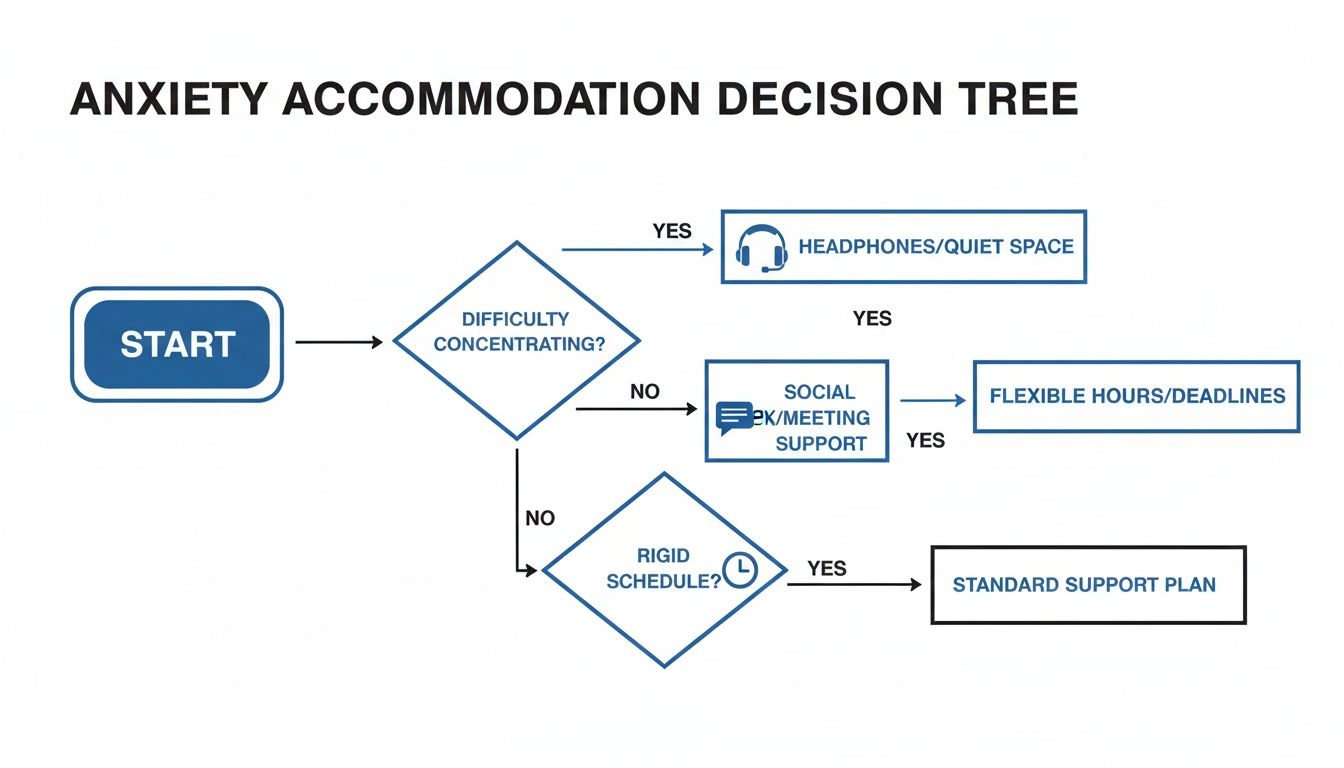
As you can see, a problem like “difficulty concentrating” can often be addressed with straightforward accommodations like noise-canceling headphones or a quieter workspace—solutions that are rarely an undue hardship.
When Your Employer Won’t Cooperate
But what if your employer refuses to give you a reason in writing? Or what if they just go silent, effectively ending the interactive process? If they refuse to engage in good faith, your next formal step is to file a Charge of Discrimination.
For workers in Mississippi, this point is absolutely critical: Mississippi does not have a human rights commission that handles these types of employment claims. Your only path forward is through the federal Equal Employment Opportunity Commission (EEOC). You are legally required to file a charge with the EEOC before you can ever file a disability discrimination lawsuit in federal court.
Filing an EEOC charge isn’t the same as suing your employer. Think of it as a formal complaint that triggers a federal investigation. The EEOC acts as a neutral fact-finder, gathering information from both you and your employer to determine if your rights were likely violated. This entire process is a mandatory first step before any legal action can be taken.
The EEOC’s procedures can feel bureaucratic and confusing if you’re not prepared. To get a better handle on what’s involved, you can learn more about the EEOC investigation process in our detailed guide. When an employer refuses to follow the law, knowing how to assert your rights is everything.
When You Should Contact a Mississippi Employment Lawyer
Trying to get the accommodations you need to manage anxiety at work can be a tough road. Ideally, you and your employer work together through the interactive process and find a solution. But what happens when that process breaks down?
Sometimes, despite your best efforts to be reasonable and provide documentation, you hit a brick wall. Knowing when to stop trying to handle it yourself and call in a professional is key to protecting your rights, your job, and your mental health. Bringing in an attorney isn’t an act of aggression; it’s a strategic move to ensure the law is respected.
Spotting the Red Flags
While you can often manage an accommodation request on your own, certain employer actions are immediate red flags. If you experience any of the following, it’s time to stop negotiating and start consulting with an employment lawyer. These aren’t just signs of a difficult manager—they’re signs your employer may be acting in bad faith or breaking the law.
Keep an eye out for these clear warning signs:
- A Flat-Out Denial: You’ve provided a reasonable, well-documented request, and your employer simply says “no” without giving a valid reason or suggesting an alternative.
- Retaliation: Shortly after you ask for an accommodation, you’re suddenly hit with a negative performance review, a demotion, a pay cut, or even termination. The timing is no coincidence.
- A Hostile Environment: Management or even coworkers start mocking you, leaving you out, or harassing you about your anxiety. If the workplace becomes toxic because you asked for help, that’s a serious problem.
- Refusal to Engage: Your employer goes silent. They ignore your emails, dodge your questions, and completely refuse to participate in the required interactive process.
If your employer’s response to your request for help is to punish you or make your life harder, they are likely breaking the law. Retaliation is illegal under the ADA, and it’s a clear signal that you need an advocate in your corner.
How a Lawyer Can Help Your ADA Claim
When you’re up against a resistant employer, an experienced Mississippi employment lawyer can completely change the dynamic. They step in to shoulder the burden, freeing you up to focus on your health and your work. Think of them as both your shield and your strategist.
An attorney will immediately get to work by:
- Taking Over All Communication: They will handle every phone call, email, and meeting with HR and management, making sure every interaction is documented and legally sound.
- Strengthening Your Evidence: Lawyers know exactly what medical proof the EEOC and courts find compelling. They’ll guide you in gathering the right documentation to build an undeniable case.
- Expertly Navigating the EEOC Process: Because Mississippi does not have a human rights commission, your main path for a formal complaint is the federal EEOC. An attorney can draft and file a powerful charge on your behalf.
- Negotiating a Resolution: Often, just having a lawyer involved is enough to bring an employer to the table. They can frequently negotiate a fair settlement without ever needing to step into a courtroom.
Affording Legal Help on a Contingency Fee Basis
Many workers in Mississippi, from the Gulf Coast to the Delta, hesitate to call a lawyer because they think they can’t afford one. This is a common and understandable myth. The good news is that most employment lawyers handle ADA cases on a contingency fee basis.
Here’s what that means: you pay no upfront fees. The lawyer only gets paid if they successfully recover money for you, either through a settlement or a court award. Their fee is a percentage of that recovery, which is typically between 40-50%.
If you don’t win your case, you owe them nothing for their time. This model levels the playing field, ensuring every worker has access to top-tier legal representation, regardless of their bank account.
Frequently Asked Questions About Anxiety and ADA Rights
When you’re dealing with anxiety and trying to figure out your rights at work, it’s easy to get overwhelmed. Let’s clear up some of the most common questions we hear from workers here in Mississippi about the Americans with Disabilities Act (ADA).
Do I Have to Tell My Boss I Have Anxiety?
Absolutely not. You have a right to medical privacy. You are never required to share your specific diagnosis, whether it’s Generalized Anxiety Disorder or something else.
What you do need to share is that you have a medical condition that’s affecting your ability to do your job and that you need some sort of change or adjustment to help you succeed. For instance, you could say, “I have a medical condition that makes it difficult for me to concentrate in a noisy environment,” instead of spelling out your diagnosis. The conversation should focus on the work-related limitation, not the medical label.
Can I Be Fired for Having Anxiety?
Let’s be very clear about this: it is illegal for an employer to fire you just because you have an anxiety disorder that qualifies as an ADA disability. It’s also illegal for them to fire you as payback for requesting an accommodation.
However, the ADA isn’t a free pass. You still have to be able to perform the core functions of your job, with or without a reasonable accommodation. The law protects qualified employees who can meet their job duties with some support; it doesn’t excuse persistent poor performance or violations of company policy.
Key Insight: The ADA protects qualified individuals. This means you must still be able to perform the essential duties of your role, with or without reasonable accommodations, to be shielded from termination.
What if I Cannot Afford a Lawyer for an ADA Claim?
This is a real and understandable worry for so many people. The good news is that most employment lawyers who handle these cases work on a “contingency fee” basis. This system is designed to give everyone access to justice, regardless of their financial situation.
It means you pay nothing upfront. The lawyer only gets paid if they win your case, either by negotiating a settlement or winning a court verdict. Their fee is a percentage of the money recovered for you, usually around 40-50%. If you don’t win, you owe them no attorney’s fees.
Is Stress the Same as a Disability?
No, and this is a critical distinction. Everyday workplace stress, while difficult, is not considered a disability under the ADA. The law draws a firm line between the normal pressures of a job and a recognized medical impairment.
To receive ADA protection, your anxiety must be a diagnosed condition that substantially limits a major life activity like concentrating, sleeping, or interacting with others. That’s a much higher legal standard than just feeling stressed out by a heavy workload or a tough deadline.
If your employer has denied your request for an accommodation, retaliated against you, or allowed a hostile work environment to form because of your anxiety, you don’t have to fight this battle on your own. The legal team at Nick Norris, P.A. is committed to defending the rights of Mississippi workers. Contact us today to understand your options and get the advocacy you deserve.
This article has been reviewed for legal accuracy by Nick Norris. For employment law matters in Mississippi, consult with an attorney licensed to practice in your state.
Leave a Reply