

ADA Leave of Absence MS: Understand Your Rights in 2026
A lot of Mississippi workers end up in the same hard spot. Your doctor says you’re not ready to go back yet. Your FMLA time is almost gone, or already gone. HR starts talking about attendance points, return dates, or separation paperwork, and you’re left wondering whether your job is about to disappear because your recovery is taking longer than the company wanted.
That fear is real, especially in Mississippi, where employees often hear “at-will” as if it wipes out every workplace protection. It doesn’t. If your medical condition rises to the level of a disability, the ADA may require your employer to consider more leave as a reasonable accommodation, even after FMLA is exhausted. That’s where many employees, and many employers, get it wrong.
This article is for workers who need straight answers about ada leave of absence rights in Mississippi. If you need more time off because of surgery, cancer treatment, a serious back condition, anxiety, depression, PTSD, or another disabling condition, you need to know how to ask the right way, what your employer can require, and what to do if they refuse to deal fairly.
Your Job and Your Health Navigating Leave in Mississippi
Take a common example. You work for a Mississippi employer, you’ve been out for a serious health issue, and your leave clock is nearing the end. Your supervisor wants a firm return date. Your doctor says you need more time. HR sends paperwork that sounds final. You start thinking you have only two choices: go back before you’re medically ready or lose your job.
That’s often the moment when the ADA becomes the most important law in the room.

An ADA leave of absence isn’t automatic, and it isn’t unlimited. But it can be the difference between a lawful medical accommodation and a rushed termination. Many workers assume leave rights stop when company policy says they stop. That’s not how federal disability law works.
Why Mississippi workers need to pay close attention
Mississippi employees don't have a state human rights commission to step in and handle disability discrimination issues at the state level. That makes federal rights more important, not less. It also means you need to be careful about how you communicate with your employer, because the paper trail often determines whether your rights were respected.
Practical rule: If your employer knows you need leave because of a medical condition that may qualify as a disability, the conversation shouldn't end with “your leave is up.”
A lot of people wait too long to connect the dots. They ask for “more time” without clearly tying it to a medical limitation. They trust verbal conversations. They hand over too much private information, or not enough useful information. Then they get denied for reasons that could have been challenged earlier.
What matters most right now
If you're in that position, focus on three things:
- Get specific: Ask for additional leave as an accommodation related to your medical condition.
- Get it in writing: Email is usually better than a hallway conversation.
- Get medical support: Your provider should explain your limitations and the expected period of leave in practical terms.
The law can protect your job during recovery. But you have to trigger those protections the right way.
What Qualifies as an ADA Leave of Absence
An ada leave of absence is not its own separate leave program. It’s a form of reasonable accommodation under the Americans with Disabilities Act. Think of it as a temporary bridge. The employer may have to give you time away from work if that time helps you return and do the job.
Under the ADA, enacted in 1990, employers with 15 or more employees must provide reasonable accommodations, including unpaid leave of absence, to qualified individuals with disabilities unless doing so would cause undue hardship, and there is no fixed maximum duration because inflexible leave caps can violate the law, according to EEOC-related guidance discussed here. That basic rule is where many company policies fall apart.
Who is protected
Two phrases matter.
The first is disability. In plain English, that means a physical or mental condition that substantially limits a major life activity. Some conditions are obvious. Others, especially mental health conditions, are less visible but still covered when they significantly affect daily functioning.
The second is qualified individual. That usually means you can perform the essential functions of the job with or without accommodation. For leave cases, the key question is often whether the time off will allow you to come back and do the work after recovery.
If you’re dealing with stress-related or psychiatric symptoms, this issue often overlaps with conditions employers misunderstand. This discussion on whether anxiety can qualify as a disability under the ADA is a useful starting point for that analysis.
What leave as an accommodation looks like
Leave can take different forms, depending on the medical need and the job:
- A short continuous absence: Common after surgery, hospitalization, or a treatment cycle.
- Intermittent time away: Useful when symptoms flare or treatment happens in blocks.
- A reduced schedule: Sometimes a worker can come back gradually rather than all at once.
If you’re trying to understand where this fits among other workplace absences, this overview of managing various employee leaves gives a practical picture of how employers often categorize time off.
ADA leave works best when the request has a medical reason, a work-related purpose, and a realistic path back to the job.
What doesn't work well
Some requests are harder to defend than others. A vague statement like “I’ll come back when I feel better” creates problems. So does asking for leave with no explanation of how it connects to your ability to return and perform the job.
What usually works better is a targeted request: you have a medical condition, it limits your ability to work right now, your provider expects improvement, and leave will help you return to work safely.
ADA Leave vs FMLA A Crucial Comparison for Workers
The biggest source of confusion is that the ADA and the FMLA can both apply to the same medical issue, but they do different jobs. FMLA is a leave statute with set eligibility rules and a set leave amount. ADA is an accommodation law that may require additional leave in the right circumstances.
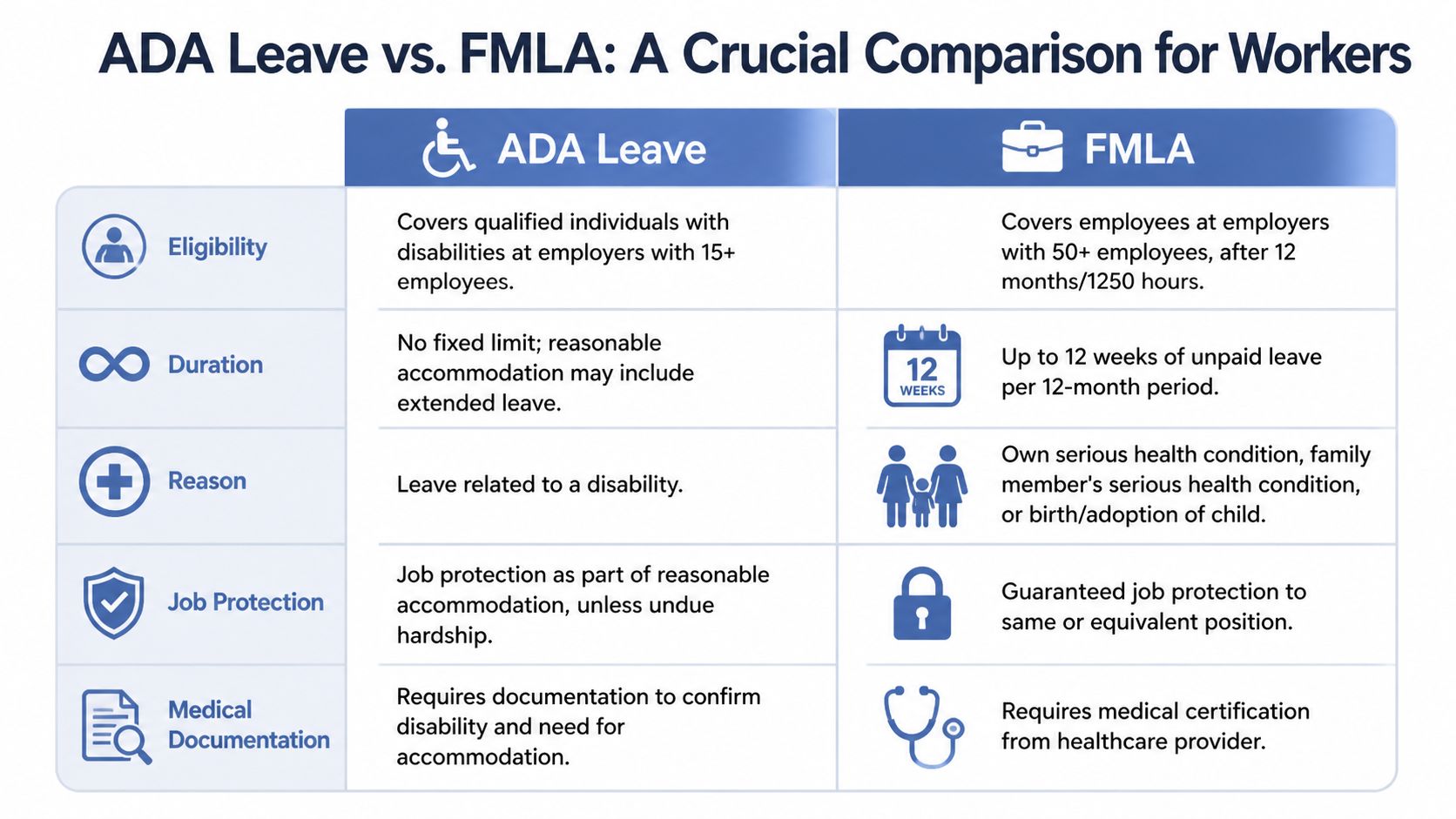
ADA Leave vs. FMLA Leave Key Differences
| Feature | ADA Leave | FMLA Leave |
|---|---|---|
| Who is covered | Qualified individuals with disabilities at employers with 15+ employees | Eligible employees at employers with 50+ workers within 75 miles |
| Employee eligibility | Must be able to perform essential job functions with or without accommodation | Must have worked for employer for at least 12 months and 1,250 hours |
| Length of leave | No fixed maximum. Must be assessed as a reasonable accommodation | Up to 12 weeks of unpaid, job-protected leave in a 12-month period, or 26 weeks for caring for a service member with a serious injury |
| Reason for leave | Disability-related need for accommodation | Employee’s serious health condition, certain family-care reasons, or qualifying military-related leave |
| How it works | Interactive process, individualized assessment, possible unpaid leave beyond policy limits | Statutory entitlement if eligibility and certification requirements are met |
If you want a deeper look at when employers mishandle FMLA administration, this page on Family and Medical Leave Act violations is worth reviewing.
The moment that matters most
The transition point is where people lose jobs unnecessarily. FMLA has a firm cap. The ADA does not use that same ceiling. The ADA leave framework operates independently from FMLA’s rigid 12-week limit, and when an employee exhausts FMLA leave but still can’t return because of a disability, the employer must engage in an interactive process to decide whether additional unpaid leave is a reasonable accommodation. The EEOC has also said that automatic termination when FMLA expires violates the ADA, as explained in this discussion of the FMLA-ADA compliance gap.
That means “you used all your FMLA” is not a complete legal answer.
What a bad policy looks like
A bad policy says: once your protected leave runs out, you’re done.
A lawful approach asks more questions:
- Can the employee return if given additional time?
- Is the request tied to a disability?
- How long is the additional leave expected to last?
- Would granting it create an undue hardship in this particular workplace?
When FMLA ends, ADA analysis may begin. Employers that treat those as the same thing often get into trouble.
Why this matters in the real world
Workers often assume a company handbook settles the issue. It doesn’t. A handbook can describe policy, but it can’t override federal law. If the employer has a “maximum leave” rule and applies it without looking at your individual medical situation, that can be a serious problem.
Your Rights and Duties in the Interactive Process
The interactive process is just a structured back-and-forth between you and the employer about whether an accommodation will let you keep working or return to work. It’s not supposed to be a trap. It’s supposed to be a real effort to solve the problem.
Still, cases often turn at this juncture. Employers may ask too little, too much, or the wrong thing. Employees may stay too vague, miss deadlines, or fail to clarify that they need leave because of a disability.
What you need to do
Your side of the process is straightforward, but it matters.
- Say enough to put the employer on notice: You don’t need perfect legal language. You do need to make clear that you need leave or another adjustment because of a medical condition.
- Provide reasonable support: If the employer asks for appropriate medical documentation, respond promptly.
- Give a workable timeline if you can: A request with an expected duration is much stronger than an open-ended absence.
What usually helps most is a request that connects the condition, the limitation, and the accommodation. For example: “My medical provider has advised that I cannot return yet because of my condition. I’m requesting additional unpaid leave as an accommodation and expect to be reevaluated on [date].”
What your employer is supposed to do
The employer doesn't have to grant every request. But it does have to participate in good faith.
That generally means the employer should:
- consider the request individually,
- ask job-related questions,
- review medical support that is relevant,
- explore whether leave would allow a return to work, and
- avoid hiding behind automatic cutoff rules.
The hard question of how long is too long
This is the part employees hate, because there isn’t a clean formula. The definition of a qualified individual can become blurry when leave gets very long. A federal appellate court has said that extremely extended leave may remove someone from ADA protection because it “excuses his not working” rather than enabling work, while EEOC guidance still requires employers to seriously explore leave requests without clear duration benchmarks, which leaves the issue to a case-by-case analysis, as discussed in this analysis of extended leave under the ADA.
That uncertainty cuts both ways. It means employers can’t deny leave just because there’s no bright-line rule in their favor. It also means employees do better when their doctor can give some concrete estimate, even if recovery is still developing.
The strongest ADA leave request is usually finite, medically supported, and tied to a likely return.
What often helps and what often hurts
Here’s the practical version.
| Helps | Hurts |
|---|---|
| A doctor gives an estimated duration | “Until further notice” |
| You ask in writing | You rely on a verbal talk with a supervisor |
| You explain the leave is disability-related | You only say you “need more time” |
| You respond to reasonable follow-up questions | You ignore paperwork and deadlines |
“Undue hardship” is the employer’s main defense, but it isn’t a free pass. The employer should be able to explain why your specific request would create a real operational burden, not just inconvenience or impatience.
Providing Medical Documentation Without Giving Up Your Privacy
A lot of workers assume that if they ask for ADA leave, the employer gets to see everything. That’s not true. For ADA purposes, the employer is entitled to information that is relevant to the disability and the accommodation request. The law does not give HR open access to your entire medical history.
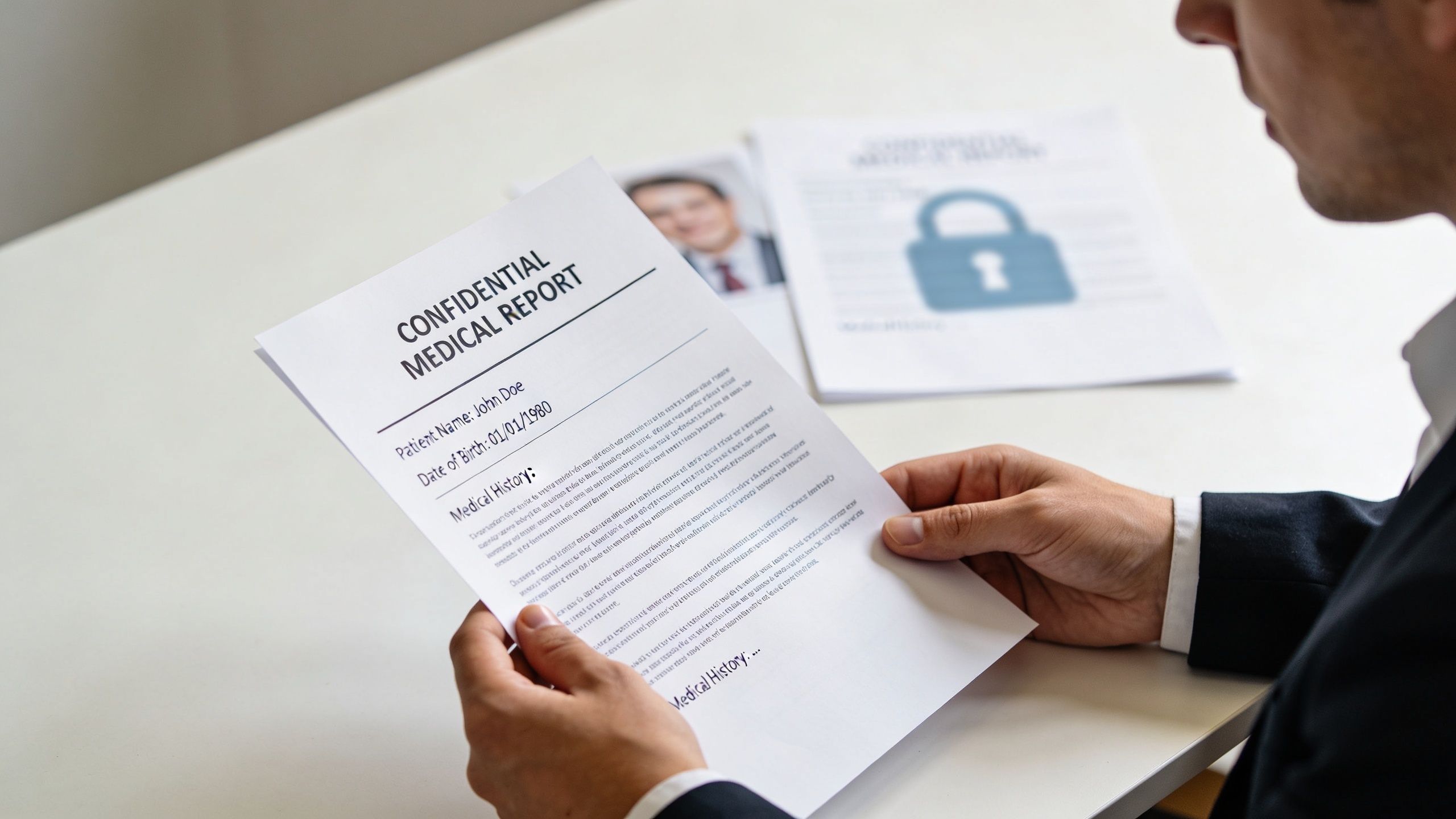
Medical information collection under the ADA is narrower than under FMLA. The ADA prohibits unduly lengthy or irrelevant requests, does not require ongoing updates unless circumstances change, and ADA medical records must be kept in separate confidential files rather than general personnel files, as explained in the ADA leave fact sheet from the ADA National Network.
What your doctor's note should actually cover
A useful ADA note usually does not need to read like a full medical chart. It should focus on function and work impact.
Ask your provider to address:
- The work limitation: Why you can’t perform the job right now.
- The accommodation needed: Additional leave, intermittent leave, or reduced schedule.
- Expected duration: An estimated return date or reevaluation date, if possible.
- Any restrictions on return: If a gradual return or modified schedule may be needed.
If you're dealing with neurodivergence, attention-related conditions, or autism-related workplace issues, the Sachs Center workplace accommodation guide gives practical examples of how accommodation discussions can be framed around function rather than unnecessary personal detail.
What you should be careful not to hand over
Employees often overshare because they’re trying to prove they’re telling the truth. That can backfire.
Avoid volunteering:
- full treatment notes,
- unrelated diagnoses,
- broad medical history,
- family medical details, or
- weekly updates unless something has changed.
If privacy at work is already a concern, this discussion of employee privacy rights in the workplace can help you think through where the boundaries should be.
Your employer can seek enough information to evaluate the accommodation. It doesn't get a blank check to collect everything.
Watch how records are handled
Confidentiality matters. ADA-related medical paperwork should not be sitting in a regular personnel file where supervisors or unrelated staff can browse through it. Bad recordkeeping can create another layer of legal trouble for the employer.
Requesting ADA Leave and Challenging a Denial
A strong request is simple, direct, and documented. You don’t need magic words, but you do need words that clearly connect your medical condition to the accommodation you’re seeking.
A basic written request might look like this:
I have a medical condition that is affecting my ability to work, and I am requesting unpaid leave as a reasonable accommodation under the ADA. My provider has advised that I need leave through [date], or until reevaluation on [date]. I’m happy to provide medical documentation that addresses my work limitations and expected duration.
That kind of message does three things at once. It identifies a medical basis. It requests a specific accommodation. It invites the employer into the interactive process.
How to make the request stronger
Send it to HR and keep a copy. If your employer has accommodation forms, use them, but don’t wait forever for the company to hand you paperwork. Your email can trigger the process even before the form is completed.
It also helps to attach or quickly follow up with supporting medical documentation that is focused and practical. The cleaner the request, the harder it is for the employer to later say it didn’t understand what you were asking for.
Common denial lines and how to read them
Some denials are legally stronger than others. Some are warning signs.
- “You already used all your leave.” That may ignore ADA obligations if the additional leave is disability-related and potentially reasonable.
- “Our policy only allows a certain amount of time off.” A rigid maximum-leave rule can be a problem if the employer refuses individualized review.
- “We need someone in your position now.” Staffing pressure can matter, but the employer still should assess your request rather than shut it down automatically.
- “You didn’t give enough information.” Sometimes that’s legitimate. Sometimes it’s a moving target used to stall. The fix is usually to ask what specific, job-related information is still needed.
What to do after a denial
Don’t assume the first “no” ends the issue.
Instead:
- Ask for the reason in writing.
- Respond with clarifying medical support if the employer says the request is too vague.
- Point out that you are requesting leave as a disability accommodation, not just personal time off.
- Keep every email, form, note, and deadline.
A denial often reveals the employer’s theory of the case. If HR keeps repeating policy language and never addresses your individual circumstances, that matters. If they stop communicating after your FMLA time ends, that matters too.
Why You Need a Mississippi Lawyer for Your ADA Claim
Mississippi workers face a narrower support system than employees in some other states. There is a significant gap in guidance on how federal ADA leave rights interact with Mississippi’s at-will employment doctrine, and Mississippi has no state equivalent to the FMLA for private employees or a human rights commission, which makes careful federal-law analysis especially important, as noted in this discussion of the Mississippi-specific gap.

That doesn’t mean you’re unprotected. It means the margin for error is smaller. In an at-will state, employers often act as if they can end the relationship for almost any reason. Sometimes they can. But they still can’t violate federal disability law, and they still can’t lawfully deny accommodations or retaliate because you asserted protected rights.
Why legal help changes the outcome
An ADA leave case is rarely about one dramatic moment. More often, it’s about a sequence of emails, doctor notes, policy references, and HR decisions. A lawyer can look at that sequence and spot what a worker under stress usually can’t spot in real time.
That includes questions like:
- Did your request put the employer on notice?
- Did the company confuse FMLA exhaustion with the end of all leave rights?
- Did HR ask for information that was irrelevant or too broad?
- Did the employer thoroughly evaluate accommodation, or just recite policy?
- Did the company treat your medical absence as a performance or attendance issue without proper ADA review?
A lawyer can also help frame your communications before the situation gets worse. That often matters as much as anything filed later.
What the process often feels like
Employees usually come in thinking they need to know the entire law before they ask for help. They don’t. They need to preserve the facts, avoid saying something inaccurate out of panic, and get guidance before deadlines and paperwork pile up.
A short video may help if you want a plain-language overview before taking the next step.
The cost question most people ask first
A lot of workers hesitate to contact an employment lawyer because they assume they can’t afford one. In practice, many employee-side employment cases are handled on a contingency fee, and 40% to 50% is a common range. That means the fee is tied to recovery rather than hourly billing.
That doesn't mean every case should be pursued. It does mean you can usually get a clearer read on your rights without paying upfront litigation fees just to understand whether your employer crossed the line.
If your health kept you out of work and your employer treated that as the end of your job without a real ADA analysis, it’s worth having the situation reviewed carefully.
If your employer denied an ADA leave of absence, pushed you out after medical leave, or refused to engage in the interactive process, Nick Norris, P.A. helps Mississippi workers understand their federal rights and evaluate what to do next. A timely review of your emails, leave paperwork, and medical documentation can make a major difference in protecting your job and your claim.
This article has been reviewed for legal accuracy by Nick Norris. For employment law matters in Mississippi, consult with an attorney licensed to practice in your state.
Leave a Reply