

Is Depression a Disability Under the ADA: Depression & ADA:
Yes, depression can be a disability under the ADA if it substantially limits a major life activity. A diagnosis alone isn't enough, but if depression seriously affects things like concentrating, sleeping, communicating, interacting with others, or caring for yourself, federal law may protect you at work.
If you're in Mississippi, that matters more than many people realize. Mississippi doesn't have its own human rights commission handling this kind of workplace disability claim, so your rights usually run through federal law, especially the ADA and the EEOC process.
A lot of people reach this question at the same moment. You used to keep up. Then depression starts changing your work in ways you can't hide. You miss deadlines you normally hit. You stare at a screen and can't process simple tasks. You start dreading meetings, avoiding coworkers, or calling in because getting out of bed feels impossible.
That doesn't make you lazy. It also doesn't automatically make you legally disabled. The ADA lives in the middle. It protects real functional limitations, not just a label on a medical chart. For Mississippi employees, that's the distinction that decides whether you can demand fair treatment, ask for accommodations, and challenge disability discrimination through the right federal channel.
Your Rights When Depression Affects Your Work
A Mississippi employee can look fine on paper and still be in serious trouble at work because of depression. Maybe you've always been dependable, then your attendance slips. Maybe your supervisor suddenly says you're disengaged, slow, or difficult, when the actual problem is that depression has started wrecking your focus, sleep, and ability to interact normally.
That situation is common enough that many workers blame themselves first. They shouldn't. Federal law can protect employees whose depression creates real work limitations, even in Mississippi.
What protection looks like in real life
If depression affects your ability to concentrate, communicate, get to work consistently, handle stress, or function through the workday, the ADA may apply. That matters because the ADA can require an employer to stop discrimination and consider reasonable accommodations.
You don't need to prove you're incapable of working. You need to show that depression is substantially limiting major life activities and affecting your job in a concrete way.
For some workers, that means needing a later start time because medication causes morning grogginess. For others, it means time off for treatment, a quieter workspace, remote work, or a modified schedule during a severe episode. The law is practical when it's used correctly.
Mississippi workers need to think federally
In Mississippi, you usually won't start with a state civil rights agency because there isn't one serving that role. That means employees often need to think early about preserving a federal ADA claim through the EEOC process.
If your job involves trauma exposure or public safety work, mental health issues may overlap with other legal questions. A useful outside example is this California guide to first responder PTSD claims, not because California law controls Mississippi, but because it shows how work-related mental health conditions can affect legal rights in structured, job-specific ways.
The main point is simple. If depression is hurting your ability to function at work, don't wait for a write-up or termination to start taking it seriously.
How the ADA Defines a Disability for Depression
The ADA uses a legal definition, not a common-sense label. For a Mississippi employee, that distinction matters because your rights usually rise or fall under federal law and the EEOC process, not through a state human rights agency.

The three ways depression can qualify
Under the ADA, depression can qualify as a disability in three different ways: you have an actual impairment that substantially limits a major life activity, you have a record of that impairment, or your employer regards you as having it.
Here is what that means in plain English:
- Actual impairment: You have depression or a related mental health condition that limits one or more major life activities.
- Record of impairment: Your medical or employment history shows you have had that kind of limiting condition.
- Regarded as: Your employer acts on the belief that you have a mental impairment, even if the employer misunderstands your condition or its severity.
Most Mississippi workers with depression claims focus on the first category. The other two still matter. They often show up when an employer starts making decisions based on fear, stigma, or assumptions about mental health.
Why the ADAAA broadened protection
For psychiatric conditions, the 2008 ADA Amendments Act broadened protection and pushed courts away from an overly cramped reading of disability. The law directs attention to functional limits, not to stereotypes about what a disabled worker is supposed to look like.
That change helps employees with depression because symptoms are often intermittent, misunderstood, or minimized at work. A person can still be protected even if the condition is not constant every day of the year.
A comparative resource from another jurisdiction, UL Lawyers on depression disability rights, makes a similar practical point: depression can be disabling when it materially affects daily functioning. Canadian law does not control a Mississippi ADA claim, but the functional analysis is a useful comparison.
What this means for a Mississippi employee
Do not build your case around the sentence, "I have depression." That is medically important. It is not enough by itself under the ADA.
Build it around proof like this:
- Which major life activity is limited
- What job duties or work functions are affected
- Whether the symptoms are ongoing, episodic, or triggered by specific conditions
- What records support the problem
- What the employer knew, and when the employer knew it
That is the practical framework. It is also the framework the EEOC and courts expect to see.
If depression overlaps with panic symptoms, intrusive thoughts, or another mental health condition, this guide on whether anxiety qualifies as a disability under the ADA applies the same legal test in a closely related context.
What Substantial Limitation Means for Your Job
Success or failure in most ADA depression cases depends on this factor. The legal test isn't whether you have depression. The test is whether depression substantially limits a major life activity.

Diagnosis is not the same as limitation
Under the ADA, depression isn't a disability by diagnosis alone. The controlling question is functional impact. The ADAAA also clarified that a condition doesn't have to be permanent, and symptoms that come and go can still qualify when active, as explained in the ADA National Network fact sheet on health conditions and disability coverage.
That means a Mississippi employee needs to stop thinking in labels and start thinking in effects.
Practical rule: Your proof should connect symptoms to specific work limitations, not just to treatment history.
A doctor may diagnose major depressive disorder. That's important. But for an ADA claim, the stronger question is whether the condition limits your concentration, cognitive pace, attendance, communication, sleep, emotional regulation, or interaction with others compared with ordinary daily functioning.
What major life activities often look like at work
Depression commonly affects major life activities that matter on the job, including:
- Concentrating: You read the same email four times and still can't process it.
- Sleeping: You arrive exhausted because insomnia or medication side effects are wrecking your rest.
- Interacting with others: Meetings feel unbearable, and routine collaboration becomes unusually hard.
- Communicating: You freeze, shut down, or can't respond with normal speed and clarity.
- Regulating thoughts or emotions: Stress that used to feel manageable now causes spiraling, crying spells, or shutdowns.
Those aren't minor frustrations when they materially disrupt your ability to work. They are exactly the kind of limitations the ADA expects employers to evaluate seriously.
A short video can help clarify the workplace side of the issue:
How to build useful evidence
Don't wait until after discipline to organize your facts. Start documenting the pattern while it's happening.
A strong record often includes:
- Medical support: Notes or records showing your symptoms and work-related restrictions.
- Specific examples: Missed meetings, inability to focus, panic during customer calls, or trouble completing routine tasks.
- Timing: When symptoms flare, how long episodes last, and whether they are episodic.
- Notice to the employer: Emails or messages showing you informed management or HR that you were dealing with a medical condition affecting work.
The best evidence is concrete. "I have depression" is weak. "My depression has recently caused insomnia, slowed concentration, and difficulty interacting in team meetings, and I need a schedule adjustment for treatment" is far stronger.
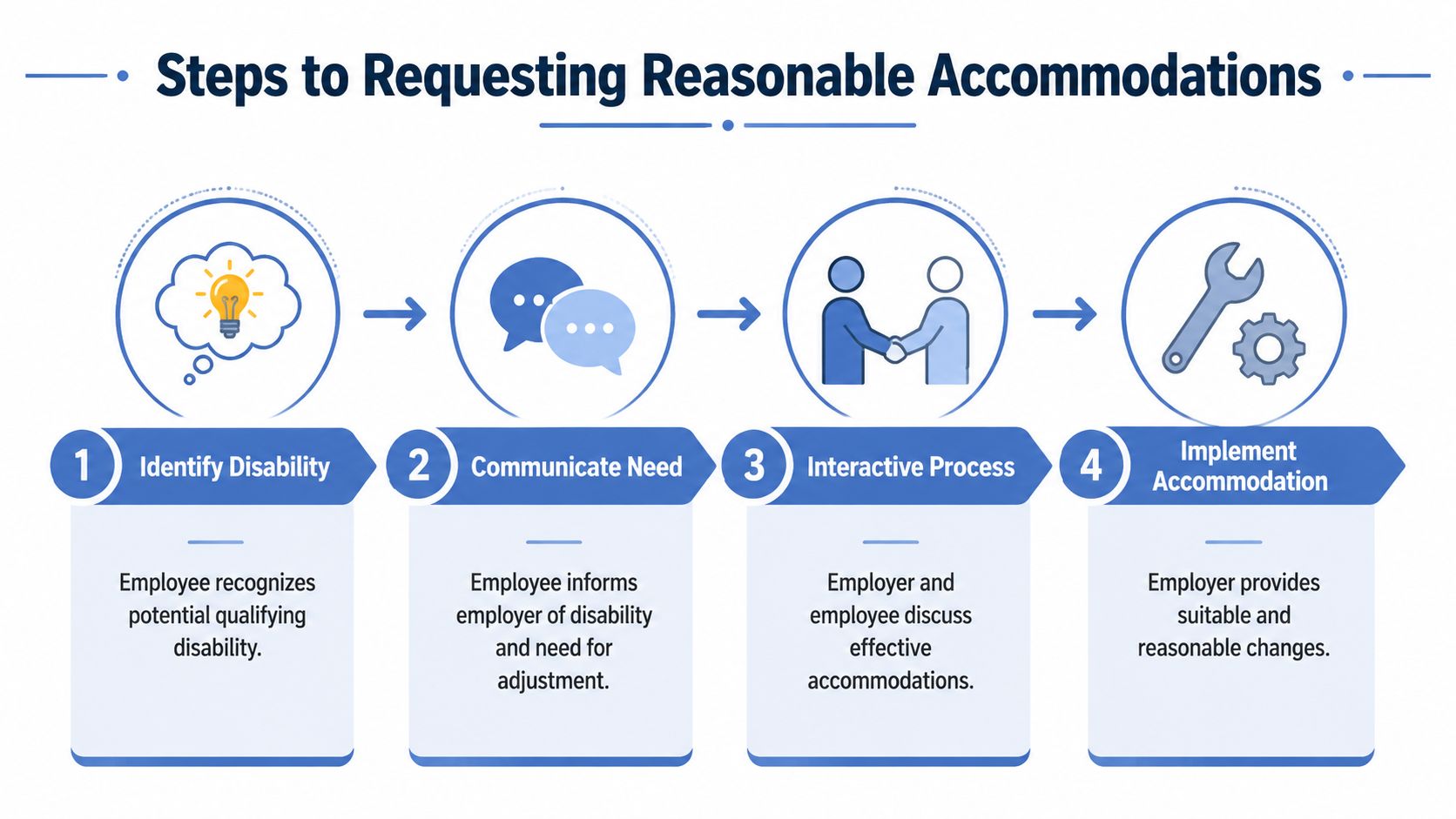
Requesting Reasonable Accommodations at Your Job
You tell your supervisor you are struggling. Instead of guessing what you need, make a clear accommodation request and create a paper trail. In Mississippi, that matters even more because the state does not have its own human rights commission to step in on ADA workplace claims. Federal enforcement usually runs through the EEOC, so your own documentation often becomes the backbone of the case.
What you can ask for
The U.S. Department of Labor's Job Accommodation Network identifies several common accommodations for psychiatric disabilities, including flexible schedules, telework, and leave for treatment, in its accommodation guidance for psychiatric disabilities.
These requests are routine. Employers should treat them that way.
Common accommodation requests for depression include:
- A modified schedule: Later start time, shorter temporary shifts, or protected time for treatment.
- Remote work or hybrid work: Useful when commuting, overstimulation, or lack of privacy makes symptoms worse.
- Leave for treatment or recovery: Time for therapy, medication adjustments, or a short recovery period.
- Changes to supervision or communication: Written instructions instead of rapid verbal direction, or regular structured check-ins.
- Environmental adjustments: A quieter workspace or tools that reduce distraction.
Ask for the change that helps you perform the job. Do not ask for everything at once if one or two adjustments will solve the problem.
How to ask the right way
Keep it simple and put it in writing. Email is usually the best choice.
You do not need to cite the ADA or use legal terms. Say you have a medical condition, explain how it affects your work, and identify the adjustment you need. Be specific enough that HR cannot pretend they did not understand the request.
For example:
"I have a medical condition that affects my concentration, sleep, and attendance. I'm requesting a reasonable accommodation in the form of a modified start time and flexibility for treatment appointments."
That should start the employer's duty to discuss options with you. The law calls that the interactive process. If you want a fuller explanation, read this article about the ADA interactive process.
What employers can and can't do
Your employer can choose an effective accommodation without giving you your first choice. But the employer cannot lawfully ignore the request, retaliate against you for making it, or reject it without considering whether a workable option exists.
Employers often respond with "undue hardship." Sometimes that defense is legitimate. Sometimes it is just a reflex. If a company says your request is too disruptive, ask what specific problem they believe it creates and whether a narrower adjustment would work instead.
Use this checklist:
- Put it in writing. Verbal conversations are easy to deny later.
- Connect the request to the job. Explain how the change will help you perform your duties.
- Provide medical support if requested. A short note describing restrictions is often enough.
- Answer follow-up questions promptly. Do not give HR an excuse to claim the request went cold.
- Save everything. Keep emails, notes from meetings, and any policy documents.
If your employer stalls, refuses to engage, or starts treating you differently after the request, take that seriously. Mississippi workers usually have to protect these rights through federal channels, not a state agency process. Consulting an employment lawyer such as Nick Norris, P.A., who handles employee-side workplace claims, can help you assess whether the employer is evaluating the request or delaying until the problem becomes a discipline case.
Comparing Your Rights Under the ADA and FMLA
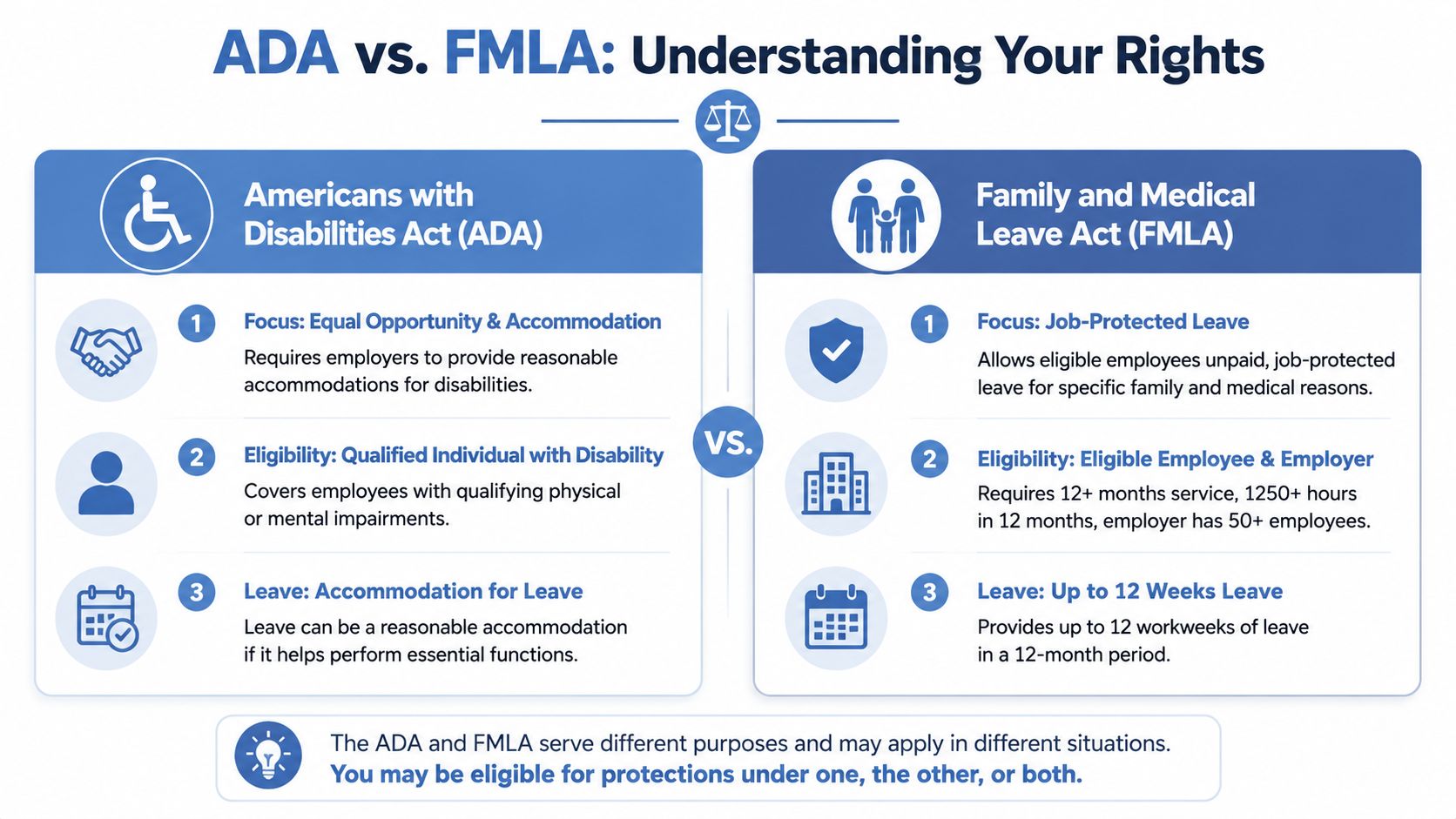
Employees mix up the ADA and the FMLA all the time. That's understandable, but it's a mistake. They do different jobs.
The ADA is mainly about helping you keep working through accommodation. The FMLA is about protected leave away from work if you qualify.
ADA vs FMLA for Depression
| Aspect | ADA (Americans with Disabilities Act) | FMLA (Family and Medical Leave Act) |
|---|---|---|
| Primary purpose | Accommodation and equal opportunity at work | Job-protected leave for qualifying medical or family reasons |
| Core question | Can you perform the job with a reasonable accommodation? | Are you eligible for protected leave from work? |
| Who qualifies | A qualified individual with a disability | An eligible employee who meets FMLA requirements |
| What it may provide | Schedule changes, remote work, leave, other adjustments | Time away from work with job protection |
| How depression fits | Depression may qualify if it substantially limits a major life activity | Depression may support leave if it qualifies as a serious health condition and you meet FMLA rules |
Where the laws differ most
The FMLA has specific eligibility rules. The comparison provided in the required visual is the key one: 12+ months of service, 1250+ hours worked in the prior 12 months, and an employer with 50+ employees. The ADA doesn't use that same framework. It focuses on disability status and whether accommodation would allow the employee to do the job.
That means a Mississippi employee might have rights under one law, the other, or both.
The ADA may keep you working. The FMLA may protect time away from work. In some cases, you use both in sequence.
When both laws matter
A common example looks like this:
- You need leave for medication adjustment or intensive therapy.
- FMLA may protect the leave period if you're eligible.
- When you return, the ADA may require accommodations such as a modified schedule, telework, or reduced distractions.
That's why employees shouldn't force every problem into one legal box. A leave issue may also be an accommodation issue. If you're sorting through that overlap, this guide to employee rights under FMLA is a practical companion.
The biggest mistake I see is waiting until an employer labels the problem "performance" before raising the medical issue. Once discipline starts, the facts get harder, and the employer's paper trail gets longer.
How to Protect Your Rights and When to Call an Attorney
If you think your depression is affecting your job and your employer is mishandling it, stop relying on casual conversations. Start building a record.
Mississippi workers need to be especially careful because there isn't a state human rights commission acting as a local backup for these claims. In many cases, the EEOC is the formal administrative path.
The steps I recommend
Write down how depression affects your work.
Be specific. Note concentration problems, attendance issues, sleep disruption, communication breakdowns, or episodes that interfere with tasks.Get medical documentation that matches the work problem.
A useful note doesn't just confirm treatment. It ties symptoms to functional limitations and, where appropriate, recommended accommodations.Request accommodation in writing before things get worse.
Ask for the change you need. Don't wait for a final warning.Save every response from HR and management.
Keep emails, texts, policy documents, and meeting summaries. If a supervisor says something important in person, send a follow-up email confirming the discussion.Watch for retaliation or pretext.
If the employer suddenly changes your duties, disciplines you selectively, or starts building a suspicious attendance record after you disclose a mental health condition, take that seriously.
Why timing matters
If you wait until after termination to explain the connection between depression and your work problems, you've made the case harder than it needed to be.
ADA claims often turn on notice. What did the employer know, and when did it know it? If the employer never had meaningful notice of a qualifying limitation and a need for accommodation, the defense gets easier for them.
That doesn't mean you have no claim if things moved fast. It means you need to evaluate the timeline with care.
Why legal help can be worth it
The EEOC process looks simple from a distance. It isn't. The wording of your charge matters. The documents you submit matter. The theory of the case matters. So does avoiding unhelpful statements that let the employer reframe a disability issue as mere misconduct.
If you're researching broadly, outside resources can help you understand how disability systems differ. For example, the Lein Law Offices Wisconsin disability guide discusses disability-related claims in another context. It isn't Mississippi employment law, but it can help some readers separate workplace discrimination issues from disability benefit issues, which are not the same thing.
Most employment lawyers handling these cases work on contingency, often around 40-50%. That means you need to ask hard questions at the front end about strategy, costs, and the likely administrative path. In Mississippi ADA cases, that path usually means dealing with the EEOC first, not some state civil rights agency that doesn't exist here.
If your employer refused to discuss accommodation, punished you after disclosure, or fired you while depression was clearly affecting major life activities, get advice early. Delay helps the employer.
If you're a Mississippi employee dealing with depression, disability discrimination, or a failed accommodation process, Nick Norris, P.A. offers worker-side employment law guidance focused on federal workplace rights in Mississippi.
This article has been reviewed for legal accuracy by Nick Norris. For employment law matters in Mississippi, consult with an attorney licensed to practice in your state.
Leave a Reply