

Mississippi Separation and Release Agreement Guide
When your employment comes to an end, you might be handed a document called a separation and release agreement. It's a legal contract that offers you a severance package in exchange for a promise: that you won't sue your former employer over anything related to your job or its termination.
What Is A Mississippi Separation And Release Agreement

Think of it as a final, legally binding handshake on your way out. It’s a contract where your employer offers you something of value—usually severance pay—and in return, you agree to give up your right to take legal action against them.
This isn't just a standard piece of HR paperwork; it's a serious legal document with permanent consequences. For companies in Mississippi, these agreements are a crucial risk-management tool. By offering you a severance package, they're trying to ensure a clean break and eliminate any chance of facing a lawsuit down the road.
At their core, all termination agreements are designed to finalize the employment relationship on very clear, documented terms. When you sign one, you’re closing the door on your ability to file a claim. Understanding this purpose is the first step toward making an informed decision.
Why Employers Use Separation Agreements
So, why would a company pay you to leave? It all comes down to one thing: to buy legal peace of mind. When you sign a separation and release agreement, you're usually waiving your right to sue over a whole host of potential claims, such as:
- Wrongful termination
- Discrimination based on age, race, sex, or disability
- Retaliation for whistleblowing or reporting illegal activity
- Any violations of federal employment laws
The fundamental trade-off is this: you get a severance package, and the company gets a shield against potential lawsuits. This exchange is what makes the agreement legally enforceable.
In essence, your former employer is paying you not just for your past contributions, but for your future silence and agreement not to pursue legal action. This is particularly valuable to employers in Mississippi, as it helps them avoid costly federal lawsuits. An employee's main option for recourse is often through federal agencies—a process that can be incredibly expensive and time-consuming for a company to fight.
What It Means For You As An Employee
For you, this agreement is a major crossroads. You're being asked to permanently sign away valuable legal rights. The real question you need to ask is whether what you’re being offered—the severance pay and any other benefits—is a fair exchange for those rights.
It’s critical to remember that a separation agreement is a proposal, not an order. You are never obligated to sign it. In Mississippi, many attorneys who review these documents work on a contingency fee, which often falls between 40-50% of any additional money they successfully negotiate for you above the company's first offer.
Understanding the purpose of this agreement is your most powerful tool. It allows you to shift your mindset from feeling pressured to sign to recognizing that you have a choice—a choice that will directly impact both your financial future and your legal rights. If your job loss is part of a larger layoff, you may also want to review our guide on Mississippi's rules for large-scale layoffs.
Decoding The Key Clauses In Your Severance Agreement
Getting handed a separation agreement can feel like you've been asked to read a document in a foreign language. It's dense, full of legal terms, and intimidating. But before you even think about signing, you have to understand what you're actually agreeing to. Let's translate the most important parts into plain English.
The General Release of Claims
This is the absolute heart of the agreement. The General Release of Claims is the trade-off: in exchange for what's in your severance package, you are giving up your right to sue the company for almost anything that happened during your employment.
This clause is written to be incredibly broad on purpose. It's the company’s way of buying total peace of mind and closing the book on your time there. You'll see a long list of specific federal laws, and by signing, you agree you won't use them to bring a lawsuit.
Typically, you're asked to waive claims like:
- Wrongful termination or breach of an employment contract.
- Discrimination based on age, race, sex, religion, or disability.
- Retaliation for whistleblowing or reporting illegal activity.
- Violations of other wage and hour or employment laws.
It's important to know that Mississippi does not have a human rights commission like many other states. This means most discrimination claims go through federal bodies like the Equal Employment Opportunity Commission (EEOC). Signing a release prevents you from getting any personal financial payout from an EEOC claim, even if the agency finds in your favor.
Confidentiality and Non-Disparagement
Almost every agreement will include clauses about confidentiality and non-disparagement. These sections control what you can and can't say after you leave, and they have a long-lasting impact on your professional life.
The confidentiality part usually means you can’t tell anyone the terms of your agreement, especially how much money you received. A non-disparagement clause goes a step further—it stops you from saying anything negative about the company, its management, or its products. Breaking these rules can have serious financial penalties; some agreements even state you’d have to repay your entire severance.
Understanding Consideration
The "consideration" is what the company gives you for signing. Think of it as the "payment" for the rights you're giving up. It’s critical to understand what is new and what you were already owed.
Consideration is the new value—typically a severance payment—that you get specifically for signing the agreement. Money you're already legally entitled to, like your final paycheck or earned and unused vacation time, does not count as consideration.
Your employer can't legally hold your final wages hostage to get you to sign. The consideration must be something extra. This is especially true for workers aged 40 and over, who have added protections under federal law.
The Older Workers Benefit Protection Act (OWBPA), for instance, has strict rules. To waive an age discrimination claim, the agreement must give you at least 21 days to think it over (45 days if it's part of a group layoff). You also get a 7-day window to revoke your signature even after you sign.
Common Clauses And What They Really Mean For You
To help you navigate these documents, we've put together a quick guide to some of the most common legal terms you'll see. Think of this as your cheat sheet for spotting what really matters.
| Clause Name | What It Means for You | What to Watch For |
|---|---|---|
| General Release | You give up your right to sue the company for past events. | The scope of the release. Does it try to waive future claims or rights you can't legally give up (like filing an EEOC charge)? |
| Consideration | The severance pay or benefits you receive for signing. | Is it actually something extra? Your final paycheck or accrued PTO doesn't count. |
| Confidentiality | You cannot discuss the terms of the agreement with others. | Vague or overly broad language. Are there exceptions for talking to your spouse, attorney, or financial advisor? |
| Non-Disparagement | You agree not to say anything negative about the company. | Is it "mutual"? A one-sided clause is a red flag. The company should also agree not to disparage you. |
| Non-Compete | Restricts your ability to work for a competitor. | Geographic scope, time limits, and the definition of a "competitor." Is it so broad it would prevent you from working in your field? |
| Revocation Period | A set amount of time you have to change your mind after signing. | For employees 40+, this must be at least 7 days. If it's missing or shorter, the age discrimination waiver is invalid. |
Seeing these terms laid out makes it clearer what's at stake. Each one carries significant weight, and a small change in wording can have a big impact on your future.
Looking Out For Restrictive Covenants
Finally, watch out for other restrictive clauses that might be buried in the agreement. A non-compete or non-solicitation provision can drastically limit your options for finding a new job in your industry.
These clauses are complex and have their own set of legal rules. To get a better handle on what's enforceable and what's not, check out our in-depth article on the enforceability of non-compete agreements in Mississippi. Before you put pen to paper, you have to understand every single clause and what it means for you.
Spotting Red Flags and Negotiating Your Agreement
After you've been handed a separation and release agreement, it’s easy to feel like you have no choice but to sign it as-is. This is a common and costly mistake. Think of the first draft you receive not as a final document, but as an opening offer in a negotiation—an offer written entirely by your employer, for your employer.
You have something they want: a legal promise not to sue. That promise has value. Before you give it away, you need to understand what you’re being asked to sign, spot the hidden dangers, and be ready to negotiate for a deal that’s actually fair to you.
This whole process really boils down to three key moving parts: what you’re giving up (the claims), what you’re promising (confidentiality and other restrictions), and what you’re getting in return (the payment).
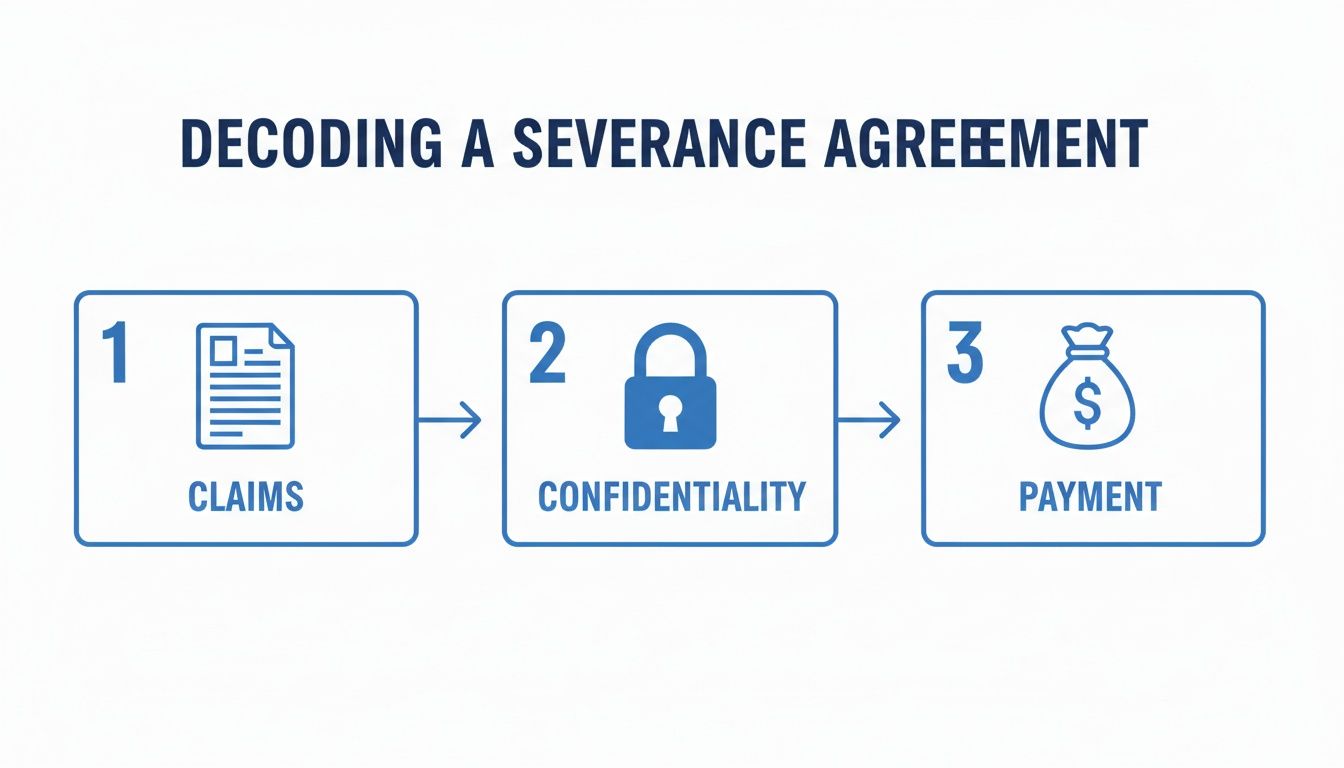
Every single one of these elements can—and often should—be negotiated.
Identifying Major Red Flags
Some clauses in these agreements aren't just unfavorable; they're outright red flags that could jeopardize your finances and future career. Knowing how to spot them is your first line of defense.
One of the worst offenders is an overly restrictive non-compete clause. If the language is so broad that it could prevent you from working in your own field or a large geographic area for a long time, it can effectively put your career on hold. You have to ask yourself: could this clause make it nearly impossible for me to find another job?
Another critical red flag is a clawback provision. This nasty little clause gives the company the right to take back your severance money if they decide you've violated the agreement, often for something as simple as a perceived negative comment. It's a one-sided threat that can hang over your head for years.
Keep an eye out for these other common trouble spots, too:
- A one-sided non-disparagement clause: If you’re barred from speaking ill of the company, the company should be held to the same standard. It should be a two-way street.
- High-pressure tactics: Being rushed to sign is a huge red flag. For workers aged 40 and over, federal law guarantees at least a 21-day review period. Any reasonable employer should give you time to consult an attorney, no matter your age.
- Releasing future claims: The agreement should only cover claims related to things that happened before you sign. Any attempt to make you waive rights for future events is a serious overreach and generally unenforceable.
Your Playbook for Negotiation
Negotiation is more than just asking for more cash. It’s about building a case for why the company's first offer falls short. The good news is that nearly everything in a separation agreement is on the table, from the severance amount to the fine print in every clause.
The strength of your negotiating position—your leverage—hinges on the specifics of your exit. Were you a victim of discrimination or retaliation? Do you have documentation of wrongdoing? Even without a slam-dunk legal claim, you have leverage. The company wants your signature to close the books and eliminate risk, and that’s worth something.
The heart of the negotiation is showing the company that your signature on a full release of claims is worth more than what they initially put on the table. This is precisely where an experienced employment attorney adds tremendous value.
Many Mississippi employment attorneys handle these cases on a contingency fee basis. This typically means they receive 40-50% of any additional money they negotiate for you above the original offer. You pay nothing upfront, and their fee is tied directly to getting you a better outcome.
Framing Your Requests and Calculating Your Worth
When you or your attorney presents a counteroffer, it needs to be professional and backed by solid reasoning. This isn't about making angry demands; it's about making a logical case for a fairer package.
Here’s a practical approach:
- Calculate the Real Value: Don't just think in terms of "weeks of pay." A truly fair package considers your years of service, your role in the company, the strength of any legal claims you're giving up, and a realistic estimate of how long it will take to find a comparable new job.
- Ask for Non-Monetary Changes: The best negotiations aren't always about money. You can push for a less restrictive non-compete, a mutual non-disparagement clause, a positive letter of reference, or a longer period of health insurance coverage.
- Put it in Writing: Always submit your counteroffer formally in writing. It creates a clear paper trail of your requests and signals to the employer that you are serious and organized.
Keep in mind, Mississippi doesn't have a human rights commission, so claims of discrimination are primarily handled through federal bodies like the EEOC. Waiving your right to pursue these federal claims is a major concession. Make sure the compensation you get in return truly reflects that. By looking for red flags and negotiating strategically, you can transform a standard corporate document into a severance package that truly protects your interests.
Managing Your Finances After Separation

Once you’ve worked through the legal language of a separation and release agreement, the focus immediately shifts to your financial reality. It’s one thing to read the terms, but it’s another to live with their real-world impact on your bank account. Let’s break down the practical money matters you'll face after leaving your job.
The severance payment is often the main event, but how it interacts with other benefits, like unemployment, is where things can get tricky. Understanding this relationship is your first step to building a solid financial plan.
How Severance Pay Affects Mississippi Unemployment Benefits
A common question I hear is, "Can I still get unemployment if my company gave me severance?" The short answer is yes, but there's a catch. In Mississippi, severance pay is considered income, which means it will almost certainly delay when you can start receiving unemployment benefits.
Think of it this way: if your company gives you a severance package equal to eight weeks of your old salary, the Mississippi Department of Employment Security (MDES) essentially views you as still being paid for those eight weeks. Your unemployment clock won't start ticking until that period is over.
The most important thing to remember is that severance delays your unemployment benefits—it doesn't disqualify you from them. You should always apply for benefits right after your termination and report the severance. Just be prepared for the waiting period.
Knowing about this delay is crucial for budgeting. It gives you a realistic timeline for when you can expect state assistance to kick in while you're looking for your next role. For a deeper dive, check out our guide on how severance affects unemployment benefits after termination.
Continuing Your Health Insurance with COBRA
Losing your job usually means losing your health insurance, which can be a huge source of anxiety. Thankfully, a federal law called COBRA (the Consolidated Omnibus Budget Reconciliation Act) acts as a safety net. It allows you and your family to stay on your former employer's health plan for up to 18 months.
Here's the sticker shock, though. While you were employed, your company likely paid a big chunk of your monthly premium. Under COBRA, you're on the hook for 100% of the cost, plus a small administrative fee of around 2%. That can easily cause your monthly payment to double or triple.
This is a major point of negotiation in your separation agreement. Don't be afraid to ask your employer to soften the blow. You could request that they:
- Pay the entire COBRA premium for a few months.
- Give you a lump-sum payment designated for healthcare costs.
- Continue paying their usual share of the premium for a set period.
Getting your employer to cover some of these costs can add significant real-world value to your severance package.
The Tax Realities of Your Severance Package
Finally, let's talk taxes, because you can be sure the IRS is thinking about them. Severance pay is considered supplemental income, and it's fully taxable. Your former employer will withhold federal and state income taxes, plus Social Security and Medicare, just like they did from your regular paychecks.
It’s worth noting that these agreements are now standard procedure. Only 3% of employers report having no written severance policies, meaning most companies have a formal process in place. This formalization means they are well-versed in the tax rules.
While you can't avoid the taxes, you might be able to influence how the payment is delivered. If you receive a large severance in a single lump sum, it could push you into a higher tax bracket for the year. A smart negotiating tactic is to ask for the payments to be split between two tax years (e.g., half in December and half in January). This simple change could lower your overall tax bill.
Navigating this new financial chapter can feel overwhelming. If you need help creating a budget and a plan, professional guidance through financial coaching can be a great resource to get you on solid ground.
When To Consult A Mississippi Employment Attorney
Getting a separation agreement handed to you can feel like a punch to the gut. The first thing you might want to do is sign it, grab the severance check, and just put this whole experience behind you. But this is exactly the moment you need to stop, take a breath, and think about getting a legal opinion.
It's simple: your employer’s lawyers wrote that agreement to protect the company. Their job isn’t to look out for you. An employment attorney’s sole purpose, on the other hand, is to protect your interests. We're trained to cut through the dense legal jargon, spot the traps buried in the fine print, and help you understand what you're really giving up.
Even if everything seems friendly and above board, a quick review can give you incredible peace of mind. It’s the only way to be sure the terms are fair and you aren't accidentally signing away critical rights.
When Legal Review Is A Must
While I'd argue a review is always a good idea, there are some situations where it's absolutely non-negotiable. If you have even a gut feeling that your termination was about more than just a business decision, you need an ally.
Does any of this ring a bell?
- You suspect discrimination: You believe you were let go because of your race, gender, religion, age (if you're 40 or older), a disability, or your national origin.
- You recently reported harassment: You were fired shortly after you complained about sexual harassment or being in a hostile work environment.
- You blew the whistle: Your termination feels like payback for reporting illegal activities or unsafe conditions at the company.
- You recently took protected leave: The company fired you right after you came back from FMLA leave or asked for a reasonable accommodation for a disability.
If you answered yes to any of these, you may have a serious legal claim against your employer. That severance check they're offering is almost certainly a lowball offer compared to what you could be owed. An attorney can give you a realistic assessment of your claim and fight for what's truly fair.
The Mississippi Context An Attorney Understands
Your rights as an employee can be tricky to navigate anywhere, but Mississippi has its own unique landscape. Here’s a critical fact most people don’t know: Mississippi does not have a human rights commission.
What does that mean for you? For most discrimination and harassment claims, your only path to justice is through a federal agency—the Equal Employment Opportunity Commission (EEOC).
An experienced Mississippi employment attorney knows the ins and outs of the EEOC process. We understand how to file a formal charge of discrimination and meet all the strict deadlines, a process that is often confusing and overwhelming to do on your own.
Without that specialized knowledge, it's easy to make a mistake that could get your case thrown out, potentially losing your rights for good.
How A Lawyer Adds Value Through Negotiation
A good attorney does more than just spot illegal firing. We are negotiators. By leveraging your potential legal claims, we can argue from a position of strength to get you a much better deal. And it's not always about more money.
We can negotiate for important changes that protect your career and your finances, like:
- Weakening or removing non-compete clauses that could stop you from getting your next job.
- Making non-disparagement clauses mutual so the company can’t bad-mouth you to future employers.
- Securing a positive or neutral job reference to help your job search.
- Getting the company to pay your COBRA health insurance premiums for a few months.
Best of all, you don't have to worry about upfront costs. For severance negotiations in Mississippi, attorneys often work on a contingency fee. A common rate is 40-50% of the extra money we get for you. This means we only get paid if we win you a better deal than what the company first offered, making expert help accessible right when you need it most.
Common Questions About Separation Agreements In Mississippi
When a separation agreement lands on your desk, your mind starts racing with practical questions. This isn't about abstract legal theory anymore—it’s about your career, your finances, and your future. Let's walk through some of the most common questions we hear from employees right here in Mississippi when they're handed one of these documents.
What Happens If I Refuse To Sign The Separation Agreement?
You are under no obligation to sign. It's entirely your right to refuse, and the consequence is straightforward: you won't get the severance pay or any other perks offered in the agreement.
On the flip side, by not signing, you hold onto all your legal rights. This means you can still pursue a lawsuit against your employer for things like wrongful termination, discrimination, or retaliation. Your employer still has to give you everything you’re legally owed, like your final paycheck and any vested benefits such as earned vacation time or 401(k) funds.
So you have to ask yourself: is the cash on the table worth more to you than the potential legal claim you'd be giving up? It’s a tough call that requires a hard look at what they're offering versus the strength of any case you might have.
Can I Still Get Unemployment If I Sign And Get Severance?
Yes, but there’s a catch. Signing a separation agreement and getting severance won’t disqualify you from receiving unemployment benefits in Mississippi, but it will almost certainly delay them.
Think of it this way: the Mississippi Department of Employment Security (MDES) sees that severance pay as continued income. If your severance package is equal to six weeks of your old salary, MDES will likely treat you as if you were still being paid for those six weeks. Your unemployment benefits won't kick in until after that period is over.
Since your job ended because of a layoff or termination, you should be eligible for benefits once the severance runs out. The key is to apply for unemployment as soon as your job ends and to report the severance payment accurately. This gets you in the system so your benefits can start the moment you're eligible.
How Much Does A Lawyer Cost For A Severance Review?
The cost for a lawyer to look over a separation and release agreement is usually more accessible than people think. Most Mississippi employment attorneys will offer a flat-fee initial consultation. For this one-time fee, they'll review the entire document, explain what all the legal jargon actually means, and point out any red flags.
If you then want the attorney to negotiate for a better deal, they typically switch to a contingency fee basis. Here in Mississippi, this is often 40-50% of the new money they get for you. It doesn't touch your original offer.
For example: Let's say your original offer was $10,000. If your lawyer negotiates it up to $20,000, their fee comes out of the extra $10,000 they secured for you.
This approach means you don't pay anything upfront for the negotiation. The attorney only gets paid if they put more money in your pocket, so their goal is the same as yours: to get you the best possible outcome.
Does Signing Waive My Right To File An EEOC Charge?
No, you can never waive this right. A separation agreement cannot legally stop you from filing a discrimination charge with the Equal Employment Opportunity Commission (EEOC). That's a protected right that no contract can take away.
But here’s the critical distinction: while you can still file a charge, signing the release means you give up your right to get any money from it.
- You can still report: You absolutely retain the right to notify the EEOC about what you believe were illegal actions, like harassment or discrimination.
- You can still participate: You can and should cooperate fully with any investigation the EEOC decides to launch.
- You likely cannot collect money: By signing the release, you waive your personal right to any financial settlement or award that comes out of an EEOC lawsuit.
In short, you can still be a whistleblower for the government, but you've already agreed not to personally profit from the outcome. Since Mississippi does not have a human rights commission, the federal EEOC is the main place to file these claims, making this a crucial detail to understand before signing anything.
If you've been presented with a separation and release agreement and need help understanding your rights and options, don't hesitate to seek expert legal guidance. The team at Nick Norris, P.A. is dedicated to protecting Mississippi workers and can help you navigate this complex process with confidence. Contact us today for a review of your case.
This article has been reviewed for legal accuracy by Nick Norris. For employment law matters in Mississippi, consult with an attorney licensed to practice in your state.
Leave a Reply