

Top Civil Rights Attorney in Mississippi | 2026 Legal Guide
You may be reading this after a write-up, a suspension, a demotion, a denied leave request, or a meeting where someone told you your treatment was “just policy.” In Mississippi, that kind of workplace problem often feels personal, unfair, and confusing all at once. The hardest part for many workers is not knowing whether what happened was merely bad management or an actual civil rights violation.
That confusion matters because Mississippi workers usually need to act under federal law, not rely on broad state-level protections that don't exist here. If you're searching for a civil rights attorney in mississippi, you're often not looking for a history lesson or a general definition of rights. You're trying to figure out whether your employer crossed a legal line, what evidence matters, how fast you need to move, and who can handle the claim in the system that decides it.
Understanding Civil Rights Violations in the Workplace
A workplace civil rights case usually falls into one of three buckets: discrimination, harassment, or retaliation. Many employees experience all three in the same sequence. Someone reports misconduct, gets treated differently afterward, and then gets pushed out.

Discrimination at work
Discrimination means an employer takes action because of a protected characteristic. In employment cases, that often involves race, sex, religion, national origin, disability, or age. The action might be firing, demotion, reduced hours, denial of promotion, unequal discipline, or refusal to accommodate a medical limitation when federal law requires the employer to engage with the issue.
A few common examples look like this:
- Race-based discipline: A worker gets written up for conduct that others outside the worker's racial group did without consequence.
- Pregnancy or sex bias: An employee returns from medical restrictions related to pregnancy and suddenly gets labeled “unreliable.”
- Disability-related exclusion: A qualified employee asks for a reasonable adjustment and management responds by forcing the person out instead of evaluating the request.
- Age-based replacement: An older worker is pushed aside and told the company wants “new energy” or a “different image.”
If you want a practical overview of how these claims are framed, this guide on employment discrimination cases in Mississippi is a useful starting point.
Harassment and hostile work environment
Not every rude workplace is illegal. That distinction matters. Federal law doesn't punish ordinary unfairness, personality conflicts, or a tough supervisor with a bad attitude. Harassment becomes legally significant when it is tied to a protected trait and is serious or persistent enough to alter the conditions of employment.
That can include repeated racial slurs, sexual comments, unwanted touching, mocking a disability, or religious hostility that management ignores.
Practical rule: If the conduct targets who you are, not just how your manager feels that day, it needs legal evaluation.
Retaliation after you speak up
Retaliation is one of the most common patterns I see in employment cases. It happens when an employee complains about discrimination, requests protected leave, participates in an investigation, or otherwise exercises a protected right, and the employer responds with punishment.
The punishment isn't always termination. It can be schedule changes, isolation, bad evaluations, sudden policy enforcement, or creating a paper trail designed to justify a later firing.
The fight for workplace justice in Mississippi has deep roots. In the 1960s, R. Jess Brown, Carsie Hall Sr., and Jack Young Sr. worked from Farish Street in Jackson and handled over 100 cases during Freedom Summer 1964, helping lay the legal groundwork for the federal protections workers still depend on today, as noted by the Mississippi Freedom Trail marker announcement honoring these civil rights lawyers.
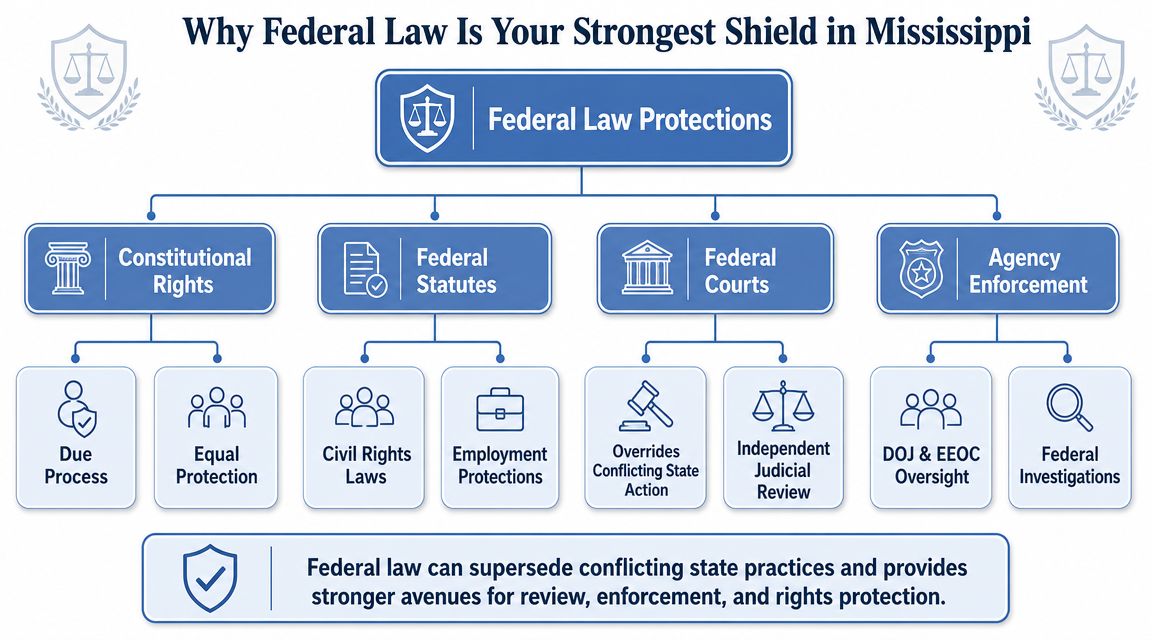
Why Federal Law Is Your Strongest Shield in Mississippi
Mississippi doesn't have a state human rights commission to investigate employment discrimination claims for you. That gap changes everything. In many states, workers have a state agency process running alongside federal law. In Mississippi, the practical center of gravity is federal law and the federal administrative process.
The federal laws that usually matter most
Most workplace civil rights claims in Mississippi turn on one or more of these laws:
| Federal law | What it generally covers | Why it matters in Mississippi |
|---|---|---|
| Title VII | Discrimination and retaliation involving race, sex, religion, and national origin | It often provides the main route for workers facing unequal treatment or harassment |
| ADA | Disability discrimination and failure to accommodate qualified workers | It gives employees a federal framework when health-related limitations affect work |
| ADEA | Age discrimination | It addresses decisions driven by age rather than performance |
| FMLA | Protected leave for eligible employees | It can protect workers who need time off for serious health conditions or family care |
These laws have technical requirements, and those details decide cases. Coverage thresholds matter. Eligibility matters. Timing matters. Employer records matter.
One example shows why federal law is so important. Under the FMLA, employers with 50+ employees within 75 miles can face liability if they interfere with an eligible employee’s 12-week leave entitlement, and around 70% of FMLA charges involve retaliation, according to the discussion of FMLA benchmarks on Nick Norris’s employment law profile.
What works and what usually doesn't
Workers often lose momentum because they rely on the wrong kind of complaint. An internal complaint to HR may help create a record, but HR is not a government enforcement agency. Complaining to a supervisor is important, but it doesn't replace the federal filing process. A social media post may feel satisfying, but it rarely advances the legal side of the case.
What usually works better is narrower and more disciplined:
- Use the employer's systems carefully: Report the conduct in writing if possible.
- Tie facts to protected activity: Identify what you complained about and when.
- Preserve documents: Keep emails, write-ups, leave paperwork, schedules, and texts.
- Get legal advice early: A federal employment claim can strengthen or collapse based on initial framing.
Mississippi employees often assume state law will fill the gap. In employment discrimination and retaliation cases, that assumption can be costly.
There's another important limit to understand. Mississippi does not provide state-law protection from retaliation for filing a workers' compensation claim. That's one reason workers need a realistic assessment of whether their facts fit a federal statute or one of the narrow claims recognized elsewhere in Mississippi law.
How an Attorney Helps You Navigate the Process
Most employees come in with facts, not legal categories. They know what happened. They don't know which documents matter, whether the employer's explanation is legally important, or what has to be filed before a federal case can move forward.
The first review
The first job is case evaluation. That means matching your timeline to a legal theory, identifying the employer involved, checking whether federal coverage requirements are met, and spotting immediate deadline issues. A good review also tests weaknesses early, because a claim that feels morally strong may still have a legal gap.
An attorney will usually want to see the items employees often underestimate:
- Your timeline: Complaint date, leave request date, discipline date, termination date
- Employer documents: Handbook excerpts, write-ups, separation notice, leave forms
- Communications: Emails, text messages, HR complaints, manager responses
- Witness context: Who saw what, who heard what, who made the decision
The EEOC charge
For many discrimination and retaliation claims, the next major step is filing a Charge of Discrimination with the EEOC. That filing is not a formality. It frames the claim, identifies the protected basis, and preserves your right to move forward under federal law.
A lawyer helps by deciding how broad or narrow the charge should be, what dates to include, which theories fit the facts, and how to avoid leaving out a key issue. This overview of the EEOC investigation process for Mississippi workers explains why that early filing stage deserves careful attention.
The words used in an EEOC charge matter. An incomplete charge can create problems later, even when the underlying facts are strong.
Investigation, negotiation, and federal litigation
After the charge is filed, the case may move through an EEOC investigation, requests for information, mediation discussions, or a right-to-sue stage. Some cases resolve before litigation. Others don't, especially when the employer has already committed to a defense story and built its internal record around it.
A lawyer's role changes as the case develops:
- During investigation, counsel organizes evidence and responds strategically.
- During settlement talks, counsel measures risk, damages, and proof problems.
- If litigation becomes necessary, the case proceeds in federal court, where procedure and evidence rules matter a great deal.
The value of counsel isn't just filing papers. It's judgment. Knowing what claim fits, what facts move it, and when an employer's stated reason is likely to hold up or fall apart.
Potential Remedies and Critical Deadlines in Employment Claims
Employees usually ask two questions first. What can I recover, and how long do I have?
The answer to the first depends on the claim and the facts. In federal employment cases, potential remedies can include back pay, front pay, compensatory damages, and sometimes punitive damages. Some cases also support reinstatement or correction of personnel records. In leave cases and reemployment disputes, the practical remedy may focus more on wages, benefits, and restoring the employee to the position the law required.
Remedies depend on proof, not outrage
Strong feelings alone don't produce recovery. The case has to connect the employer's action to a protected status or protected activity, and the damages need support from records and testimony.
A simple way to think about remedies is this:
- Lost income claims depend on payroll history, termination date, mitigation efforts, and benefits evidence.
- Emotional harm claims depend on credible testimony and supporting context.
- Job-related relief depends on whether returning to work is realistic and legally appropriate.
Deadlines can end a claim fast
For many federal discrimination claims in Mississippi, an employee generally has 180 days from the discriminatory act to file an EEOC charge. That window is short, and employees often lose time while hoping the employer will “make it right” internally.
Keep this in mind:
Waiting for HR to finish an internal process doesn't automatically protect your federal deadline.
If you're close to the deadline, the legal question isn't whether the employer acted unfairly in a general sense. The question is whether your claim can still be preserved. Delay is one of the most common reasons viable claims become much harder to pursue.
Choosing the Right Civil Rights Attorney in Mississippi
Not every lawyer who handles “civil rights” work handles employment claims. In Mississippi, that's a major distinction. Many search results mix together police misconduct, prisoner-rights cases, personal injury claims, and workplace disputes. Those are different systems, different statutes, and different proof problems.
Look for plaintiff-side federal employment focus
If your case involves discrimination, harassment, retaliation, FMLA interference, WARN issues, USERRA rights, or unpaid wage problems tied to workplace rights, you need someone who works on the employee side and understands federal employment procedure. A lawyer can be skilled and still be the wrong fit if most of the practice is criminal defense, insurance defense, or constitutional litigation outside employment.
Ask direct questions:
- What percentage of the practice is employee-side employment law?
- How often does the lawyer handle EEOC charges and federal employment cases?
- Has the lawyer worked with FMLA, WARN, USERRA, or retaliation claims similar to mine?
- Who will manage my file and communicate with me?
Understand the fee structure
Most employee-side employment cases are handled on a contingency fee. That usually means you don't pay attorney's fees upfront, and the lawyer is paid a percentage of the recovery if the case resolves successfully. The average contingency fee is 40-50%, so you should ask exactly how fees, expenses, and litigation costs are handled before signing anything.
A clear fee conversation should cover:
| Question to ask | Why it matters |
|---|---|
| What is the contingency percentage? | You need to know how the recovery will be divided |
| Who advances case costs? | Filing fees, records, and experts can affect net recovery |
| What happens if there is no recovery? | The answer should be stated plainly in the agreement |
Statewide access matters
Access to legal help is a real problem outside major population centers. According to the Mississippi Bar’s pro bono resources overview, workers often face county-based limits on free legal services, and rural areas can feel especially isolated. The same resource context also supports the point that per capita discrimination claims can be 20% higher than the state average in some rural areas, which makes statewide access especially important.
That matters if you live far from Jackson, work at a plant or regional facility, or can't make repeated in-person trips just to get basic answers.
One option in this space is guidance on how to find an employment lawyer in Mississippi, which can help you compare lawyers by case focus, geography, and experience with federal workplace claims. If you're evaluating a civil rights attorney in mississippi, don't start with branding. Start with whether the lawyer handles the kind of federal employment case you have.
Mississippi Worker Rights FAQ
Is Mississippi an at-will employment state
Yes. Mississippi is generally an at-will employment state. That means an employer can often end employment for a reason that is harsh, mistaken, or unfair, so long as the reason is not illegal under federal law or one of the narrow exceptions recognized by state law.
That surprises many workers. They assume a bad termination automatically creates a lawsuit. It doesn't.
Can I sue for wrongful termination just because I was treated unfairly
Usually, no. Mississippi wrongful termination claims are difficult because the state's common-law exception is narrow. As explained in this discussion of the Mississippi public policy exception and whistleblower limits, a viable claim generally has to fit a clear public policy violation, such as being fired for refusing to commit an illegal act.
That means “unfair” and “illegal” are not the same thing.
What should I save if I think my rights were violated
Save documents before they disappear from your work account or phone access changes. Focus on material that shows sequence, decision-makers, and stated reasons.
Useful items often include:
- Emails and texts: Especially messages about complaints, leave, discipline, or accommodations
- Write-ups and reviews: These help show whether the employer changed course after protected activity
- Pay records and schedules: Important for damages and timing
- Witness names: You don't need sworn statements on day one, but you do need to know who observed events
Write down a timeline while the details are still fresh. Dates matter more than people realize.
Should I quit before talking to a lawyer
Usually not without getting advice. Quitting can affect damages, proof, and the employer's defense. In some situations resignation may still be necessary, but it shouldn't be a reflex decision made in the middle of a bad week.
Do I need proof before I call an attorney
You don't need a complete trial file. You do need enough facts to allow a lawyer to evaluate the claim. A short timeline, the names of the people involved, and the documents you already have are often enough to start.
Does complaining to HR protect me
Sometimes it helps create a record, but it doesn't replace the legal steps required for federal claims. Internal reporting can be useful evidence. It is not the same as preserving a federal discrimination claim.
What if my employer says the decision was about performance
That is common. Employers rarely admit unlawful motive. Many cases turn on whether the performance explanation is consistent, documented, and applied the same way to others. A sudden drop in evaluations after a complaint or leave request can matter, but context is everything.
Do I have a claim if I was fired after filing a workers' compensation claim
Mississippi does not provide state-law retaliation protection because you filed a workers' compensation claim. Whether any legal claim exists depends on other facts and whether a federal law was implicated.
Is a civil rights attorney in mississippi the same as an employment lawyer
Not always. Some civil rights lawyers focus on police misconduct, prisoner-rights litigation, or constitutional claims against government actors. If your problem happened at work, ask whether the lawyer regularly handles employee-side federal employment cases.
If your employer punished you for speaking up, denied protected leave, ignored harassment, or fired you for a reason that may violate federal law, don't wait for the situation to get clearer on its own. A timely review can tell you whether your facts fit a federal claim, what documents matter, and what deadline controls your next step. Nick Norris, P.A. represents Mississippi workers in employment matters and offers guidance focused on the realities of federal workplace claims.
This article has been reviewed for legal accuracy by Nick Norris. For employment law matters in Mississippi, consult with an attorney licensed to practice in your state.
Leave a Reply