

A Guide to Discrimination Employment Cases in Mississippi
When you're treated poorly at work, it’s natural to feel wronged. But the line between a bad boss and an illegal action can be blurry. An employment discrimination case isn't just about general unfairness; it’s about being treated unfavorably because of a specific, protected part of who you are, like your race, gender, age, or disability.
Understanding Discrimination Employment Cases in Mississippi
It’s a tough situation, and many Mississippi workers find themselves wondering if what they’re experiencing is just a difficult workplace or something more. The legal distinction all comes down to the reason behind the negative treatment.
To put it simply, it's not illegal for a manager to be a jerk. It is illegal for them to be a jerk to you specifically because of your protected identity.
Think of it this way: a referee can make a bad call. But if that referee only calls fouls on one team for actions that both sides are committing, the game is no longer fair—it’s biased. That’s the difference between simple unfairness and illegal discrimination.
Your Rights Under Federal Law
For workers in Mississippi, federal laws are your primary shield against discrimination. This is incredibly important because, unlike many other states, Mississippi does not have its own human rights commission to handle these claims. This means you must rely on the powerful protections offered at the federal level.
Here are the three cornerstone laws you need to know:
- Title VII of the Civil Rights Act of 1964: The bedrock of employment law, this act makes it illegal to discriminate based on race, color, religion, sex, and national origin.
- The Americans with Disabilities Act (ADA): The ADA protects qualified employees with disabilities and legally requires employers to offer reasonable accommodations so they can do their jobs.
- The Age Discrimination in Employment Act (ADEA): This law specifically protects workers who are 40 years of age or older from being treated differently simply because of their age.
These laws don’t just cover hiring and firing. They apply to almost every aspect of your job, including promotions, pay, work assignments, and training opportunities.
It’s About More Than Just Unfairness
This heavy reliance on federal law has a direct impact on how you seek justice in Mississippi. If you feel you've been discriminated against, your first official step isn't filing a lawsuit. It's filing a formal complaint with the U.S. Equal Employment Opportunity Commission (EEOC), the federal agency responsible for enforcing these laws.
The core of a discrimination case is connecting an adverse employment action—like being fired, demoted, or denied a promotion—directly to your protected status. Without this link, a claim is unlikely to succeed.
Sadly, this isn't just a local problem. Workplace discrimination is a stubborn issue worldwide. In fact, 19% of workers globally report facing some form of discrimination on the job. These figures, highlighted in various workplace discrimination statistics, show just how much hidden bias can impact careers and cost companies dearly in lost talent and productivity.
This guide is designed to cut through the legal jargon and give you clear, practical knowledge. Our goal is to help you understand if what you’re facing at work is more than just unfair—it’s unlawful.
What Does Workplace Discrimination Actually Look Like?
It's one thing to know discrimination is illegal, but it's another thing entirely to spot it happening in real-time. Often, it isn't a blatant, obvious act. Instead, it’s subtle and frequently disguised as a standard business decision, which can leave you feeling confused and questioning yourself.
The first step toward protecting your rights is learning to identify the specific forms that illegal bias can take. Federal laws are clear: an employer cannot make decisions about hiring, firing, pay, or promotions based on certain parts of who you are. These are called protected classes.
Let's unpack these categories with some real-world scenarios you might face.
Race and National Origin Discrimination
This is when an employer treats you differently because of your race, skin color, ethnicity, or country of origin. It often hides in plain sight within everyday workplace dynamics.
A Clear Example: A highly qualified Black employee with a stellar performance record is repeatedly passed over for management roles. Each time, a less-experienced white colleague gets the job. When he asks for feedback, his manager offers vague comments about him "not being a good fit for the leadership culture."
Another Common Scenario: A manager constantly makes "jokes" about a Hispanic employee's accent during team meetings. That employee is later taken off a major client account, with the manager claiming customers might "have a hard time understanding her," despite a history of positive client feedback.
These aren't just instances of unfairness. The negative actions are directly linked to the employees' race and national origin, and that's what makes them illegal.
To help you distinguish between what's unfair and what's unlawful, here is a quick guide.
Recognizing Discrimination Examples and Protected Actions
| Protected Class | Example of Potential Discrimination | Example of a Lawful (Though Potentially Unfair) Action |
|---|---|---|
| Race | Promoting a less-qualified white employee over a more qualified Black employee, with vague "culture fit" reasoning. | Promoting an employee who has better performance metrics, even if another employee has been there longer. |
| Sex | Denying a promotion to a new mother based on the assumption she won't be as committed to her career. | Denying a promotion to an employee (of any gender) who consistently misses project deadlines. |
| Age (40+) | Laying off several employees over 50 during a "restructuring" while hiring younger staff for similar roles. | Laying off an employee due to the elimination of their specific job function, regardless of their age. |
| Disability | Refusing to provide an ergonomic chair for an employee with a documented back injury, calling it "special treatment." | Terminating an employee who can no longer perform the essential duties of the job, even with accommodation. |
The key takeaway is that the law protects you from adverse actions taken because of your protected status, not from every tough or unpopular decision an employer makes.
Sex and Gender Discrimination
This involves poor treatment because of your sex, which also includes bias related to pregnancy, childbirth, or related medical conditions. This kind of discrimination is often rooted in outdated stereotypes about an employee's abilities or priorities.
A huge red flag is when an employer's official reason for a decision just doesn't add up. If their explanation feels flimsy or contradicts how they've treated other employees in similar situations, it could be a cover—what we call pretext—for illegal bias.
For example, an employer might pass on a woman for a key project right after she announces her pregnancy, assuming she'll be less available. Even if the manager believes they're just being "practical," making a decision based on a stereotype about pregnant employees is against the law. When this kind of behavior is repeated or widespread, it can create a toxic atmosphere. We cover this in more detail in our guide on how to prove a hostile work environment.
Age Discrimination
The Age Discrimination in Employment Act (ADEA) offers specific protections for workers who are 40 years of age or older. It’s not uncommon to see companies push out experienced, older employees under the banner of "modernizing" or creating a more "dynamic" workforce.
- Here's a classic example: A company announces a major reorganization aimed at building a more "energetic and forward-thinking culture." Soon after, a handful of employees over 50 are laid off. Their jobs aren't eliminated; instead, their responsibilities are handed to younger, less-experienced new hires. The company cites "performance issues," but the terminated employees all had years of positive reviews.
Watch out for coded language. Words like "energy" or "needing a fresh perspective" can sometimes be used to mask an illegal preference for younger workers, which is a clear violation of the ADEA.
Disability Discrimination
Under the Americans with Disabilities Act (ADA), employers are required to provide reasonable accommodations for qualified employees with disabilities. A disability is a physical or mental impairment that substantially limits one or more major life activities. Discrimination often happens when an employer simply refuses to have a conversation about finding a solution.
- What this looks like: An employee provides a doctor's note for a chronic back condition and requests a better office chair to do his job without constant pain. The manager flatly denies the request, saying it's "special treatment" and tells him to "deal with it."
This refusal to even consider a simple, reasonable accommodation may be a violation of the ADA. The law doesn't force an employer to create a brand-new position or remove essential job duties, but it absolutely requires them to engage in a good-faith process to find a workable accommodation.
How the EEOC Process Works for Mississippi Employees
If you’ve been discriminated against at work in Mississippi, your path to justice doesn't start at the courthouse. Instead, there's a mandatory first stop you have to make: the U.S. Equal Employment Opportunity Commission, or EEOC. You can think of the EEOC as the official gatekeeper for all federal employment discrimination claims.
Before you can even think about filing a lawsuit, you must file a formal complaint—called a Charge of Discrimination—with the EEOC. This isn't just a suggestion; it’s a strict legal requirement. Getting this step right is absolutely crucial to preserving your legal rights.
This chart breaks down the basic thought process: moving from feeling unfairly treated to understanding if you have a real legal claim.
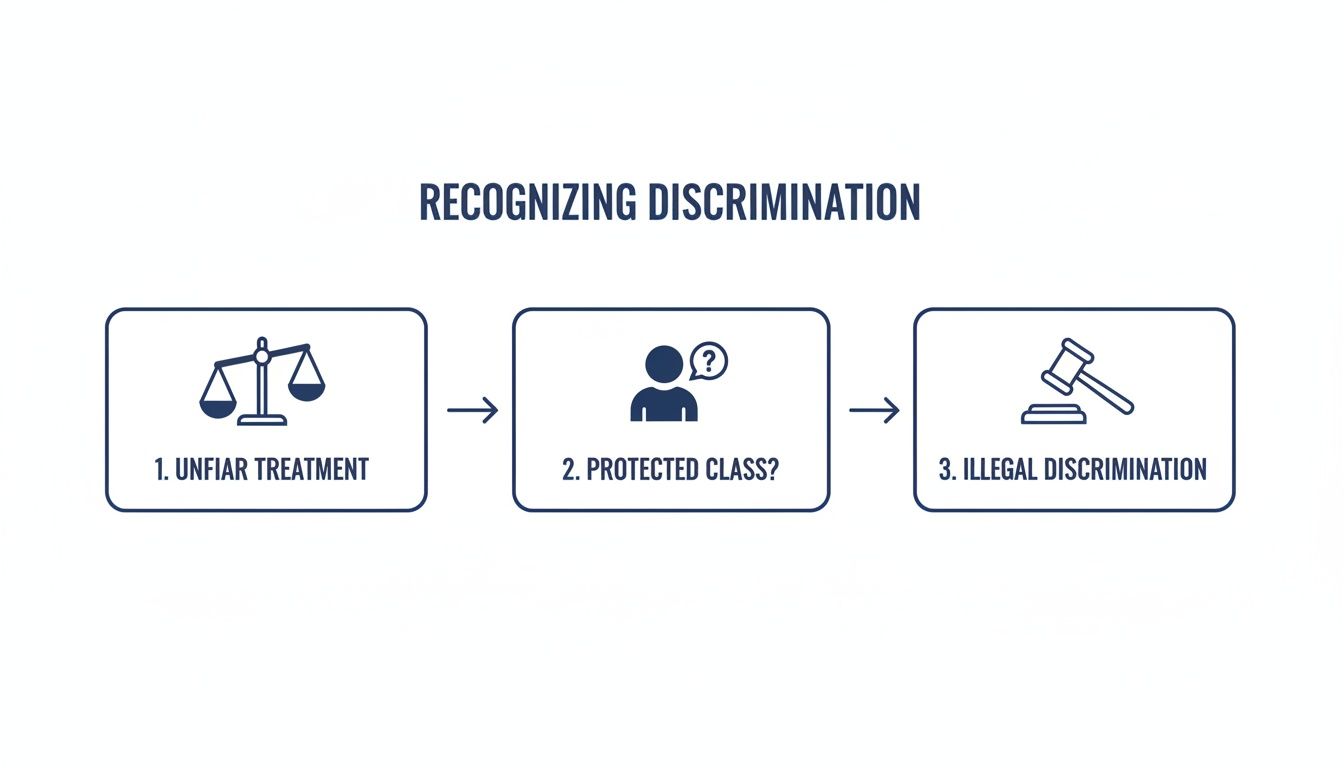
As the visual shows, it’s not enough to just be treated unfairly. The unfair treatment must be directly connected to your status as a member of a protected class to become illegal discrimination.
The Unforgiving 180-Day Deadline
Here’s the single most important rule to remember: the deadline. In Mississippi, you typically have just 180 days from the date of the discriminatory act to file your charge with the EEOC. This is a brutally short and unforgiving timeframe.
Miss that deadline, and your right to pursue the case is likely gone for good. That's why you can't afford to wait and see if things get better at work. The clock starts ticking the moment the discrimination happens—whether that's the day you were fired, demoted, or harassed.
The Five Stages of an EEOC Charge
Once you file a charge, the EEOC follows a predictable path. While the details of every case are different, you can generally expect the process to unfold in these five stages.
Intake and Filing: It all begins when you first contact the EEOC. An agent will interview you to understand what happened. If your situation is covered by the laws they enforce, they will help you prepare and file your official Charge of Discrimination.
Employer's Response: After your charge is filed, the EEOC sends a formal notice to your employer. The company is then required to submit a written answer to your claims, known as a "Position Statement," along with any evidence they have.
Mediation Opportunity: In many cases, the EEOC will offer a chance to resolve the issue early through mediation. This is a voluntary and confidential process where a neutral third party helps you and your employer try to find common ground and reach a settlement. If it doesn't work out, the investigation continues.
The Investigation: Your case will be assigned to an EEOC investigator. Their job is to gather the facts from both sides. This could involve interviewing you, your coworkers, and management; requesting documents like emails and personnel files; and reviewing company policies. This can often be the longest part of the process.
Final Determination: Once the investigation is complete, the EEOC issues its findings. They might determine there is "reasonable cause" to believe discrimination occurred, or they might dismiss the charge. Either way, they will issue a "Notice of Right to Sue" letter. This letter is your official green light to file a lawsuit in federal court.
It's important to understand that the EEOC's job is to investigate potential violations of federal law, not to act as your private attorney. Their decision doesn't stop you from pursuing your case on your own once you have that Right to Sue letter.
The process is full of procedural hurdles. Navigating this administrative maze with a clear strategy can make all the difference, and working with an experienced attorney from the start ensures your case is built on a solid foundation.
Building Your Case: How to Document Workplace Discrimination

A successful discrimination claim isn't built on feelings or hunches. It's built on a foundation of solid, organized evidence. Your power begins the moment you start documenting what’s happening to you. This isn’t about picking a fight; it's about being prepared and taking control of your own narrative.
Think of it this way: good documentation turns a vague sense of being wronged into a compelling story that an attorney or the EEOC can act on. Every piece of proof you collect helps paint a clearer picture of the illegal treatment you’ve faced.
Start a Detailed Log of Events
Your single most powerful tool is a simple journal. After every incident that strikes you as discriminatory, take a few minutes to write it all down while it’s fresh. Channel your inner reporter and get the facts on paper.
- Who: Who was involved? Note every manager, coworker, or HR person by name.
- What: What exactly was said or done? Quote directly if you can. Try to be as objective as possible.
- When: Write down the date and time. Timing is often critical in these cases.
- Where: Did this happen in a private office, a public team meeting, or over email? The context matters.
- Why: Why do you believe this was discrimination? Connect the dots. For example, "This comment was made the day after I requested a religious accommodation."
This habit of consistent, detailed record-keeping forms the backbone of your case. It keeps the details from fading and gives your attorney a clear timeline to work with.
Gather and Preserve All Physical Evidence
Beyond your personal notes, you need to save every piece of tangible proof you can get your hands on. In today's workplace, a lot of this evidence is already in writing.
The goal here is simple: move your claim from a "he said, she said" situation to a "here is the proof" case. Every email, text message, and performance review is another brick in that foundation.
Be meticulous about saving these items:
- Emails and Texts: Forward important work emails to a personal email address. Take clear screenshots of any relevant text messages or instant messages.
- Performance Reviews: Keep copies of all your reviews. This is especially crucial if you have a history of glowing feedback that suddenly soured for no apparent reason.
- Company Policies: If possible, get a copy of the employee handbook or specific policies on things like promotions, discipline, and accommodations.
- Witness Information: Quietly create a list of coworkers who saw or heard what happened. Get their names and personal contact information (if you can do so discreetly), as their testimony could be essential for backing up your story. For instance, knowing how to prove age discrimination often means showing a pattern of behavior that colleagues can confirm.
Look for Your "Comparator"
One of the most powerful ways to prove discrimination is by showing you were treated differently than someone in a very similar position who isn't in your protected class. Lawyers call this "comparative evidence."
For example, if you were written up for being 5 minutes late, but your younger coworker is regularly late with no consequences, that’s a powerful discrepancy. A legal employment document analyzer can sometimes help spot these patterns in formal records. Your job is to find a "comparator"—a coworker whose situation is nearly identical to yours, except for their age, race, gender, or other protected characteristic.
What Happens After the EEOC? The Path to a Lawsuit
Once the EEOC wraps up its investigation, you're not at the end of the road—you're at a critical fork. The administrative process is over, and the path to the courthouse opens up. It all hinges on one very important piece of mail: the "Notice of Right to Sue" letter.
Think of this letter as your green light. It officially gives you permission to take your employer to court. But it comes with a catch, and it's a big one. The moment that letter is issued, a 90-day countdown starts ticking.
This isn't a suggestion; it's a hard deadline. If you don't file a lawsuit in federal court within those 90 days, you lose your right to sue forever. It doesn't matter how strong your case is. This tight window is why it's so important to have a plan—and an attorney—ready to move quickly.
Settlement or Trial? The Two Roads to Resolution
With your Right to Sue letter in hand, your case will almost certainly go down one of two paths. It might surprise you to learn that the vast majority of employment discrimination cases—over 95%, in fact—are resolved without ever seeing the inside of a courtroom.
Settlement Negotiations: This is where most cases land. Your lawyer and your employer's lawyer will start talking, trying to find a middle ground. A settlement is simply a confidential deal where the company agrees to pay a sum of money, and in return, you agree to drop the lawsuit. It gives both sides certainty and avoids the stress, time, and expense of a full-blown court battle.
Formal Litigation: If you can't reach a fair settlement, the next step is to file a formal complaint in federal court. This kicks off the litigation process, which involves things like "discovery" (where both sides exchange all their evidence), depositions (sworn testimony taken out of court), and various pre-trial motions. Even though very few cases actually make it to a trial, preparing as if you're going all the way is the best way to show the other side you mean business.
What Can You Actually Recover in a Discrimination Lawsuit?
If your claim is successful, the law provides for different kinds of compensation, legally called "damages." The whole point is to make you financially "whole" again, as if the discrimination never happened, and to hold the company accountable.
Here’s what you might be able to recover in a discrimination case:
- Back Pay: This is straightforward. It’s the money you lost—wages, bonuses, benefits—from the day the discrimination occurred up until your case is resolved.
- Front Pay: Sometimes, going back to your old job just isn't an option. In that situation, a court might award "front pay" to cover the future earnings you'll lose while you search for a new job.
- Compensatory Damages: This is compensation for the real, human cost of discrimination—the stress, the anxiety, the emotional distress, and the mental anguish you’ve been put through.
- Punitive Damages: These are reserved for the worst cases. If an employer's actions were especially malicious or reckless, a court can award punitive damages. The goal isn't to pay you back for a loss but to punish the company and send a clear message that their behavior won't be tolerated.
How Can You Afford to Go Up Against a Big Company?
The thought of suing a company with deep pockets is intimidating for anyone. That's why experienced employment attorneys, including our firm, Nick Norris, P.A., almost always handle these cases on a contingency fee basis.
What does that mean? It means you pay zero attorney's fees upfront. The law firm advances all the costs of fighting your case. You only pay a fee if—and when—we win a settlement or a verdict for you.
This approach levels the playing field. It ensures that anyone with a valid claim can get high-quality legal help, not just those who can afford to write a big check. The fee is a set percentage of the total amount recovered, usually between 40% and 50%. If we don't win your case, you owe us nothing in attorney's fees. It's that simple.
And these issues are more common than you might think. In fiscal year 2024, the EEOC saw 88,531 new discrimination charges filed nationwide—that's a shocking 9.2% jump from the year before. Retaliation remains the number one complaint, proving that many workers who dare to speak out are punished for it. This trend makes having a skilled legal advocate in your corner more critical than ever. Discover more insights about workplace discrimination trends in 2025.
When You Should Contact an Employment Lawyer
Knowing your rights is the first step, but the real power comes from taking action. While this guide gives you a solid overview of employment discrimination cases, the truth is that every situation is different. Yours has its own unique facts and nuances that really need a professional legal eye.
If there's one thing you take away from this guide, let it be this: contact an attorney the moment you suspect you've been a victim of discrimination.
This isn’t about being overly aggressive; it’s about being smart. The law gives you a very narrow window to act. The federal 180-day deadline to file a charge with the EEOC is incredibly strict and unforgiving. Waiting around, hoping things will get better, or second-guessing yourself can mean permanently losing your chance to seek justice. That clock starts ticking on the day the discriminatory act happens.
Taking Action Is an Act of Empowerment
Hiring a lawyer doesn't mean you're looking for a fight. It means you're looking for protection. It’s about making sure your story gets told correctly and that you have a professional in your corner.
A good attorney can quickly evaluate your claim, help you gather and preserve the right evidence, and handle all the complicated paperwork and procedures the EEOC requires.
You do not have to walk this path alone. Seeking legal counsel is an act of empowerment that levels the playing field, giving you a dedicated advocate to stand up for your rights against an employer's resources.
Remember, Mississippi doesn't have its own state agency for these claims, so the federal EEOC process is your only shot. That makes getting experienced legal help even more crucial.
You Can Afford to Get Help
So many people hesitate because they're worried about the cost. It's a valid concern, but here's how it usually works: most employment law firms take these cases on a contingency fee basis.
What does that mean? You pay nothing upfront. Zero. The lawyer's fee is simply a percentage of the money they recover for you, which is typically between 40-50%. If you don’t win your case, you owe them nothing for their time.
Please don't let the fear of legal bills stop you from finding out what your options are. At Nick Norris, P.A., we're here to listen, help you understand your rights, and fight for the justice you deserve.
Common Questions About Discrimination Cases
When you're facing potential discrimination at work, it's natural to have a lot of questions and concerns. Let's walk through some of the most common ones that come up for Mississippi workers.
"How Can I Afford an Employment Lawyer in Mississippi?"
This is often the first and biggest hurdle people worry about, but there's good news. Most experienced employment attorneys, including our firm, take these cases on what's called a contingency fee basis.
Put simply, this means you don't pay anything out of pocket. There are no upfront attorney fees. Your lawyer's fee is just a percentage of the money they win for you, whether that comes from a settlement or a court verdict. In Mississippi, this usually ranges from 40% to 50%.
This system is designed to give everyone a fair shot at justice, regardless of their financial situation. You don't have to carry the financial risk of a lawsuit. If there's no recovery in your case, you owe no attorney's fees.
It also means your lawyer is fully invested in getting you the best possible outcome. We only succeed when you do.
"I'm Afraid I'll Be Fired if I Report Discrimination. What Can I Do?"
That's a completely understandable fear, and it's one the law takes very seriously. Federal law makes it illegal for your employer to retaliate against you for standing up for your rights. This protection kicks in when you report discrimination, participate in an investigation, or file a formal charge.
"Retaliation" isn't just about being fired. It's any negative action that could scare a reasonable person away from speaking up. This can look like:
- Being fired, demoted, or having your hours cut.
- Suddenly getting a string of bad performance reviews.
- Being left out of meetings, projects, or training you used to be part of.
- Facing a new wave of harassment or micromanagement.
If your employer takes any of these actions against you after you've raised a concern, they've just created a separate legal claim for retaliation—which is often even stronger than the original discrimination issue. If you suspect this is happening, document everything immediately.
"How Do I Know if My Difficult Boss Is Actually Breaking the Law?"
This is a crucial distinction. Unfortunately, the law doesn't protect us from bosses who are just plain difficult, unfair, or rude. For bad behavior to be illegal, it has to be connected to your protected status—your race, gender, age, disability, religion, or national origin.
The question you have to ask is: "Is my boss treating me this way because of who I am?"
Think of it this way: A manager who's a tough taskmaster with everyone on the team is probably just a difficult boss. But if that same manager only criticizes the work of older employees, or only denies promotions to women, their behavior has likely crossed the line from just being "tough" into illegal discrimination.
If you believe your rights have been violated, you don't have to figure this out alone. The team at Nick Norris, P.A. is here to provide the clear guidance and strong advocacy you need. Contact us today for a confidential consultation to understand your options.
This article has been reviewed for legal accuracy by Nick Norris. For employment law matters in Mississippi, consult with an attorney licensed to practice in your state.
Leave a Reply