

Retaliation for Workers Comp Claim: A MS Guide
You reported the injury. You followed the rules. You asked for medical care and wage benefits because you got hurt doing your job. Then the mood changed.
Your supervisor stopped talking to you like a human being. Your schedule got weird. Small mistakes suddenly became “performance issues.” Overtime disappeared. You started wondering whether filing a claim was a mistake.
It wasn’t.
But if you’re in Mississippi, you need the truth, not a comforting myth. A lot of workers assume the law clearly protects them from retaliation for workers comp claim activity. In this state, that assumption can get you hurt twice. First at work, then in the legal system. The path forward usually isn’t a simple workers’ comp retaliation claim. It’s often a smarter, tougher federal-law strategy built around what happened after the injury, especially leave rights and disability-related issues.
The Fear After Filing a Workers Comp Claim
A common story goes like this. A warehouse worker hurts his back lifting inventory. He reports it the same day, gets medical restrictions, and starts a workers’ compensation claim. Before the injury, nobody complained about his attitude. After the claim, he’s “not a team player.” He gets moved to a worse shift. His manager starts documenting things that had never mattered before.
That kind of timing puts people on edge for a reason.
You know when something changes overnight. Most workers don’t need a lawyer to tell them the workplace turned hostile right after an injury. They feel it in the write-ups, the silence, the cold shoulder, the sudden scrutiny, and the pressure to resign before the employer has to say the quiet part out loud.
If your job changed right after your injury report, trust your instincts. Then back those instincts up with records.
Here’s the hard part. In Mississippi, unfair treatment after a work injury may be real, obvious, and morally wrong, but that doesn’t mean state law gives you a clean claim for it. That’s why you need to stop thinking only in workers’ comp terms. You need to look at the full employment picture. Did you need leave? Did you ask for restrictions? Did your employer refuse to work with medical limitations? Those questions often matter more than the workers’ comp filing itself.
Defining Workplace Retaliation After an Injury
Retaliation is an adverse employment action tied to protected conduct. In plain English, it means your employer took action against you because you asserted rights connected to your injury or recovery.

A lot of people think retaliation only means getting fired. That’s too narrow. Retaliation often starts smaller because smaller actions are easier for employers to explain away later.
Harvard-linked reporting on a study of injured workers states that workers injured on the job are twice as likely to be fired within the six months following their injury compared to uninjured workers. That doesn’t mean every bad outcome is illegal. It does mean your suspicion isn’t paranoid.
What retaliation can look like
- Termination: The obvious one. You file, report restrictions, or need time off, and suddenly you’re gone.
- Demotion or reassignment: You keep your job title on paper, but the employer strips away duties, status, or decent work.
- Cut hours or pay: This is common because employers know financial pressure pushes people out fast.
- Discipline that appears out of nowhere: Old habits become “violations” only after the injury.
- Shift changes: A move to nights, weekends, or an impossible schedule can be punishment dressed up as operations.
- Isolation: Exclusion from meetings, training, overtime, or normal workplace access can matter.
- Hostility: Harassment, surveillance, or repeated comments about your injury can support a broader pattern.
Constructive discharge is real
Sometimes the employer doesn’t fire you. They make the job miserable enough that quitting looks like the only option. That’s called constructive discharge.
A worker with lifting restrictions gets assigned tasks designed to expose the restriction. Another worker returns from treatment and loses access to the tools or schedule that made the job workable. Someone else gets written up every week until they crack and resign. That isn’t a coincidence. It’s often strategy.
Practical rule: Don’t quit until a lawyer reviews the facts, unless staying puts your health or safety at risk.
Quitting can wreck an otherwise strong case if you can’t prove the conditions were objectively intolerable.
Mississippi’s Legal Gap for Workers Comp Retaliation
Here’s the blunt answer. Mississippi does not give workers a specific state-law protection against retaliation for filing a workers’ compensation claim. If someone told you otherwise, they oversimplified the law or confused Mississippi with states that do provide that remedy.
That matters because Mississippi is generally an at-will employment state. In an at-will system, an employer can fire you for a bad reason, a thin reason, or no stated reason at all, unless a contract or a specific law says otherwise. If you want a straightforward primer on that framework, read these Mississippi exceptions to at-will employment.
What that means in real life
If your employer fires you right after you file a claim, that timing may look ugly. It may even feel like obvious retaliation. But in Mississippi, ugly facts alone don’t automatically create a state retaliation claim based only on the workers’ comp filing.
That’s why workers lose time chasing the wrong theory. They think, “I filed a claim, then I got fired, so I must have a case under Mississippi workers’ comp retaliation law.” Usually, that’s not the right frame.
The quitting trap
This gap in Mississippi law also makes quitting especially dangerous. Some workers try to preserve dignity by walking away. I understand that impulse. But from a legal standpoint, it can make a hard case even harder.
This discussion of constructive discharge in a workers’ comp retaliation context states that constructive discharge comprises 25% of retaliation suits according to 2024 EEOC data, and that in Mississippi a worker must prove conditions were so unbearable a reasonable person couldn’t endure them. That is a high bar.
| Situation | Legal reality in Mississippi |
|---|---|
| You filed a comp claim and got treated worse | Suspicious, but not automatically actionable under a specific Mississippi anti-retaliation statute |
| You were pushed to resign | Possible constructive discharge theory, but proof has to be strong |
| You also requested leave or accommodations | Federal law may provide the better path |
Stop expecting Mississippi workers’ comp law to save you from every retaliatory employer. In this state, the stronger move is often to build the case around federal protections your employer violated while dealing with your injury.
Finding Protection Under Federal Law
When Mississippi law leaves a hole, federal law may fill part of it. Not always. But often enough that you’d be foolish to ignore it.
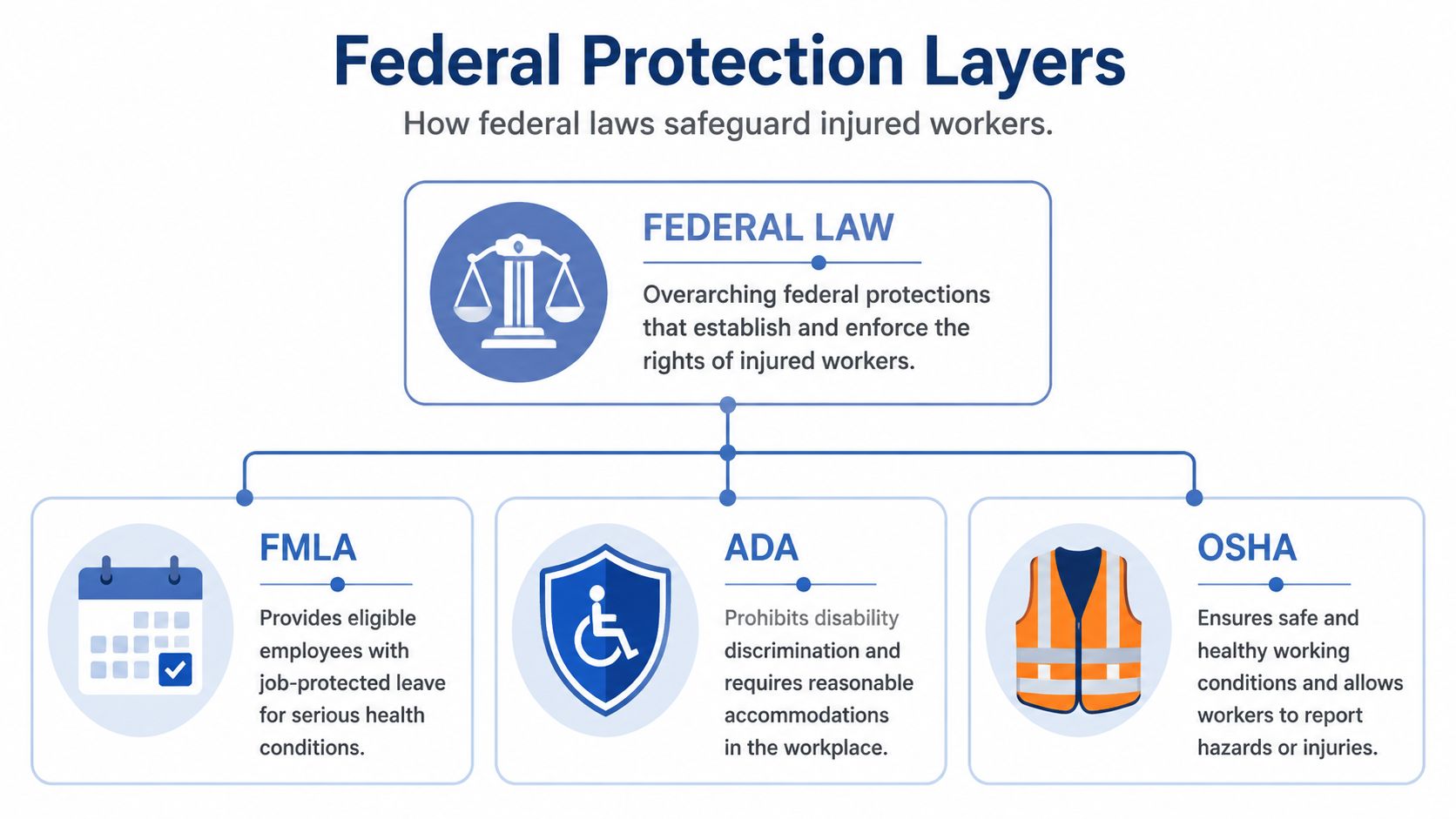
The two most important statutes are usually the Family and Medical Leave Act and the Americans with Disabilities Act. Sometimes OSHA-related safety reporting or whistleblower facts also matter. If your employer punished you after you raised safety concerns, this overview of whistleblower retaliation can help you spot overlap.
FMLA can matter more than the comp claim
If your injury is serious enough to keep you out of work or require ongoing treatment, FMLA may be the first place to look. This discussion of FMLA retaliation and leave rights states that the FMLA provides up to 12 weeks of job-protected leave for serious health conditions, including work injuries, and retaliation for using FMLA is illegal under federal law. It also notes that a 2023 DOL report shows FMLA violation charges rose 12% year-over-year.
That means the legal issue may not be, “My boss hated my workers’ comp claim.” It may be, “My employer interfered with protected leave, failed to designate leave properly, or punished me for taking it.”
Watch for these facts:
- Leave was discouraged: Your employer told you not to “make this an HR thing.”
- Absences were counted against you: Time off for treatment got turned into attendance violations.
- Your return triggered punishment: You came back from protected leave and immediately got demoted, sidelined, or terminated.
ADA claims often hide inside injury cases
A serious injury can also trigger ADA rights if it substantially limits major life activities or requires work restrictions. The ADA may require an employer to consider reasonable accommodations. That could mean modified duties, temporary changes, or a real conversation about what work you can safely do.
Employers get this wrong all the time. They treat restrictions as inconvenience. They refuse to engage. They act like “100% healed” is the only acceptable answer. That can be a legal problem for them.
You don’t need your injury to fit neatly into one box. A work injury can involve workers’ comp, FMLA, ADA, and sometimes whistleblower issues at the same time.
That overlap is where experienced counsel earns their keep. The winning theory is often not the obvious one.
Building Your Case What Evidence Matters
Feelings don’t prove retaliation. Documents do.
Start collecting records the day your employer’s behavior changes. Don’t wait for termination. Don’t assume HR is keeping things straight. HR works for the company.

Build a timeline before you need one
A retaliation case is usually a timeline case. The date of injury matters. The date you reported it matters. The date restrictions were issued matters. The date your supervisor started writing you up matters.
This analysis of workers’ comp retaliation proof explains that courts and agencies often rely on temporal proximity, meaning a sharp change in performance reviews, schedule, or access to perks within weeks of a claim, especially when the employer’s explanations keep shifting.
Create a timeline with these items:
- Injury and reporting dates: When you got hurt and when you informed the company.
- Medical records and restrictions: Work notes, lifting limits, treatment dates, and return-to-work instructions.
- Leave requests: FMLA forms, emails to HR, call-in records, and responses from management.
- Job changes: New shift assignments, lost overtime, duty changes, or removal from meetings.
- Discipline trail: Write-ups, warnings, evaluations, and any sudden criticism that didn’t exist before.
- Witness names: Coworkers who saw the change in how you were treated.
If your injury led to a dispute over work capacity, medical restrictions, or return-to-work status, understanding how impairment ratings affect workers’ compensation claims can help you see why employers often fight over those records.
Preserve the right records
Use your personal phone or personal email for your own notes. Don’t steal company documents. Don’t forward confidential files to yourself. But do preserve what you lawfully have access to, including your own emails, schedules, evaluations, pay records, and medical paperwork.
This video gives a useful overview of how workers should think about retaliation evidence and next steps:
Write down verbal comments the same day. Include who said it, where, when, and who heard it.
A good timeline turns “I know they targeted me” into something a lawyer, agency investigator, or opposing counsel has to take seriously.
Strategic Next Steps for Mississippi Workers
First, stop waiting for your employer to “do the right thing.” Most don’t once they’ve decided you’re a problem. Delay helps them, not you.
Second, hire an attorney early on. This area is complicated because your most effective claim might not be the one you initially suspect. You might begin by discussing retaliation for workers comp claim issues, but significant legal strength might instead stem from FMLA interference, ADA accommodation failures, disability-related bias, or a related federal retaliation theory.
Third, prepare for the money discussion without embarrassment. In employment cases, the average contingency fee is 40-50%. Ask the lawyer to explain the percentage, litigation costs, and what happens if there’s no recovery. If a lawyer gets defensive about fee questions, that’s a bad sign.
What to bring to the first meeting
- Your timeline: Dates, names, and key events in order.
- Your documents: Write-ups, restrictions, emails, texts, leave paperwork, pay records.
- Your goal: Reinstatement, severance, damages, a clean exit, or protection while you recover.
If you’re heading into a functional capacity evaluation, practical preparation matters because those results can affect how your employer responds to restrictions and return-to-work issues. A solid primer on MedAmerica Rehab Center’s FCE preparation can help you avoid preventable mistakes.
And yes, employers can face serious consequences when they cross the line. This report on a workers’ compensation retaliation settlement describes a $650,000 settlement for two employees who were wrongfully terminated after seeking benefits. Your case won’t rise or fall on that number. The point is simpler. Employers are not untouchable when the facts are strong and the legal theory is right.
You don’t need false hope. You need a smart plan, built fast, around the laws that apply.
If your employer started punishing you after a work injury, talk to Nick Norris, P.A.. Mississippi workers often need a federal-law strategy, not guesses and not delay. A focused review of your timeline, leave history, medical restrictions, and employer communications can tell you whether you have an FMLA, ADA, or related retaliation claim worth pursuing.
This article has been reviewed for legal accuracy by Nick Norris. For employment law matters in Mississippi, consult with an attorney licensed to practice in your state.
Leave a Reply