

How to Prove Sexual Harassment in Mississippi: A Guide
You may be reading this after weeks of trying to make sense of what's happening at work. Maybe a supervisor keeps making comments that cross the line, or a coworker keeps pushing physical boundaries, or someone has tied your schedule, hours, or advancement to whether you “play along.” Often, those in that position don't start by asking how to prove sexual harassment. They start by wondering whether anyone will believe them.
That question matters in Mississippi because there is no state human rights commission handling these claims. For many workers here, the federal process is the main path. That makes evidence, timing, and strategy especially important from the beginning.
The hard truth is that most strong harassment cases are not built on a single dramatic moment. They're built on a pattern. A text message. A calendar entry. A complaint email. A witness who saw your reaction. A sudden write-up after you reported the conduct. When people ask me how to prove sexual harassment, the practical answer is simple. Start preserving facts before the facts disappear.
Your First Steps to Building a Sexual Harassment Case
If you're still going to work every day and trying to keep your job, your first job legally is to protect the evidence. Waiting for one perfect piece of proof usually backfires. What works is building a reliable record while events are still fresh.

Under federal law, which is central for Mississippi workers, harassment is illegal when it is “so frequent or severe” that it creates a hostile or offensive work environment, or when it leads to an adverse employment decision such as firing or demotion, according to the EEOC's sexual harassment guidance. That same guidance also reflects the practical burden in civil cases: the claim usually has to be proved by a preponderance of the evidence, meaning more likely than not.
What a strong case usually looks like
A strong case usually has three features:
- Clear facts recorded early that show what happened, when it happened, and who was there.
- Proof the conduct was unwelcome, not mutual joking or invited behavior.
- Facts showing seriousness or repetition that affected the conditions of work.
That last point is where many employees get tripped up. The law doesn't punish every rude, immature, or uncomfortable interaction. The conduct has to be legally significant. That's why details matter.
Practical rule: Write things down the same day if you can. A simple, dated note made close in time often helps more than a polished summary written months later.
What to do in the first 48 hours
If harassment happened recently, take these steps on a personal device or account, not company equipment:
- Create a timeline. Include dates, times, locations, names, and exact words as best you can recall them.
- Preserve communications. Save texts, emails, direct messages, photos, and call logs.
- Identify witnesses. List who saw the event, who heard about it right after, and who noticed changes in how you were treated.
- Keep your response factual. If you told the person to stop, note that. If you froze or walked away, note that too.
- Avoid editing old entries. Add new entries instead. That makes the record look more reliable.
In Mississippi, employees often assume they should “wait and see” before taking action. That usually makes proof harder, not easier.
Understanding What Qualifies as Harassment Under Law
Not every offensive workplace interaction is sexual harassment under the law. To build a case, you need to fit the facts into a legal theory that the EEOC and a lawyer can use. Most workplace sexual harassment claims fall into two familiar categories.

If you want a broader overview of conduct that can fall within this area, this explanation of what is considered sexual harassment is a useful starting point.
Quid pro quo harassment
This phrase sounds technical, but the idea is straightforward. Quid pro quo means job benefits or job harm are tied to sexual conduct.
A manager says you'll get better shifts if you go out with him. A supervisor suggests your promotion depends on being “nicer” after work. An employee gets punished after refusing sexual advances from someone with authority over scheduling, pay, discipline, or evaluations.
That kind of claim often turns on the link between the sexual demand and the work consequence. If that link exists, the evidence should focus on both pieces. What was said, and what happened at work afterward.
Hostile work environment
A hostile work environment claim usually involves repeated unwelcome conduct that makes doing the job difficult, intimidating, or degrading. This can include sexual comments, repeated propositions, explicit messages, unwanted touching, remarks about someone's body, or humiliating conduct in front of others.
One isolated comment may be offensive without being enough legally. A pattern of conduct is often more powerful because it shows frequency, persistence, and impact on working conditions. But a single incident can still matter if it is serious enough.
What Mississippi employees often misunderstand
In real workplaces, harassment doesn't always look dramatic. It may start with comments that are played off as jokes. Then come late-night texts, pressure to meet alone, touching on the shoulder or lower back, comments about clothing, and hostility when the attention isn't welcomed. Employees often minimize the early incidents. Employers often do too.
That's why categorizing the conduct helps. Ask:
- Was there a job-related threat or promise?
- Was the conduct unwelcome?
- Was it repeated or serious enough to change the work environment?
- Did management know, or should they have known, and fail to correct it?
If the conduct made you dread going to work, changed how you interacted with coworkers, or affected your performance, attendance, or emotional state, those facts may matter even if there was no witness to every incident.
A legal claim needs more than a label. It needs facts that fit one of these frameworks.
How to Document and Organize Your Evidence
This is the section that makes or breaks many cases. People often think documentation means saving one offensive text. It's much bigger than that. The strongest approach is to create a contemporaneous evidence chain that shows what happened over time.
The EEOC's policy guidance on sexual harassment says investigators should look for corroborative evidence of any nature. That includes more than direct proof. It can include changes in treatment, supporting records, and witness observations. The same guidance supports a practical method: log each incident immediately with the date, time, location, people present, exact words or actions, and whether the conduct was repeated or escalated, then preserve supporting material such as screenshots, emails, texts, calendar entries, performance reviews, attendance changes, and healthcare records showing emotional or physical impact.
Build a private journal that can hold up later
Use a personal phone, a personal email account, or a paper notebook kept outside work. Don't use a work laptop, work cloud folder, or your employer's messaging platform to store your private timeline.
For each incident, record:
- Date and time if known, or the closest estimate you can provide.
- Location such as office, break room, parking lot, work truck, job site, or company event.
- Who was present, including people who may have seen your reaction even if they didn't hear every word.
- Exact words or actions as closely as possible.
- Your response such as “I told him to stop,” “I moved away,” or “I didn't respond because I was afraid.”
- What happened next including schedule changes, write-ups, gossip, cold treatment, or retaliation.
Preserve more than the obvious
Many employees save the worst text and ignore the surrounding evidence. That's a mistake. Context matters.
Save and organize:
- Digital communications like text messages, emails, social media messages, voicemail, and call logs.
- Work records including performance reviews before and after the harassment, attendance records, disciplinary notices, and schedule changes.
- Personal records such as calendar entries, handwritten notes, therapist or medical records, and notes to family or friends made close in time.
- Witness information with names, job titles, phone numbers if you have them lawfully, and a note about what each person may know.
If you're thinking about recording conversations, first understand the legal risks and limits. A plain-language explanation of one-party consent laws explained can help you think through that issue before you act.
Keep the file organized
Messy evidence is still better than no evidence, but organized evidence is far easier for a lawyer, investigator, or EEOC officer to understand.
| Type of Evidence | What to Document | Example |
|---|---|---|
| Journal entry | Date, time, place, people, exact conduct, your response | “March 4, break room, supervisor commented on my body and touched my shoulder after I stepped away” |
| Text or email | Full thread, sender, date, context | Late-night messages asking to meet alone after prior unwanted comments |
| Witness record | Name and what the person likely observed | Coworker saw you leave upset after a meeting |
| Work record | Changes before and after report | Strong reviews followed by sudden discipline after complaint |
| Health record | Symptoms and timing | Visit documenting anxiety or sleep issues after repeated incidents |
Don't rewrite events to sound more legal. Accurate and consistent beats dramatic every time.
What usually hurts a case
Three problems come up over and over:
- Delayed writing. People wait months and then try to recreate everything.
- Using work systems. Employers often control access to those systems.
- Mixing fact with guesswork. Write what you know happened. If you infer motive, label it as your belief.
If you want to know how to prove sexual harassment in a way that holds up, this is the core answer. Build the record while it's still fresh.
Using Your Company's Internal Complaint Process
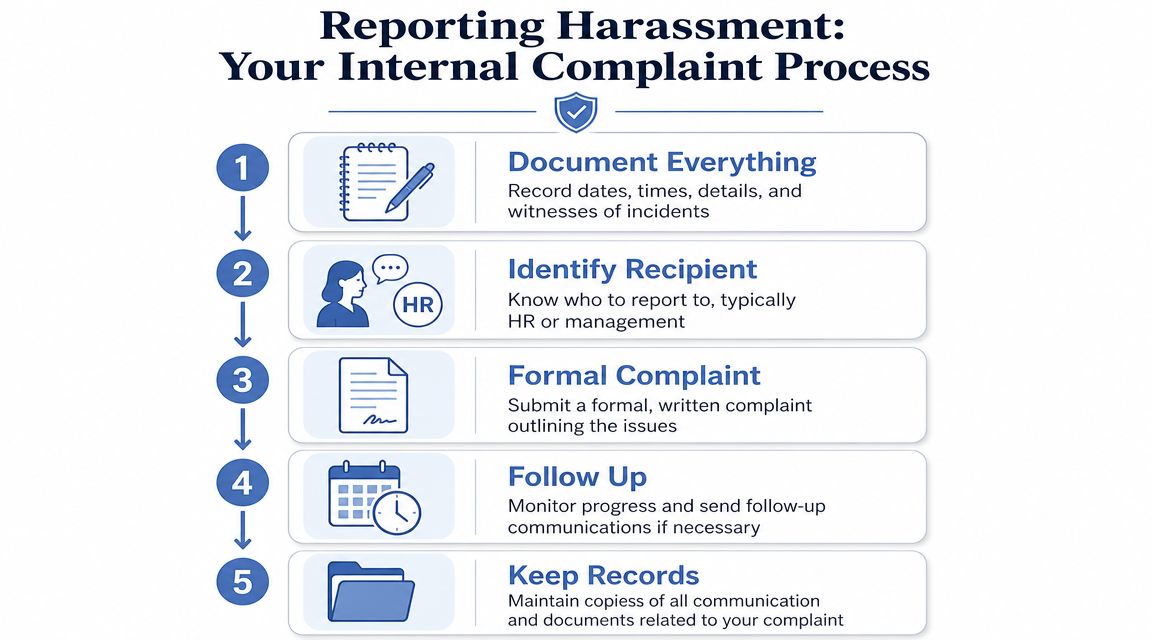
Reporting internally is often one of the hardest steps emotionally. It can also be one of the most important steps strategically. In many cases, the employer's liability turns in part on notice. If the company didn't know, or claims it didn't know, your written report may become a central piece of the case.
Nationally, over 85% of people who experience sexual harassment never file a formal legal charge, and about 70% never even complain internally. The same UMass resource notes that 68% of sexual-harassment charges include an allegation of employer retaliation. Those realities explain why many employees stay silent, even when the conduct is serious, as discussed by UMass Amherst's review of employer responses to sexual harassment.
What a smart internal complaint looks like
A Mississippi employee might start by checking the handbook and seeing three reporting options: supervisor, HR, or another designated manager. If the supervisor is the harasser, reporting to that same person obviously makes no sense. Use the alternate path the policy gives you.
A good written complaint is usually plain and factual. It should identify the person, describe the conduct, give approximate dates, name witnesses if any, state that the conduct is unwelcome, and ask the company to stop it. You don't need legal buzzwords. You do need enough detail that nobody can later say they didn't understand what you were reporting.
For a fuller discussion of reporting mechanics, see this guide on how to report workplace harassment.
A short example of what works
An employee sends HR an email from her personal account after work. She writes that her manager has made repeated sexual comments, touched her twice without consent, and implied her schedule would improve if she spent time with him outside work. She lists dates, names two coworkers who saw one incident, attaches screenshots of messages, and asks for a written response.
That works better than a hallway conversation that leaves no record.
What doesn't work as well is saying only, “I'm uncomfortable,” without details, or making a verbal complaint and never following up in writing.
Keep your expectations realistic
HR works for the company. Sometimes HR handles complaints properly. Sometimes HR focuses on limiting the employer's exposure. You should still use the process if it fits your situation, but you should use it carefully.
After you report:
- Save the complaint and every follow-up email.
- Document meetings with HR or management right after they happen.
- Track changes at work including hours, duties, treatment, discipline, and evaluations.
- Stay factual even if you're angry. Emotion is understandable, but specifics carry the weight.
Report in writing when possible. A timestamped email often becomes one of the most important documents in the entire file.
Federal law prohibits retaliation for reporting sexual harassment or participating in an investigation. In practice, though, retaliation can be subtle. A schedule gets worse. Duties change. A worker gets isolated, nitpicked, or suddenly written up. That's why your follow-up documentation matters almost as much as the original complaint.
Filing a Formal Charge with the EEOC in Mississippi
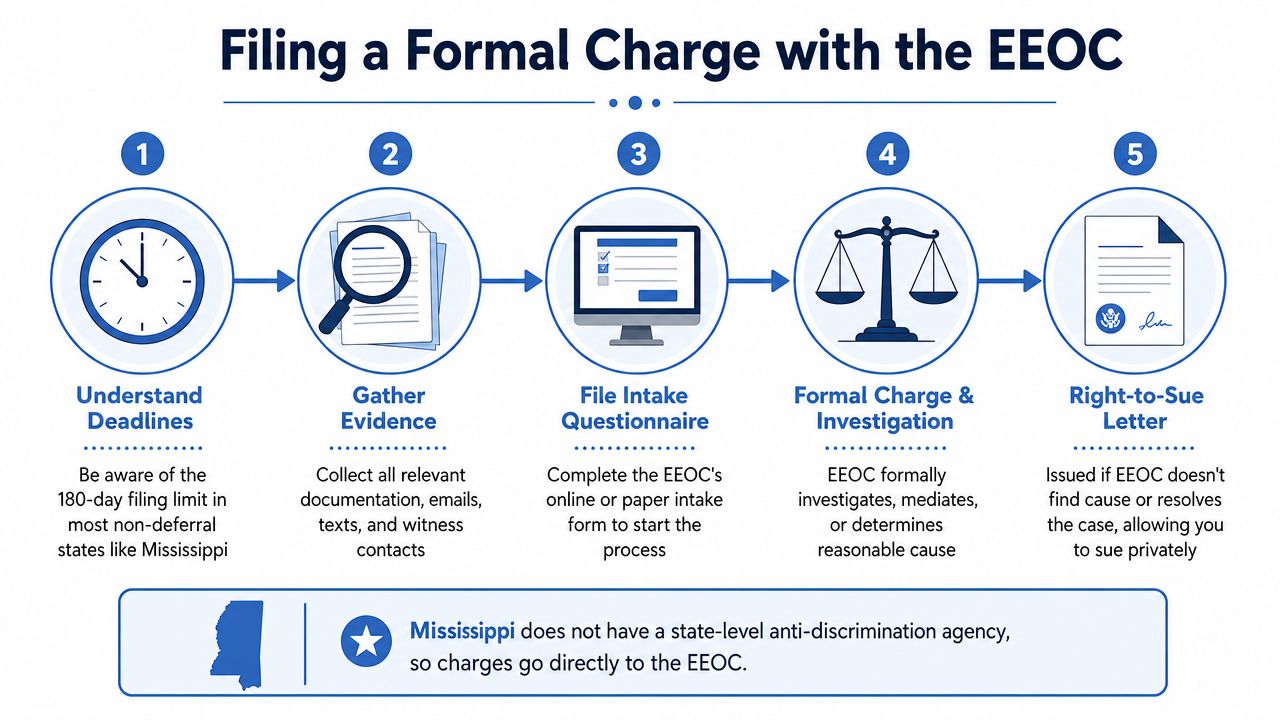
Mississippi workers need to understand one local reality early. Mississippi does not have a state human rights agency handling these discrimination and harassment charges. For many employees, the EEOC is the primary administrative path.
That matters because delay can cost you the claim. A practical warning from this discussion of proving sexual harassment claims is that the EEOC charge deadline is generally 300 days from the incident for claims under its jurisdiction. Waiting too long can cut off the administrative route, and under-documentation makes the process harder from the start.
What the EEOC process usually involves
Filing with the EEOC is not the same as filing a lawsuit. It starts an administrative process. You provide information about the employer, the conduct, the dates, and the harm that followed. The EEOC may ask for more information, notify the employer, and in some cases offer mediation.
Later, the agency may investigate. That can include requests for records, written statements, and witness information. The process can feel slow and bureaucratic, which is one reason employees often benefit from legal help before filing, not after problems develop.
A more detailed overview appears in this explanation of the EEOC investigation process.
To get oriented visually, this short video is helpful:
What to gather before you file
Before submitting anything, collect and sort:
- Your timeline with dates and the last incident date especially clear.
- The names of decision-makers and anyone who received your internal complaint.
- Copies of messages and records that support the timeline.
- A short summary of retaliation if conditions worsened after reporting.
- An explanation for any delay in reporting, if fear, power imbalance, or workplace culture played a role.
That last point matters. Delayed reporting does not automatically defeat a case. But unexplained delay can create credibility problems. If there was a reason you stayed quiet, say so clearly and consistently.
What workers often get wrong
Some employees file too early with a vague story and no supporting records. Others wait too long because they hope the company will fix it discreetly. Both can create avoidable problems.
The stronger approach is to file once you can state the claim clearly, identify the people involved, and attach or describe the main supporting facts. The EEOC process is formal enough that casual wording can hurt you. It's also important enough that you shouldn't assume you can “fix it later” if the first filing is thin or inaccurate.
In Mississippi, where there isn't a state agency filling this role, getting the federal filing right matters even more.
Why You Should Consult a Mississippi Employment Lawyer
Employees can and often should take the first steps themselves. Preserve evidence. Report internally when appropriate. Keep records. Watch the deadline. But there's a point where handling everything alone starts to create risk.
A lawyer helps by testing the case the way the employer and the EEOC will test it. Is the conduct legally severe or pervasive, or merely offensive? Is there evidence it was unwelcome? Can the employer argue it never had notice? Are there records that support retaliation after the complaint? Those questions sound simple until you have to answer them with documents instead of instincts.
What legal counsel changes in practice
A Mississippi employment lawyer can help you do at least four things well:
- Evaluate the facts objectively. Not every bad workplace situation is a legal claim, and candor early saves time and damage later.
- Shape the record before filing. That includes organizing evidence, tightening the timeline, and avoiding statements that can be misread.
- Handle communications strategically. Employers and agencies pay attention to wording, dates, and consistency.
- Prepare for the next stage. After the EEOC process, the path may involve negotiation or, if appropriate, federal litigation after a right-to-sue notice.
This is also where a law office can be a practical tool, not just an advocate. For example, Nick Norris, P.A. represents Mississippi employees in workplace matters and helps evaluate evidence, advise on reporting, and guide through agency proceedings under federal employment law.
The fee question most people ask first
People often delay calling a lawyer because they assume they can't afford one. In Mississippi employment cases, contingency arrangements are common. The average contingency fee is 40-50%. That usually means the fee is tied to recovery rather than paid upfront.
You should still ask detailed questions before signing anything:
- What percentage applies, and when?
- Who pays case expenses?
- Does the percentage change if the case becomes more involved?
- What happens if there is no recovery?
Those are fair questions. A good consultation should answer them directly.
A lawyer can't create facts that don't exist. What counsel can do is preserve the facts, frame them correctly, and keep a winnable claim from being lost through avoidable mistakes.
Why local focus matters in Mississippi
Mississippi workers are dealing with a legal environment that relies heavily on federal procedure in this area. That affects timing, filing decisions, and how cases get positioned from the start. Local practice also matters because workplace culture, reporting structures, and witness dynamics vary widely from one employer to another, whether the job is in Jackson, the Gulf Coast, a plant, a hospital, a school setting, or a small private office.
When you're trying to figure out how to prove sexual harassment, don't measure your case only by whether you have a recording or a witness to every moment. Measure it by whether you can build a credible, organized story supported by records, complaints, and surrounding facts. That's what moves cases.
If you're dealing with sexual harassment at work in Mississippi, Nick Norris, P.A. offers confidential evaluations for employees who need help assessing evidence, navigating the EEOC process, and protecting their rights. Taking action early can make a major difference in what you're able to prove later.
This article has been reviewed for legal accuracy by Nick Norris. For employment law matters in Mississippi, consult with an attorney licensed to practice in your state.
Leave a Reply